
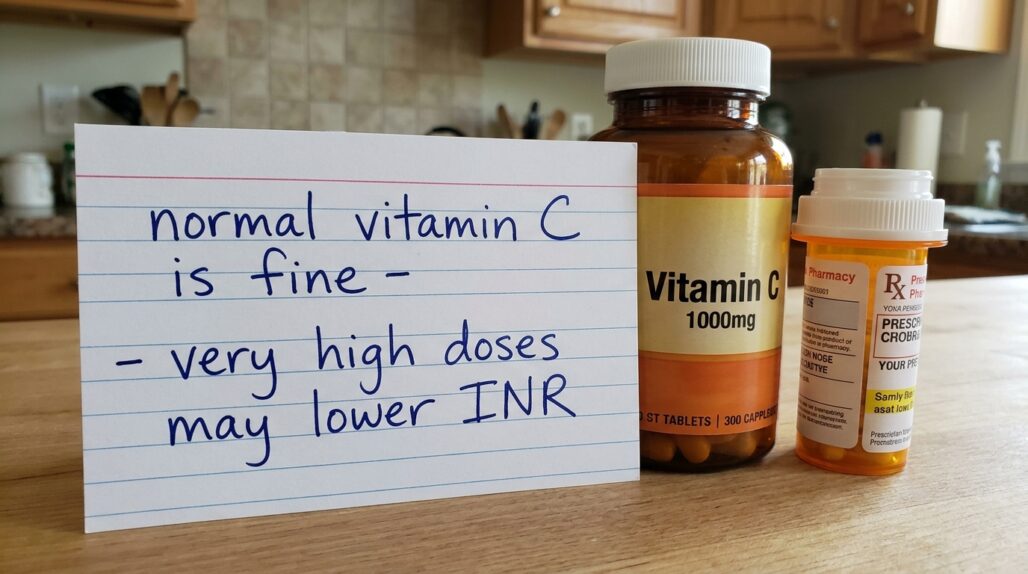
Before you decide
This article is general information, not medical advice, and warfarin is one of the most monitored drugs in the pharmacy for a reason. Small shifts in your INR can mean too much clotting or too much bleeding, so any change to your routine deserves a conversation with the clinician who manages your dose.
The people who need to read this most are warfarin patients who reach for high-dose vitamin C during cold season, after surgery, or as part of a general "boost my immune system" habit. If that describes you, the dose is the whole story. For the wider picture, our guide to drug and supplement interactions maps the combinations worth watching.
Most readers will find this reassuring. The orange in your breakfast and the 500 mg tablet in your cabinet are very unlikely to move your INR. The question only gets interesting once the numbers climb into the gram range.
What the vitamin C and warfarin interaction actually is
Warfarin is a vitamin K antagonist. It blocks an enzyme called VKORC1 (vitamin K epoxide reductase), which your liver needs to recycle vitamin K into its active form. Without that recycling, your body makes less of the vitamin K-dependent clotting factors II, VII, IX, and X, and your blood clots more slowly. That slowdown is what the INR test measures, with most patients aiming for a target range of 2.0 to 3.0.
Vitamin C does not work on that vitamin K pathway. So unlike vitamin K2, which directly antagonizes warfarin, vitamin C has no clean mechanistic reason to fight your dose. If you want the vitamin K side of the picture, our warfarin and vitamin K calculator walks through the foods that matter most. That contrast is part of why the vitamin C question has stayed controversial for fifty years.
The signal that exists points one direction: very high vitamin C may make warfarin less effective, lowering the INR rather than raising it. The proposed explanations are indirect. A 2024 case report and literature review lists possibilities such as gram-level ascorbic acid causing loose stools and faster gut transit that reduce warfarin absorption, or altering the drug in the gut before it is taken up.
None of those mechanisms is proven. The honest summary is that the effect, when it shows up at all, appears at large doses and the "why" is still uncertain.
How big is the effect, and at what dose?
The alarming-sounding cases are old and involved very large intakes. In a frequently cited 1971 report, a woman on warfarin became resistant to her usual dose while taking ascorbic acid for a cold, and her clotting time corrected only after she stopped it. A 1972 report described a patient taking roughly 16 grams of vitamin C a day who needed her warfarin pushed up to 25 mg daily to respond at all. Both are catalogued in that same Frontiers literature review.
A more recent index case in that review involved a postoperative patient on only 0.2 g (200 mg) twice daily whose INR stayed stubbornly subtherapeutic until the vitamin C was stopped. That lower dose is a useful reminder that individual responses vary, especially in the days after surgery when many things are shifting at once.
Now the counterweight. The FDA-approved Coumadin prescribing information states that controlled trials have not shown clinically important changes in prothrombin time, and that patients given ascorbic acid up to 1,000 mg/day for two weeks showed no meaningful variation. The label still tells prescribers to consider vitamin C if unexplained warfarin resistance appears in someone on high doses.
A 2024 review of vitamin and mineral interactions with warfarin in Nutrients reaches a similar place: the dietary and standard-supplement range looks safe, and the documented problems cluster at high intakes.
So the practical read is straightforward. At or below about 1,000 mg a day, the evidence says no meaningful interaction. Above that, the picture is built on scattered case reports rather than solid trials, which is exactly why caution and monitoring make sense.
Who is most at risk
The risk is not evenly spread. A few situations deserve extra care.
- Megadose users. Anyone taking 2,000 mg or more of vitamin C daily, whether for colds, "immune support," or unproven cancer-adjunct protocols, sits in the only zone where the case reports live.
- The postoperative and acutely ill. Surgery, infection, and changing diets all disturb the INR on their own. Adding a new high-dose supplement makes it harder to tell what caused a shift.
- People who change intake suddenly. Warfarin tolerates consistency. Bouncing from zero to a heavy effervescent vitamin C habit at the first sneeze is the kind of swing that destabilizes a dose.
- Anyone not telling their clinic what they take. The interaction only becomes dangerous when nobody is watching for it.
If none of those apply and you take a modest, steady amount of vitamin C, you are almost certainly in the reassuring majority.
What to do about it
The guidance here is about steadiness and ceilings, not avoidance. Vitamin C is a normal part of a healthy diet, and there is no reason for a warfarin patient to fear an orange.
A few practical principles:
- Keep a sensible ceiling. For everyday use, the adult requirement is small: the NIH Office of Dietary Supplements puts the RDA at 90 mg/day for men and 75 mg/day for women, with a tolerable upper limit of 2,000 mg/day. Most people get plenty from food, and a typical supplement adds a few hundred milligrams more. Our vitamin C benefits and dosage explainer covers how much is actually useful for general health.
- Be consistent. If you take a daily vitamin C tablet, take roughly the same amount each day rather than swinging up and down. Predictability is what keeps your INR stable.
- Flag the megadoses. Planning a multi-gram immune protocol or a high-dose intravenous course is a clinic conversation, not a solo decision.
- Monitor around changes. If you and your clinician decide a higher dose is worth it, expect to check your INR more often while you start or stop, so any drift is caught early.
Vitamin C is one of the gentler items on a warfarin patient's shelf. The supplements that more often raise real flags act on bleeding rather than INR, and you can check a specific combination against our drug and supplement interaction checker before adding anything new. Two common ones worth reading up on are fish oil and bleeding risk on anticoagulants and turmeric with blood thinners.
The table below sorts the common scenarios by how much attention they need.
| Scenario | Typical vitamin C amount | Interaction concern | What to do |
|---|---|---|---|
| Food only (fruit, vegetables) | Roughly 75 to 200 mg/day | None expected | Eat normally and consistently |
| Standard supplement | 250 to 1,000 mg/day | No clinically important change in studies | Keep the dose steady day to day |
| High-dose “immune” use | Over 1,000 mg/day | Possible, based on case reports | Tell your clinic and monitor INR |
| Megadose or IV protocols | Several grams per day | Warfarin resistance reported | Manage only with clinician oversight |
Keeping an accurate list of everything you take makes that conversation far easier. A free app like StackMyMed lets you log your supplements and prescriptions in one place and flag combinations worth raising with your pharmacist. It is a prompt for a better conversation, not a substitute for INR monitoring or clinical judgment.
When to see a clinician
Some changes should not wait for your next routine check. Contact your anticoagulation clinic or doctor promptly if your INR drops below your target range without an obvious cause, especially while you are taking high-dose vitamin C.
Seek urgent care for signs that a clot may be forming because your warfarin is underperforming: sudden leg pain or swelling, chest pain, sudden shortness of breath, or new weakness or trouble speaking. These can signal a clot and need same-day evaluation.
And before you start or stop any gram-level vitamin C, make that decision with the clinician who manages your dose rather than on your own.
FAQ
Is it safe to take vitamin C with warfarin? At normal dietary and standard supplement amounts, yes, the evidence shows no meaningful effect on your INR. The caution applies only to high doses, generally above 1,000 mg per day.
Does vitamin C raise or lower INR? When an effect appears in case reports, it tends to lower the INR by making warfarin less effective, which is the opposite of a bleeding risk. The bigger danger is an under-treated clot, not extra bleeding.
How much vitamin C is too much on warfarin? There is no proven exact threshold, but controlled data showed no important change up to about 1,000 mg per day, though one recent case occurred at a lower dose in a postoperative patient, so the threshold is a guide rather than a hard line, while the warfarin-resistance reports involved far higher intakes, including roughly 16 grams daily in one case. Treat anything above 1,000 mg per day as worth discussing.
Can I drink orange juice while taking warfarin? Yes. The vitamin C in juice and fruit is far below the levels linked to any interaction. Keeping your daily intake roughly consistent is the main thing.
Should I stop vitamin C before surgery if I am on warfarin? That is a question for your surgical and anticoagulation team, since the perioperative period changes many factors at once. Do not start a new high-dose regimen around surgery without telling them.
Does this interaction apply to apixaban or other DOACs? No. The vitamin C concern is specific to warfarin’s vitamin K pathway and INR monitoring. Direct oral anticoagulants do not work that way and are not monitored by INR.
Conclusion: keep it steady, save the worry for the megadoses
The vitamin C and warfarin story is mostly reassuring once you separate dose from headline. Food and standard supplements have no clinically important effect on your INR, and the alarming case reports involved doses many times larger than anyone needs.
The single most useful habit is consistency: a steady, modest intake your clinic knows about. If you are tempted by a multi-gram immune protocol, treat that as a reason to call your anticoagulation team and arrange closer INR checks rather than a decision to make alone.
This article is for general educational purposes only and is not medical advice. It does not replace guidance from your doctor, pharmacist, or anticoagulation clinic, who can account for your specific medications, dose, and health history. Do not start, stop, or change any supplement or prescription based on this article alone.
Reviewed by the UsefulVitamins Editorial Team.
