
Affiliate disclosure: this article contains affiliate links. As an Amazon Associate, UsefulVitamins.com earns from qualifying purchases at no extra cost to you.
Before you buy
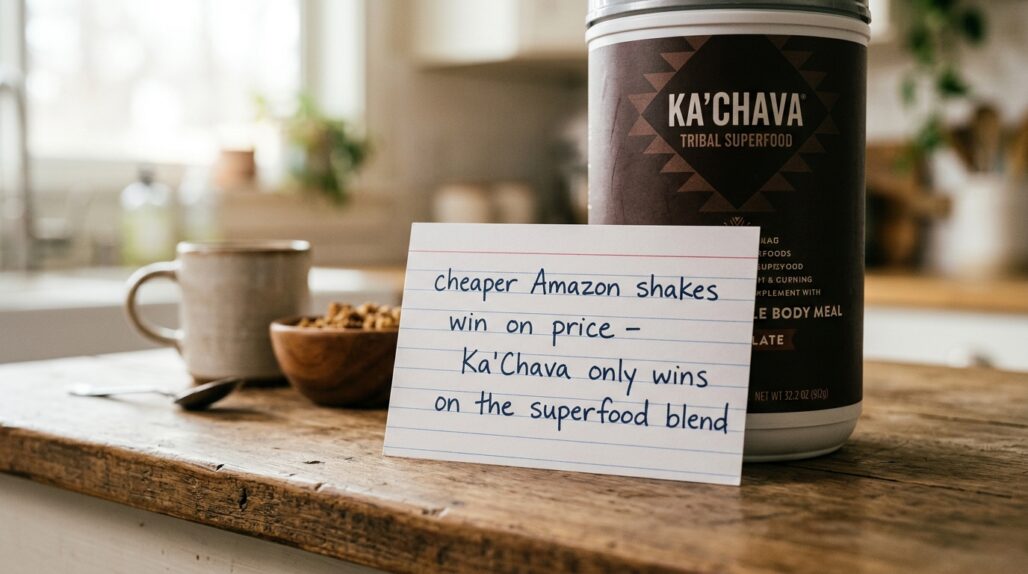
Ka'Chava is a good product wrapped in a steep price. At about $4.66 per serving for a one-time order (closer to $3.99 if you subscribe), a daily habit costs well over $100 a month. That is the real reason people search for a dupe.
The decision is not "is Ka'Chava bad." It is "am I paying for the label?" Most of what Ka'Chava delivers – 25g of plant protein, a greens blend, fiber, probiotics, a sprinkle of adaptogens – shows up in several Amazon shakes that cost half as much.
What you give up with a cheaper pick is mostly blend breadth. Ka'Chava lists 85-plus ingredients. A budget shake might list 20 to 50. Whether that extra long tail of superfruit and mushroom dust does anything measurable is the open question, and the honest answer is that the doses are small.
This guide ranks 6 Amazon meal shakes against Ka'Chava on the only numbers that matter for value: protein per serving, price per serving, and what greens or extras you actually get.
What Ka'Chava actually delivers
Per two-scoop serving, Ka'Chava gives you 25g of plant protein (pea, brown rice, and others), around 240 calories, 6g of fiber, and roughly 6g of fat. That is the benchmark every dupe gets measured against.
The protein number is solid but not huge. 240 calories is light for a "meal," so most people are really buying a fortified protein shake, not a full meal replacement. Treat it that way.
The marketing centerpiece is the 85-plus-ingredient blend: greens like spinach and kale, superfruits like acai and maca, functional mushrooms, digestive enzymes, and probiotics. Per Ka'Chava's own ingredients page, most of those sit inside proprietary blends, so the per-ingredient dose is small.
That matters. Independent reviewers have repeatedly pointed out that the adaptogen and mushroom amounts are fractions of a clinical dose. You are getting a taste of each, not a therapeutic amount. So the long ingredient list is more about variety than potency.
The 6 Amazon alternatives, compared
Here is how the cheaper picks stack up. Prices are approximate and move around; check the current price before you buy. Per-serving costs assume a one-time Amazon order, not a subscription.
| Product | Protein | Price / serving | Greens & extras |
|---|---|---|---|
| Ka’Chava (benchmark) | 25g | ~$4.66 | 85+ blend, mushrooms, adaptogens, probiotics |
| Orgain Perfect Meal | 25g | ~$1.65 to $2.00 | 80+ superfoods, ashwagandha, 1B probiotics, 10g fiber |
| LyfeFuel Essentials | 18g | ~$2.50 to $2.92 | 50+ superfoods, 27 vitamins & minerals |
| Garden of Life Raw Organic Meal | 20g | ~$1.65 | Sprouts, greens, probiotics, 7g fiber |
| Vega All-in-One | 20g | ~$2.25 to $2.65 | Greens, probiotics, omega-3, 12 vitamins |
| KOS Organic Plant Protein | 20g | ~$1.60 | Superfood blend, digestive enzymes |
| Orgain Organic Meal (20g) | 20g | ~$1.25 to $1.60 | Fruits, veggies, greens, 9g fiber |
Read that table once and the verdict almost writes itself. Every alternative undercuts Ka'Chava by at least half, and the closest formula match also happens to be one of the cheapest.
Closest match – Orgain Perfect Meal
If you want the nearest thing to Ka'Chava on Amazon, this is it. The Orgain Perfect Meal listing hits the same 25g of plant protein, adds 80-plus superfoods, throws in ashwagandha, maca, and turmeric as adaptogens, plus 1 billion probiotics and 10g of fiber (more than Ka'Chava's 6g).
At roughly $1.65 to $2.00 a serving, you are paying about 40 percent of Ka'Chava's price for a near-identical concept. This is our top pick for most switchers.
Best cheap-and-clean – KOS and Garden of Life
KOS Organic Plant Protein runs about $1.60 a serving with 20g of protein and a smaller superfood and enzyme blend. Garden of Life Raw Organic Meal is similar at roughly $1.65, leaning on sprouted ingredients, greens, and probiotics.
Neither matches Ka'Chava's ingredient count, but both cover the protein-plus-greens job for a third of the cost. If you mostly want a clean daily shake and do not care about a giant blend, start here.
Highest micronutrient coverage – LyfeFuel and Vega
LyfeFuel Essentials carries fewer grams of protein (18g) but loads up on 27 vitamins and minerals and a 50-plus superfood blend, which makes it the closest to a true "complete meal" on micronutrients. It is the priciest dupe at $2.50 to $2.92 a serving, but still well under Ka'Chava.
Vega All-in-One sits in the middle: 20g protein, greens, probiotics, omega-3, and a dozen vitamins for about $2.25 to $2.65 one-time, often cheaper on subscription.
Where the cheaper options fall short
Be honest with yourself about what you lose. The dupes are not identical.
- Smaller superfood blends. Ka'Chava's 85-plus list is genuinely broader. If you specifically want functional mushrooms and a long superfruit roster, only Orgain Perfect Meal comes close.
- Taste is hit or miss. Ka'Chava spends heavily on flavor and texture, and it shows. Garden of Life and plain KOS can taste earthy or chalky. Orgain and LyfeFuel tend to mix smoother.
- Mixability. Some budget powders clump in water and want a blender or milk. Read recent Amazon reviews for the specific flavor before committing.
None of these are dealbreakers, but they explain why some people stay with Ka'Chava. You are partly paying for the experience, not just the nutrition.
The heavy-metals question nobody should skip
This is the part brand-friendly roundups bury. Plant-based protein powders tend to test higher for lead and cadmium than whey, because the metals concentrate in plants from soil.
The 2025 Clean Label Project Protein Study 2.0 found that 47 percent of tested protein products exceeded California's Proposition 65 lead thresholds, and that organic and plant-based powders averaged higher than conventional ones. Consumer Reports reached similar conclusions in its own testing.
Ka'Chava is not exempt. It has carried Proposition 65 lead warnings, and independent lab work has flagged measurable lead, cadmium, and arsenic in at least one flavor. Ka'Chava's own position is that it third-party tests every batch and stays below all FDA Interim Reference Levels for lead. Both things can be true at once.
The practical takeaway: this is a category issue, not a single-brand scandal. Switching from Ka'Chava to a cheaper plant shake does not raise your risk, and may not lower it either. If contamination worries you, look for a third-party seal and consider vanilla over chocolate, since cacao tends to carry more cadmium.
How much you actually save
Drink one shake a day and the math is stark.
- Ka'Chava: roughly $140 a month at one-time pricing.
- Orgain Perfect Meal: about $50 to $60 a month for the closest match.
- KOS or Garden of Life: roughly $45 to $50 a month.
That is $80 to $95 saved every month, or close to $1,000 a year, for a shake that delivers the same core protein and greens. For a once-in-a-while shake the gap barely matters. For a daily ritual, it is the whole argument.
If you want the deeper breakdown of Ka'Chava itself before you decide, our full Ka'Chava review walks through the formula serving by serving, and our Huel versus Ka'Chava comparison covers the other heavyweight in this space.
Our picks
For most people the move is simple: buy Orgain Perfect Meal as the closest swap, or KOS for the cheapest serviceable one. Keep Ka'Chava only if the taste and the full blend genuinely matter to you.


As an Amazon Associate, UsefulVitamins.com earns from qualifying purchases at no extra cost to you.
UsefulVitamins may earn a commission from qualifying purchases made through links on this page, at no extra cost to you. This never changes our verdicts.
If you are comparing the other big direct-to-consumer shake, our Huel alternatives on Amazon guide runs the same exercise. And because every shake here is something you swallow daily, it is worth a glance at our drug and supplement interactions guide if you take prescription medication.
FAQ
What is the closest Ka’Chava alternative on Amazon? Orgain Perfect Meal. It matches Ka’Chava’s 25g of plant protein, includes 80-plus superfoods and adaptogens like ashwagandha, and costs roughly $1.65 to $2.00 a serving versus Ka’Chava’s ~$4.66.
Why is Ka’Chava so expensive? You are paying for an 85-plus-ingredient blend, heavy flavor development, and direct-to-consumer marketing. The core nutrition – protein, greens, fiber – is available much cheaper, but no single Amazon shake replicates the full ingredient list.
Do the cheaper shakes have fewer heavy metals? Not necessarily. The 2025 Clean Label Project study found plant-based and organic powders as a group tend to test higher for lead and cadmium. This is a category-wide issue, so look for a third-party seal rather than assuming one brand is cleaner.
Is a meal-replacement shake actually a full meal? Ka’Chava and most dupes run 200 to 250 calories, which is light for a meal. Per the NIH Office of Dietary Supplements, protein needs vary, but treat these as fortified protein shakes you supplement with real food rather than a true meal swap.
Which Amazon pick is cheapest? Orgain Organic Meal (the 20g version, not Perfect Meal) and KOS come in lowest at roughly $1.25 to $1.60 a serving. You give up some protein and blend breadth, but you cover the basics for about a third of Ka’Chava’s price.
Can I just use a plain protein powder instead? Yes, if you only want protein. The meal shakes here add greens, fiber, and vitamins. If you eat plenty of vegetables already, a basic protein powder plus a piece of fruit can be cheaper still.
The verdict
Ka'Chava is a well-made shake that charges a premium for breadth and branding. If you drink it daily, the price is hard to defend when Amazon stocks shakes that match it on the numbers that count.
Buy Orgain Perfect Meal if you want the closest formula at about 40 percent of the cost. Buy KOS or Garden of Life if you just want a clean, cheap daily shake and do not care about a giant ingredient list. Keep Ka'Chava only if its taste and full blend are worth roughly $1,000 a year to you.
Whatever you choose, favor a third-party-tested product and check the live Amazon price, since these shift often. Next step: pull up the two or three picks that fit your budget, compare current per-serving cost, and read the recent reviews for your flavor before you commit.
This article is for general information only and is not medical advice. Supplements and meal-replacement shakes are not evaluated the way drugs are, and individual needs vary. Talk to your doctor or a registered dietitian before relying on any shake as a meal, especially if you are pregnant, managing a health condition, or taking medication.
Reviewed by the UsefulVitamins Editorial Team.
