
Affiliate disclosure: this article contains affiliate links. As an Amazon Associate, UsefulVitamins.com earns from qualifying purchases at no extra cost to you.
Before you buy
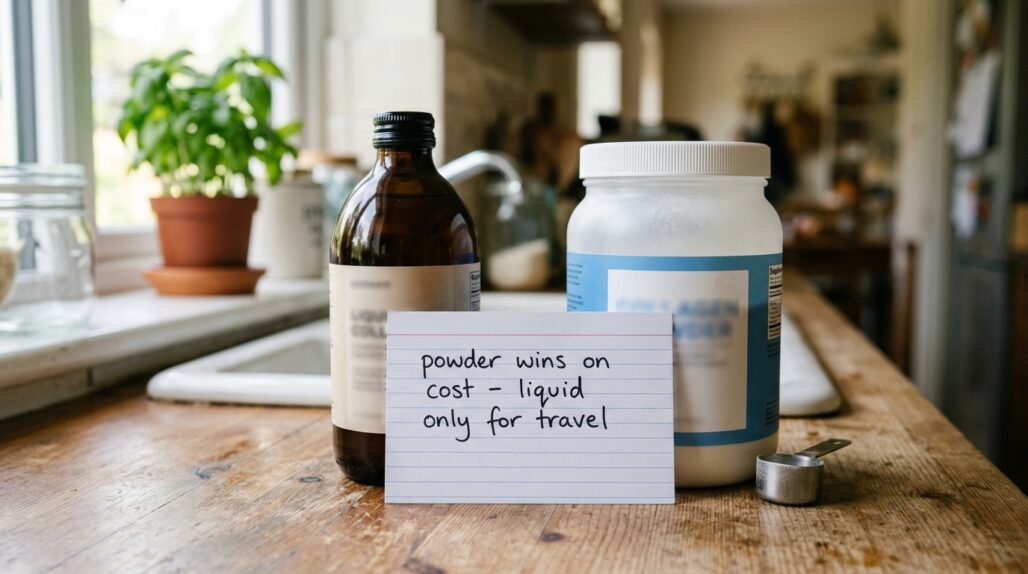
The real question is not "liquid or powder." It is whether the liquid format does anything your body can actually use, and whether that something is worth paying several times the price.
Collagen is a protein. Whether you drink it from a tube or stir it from a tub, your stomach acid and enzymes break it into small peptides and amino acids before any of it reaches your bloodstream. The form you swallow does not survive intact, so the marketing idea of "drinkable collagen that goes straight to your skin" does not match how digestion works.
So the decision comes down to two practical things: grams per day and dollars per gram. Liquid almost always loses on the second and frequently delivers less on the first.
This guide does the math, checks the absorption claims against what the research actually says, and names who the liquid format genuinely suits.
Liquid vs powder: same amino acids, different price
Both liquid and powder collagen are usually hydrolyzed, meaning the manufacturer has already pre-cut the protein into shorter peptides. That is true regardless of format. Hydrolysis happens in the factory, not in the bottle.
Once you swallow either one, the breakdown continues. Harvard's Nutrition Source describes the process plainly: dietary collagen is broken down into amino acids that the body distributes wherever it most needs protein, with no guarantee those amino acids head to your skin or joints. Your body cannot tell whether the peptides arrived as a liquid or a powder.
That single fact undercuts most of what separates the two formats on a label. A liquid is collagen peptides plus water (and usually flavoring and a few add-ins). A powder is the same peptides with the water removed so you do not pay to ship it.
Here is the part that matters for your wallet: water is heavy and expensive to package. Single-serve tubes, glass bottles, and flavor systems all add cost that has nothing to do with how much collagen you get.
What you actually get per serving
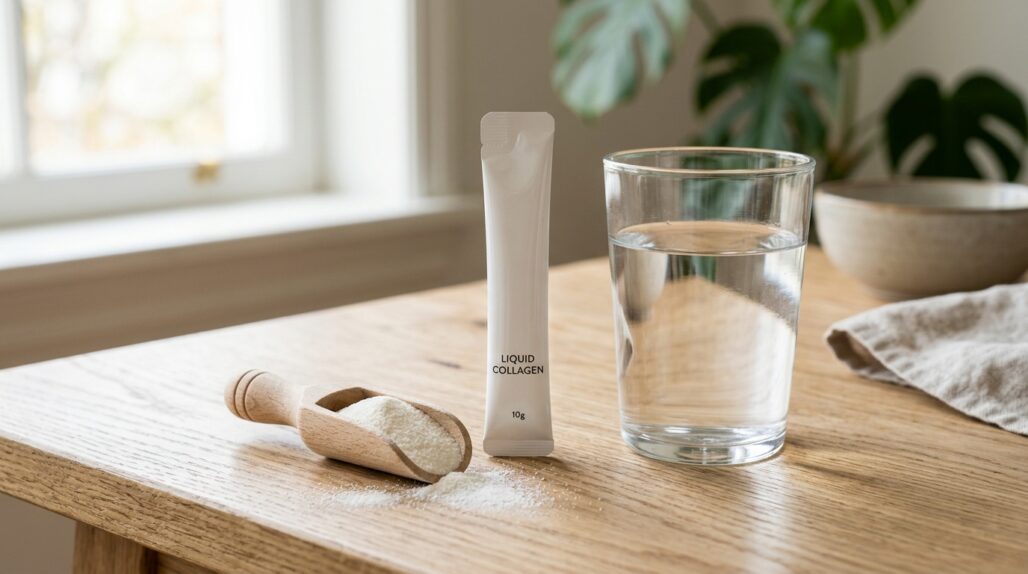
Powder is where the grams are. A standard scoop of an unflavored peptide powder delivers a real working dose, and you control how much you take.
- Vital Proteins Collagen Peptides lists 20g of collagen per scoop, around 28 servings per 20oz tub.
- Sports Research Collagen Peptides provides 11g of Type I and III collagen per scoop, unflavored, easy to stir into coffee.
Liquids tend to deliver less collagen in a bigger, pricier package. A popular example, Applied Nutrition's Liquid Collagen Skin Revitalization, provides 4,000mg (4g) of hydrolyzed collagen per single-use tube, ten tubes to a box, plus biotin and a horsetail-derived silica.
So a liquid tube can hand you roughly a third to a half of one powder scoop. Skin studies most often use about 2.5g to 5g a day, while joint and muscle work tends to use more, often 10g-plus, so a single 4g liquid tube can fall short for joints in particular. Whatever your goal, consistency over 8 to 12 weeks matters more than hitting an exact gram count.
Most clinical work on collagen and skin uses 2.5g to 15g per day of hydrolyzed peptides, taken consistently for two to three months. The trial behind a lot of the skin-moisture claims, an 8-week (56-day) study of a hydrolyzed collagen supplement, used a daily peptide dose in that range. Consistency and total grams drove the result, not the delivery format.
The absorption claim, examined honestly
Liquid brands lean on one selling point: faster, better absorption because the collagen is already dissolved. There is a grain of truth and a lot of overreach in that claim.
The grain of truth: a liquid is already in solution, so digestion does not have to dissolve a powder first. That can shave a little time off the start of absorption. For a daily supplement you take for months, that head start is not meaningful.
The overreach: claims that liquid is dramatically "more bioavailable" or "absorbs better." There is no good head-to-head human evidence showing liquid hydrolyzed collagen outperforms powder hydrolyzed collagen for skin, joints, or anything else. Both arrive at the gut as peptides and get processed the same way.
A 2022 narrative review in Nutrition Reviews on collagen and connective tissue found little strong evidence for collagen’s anabolic effects on connective tissue, and did not single out the liquid-versus-powder format as a meaningful variable. And Harvard's editors note that most collagen research is funded by the industry selling it, so treat strong format-specific claims with skepticism.
Bottom line on absorption: pay for grams and consistency, not for "drinkable."
Cost per 10g: the number that decides it
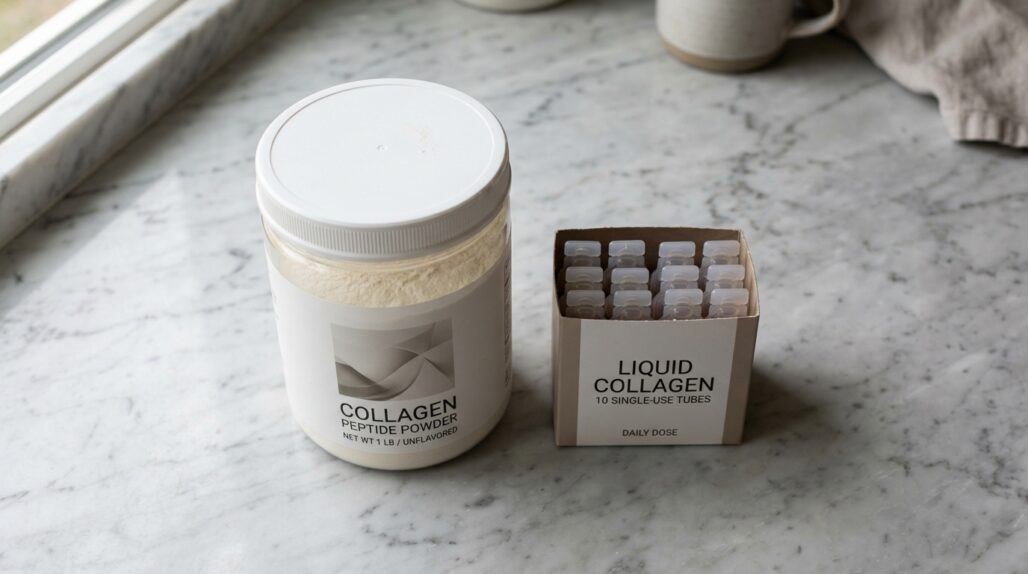
This is the whole argument in one table. Prices move, so treat these as ballpark figures as of writing and check current price before you buy.
| Product | Format | Collagen per serving | Approx. price | Cost per 10g |
|---|---|---|---|---|
| Sports Research Peptides | Powder | 11g | around $33 for ~41 servings | around $0.70 |
| Vital Proteins Peptides | Powder | 20g | around $47 for 28 servings | around $0.85 |
| Store-brand peptides | Powder | 10g | around $15 to $22 per tub | around $0.30 to $0.50 |
| Applied Nutrition Liquid | Liquid tube | 4g | around $15 to $20 for 10 tubes | around $3.75 to $5.00 |
The pattern is hard to miss. Powder lands between roughly $0.30 and $0.85 per 10g of collagen. Liquid, once you normalize for the smaller dose per tube, frequently runs three to five times that for the same grams.
Stretch that over a year of daily use and the gap is real money. At 10g a day, powder costs you something like $25 to $60 a year. Liquid can run well over $150 for the same intake. You are buying water, flavor, and packaging.
Who liquid actually suits
Liquid is not useless. It is a convenience product, and for a narrow group the convenience is worth the premium.
- You travel constantly and a sealed single-serve tube beats hauling a tub and scoop through security.
- You hate the texture or taste of powder in your drink, and that aversion has stopped you from being consistent in the past.
- You want a grab-and-go ritual with no mixing, no shaker, no cleanup.
For those people, adherence is the whole game. A liquid you actually take every day beats a powder gathering dust in the cabinet. If the format is the only thing standing between you and a daily habit, the extra cost can be worth it.
Everyone else should buy powder. If you already drink coffee, tea, or a smoothie daily, you have a delivery vehicle and zero reason to pay the liquid markup.

How to pick a good one in either format
The quality checklist is the same whether you go liquid or powder.
- Grams first. Aim for a product that gets you into the studied range, roughly 2.5g for skin up to 10g or more for joints, alone or stacked across servings.
- Hydrolyzed peptides (collagen peptides or hydrolyzed collagen on the label), so it dissolves and digests cleanly.
- Third-party testing. Look for NSF, Informed Sport, or a published heavy-metal test, since collagen is an animal-tissue product and the FDA does not vet supplements for safety or content before sale.
- Short ingredient list. Skip liquids loaded with added sugar or a long flavor system if collagen is the point.
Marine collagen (from fish) and bovine collagen (from cattle) both break down to usable peptides; pick based on diet and any allergy, not on absorption hype.
The value picks
If you want the cheapest honest path, buy an unflavored powder and stir 10g into whatever you already drink. If you genuinely need liquid for travel, buy a single-dose tube format and accept the premium for what it is.


As an Amazon Associate, UsefulVitamins.com earns from qualifying purchases at no extra cost to you.
UsefulVitamins may earn a commission from purchases made through the links above, at no extra cost to you. We only recommend products we would buy ourselves.
A few honest pointers as you compare options:
- For the lowest cost per gram, a large unflavored peptide tub is almost always the answer. See our roundup of collagen powders that match the big brands for less.
- If skin is your goal specifically, a marine source is a reasonable pick; here are the marine collagen powders worth considering for skin.
- Deciding between the two best-known powder brands? We break down Vital Proteins versus Sports Research collagen on grams, sourcing, and price.
- Tempted by a heavily advertised premium brand? Read our take on whether NativePath collagen is worth it before you subscribe.
FAQ
Is liquid collagen better absorbed than powder? No good human evidence shows it is. Both are usually hydrolyzed already, and your gut breaks both into the same peptides and amino acids before absorption. Liquid starts dissolving sooner, but that head start does not change the daily result.
Why is liquid collagen so much more expensive? You are paying to ship and package water, flavoring, and single-use tubes or bottles. Powder removes the water, so you get far more collagen per dollar, often three to five times more per 10g.
How much collagen should I take per day? Most skin and joint studies use 2.5g to 15g of hydrolyzed collagen daily for two to three months. Around 10g a day is a sensible target. Many liquid tubes deliver only about 4g, so one serving may not be a full dose.
Does collagen actually work for skin and joints? Some short trials show modest skin-moisture and elasticity improvements, but most research is industry funded and the effects are small. Total daily grams and consistency matter more than the format you choose.
Is there any reason to buy liquid at all? Yes, if convenience is what keeps you consistent. Frequent travelers and anyone who dislikes mixing powder may stick with a sealed tube better, and a dose you actually take beats a cheaper one you skip.
Is liquid or powder safer regarding heavy metals? Neither format is inherently safer. Collagen is an animal-tissue product, so what matters is third-party testing. Choose a product with NSF, Informed Sport, or a published heavy-metal test in either format.
The verdict
Strip away the marketing and liquid collagen is collagen plus water at a steep markup. Your body breaks it into the same amino acids as powder, so you are not buying better results, just a different package.
Buy powder. It gets you to a real 10g daily dose at roughly $0.30 to $0.85 per 10g, and you can stir it into coffee or a smoothie without a second thought.
Buy liquid only if the grab-and-go format is the one thing that will keep you consistent, especially for travel, and you accept paying several times more per gram for that convenience.
Next step: pick an unflavored powder that gets you to 10g a day, confirm it carries third-party testing, and check the current price per serving before you check out.
This article is for general information and is not medical advice. Supplements are not reviewed by the FDA for safety or effectiveness before sale, and collagen is not a treatment for any condition. Talk to your doctor or a registered dietitian before starting a supplement, especially if you are pregnant, nursing, or managing a health condition.
Reviewed by the UsefulVitamins Editorial Team.
