
Affiliate disclosure: this article contains affiliate links. As an Amazon Associate, UsefulVitamins.com earns from qualifying purchases at no extra cost to you.
Before you buy
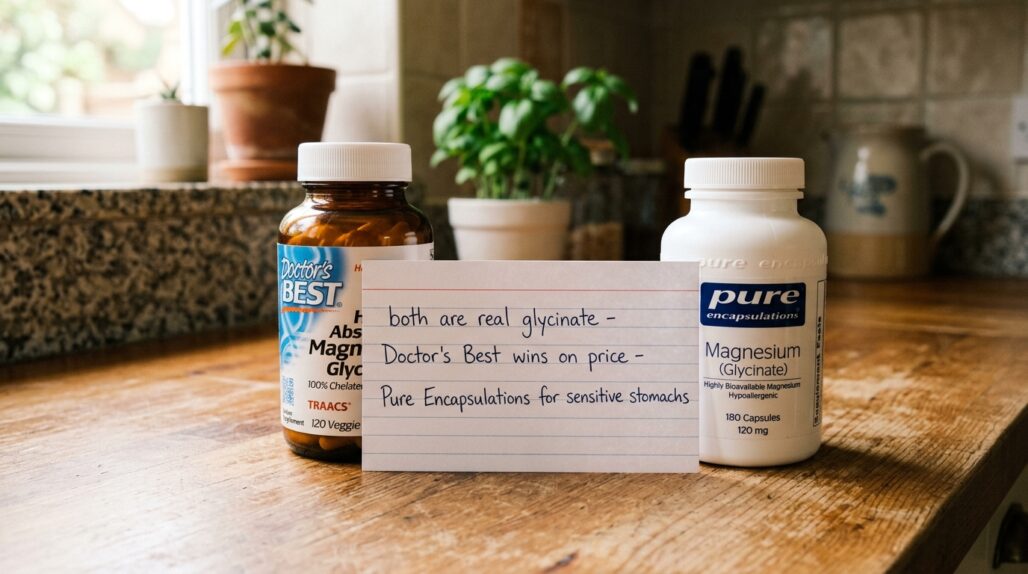
Here is the real decision. You are not choosing between a working magnesium and a broken one. You are choosing between two legitimate glycinate chelates that differ mostly on price, capsule cleanliness, and how the dose is packaged.
Magnesium glycinate (sometimes written as magnesium bisglycinate or magnesium lysinate glycinate) is the form most people reach for because it is gentle on the stomach and unlikely to send you running to the bathroom the way magnesium citrate or oxide can. Both products here use that form.
So the question is narrower than the brands want you to think. Is the Pure Encapsulations premium buying you anything you can feel? For a small group of people with real sensitivities, yes. For most people, no.
If you only remember one thing: the magnesium itself is essentially interchangeable, and the price gap is large. We will show the math.
What each one actually is
Doctor's Best High Absorption Magnesium uses a magnesium lysinate glycinate chelate made with Albion's TRAACS process. That is a real, branded chelate, not a generic blend, and the "lysinate glycinate" name just means the magnesium is bonded to both glycine and lysine amino acids.
It is sold as tablets, with 100 mg of elemental magnesium per tablet and 200 mg per 2-tablet serving. The common bottle is 240 tablets, which works out to 120 servings.
Pure Encapsulations Magnesium (Glycinate) is a vegetarian capsule delivering 120 mg of elemental magnesium per single capsule. Bottles come in 90 or 180 capsules. Pure Encapsulations is a practitioner-channel brand that built its name on hypoallergenic, minimal-ingredient formulas.
Both are vegan or vegetarian-friendly and both are real chelates. According to the NIH Office of Dietary Supplements magnesium fact sheet, the form of magnesium matters more for tolerability than for whether you absorb a meaningful amount – and glycinate is one of the better-tolerated options either way.
Elemental magnesium and how many you swallow
This is where the products feel different in daily use, even though the chemistry is similar.
With Doctor's Best you take 2 tablets for 200 mg, or 1 tablet for a lighter 100 mg. With Pure Encapsulations you take 1 capsule for 120 mg, and most people land on 1 to 2 capsules.
A few practical notes:
- The "200 mg per serving" on Doctor's Best is two tablets, not one. Read the panel; the elemental number is what counts, not the chelate weight.
- Pure Encapsulations gives you a cleaner single-capsule dose at 120 mg, which some people find easier to titrate.
- Neither gets you to a full RDA on its own at one dose, and that is fine – most adults need around 310 to 420 mg total per day from all sources, food included, per the NIH fact sheet.
If you want a typical bedtime 200 mg dose, Doctor's Best costs you 2 tablets; Pure Encapsulations costs you roughly 2 capsules (240 mg) or you settle for one at 120 mg.
Fillers, allergens, and the hypoallergenic angle
This is the one place Pure Encapsulations earns its premium, if you are the right person for it.
Pure Encapsulations keeps the "other ingredients" list almost bare: a vegetarian capsule (cellulose and water) and ascorbyl palmitate. No magnesium stearate, no extra flow agents. The brand is built around being hypoallergenic and free of common irritants, which matters if you are unusually reactive.
Doctor's Best uses a normal tablet binder list: microcrystalline cellulose, croscarmellose sodium, magnesium stearate (vegetable source), stearic acid, hydroxypropyl cellulose, silicon dioxide, and hypromellose. None of these are dangerous, and the doses are tiny.
Here is the honest part. Magnesium stearate scares people online far more than the evidence justifies. For the vast majority of users it is an inert flow agent at a few milligrams. If you have no known sensitivity, the Doctor's Best filler list is not a real downside.
But if you genuinely react to fillers, have multiple food sensitivities, or have been told by a clinician to use a minimal-excipient supplement, the Pure Encapsulations formula is the cleaner choice and that is what you are paying for.
Third-party testing and quality
Be precise here, because the brands say less than shoppers assume.
Doctor's Best leans on the Albion TRAACS chelate identity and markets it as a verified, traceable chelate with strong absorption claims. The "up to 6x better absorbed" line is a marketing comparison against poorly absorbed forms like oxide, not a head-to-head against other glycinates – treat it as directional, not a guarantee.
Pure Encapsulations markets pharmaceutical-grade, hypoallergenic manufacturing and is widely used in the practitioner channel. The brand emphasizes ingredient sourcing and quality control.
What neither one prominently carries on these specific magnesium SKUs is a public NSF or USP retail seal that you can look up by lot. Remember that, per the FDA's guidance on dietary supplements, supplements are not pre-approved for safety or potency before sale, so an independent seal is the strongest signal a shopper gets.
If a verified third-party seal is your hard requirement, neither of these is your slam-dunk pick – you would look at a brand carrying a current USP or NSF mark. For most buyers, both companies have long, clean reputations, and that is enough.
Cost per 100 mg elemental magnesium
This is the number that decides it for most people. We are comparing apples to apples by cost per 100 mg of actual magnesium, not per pill or per bottle.
| Dimension | Doctor’s Best (240 tablets) | Pure Encapsulations (180 caps) |
|---|---|---|
| Form | Mg lysinate glycinate (TRAACS) | Mg glycinate chelate |
| Elemental per pill | 100 mg per tablet | 120 mg per capsule |
| Pills per bottle | 240 tablets | 180 capsules |
| Total elemental Mg | ~24,000 mg | ~21,600 mg |
| Approx price | ~$16-21 (check current price) | ~$46.50 (check current price) |
| Cost per 100 mg elemental | ~$0.07-0.09 | ~$0.21 |
| Fillers | Standard tablet binders | Minimal, hypoallergenic |
The gap is stark. Pure Encapsulations costs roughly two and a half to three times more per unit of magnesium. Over a year of daily use, that adds up fast.
So the verdict on cost alone is blunt: if money matters at all, Doctor's Best is the buy. Prices on both move, especially with Amazon Subscribe & Save on Doctor's Best, so confirm the live number before checkout.

Who should buy which


As an Amazon Associate, UsefulVitamins.com earns from qualifying purchases at no extra cost to you.
UsefulVitamins may earn a commission from qualifying purchases made through links on this page, at no extra cost to you.
Buy Doctor's Best if you want a proven glycinate chelate at the lowest sensible cost, you have no filler sensitivities, and you do not mind taking tablets. This is the default pick for most readers, full stop.
Buy Pure Encapsulations if you have a genuinely sensitive gut, react to common excipients, or have been steered toward a minimal-ingredient supplement by a clinician. You are paying a premium for a cleaner capsule, not stronger magnesium.
If you are still deciding which glycinate brand to trust on Amazon, our roundup of the cheapest magnesium glycinate options worth buying lines up several picks side by side. To understand why glycinate beats citrate and oxide for daily use, see how the different magnesium forms compare on bioavailability.
Who actually makes it: our Brand File on Doctor’s Best covers ownership, factories, and the public record.
FAQ
Is Pure Encapsulations magnesium glycinate worth the extra money? Only if you genuinely react to fillers or want the cleanest possible capsule. The magnesium itself is comparable to Doctor’s Best, so most people are paying a premium for the minimal-ingredient formula rather than better absorption.
Are Doctor’s Best and Pure Encapsulations both real magnesium glycinate? Yes. Doctor’s Best uses an Albion TRAACS lysinate glycinate chelate and Pure Encapsulations uses a magnesium glycinate chelate. Both are legitimate, well-tolerated forms.
How much elemental magnesium does each one give? Doctor’s Best gives 100 mg per tablet (200 mg in a 2-tablet serving). Pure Encapsulations gives 120 mg per single capsule.
Is the magnesium stearate in Doctor’s Best a problem? For almost everyone, no. It is an inert flow agent at a few milligrams per tablet. Avoid it only if you have a known, specific sensitivity.
Which is cheaper per dose? Doctor’s Best, by a wide margin – roughly $0.07-0.09 per 100 mg of magnesium versus about $0.21 for Pure Encapsulations, as of writing. Always check the current price before buying.
Can I take either one for sleep or muscle cramps? Both are commonly used for relaxation and cramp support, and glycinate is a sensible form for nighttime use. For the bigger picture on dosing and timing, see our complete guide to magnesium, and talk to your doctor first if you take medication or have kidney issues.
The verdict
Strip away the branding and you have two honest magnesium glycinates separated mostly by price. The chemistry is close enough that you should not expect to feel a difference in how the magnesium works.
Doctor's Best wins for the typical buyer. It is a real chelate, it is gentle, and it costs a fraction of the premium option per unit of magnesium. That is the recommendation for most people reading this.
Pure Encapsulations earns a narrow win only on cleanliness. If you have a sensitive system or react to fillers, the bare-bones capsule is worth paying for – otherwise you are buying peace of mind, not performance.
Your next step: confirm the live price on both, lean toward Doctor's Best unless sensitivity is your deciding factor, and if you want broader context first, read our complete guide to magnesium and how it stacks up against blended formulas like Magnesium Breakthrough.
This article is for general information only and is not medical advice. Supplements are not evaluated by the FDA to treat or prevent disease. Talk to a qualified healthcare professional before starting magnesium, especially if you take medication or have kidney problems.
Reviewed by the UsefulVitamins Editorial Team.
