
Affiliate disclosure: this article contains affiliate links. As an Amazon Associate, UsefulVitamins.com earns from qualifying purchases at no extra cost to you.
Before you buy
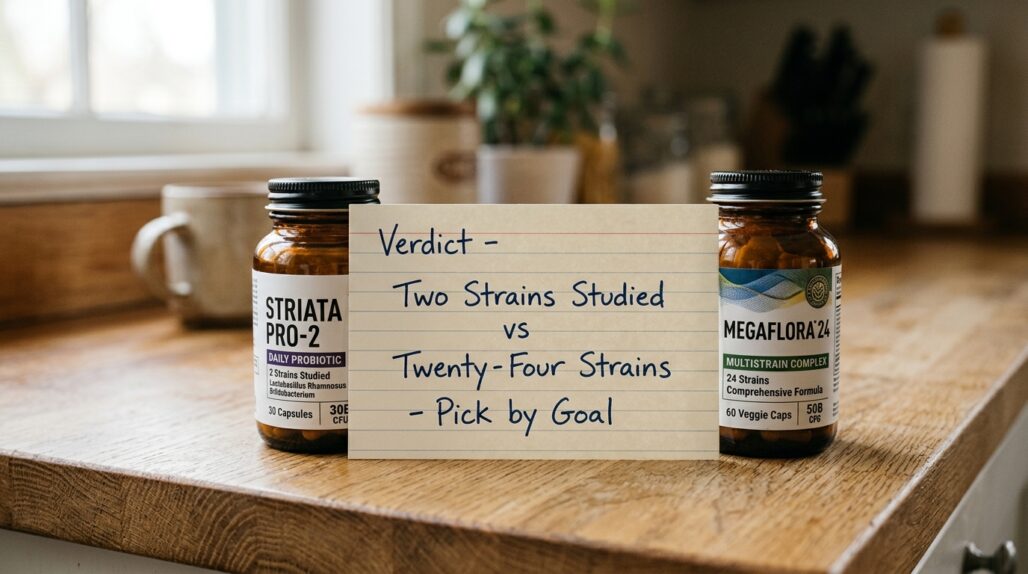
This is the most-searched probiotic matchup for a reason. Both brands spend heavily, both rank for their own names, and both have built a loyal following. So the real question is not "which is good" – both are competently made. The question is which one matches your goal and your budget.
The honest framing: a probiotic is only as useful as the specific strains inside it and whether those strains have been tested in humans for the thing you want. More strains is not automatically better, and a higher CFU or AFU number on the bottle does not mean a stronger effect. The NIH says clearly that benefits are strain-specific.
So before you commit to a $50-a-month subscription, decide what you are actually trying to do. General daily maintenance, post-antibiotic recovery, and stubborn bloating each point to a different answer – and sometimes that answer is a cheaper bottle from Amazon.
What each one actually is
These two products take opposite design philosophies, which is what makes the comparison interesting.
Ritual Synbiotic+ is a 3-in-1 built around restraint. It uses just two probiotic strains, both among the most-studied in the world: Lactobacillus rhamnosus GG (LGG) and Bifidobacterium animalis ssp. lactis (BB-12), totaling 11 billion CFU guaranteed through expiration. It adds a small prebiotic (PreforPro, a bacteriophage blend) and a 300mg tributyrin postbiotic (branded CoreBiome) that delivers butyrate, a fuel source for colon cells. It is one delayed-release capsule a day, mint-coated.
Seed DS-01 is a 2-in-1 built around breadth. It packs 24 strains across four blends, totaling 53.6 billion AFU, plus an Indian pomegranate prebiotic (a polyphenol blend Seed says is low-FODMAP friendly). It uses a capsule-in-capsule "ViaCap" design and is two capsules a day. Both products are vegan and shelf-stable, so neither needs refrigeration.
One number caveat worth knowing: Seed reports potency in AFU (active fluorescent units) rather than the more familiar CFU. AFU and CFU are counted by different methods, so you cannot directly compare 53.6 billion AFU to 11 billion CFU as if they were the same unit. Treat the headline counts as marketing reference points, not a head-to-head score.
Do the strains have human evidence?
This is where the two diverge most, and it favors Ritual more than the strain count suggests.
Ritual's two strains are arguably the best-documented probiotics on the market. LGG has been studied for decades, with the strongest evidence around antibiotic-associated and travelers' diarrhea. BB-12 is among the most-researched Bifidobacterium strains for digestive comfort and regularity. If you want strains with a long human track record behind the exact organism in the capsule, Ritual's shortlist is a genuine strength, not a limitation.
Seed's 24-strain approach is harder to evaluate strain by strain. The company has published clinical work suggesting benefits for gut barrier function and bloating, but that research was sponsor-funded by Seed, which independent reviewers including Healthline's editorial team flag as a potential bias. That does not make the formula bad – it means the evidence for the finished product is less independent than the marketing implies.
The broader point from the NIH Office of Dietary Supplements probiotics fact sheet is that clinicians should recommend strains and doses shown to work in human studies. A bigger strain list does not guarantee a bigger benefit – it can just mean more organisms at unproven doses. If you have a specific condition, that is a conversation to have with your doctor, not a label to read.
Prebiotic and delivery design
Both brands lean on their delivery tech in their marketing, so it is worth a clear look.
Seed's ViaCap is a genuinely clever capsule-in-capsule system. The inner capsule holds the probiotics; the outer one protects them through the stomach so more reach the colon. Combined with shelf-stability, it is a well-engineered package – though delayed-release capsules are common across the category, including in budget options.
Ritual uses a single delayed-release capsule designed to reach the colon, plus the tributyrin postbiotic, which is the more unusual ingredient here. Tributyrin delivers butyrate directly rather than relying on gut bacteria to ferment fiber into it. If a butyrate postbiotic is what you specifically want, Ritual is the one of the two that includes it.
On prebiotics, the two are not really comparable. Ritual's PreforPro is a 15mg bacteriophage blend, not a classic fiber. Seed's Indian pomegranate is a polyphenol prebiotic pitched as gentle for sensitive guts. Neither dose is large enough to be a meaningful fiber source – if your goal is feeding your existing microbiome, dietary fiber does far more than either capsule.

Cost per month and per serving
Here is the comparison that decides it for most readers. All prices are as of writing – check current price before you subscribe.
| Product | Strains / count | Daily dose | Approx. price/month | Approx. cost/day |
|---|---|---|---|---|
| Ritual Synbiotic+ | 2 strains, 11B CFU | 1 capsule | ~$54 retail / ~$43 subscription | ~$1.44 to $1.80 |
| Seed DS-01 | 24 strains, 53.6B AFU | 2 capsules | ~$49.99/mo subscription (single bottle one-time ~$59.99 on Amazon) | ~$1.67 |
| Physician’s Choice 60B (Amazon) | 10 strains, 60B CFU | 1 capsule | ~$8 to $9 (84-ct bottle ~$22-25 lasts ~3 mo) | ~$0.28 |
The takeaway is blunt. Ritual and Seed cost two to three times what a solidly made Amazon multi-strain costs. Seed's own site sells DS-01 on a subscription, but you can also buy a single bottle one-time on Amazon (around $59.99) and through practitioner dispensaries – so the "no trial" gap is smaller than it looks. Ritual still sells single bottles at lower one-time pricing, so the convenience modestly favors Ritual.
The cheaper Amazon pick worth considering
Before you sign up for either subscription, look at what a value pick gets you.
Physician's Choice 60 Billion is the best-selling probiotic on Amazon for a reason: 10 strains, an organic prebiotic, delayed-release capsules, third-party tested for purity, at roughly $0.28 a serving. It is not as refined as Seed's delivery system and it does not carry Ritual's butyrate postbiotic, but for general daily gut support it covers the basics for well under half the price.
It will not match Seed's strain breadth or Ritual's specific evidence-backed pair. What it will do is let you maintain a daily probiotic habit without a $50 monthly hit – and a probiotic you can actually afford to keep taking beats a premium one you cancel after two months.


As an Amazon Associate, UsefulVitamins.com earns from qualifying purchases at no extra cost to you.
UsefulVitamins may earn a commission from qualifying purchases made through links on this page, at no extra cost to you. This never changes our verdicts.
For the bigger picture on how prebiotics, probiotics, and synbiotics differ, our guide to prebiotics vs probiotics vs synbiotics is the place to start. If you are weighing Ritual's wider lineup, see whether Ritual is worth it overall. And for proven single- and multi-strain drugstore options, compare Align vs Culturelle or read our Physician's Choice probiotic review.

Quality and third-party testing
Both premium brands take testing seriously, and this is where the price partly earns itself.
Ritual has the more verifiable certification stack. It carries the Clean Label Project Purity Award, is Non-GMO Project Verified, is a Certified B Corporation, and publishes supplier traceability through its Made Traceable program. It tests for heavy metals (arsenic, cadmium, lead, mercury), allergens, and microbial contaminants.
Seed states it third-party tests for pesticides, herbicides, allergens, and contaminants, and confirms potency in finished product. That is a reasonable standard, though Seed leans more on its own clinical narrative than on independent purity seals. For shoppers who weight certifications heavily, Ritual edges ahead here.
Either way, both clear a higher bar than the average shelf probiotic. Testing is one place the DTC premium is partly justified – just not by enough to ignore the cost gap with a tested Amazon pick.
FAQ
Is Seed DS-01 better than Ritual Synbiotic+? Not universally. Seed has far more strains and a refined capsule-in-capsule delivery, while Ritual uses two of the most-studied strains plus a butyrate postbiotic in one cheaper daily capsule. Pick by goal, not by strain count.
Why does Ritual have only 2 strains? By design. LGG and BB-12 are among the most-researched probiotic strains in humans, so Ritual prioritizes evidence over breadth. More strains do not automatically mean a stronger effect.
Can I cancel the Seed subscription after one month? Seed's website is subscription-first, but you can buy a single Seed DS-01 bottle one-time on Amazon (around $59.99) or via practitioner dispensaries if you want to try it without a recurring plan. Ritual sells single bottles and one-time purchases if you prefer no commitment. Check each brand’s current terms.
Do I need a $50 probiotic at all? Often no. For general daily support, a third-party tested Amazon multi-strain like Physician’s Choice 60 Billion covers the basics at roughly $0.73 a day. Save the premium products for when you want their specific strains or design.
Is AFU the same as CFU? No. AFU (active fluorescent units) and CFU (colony-forming units) are measured by different methods, so Seed’s 53.6 billion AFU is not directly comparable to Ritual’s 11 billion CFU. Do not treat the bigger number as automatically stronger.
Should I take a probiotic for a specific health condition? Talk to your doctor first. The NIH notes that probiotic benefits are strain-specific and condition-specific, so a general daily synbiotic is not a treatment. Match the strain to evidence with a clinician’s input.
The verdict
If you want the broadest formula and a polished delivery system and you do not mind Seed's subscription-first billing (single bottles are also on Amazon), Seed DS-01 is the wider-net daily synbiotic at around $49.99 a month. If you want two strains with deep human evidence, a butyrate postbiotic, stronger purity certifications, and lower single-bottle pricing, Ritual Synbiotic+ is the more flexible and arguably better-documented pick at around $54 retail.
But the most honest answer for most readers is the cheaper one. For routine daily gut support, a third-party tested Amazon multi-strain such as Physician's Choice 60 Billion does the job at roughly a third of the price – and consistency matters more than a premium label.
Your next step: decide your goal first. General maintenance points to the budget pick; a specific evidence-backed strain points to Ritual; maximum strain breadth points to Seed. Then check current prices, because both DTC brands adjust them often.
This article is for general information only and is not medical advice. Supplements are not a treatment for any condition, and probiotic effects are strain-specific. Talk to your doctor or pharmacist before starting a probiotic, especially if you are pregnant, immunocompromised, or taking medication.
Reviewed by the UsefulVitamins Editorial Team.
