
Affiliate disclosure: this article contains affiliate links. As an Amazon Associate, UsefulVitamins.com earns from qualifying purchases at no extra cost to you.
Before you buy
Both ARMRA and Cowboy sell the same raw material: bovine colostrum, the first milk a cow produces after calving. It is rich in immunoglobulins (mostly IgG), lactoferrin, and growth factors. Neither brand invented it, and neither has a patent on the cow.
So the real decision is not "which colostrum is magic." It is which brand gives you more grams of honest, tested colostrum for your money, and whether you value flavor and brand polish enough to pay roughly double per gram.
That matters because colostrum is one of the trendiest supplements of the moment, and the marketing has outrun the science. The evidence is real but narrow. Before you commit to a $100+ subscription, it helps to know what you are actually paying for.
This comparison looks at four things: what is in each tub, how much colostrum you get per serving, the price per gram, and how loud the marketing is versus what the research supports.
What each product actually is
ARMRA Colostrum is the premium direct-to-consumer brand. The unflavored jar lists a single ingredient, "ARMRA Colostrum Concentrate (Bovine)," and the brand sells it alongside flavored versions and single-serve travel sticks. Its headline claim is "Cold-Chain BioPotent Technology," a proprietary low-temperature processing method it says preserves the bioactive nutrients better than standard high-heat methods.
Cowboy Colostrum is the value challenger. It is single-ingredient, first-day-milking, grass-fed bovine colostrum sold as an unflavored powder and a few flavors. Cowboy leans on a plainer story: bigger scoop, "unstripped" full-fat colostrum, collected only after the calves have fed.
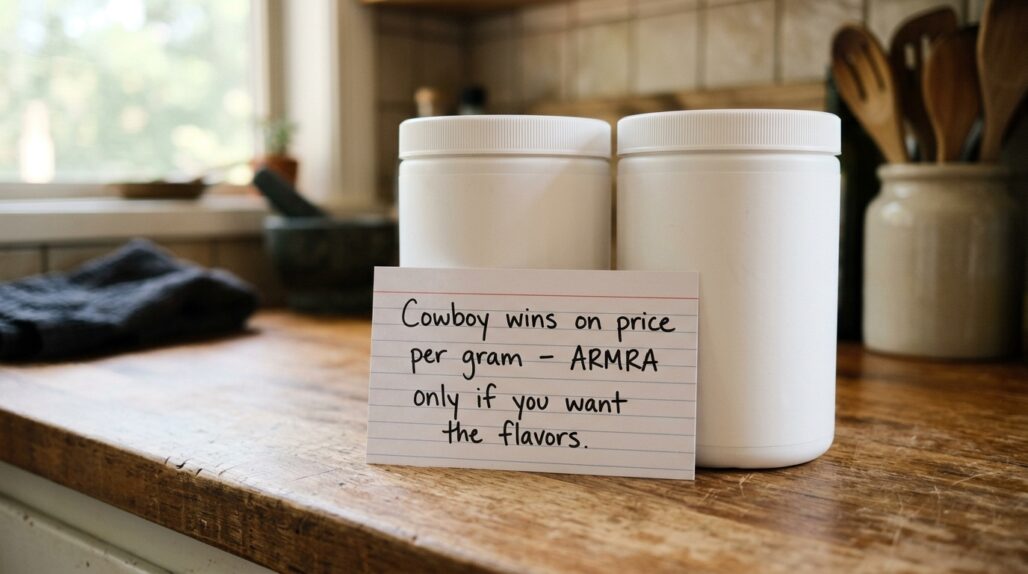
The key structural difference is serving size. ARMRA's serving is 1 gram of colostrum; Cowboy's is 3 grams. That single fact drives most of the value math below, because you are buying colostrum by weight whether the label frames it that way or not.
Both products are powders you mix into water or a smoothie. Neither needs refrigeration once sealed in powder form, despite ARMRA's "cold chain" name referring to processing, not your kitchen.

IgG and immunoglobulin content per serving
This is where both brands get frustrating, and it is the same problem on both sides.
Neither ARMRA nor Cowboy publishes a milligram figure for IgG per serving. That is the number that actually tells you how much immune protein you are getting, and it is missing from both labels.
ARMRA has stated its colostrum contains somewhere between "no less than 35%" and "greater than 40%" IgG by weight, though the figure has been described inconsistently across its own sources. One hands-on reviewer at Innerbody's ARMRA testing writeup flagged exactly this, noting the inconsistent figures make a clean head-to-head comparison hard, though they still rated the product's potency highly. Cowboy does not publish an IgG percentage at all on its main page.
Here is the part that cuts through the fog. Even if ARMRA sits at 40% IgG, its 1-gram serving holds at most about 0.4 grams of IgG. If Cowboy's first-milking powder lands in a similar 15% to 40% range, its 3-gram serving could hold roughly 0.45 to 1.2 grams. We cannot confirm Cowboy's exact percentage, so treat that as a ballpark, not a lab result.
The honest read: on raw colostrum mass per serving, Cowboy almost certainly delivers more, because three grams of anything beats one gram unless ARMRA's concentration is more than triple Cowboy's – and there is no published evidence it is.
Price per gram of colostrum, compared
Strip away the flavors and the storytelling, and a supplement like this comes down to dollars per gram of colostrum. Here is how they stack up at prices current as of writing; always check the live price, since both brands discount heavily through subscriptions.
| Dimension | ARMRA (unflavored jar) | Cowboy Colostrum |
|---|---|---|
| Colostrum per serving | 1 gram | 3 grams |
| Servings per container | About 120 | About 40 |
| Total colostrum | About 120 grams | About 120 grams |
| Standard price | Around $110 to $120 | Around $69 to $89 |
| Price per gram (standard) | About $0.90 to $1.00 | About $0.58 to $0.74 |
| Subscription price per gram | About $0.83 to $0.87 | About $0.41 |
| Stated IgG figure | 35% to 40%+ (no mg) | Not published |
| Processing claim | Cold-Chain BioPotent | Unstripped, first-milking |
The conclusion is hard to miss. Both tubs hold roughly the same total colostrum, but Cowboy costs noticeably less for it – and the gap widens on subscription, where Cowboy can land near $0.41 per gram against ARMRA's $0.83-plus.
One nuance keeps this fair: ARMRA's 120-serving jar lasts far longer at 1 gram a day, while Cowboy's larger 3g serving runs the tub down in about 40 days. If you only take the ARMRA-style 1-gram dose, an ARMRA jar lasts months and the per-day cost feels small. The grams-per-dollar math still favors Cowboy, but your real spend depends on how much you actually take.
Sourcing, testing, and marketing claims examined
Both brands tell a clean-sourcing story, and both have credible-sounding credentials. Neither is obviously cutting corners. The difference is mostly in tone and how many certifications they wave.
ARMRA leans hardest on processing. Its official ARMRA jar page describes grass-fed, pasture-raised U.S. colostrum collected after calves feed, plus testing for heavy metals and contaminants by third-party, FDA-registered, ISO-certified labs. It also carries Certified Non-GMO, Keto-Certified, and glyphosate-free labeling – a longer badge list than Cowboy.
Cowboy's own product page claims third-party testing, GMP-certified manufacturing, hormone-free and grass-fed sourcing, and exclusive first-day milking. Cowboy also cites a 12-week company-run trial reporting that 83% of users saw improved gut health. Treat that number with care: it is the brand's own marketing study, not independent peer-reviewed research, and self-reported results in a small unblinded trial are weak evidence.
Two honest cautions apply to both:
- "Third-party tested" rarely means a public certificate. Neither brand posts full batch lab reports for you to read, so you are trusting the claim.
- The Cold-Chain story is plausible but oversold. Low-heat processing does appear to preserve more IgG than high-heat methods, but that does not prove ARMRA's finished product outperforms a well-made competitor in your body.
If verified testing matters to you across your whole stack, it is worth understanding how heavy-metal and contaminant screening is done industry-wide, which the Clean Label Project's contaminant testing program explains in plain terms.
What the colostrum evidence does and does not support
This is the part the marketing skips, and it should shape your spending more than the brand you pick.
The strongest evidence for bovine colostrum is for gut barrier function, not immunity. A 2024 systematic review of colostrum in gastrointestinal conditions found it reduced markers of intestinal permeability and cut diarrhea frequency in most of the trials that measured it. That is a genuine, if modest, signal.
The immune story is weaker. A meta-analysis of colostrum in active people found no significant effect on serum IgG or other immune markers when pooled across trials. In other words, swallowing IgG does not reliably raise the IgG in your blood, because much of it is digested.
A broader review of bovine colostrum in medical practice reaches a similar verdict: promising for gut and exercise-recovery uses, but with small studies and a clear call for larger trials before strong claims are justified.
So here is the honest framing. Colostrum is a reasonable gut-support experiment, not a proven immune shield. The dose used in much of the research is around 20 grams per day, far above either brand's serving, which means real-world doses may do less than the headlines imply. If you take any prescription medication, check our guide to drug and supplement interactions before adding it, since colostrum is a dairy-derived protein and not right for everyone.

The value pick and cheaper alternatives
For most buyers chasing colostrum on a budget, Cowboy is the better-value choice between these two, and there are even cheaper single-ingredient powders on Amazon worth a look before you lock into any subscription.


As an Amazon Associate, UsefulVitamins.com earns from qualifying purchases at no extra cost to you.
UsefulVitamins may earn a commission from purchases made through links on this page, at no extra cost to you. This never changes our verdicts.
If you want the full landscape rather than this one matchup, our roundup of the best colostrum supplements on Amazon ranks options by IgG and price, and our list of ARMRA colostrum alternatives on Amazon covers the closest dupes. If you are specifically weighing whether the premium brand earns its price, read our deeper take on whether ARMRA colostrum is worth it.
The pattern with most premium DTC colostrum is the same: you pay a real premium for branding, flavors, and a processing story, not for measurably more or better colostrum.
FAQ
Is ARMRA or Cowboy colostrum better for gut health? Neither has independent proof of being better for your gut than the other. Both are bovine colostrum, and the gut-barrier evidence applies to colostrum generally, not to a specific brand. Cowboy gives you more grams per serving for less money.
Why is ARMRA so much more expensive than Cowboy? You are paying for the brand, the flavored and travel-stick formats, a longer certification list, and the Cold-Chain processing story. On raw colostrum per gram, ARMRA costs noticeably more, and there is no published evidence it works better.
Does colostrum actually boost immunity? The pooled trial evidence does not show a reliable rise in blood IgG or other immune markers from supplementing. The better-supported benefit is for gut barrier function and reduced diarrhea, and even that is modest.
How much colostrum should I take? Much of the research uses around 20 grams a day, far above either brand’s serving size. Follow the label and talk to a clinician, but know that small daily doses may do less than the marketing suggests.
Can I take colostrum if I am lactose intolerant or allergic to dairy? Colostrum is dairy-derived, so people with a milk allergy should avoid it, and the lactose-sensitive should start small and watch for symptoms. Ask your doctor if you are unsure or on medication.
Are there cheaper colostrum options than both of these? Yes. Several single-ingredient first-milking powders on Amazon cost less per gram than both ARMRA and Cowboy, which is why a quick price-per-gram check before subscribing usually pays off.
The verdict
If you are choosing strictly between these two, Cowboy is the smarter buy for value: roughly the same total colostrum as an ARMRA jar, three times the colostrum per scoop, and a clearly lower price per gram, especially on subscription.
ARMRA is the better pick only if you genuinely want the flavored versions, the travel sticks, the longer certification list, and the brand experience – and you accept you are paying a premium for those, not for proven results.
The bigger truth sits above both brands. Colostrum has real but narrow evidence, strongest for gut barrier support and weak for immunity. Set your expectations there first. Then, if you still want to try it, your next step is simple: check the price per gram on whatever you are about to buy, compare it against a plain Amazon first-milking powder, and pick the one that gives you the most tested colostrum for the least money.
This article is for general information and is not medical advice. Supplements are not a substitute for professional care. Talk to a qualified healthcare provider before starting any new supplement, especially if you are pregnant, nursing, taking medication, or managing a health condition.
Reviewed by the UsefulVitamins Editorial Team.
