
Affiliate disclosure: this article contains affiliate links. As an Amazon Associate, UsefulVitamins.com earns from qualifying purchases at no extra cost to you.
Before you buy
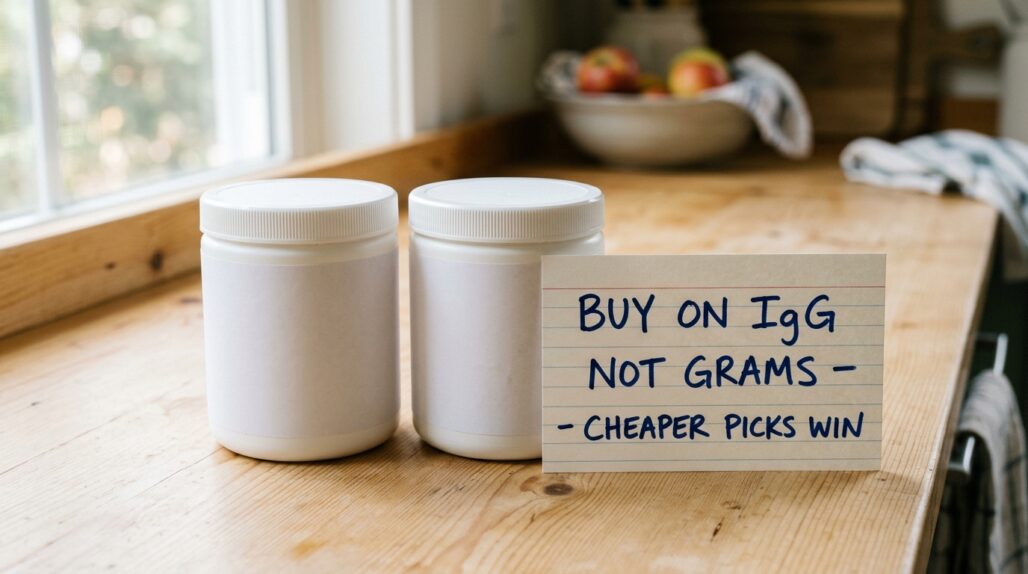
Most "best colostrum" lists rank by hype. The only number that actually separates a good colostrum from an expensive milk powder is its IgG content – the immunoglobulin fraction that the research is built around.
Here is the catch. Grams per serving and IgG percentage are not the same thing. A 3-gram scoop at 10% IgG gives you less immunoglobulin than a 1-gram scoop at 40%. Brands love to advertise grams because the number looks bigger.
So before you compare prices, decide what you are paying for. If you want the bioactive compounds in colostrum, buy on IgG percentage and third-party testing, not on tub size. If you just want a cheap protein-ish powder, that is a different and much cheaper shopping trip.
One honest note up front: the evidence for colostrum is promising but thin, and we will get to exactly what it does and does not show. That should shape how much you are willing to spend.
What makes a colostrum worth buying
Four things separate a real colostrum supplement from a tub of repackaged dairy.
- Stated IgG percentage. The serious brands print it: 15%, 25%, 40%. If a label only says "rich in immunoglobulins" with no number, treat that as a red flag.
- First-milking colostrum. True colostrum is the first milk after calving. "Transitional milk" collected days later is weaker. Look for the words first milking or first milk.
- Grass-fed, Grade A sourcing with a calf-first policy. This is partly ethics, partly quality, and most reputable brands now disclose it.
- Third-party testing for potency and heavy metals. Colostrum is a dairy concentrate, so contaminant testing matters. A published Certificate of Analysis is the gold standard.
If a product checks all four, you are buying something real. If it checks none, you are buying marketing.
Why standardized IgG beats raw grams
This is the part that flips most rankings on their head.
A standardized IgG percentage tells you what is actually in the scoop. Double Wood's capsules, for example, are standardized to 15% immunoglobulins and the brand lists a tested result of about 156 mg IgG per 1,000 mg serving, verified by HPLC, per its Amazon product listing. That is a number you can hold the brand to.
Compare that with ARMRA, the premium direct-to-consumer benchmark. ARMRA does not publish a specific IgG figure, and its official colostrum page leans on a proprietary "Cold-Chain" processing story and a count of 400-plus bioactive components instead. Independent reviewers estimate its IgG at somewhere north of 35%, but you are trusting an estimate, not a label.
Here is the practical rule. A 40% IgG powder at one gram per serving delivers more immunoglobulin than a 3-gram serving at an undisclosed low percentage – and usually for less money. Buy the percentage, then check the grams, then check the price. In that order.
Top Amazon colostrum picks, IgG-ranked
We ranked the most-bought Amazon colostrum products by disclosed IgG, sourcing transparency, and price per serving. Prices move constantly on Amazon, so treat every figure as "around this, check current price."
| Product | Form | Stated IgG | Per serving | Approx price | Best for |
|---|---|---|---|---|---|
| WonderCow | Powder | 40% (whole colostrum) | ~1 g, 60 servings | around $65 | Highest verifiable IgG powder |
| NOW Foods | Powder / capsule | ~25% (powder) | varies by SKU | around $16 to $32 | Cheapest trustworthy brand |
| Double Wood | Capsule | 15% (HPLC-tested) | 1,000 mg, 60 servings | around $20 | Best cheap, tested capsule |
| Codeage | Powder / capsule | not published | 1,000 mg powder, 120 servings | around $30 | Long supply, if you trust it |
| ARMRA (benchmark) | Powder | not published (est. 35%+) | ~1 g, 30 servings | around $47 | Premium, direct-only |
WonderCow – the highest verifiable IgG
WonderCow is the powder to beat. It states a standardized 40% IgG concentration, sells whole (not skimmed) grass-fed colostrum from USDA Grade A farms, and runs cGMP-certified, third-party-tested batches per its official product page.
At around $65 for 60 servings, it is not cheap – roughly $1.00 to $1.50 per serving. But on a dollar-per-gram-of-IgG basis it is more honest than ARMRA, because you actually know the percentage.
NOW Foods – the value floor
If you want a recognizable brand at the lowest sane price, NOW Foods is the answer. Its colostrum powder runs about 25% IgG and costs roughly $16 to $26 for a 3-ounce tub, and the brand uses ISO-accredited in-house labs plus outside certifications.
The tradeoff is potency. A 25% powder needs a bigger scoop to match WonderCow's 40%. For most casual users, that is a fine trade for the price.
Double Wood – the best cheap capsule
For people who hate measuring powder, Double Wood is the standout capsule. It is standardized to 15% IgG, uses first-milking grass-fed colostrum, costs around $20 for 60 servings, and – unusually for the price – publishes third-party HPLC testing and heavy-metal screening.
The IgG percentage is lower than the powders, but it is verified, which beats a higher unverified number every time. Note that Double Wood also sells a newer powder standardized to 30% immunoglobulins if you want more punch.
Codeage – fine, but it hides the number
Codeage's powder gives 1,000 mg per serving across about 120 servings, is grass-fed and cold-chain pasteurized, and is cGMP and non-GMO. The problem is simple. Codeage does not publish an IgG percentage, and customer support has only given a vague range. At around $30 it is reasonable, but you are buying on trust.


As an Amazon Associate, UsefulVitamins.com earns from qualifying purchases at no extra cost to you.
Some links above are affiliate links. If you buy through them we may earn a small commission at no extra cost to you, and it never changes our rankings.
Powder versus capsule, and how to dose it
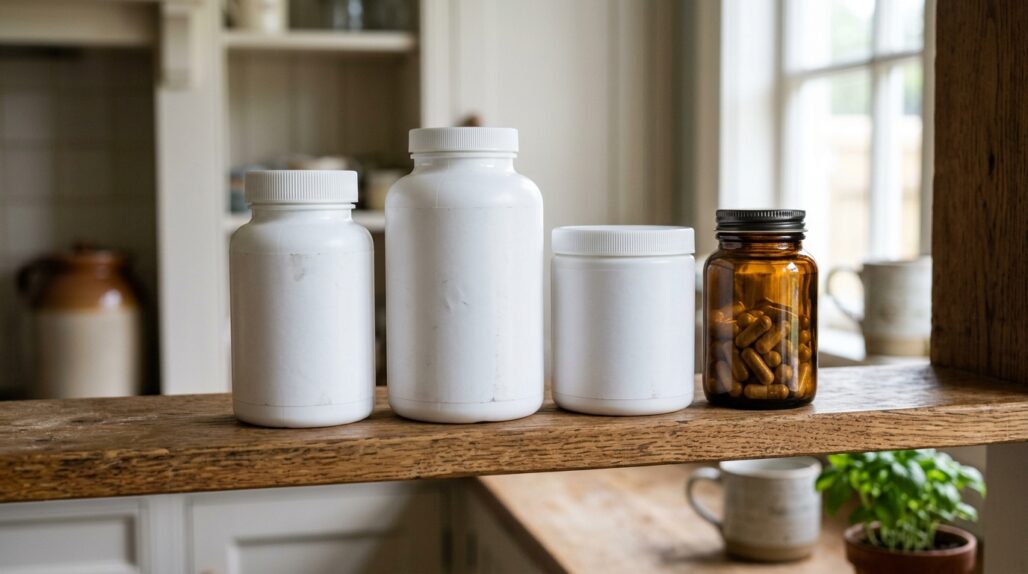
Powder wins on flexibility and cost; capsules win on convenience.
- Powder lets you scale the dose and usually costs less per gram. The downside is taste (mild, milky) and the daily ritual of mixing it into water, a smoothie, or yogurt.
- Capsules are travel-friendly and tasteless, but you often swallow two to four to hit one gram, and per-gram cost runs higher.
On dosing, be realistic. There is no official recommended dose for bovine colostrum. The 2024 review below notes that "specific dosage and usage recommendations need to be standardized." Most studies used somewhere between 10 and 60 grams of colostrum per day – far more than a typical 1-gram supplement scoop.
That gap matters. A 1-gram daily serving is a fraction of what the research used. If you are taking colostrum for gut or immune reasons, the modest supplement doses may simply be too low to do what the trials showed.
What the colostrum evidence actually supports
Here is the honest version, because it should change how much you spend.
The strongest signal is for gut barrier function. A systematic review of athletes found bovine colostrum reduced exercise-induced intestinal permeability, and a 2024 review in Frontiers in Immunology reported the same protective pattern across several trials.
The immune signal is mixed. Some studies showed fewer upper respiratory symptoms in exercising adults; others found no measurable immune change. Skin, hair, and general "wellness" claims are largely marketing, not trial data.
And the limitations are real. The research base is small, doses are not standardized, and many trials used tiny sample sizes in athletes rather than the general public. Treat the bigger health promises with skepticism.
For drug and supplement safety, colostrum is dairy-derived, so avoid it with a milk allergy and check our supplement interactions guide if you take immune-modulating medication. None of this is medical advice; ask your clinician.
FAQ
What is the single best colostrum on Amazon? For a powder, WonderCow at a stated 40% IgG. For a capsule, Double Wood at 15% IgG with published third-party testing. Both beat hiding-the-number brands.
Is a higher IgG percentage always better? Higher is better only if it is verified. A 40% claim with testing beats a vague “rich in immunoglobulins” label, but an unverified 50% claim is worth nothing.
Why is ARMRA so much more expensive? ARMRA is a direct-to-consumer brand with a proprietary processing story and premium packaging. It runs roughly $1.00 to $1.58 per serving depending on jar size (the small 30-serving jar is the most expensive per scoop), and it does not publish an IgG figure. You can read how it compares in our breakdown of whether ARMRA colostrum is worth it.
Are there cheaper alternatives that match ARMRA? Yes. We line them up in our roundup of ARMRA colostrum alternatives on Amazon, where several Amazon powders deliver similar or higher disclosed IgG for far less.
How does ARMRA compare with Cowboy Colostrum directly? We put them head to head on dose and price in ARMRA vs Cowboy Colostrum. The short version is that the value math rarely favors the premium option.
Is colostrum safe to take every day? For most healthy adults it appears safe in studies, but it is a dairy concentrate, so skip it with a milk allergy and talk to your doctor first if you take prescription medication.
The verdict
Buy on IgG, not on tub size. WonderCow is the best powder because 40% IgG is high and it is actually disclosed, and Double Wood is the best cheap capsule because its modest 15% is third-party tested rather than guessed at. If you only care about cost, a plain NOW powder undercuts everyone.
The brands to be wary of are the ones, including ARMRA, that ask you to trust a processing story instead of a number on the label. Premium price plus undisclosed IgG is the worst combination in this category.
And keep your expectations grounded. The real evidence points mostly to modest gut-barrier benefits at doses far higher than a 1-gram scoop – so the smart move is to pick a transparent, tested product, spend the least you reasonably can, and decide for yourself whether it earns a permanent spot in your routine.
Your next step: pick the form you will actually take daily, match it to the highest disclosed IgG you can afford, and check the current Amazon price before you commit.
This article is for general information only and is not medical advice. Supplements are not evaluated to treat or prevent any disease. Talk to a qualified healthcare professional before starting colostrum, especially if you have a dairy allergy, are pregnant, or take prescription medication.
Reviewed by the UsefulVitamins Editorial Team.
