
Affiliate disclosure: this article contains affiliate links. As an Amazon Associate, UsefulVitamins.com earns from qualifying purchases at no extra cost to you.
Before you buy
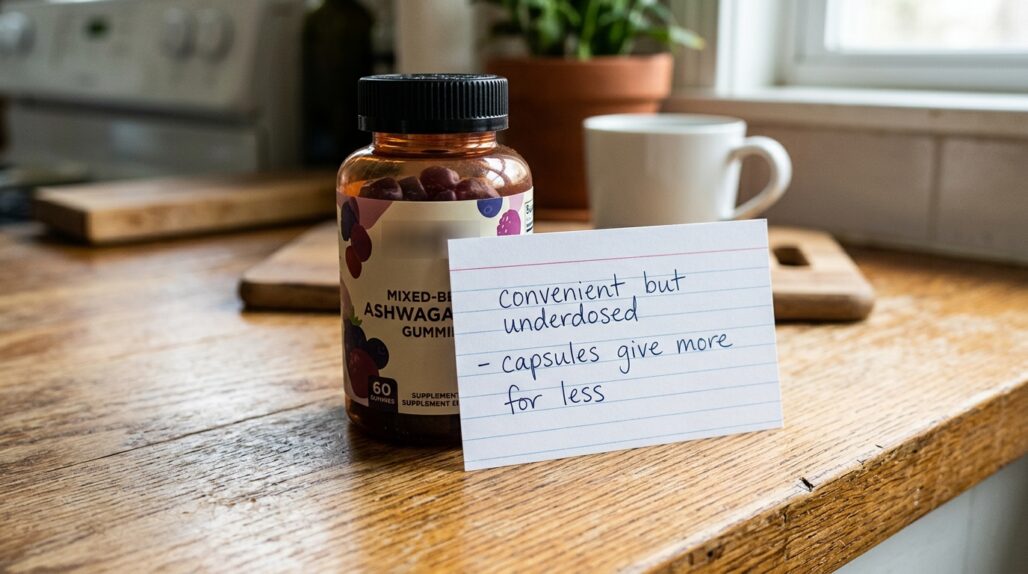
Goli is the brand that turned apple cider vinegar gummies into a TikTok category. Its ashwagandha gummy rides the same playbook: a popular ingredient, a candy format, and a marketing machine that calls it America's number one ashwagandha brand.
The real question is not whether ashwagandha works. It is whether the gummy gives you enough of it to matter, and whether you are paying for the herb or for the candy around it.
Here is the short version. The KSM-66 inside Goli is the genuine, well-studied extract. But two gummies deliver 300 mg, which sits at the bottom of the dose range used in research. Hit the dose that the best stress studies actually used and the math gets worse fast.
This review walks through the exact label, the dose problem, the sugar, the safety points that get glossed over, and a cheaper capsule that gives you more for less.
What Goli ashwagandha actually is
Goli Ashwagandha is a mixed-berry pectin gummy built around KSM-66 Ashwagandha root extract, the most-studied branded ashwagandha on the market. Each bottle holds 60 gummies. The gummies are vegan, gelatin-free, non-GMO, and free of the common allergens.
Per the official Goli ingredient page, one serving is two gummies and contains:
- 300 mg KSM-66 Ashwagandha root extract (about 150 mg per gummy)
- 25 mcg (1,000 IU) Vitamin D2
- 4 g sugar and 25 calories
KSM-66 is a full-spectrum root extract standardized to roughly 5 percent withanolides, and it is the extract behind most of the headline ashwagandha trials. Goli also states the gummies are third-party tested and made in a cGMP facility, and the company is a Certified B Corp – so on quality and sourcing the brand checks out. The problem is the amount, not the source.
If you want the deeper extract comparison, our breakdown of KSM-66 versus Sensoril explains why the two branded forms are dosed and studied differently.
The dose problem: 300 mg is the floor, not the target
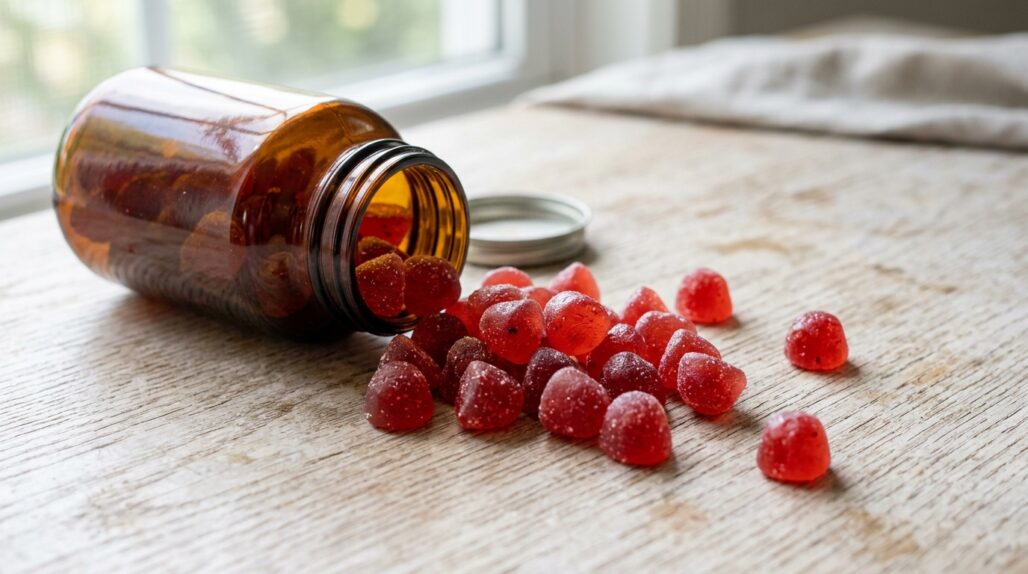
This is the part Goli's marketing skates past. Clinical trials on KSM-66 for stress and cortisol generally use 300 mg to 600 mg per day, and the most consistent results come from 300 mg taken twice daily, for 600 mg total. The KSM-66 manufacturer's own study summary and the NIH Office of Dietary Supplements fact sheet both point to that range, usually over 8 to 12 weeks.
So where does Goli land? Two gummies give you 300 mg – the very bottom of the studied range. That is a real dose, not a fairy dusting, but it is the floor.
Read Goli's own label closely and the directions say two gummies twice daily. That gets you to 600 mg, the dose with the strongest evidence. It also means you are eating four gummies and 8 grams of added sugar every day, and a 60-count bottle lasts about 15 days.
Put plainly:
- Two gummies a day: 300 mg, underdosed versus the best stress data, bottle lasts 30 days.
- Four gummies a day: 600 mg, matches the studies, bottle lasts 15 days and the sugar doubles.
There is no version of this where you get the full studied dose cheaply. Either you under-dose or you double your cost.
The sugar tradeoff
Each two-gummy serving carries 4 grams of added sugar. At the studied four-gummy dose that is 8 grams a day, roughly two teaspoons, every day for months.
To Goli's credit, the gummies use cane sugar and tapioca syrup, not sugar alcohols or high-fructose corn syrup, and there is now a zero-sugar version with a different formula. But the standard product is still candy first.
If you take ashwagandha at night to wind down, a daily slug of sugar at bedtime is not ideal. A capsule sidesteps the sugar entirely. That alone is reason enough for many people to skip the gummy.
Cost per serving: where gummies lose
Goli runs around $15 to $19 a bottle as of writing, depending on retailer and bundle (check current price, since promotions move it constantly). Call it roughly $0.50 to $0.63 per two-gummy serving.
That looks fine until you account for the dose. To reach the studied 600 mg you need four gummies, so your real cost is closer to $1.00 to $1.25 a day, and you are buying two bottles a month.
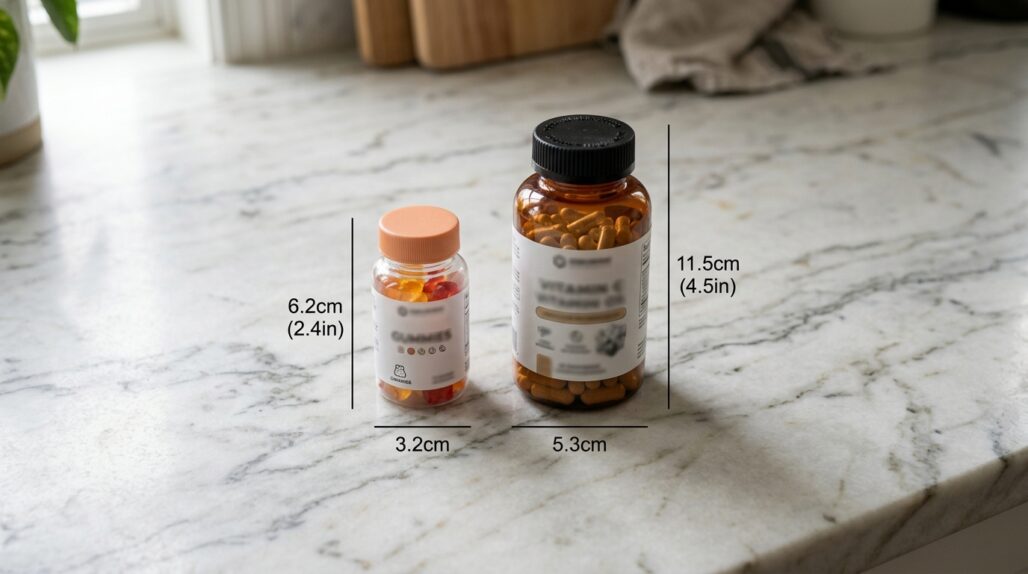
Now compare a plain KSM-66 capsule. A bottle of Nutricost KSM-66 600 mg runs around $17 to $18 for 60 capsules as of writing (check current price). One capsule is the full 600 mg studied dose, so a bottle lasts a month at about $0.30 a day – and it is third-party batch tested by an ISO-accredited lab, with no sugar.
| Option | KSM-66 per day | Sugar per day | Approx. cost per day | Bottle lasts |
|---|---|---|---|---|
| Goli, 2 gummies | 300 mg (underdosed) | 4 g | ~$0.50-$0.63 | 30 days |
| Goli, 4 gummies | 600 mg (studied dose) | 8 g | ~$1.00-$1.25 | ~15 days |
| KSM-66 capsule | 600 mg (studied dose) | 0 g | ~$0.30 | ~60 days |
Prices are approximate and shift often; confirm the current price before you buy.
On a dose-for-dollar basis the gummy is the worst of the three lines. You are paying a premium for the candy format and the brand.
Safety: the part the ads skip
Ashwagandha is well tolerated for most healthy adults over short stretches, but it is not a free pass. A few cautions matter more than the marketing lets on.
Liver injury, while rare, is documented. The NIH LiverTox monograph records cases of clinically apparent liver injury in people taking ashwagandha products, usually showing up 2 to 12 weeks after starting, with jaundice and itching. It is uncommon, but it is real, and it is why open-ended use without a break is not a good idea.
Skip ashwagandha, or clear it with a clinician first, if any of these apply to you:
- Pregnant or breastfeeding – ashwagandha should be avoided.
- Thyroid or autoimmune conditions – it can nudge thyroid hormones and may interact with thyroid medication.
- Scheduled for surgery – stop well beforehand because of sedative effects.
- On certain medications – the NIH Office of Dietary Supplements flags possible interactions with sedatives, immunosuppressants, and drugs for diabetes, blood pressure, and seizures.
It can also interact with mental-health prescriptions, which is why we cover the combination in detail in ashwagandha and sertraline. If you take any daily prescription, run it through our drug and supplement interactions guide and ask your doctor before starting. The gummy format makes it easy to forget this is still a pharmacologically active herb.

Who should actually buy it
There is a real case for Goli, just a narrow one.
Buy it if you genuinely will not swallow a capsule, want to try ashwagandha with low friction, and are fine with the lower 300 mg dose and the sugar. The taste is good, the format is easy, and the KSM-66 is real. For a casual trial that is a fair trade.
Look elsewhere if you want the studied 600 mg dose at a sensible price, you are watching sugar, or you plan to take it for a full 8-to-12-week course. In every one of those cases a capsule wins.
If your goal is daytime stress or focus rather than sleep, it is also worth weighing ashwagandha against another adaptogen first – our comparison of ashwagandha versus rhodiola for stress covers when each one makes more sense.
The better-value pick
For the same money you can get the full clinical dose, no sugar, and third-party testing in capsule form. That is the swap we would make.


As an Amazon Associate, UsefulVitamins.com earns from qualifying purchases at no extra cost to you.
UsefulVitamins may earn a commission from purchases made through the links above, at no extra cost to you. This never changes our ratings or which products we recommend.
A plain KSM-66 600 mg capsule delivers the studied dose in one pill, costs roughly $0.30 a day, and skips the added sugar. Look for a label that names KSM-66 specifically (not just generic ashwagandha) and states it is third-party or batch tested. That single feature – the right dose at the right price – is what the gummy cannot match.
FAQ
How many Goli ashwagandha gummies should I take a day? The label lists two gummies twice daily, for a total of four gummies and 600 mg of KSM-66. Two gummies give 300 mg, which is the low end of the studied range, so four is what matches the strongest stress research.
Is the KSM-66 in Goli real or just a marketing label? It is real. KSM-66 is a specific branded, full-spectrum root extract used in most major ashwagandha trials. The active ingredient is legitimate; the issue is the per-serving amount, not the source.
How much sugar is in Goli ashwagandha gummies? About 4 grams per two-gummy serving, or 8 grams a day at the full four-gummy dose. A zero-sugar version exists with a different formula, but the standard gummy is sweetened with cane sugar.
Is a capsule really better value than the gummy? On dose-for-dollar terms, yes. A KSM-66 600 mg capsule delivers the studied dose for around $0.30 a day with no sugar, while reaching the same dose with Goli costs roughly three to four times as much and burns a bottle every two weeks.
Who should not take ashwagandha? Avoid it if you are pregnant or breastfeeding, have a thyroid or autoimmune condition, or are heading into surgery. It can also interact with thyroid, diabetes, blood pressure, sedative, and seizure medications, so check with a clinician first.
Can ashwagandha hurt your liver? Rarely. NIH’s LiverTox has recorded uncommon cases of liver injury tied to ashwagandha products, usually within a few weeks to a few months of starting. It is not common, but it is why taking breaks and watching for symptoms is sensible.
The verdict
Goli ashwagandha gummies are not a scam, and the KSM-66 inside them is the real, well-studied extract. They are simply an expensive way to take a low dose.
Two gummies put you at the bottom of the studied range; reaching the dose with the best evidence means four gummies, double the sugar, and a bottle every 15 days. For pill-averse people who want an easy trial, that may be fine.
For everyone else, a clinically-dosed KSM-66 capsule gives you the full 600 mg, no sugar, and third-party testing for roughly a third of the daily cost. That is the honest call.
Next step: if you are pill-friendly, pick up a KSM-66 600 mg capsule and run it past your doctor first – especially if you take any daily medication or have a thyroid condition.
This article is for general information and is not medical advice. Supplements can interact with medications and health conditions; talk to a qualified healthcare provider before starting ashwagandha or any new supplement.
Reviewed by the UsefulVitamins Editorial Team.
