
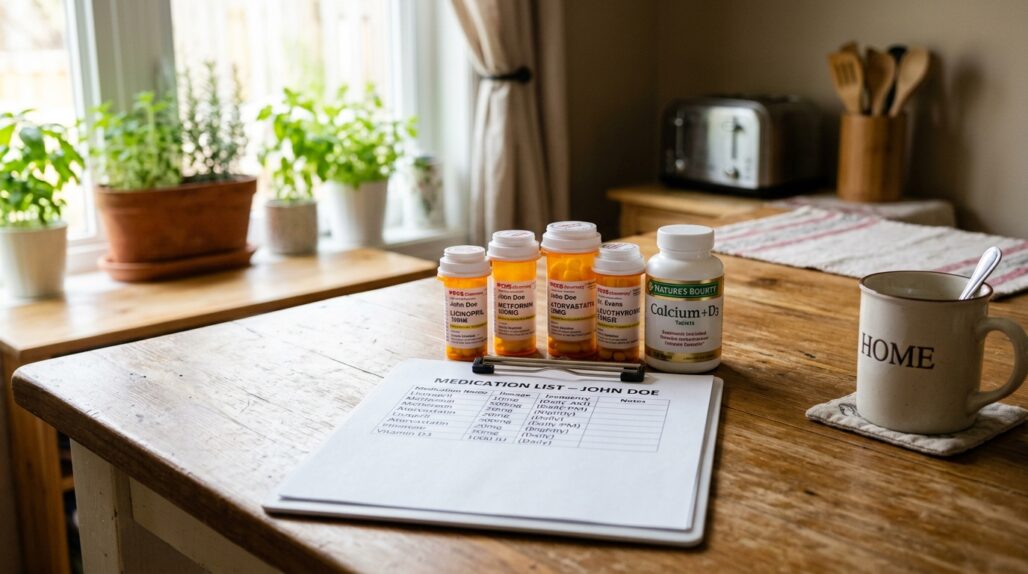
Why one list matters when several doctors are involved
When a parent sees a cardiologist, an endocrinologist, a primary care doctor, and maybe a specialist or two more, each one writes prescriptions inside their own chart. None of them automatically sees the full set. The pharmacy catches some of it, but only the part filled at that pharmacy.
This is common, not unusual. According to a StatPearls polypharmacy review, people aged 65 and older account for over a third of outpatient prescription spending in the United States, and using five or more medicines at once is linked to a higher risk of falls and other problems. When several prescribers each add a drug, the gaps between them are where mistakes hide.
A single master list closes that gap. It is one page that says everything your parent takes, why, and who ordered it. Handing it to each provider forces a quick review that would otherwise never happen. The rest of this guide walks through how to build that page, keep it current, and bring it where it counts.
What to capture for each item
A name alone is not enough. A good entry tells any clinician what the drug or supplement is, how much, and where it came from. The FDA's guidance on keeping a medicine list and the FDA's free My Medicine Record form both ask for the same core fields, and pharmacist guidance from ASHP SafeMedication lines up with it.
Capture these for every single item:
- Name and strength – the exact name and the milligrams or units on the label, not just "the blue one."
- Dose and schedule – how much and when, such as "one tablet every morning with food."
- What it is for – the reason, like "blood pressure" or "thyroid," in plain words.
- Who prescribed it – the doctor's name, so a duplicate or conflict can be traced back.
- Which pharmacy fills it – useful when more than one pharmacy is in play.
- Start date – roughly when it began, which helps connect a new symptom to a recent change.
Here is a blank template you can copy onto paper or into a phone note right now. It works with zero apps.
| Medicine or supplement | Dose and when | What it is for | Prescribed by | Pharmacy | Started |
|---|---|---|---|---|---|
| Example – Levothyroxine 75 mcg | 1 tablet, empty stomach, morning | Thyroid | Dr. Reyes (endocrinology) | Corner Rx | 2024 |
| Example – Vitamin D3 2000 IU | 1 softgel with lunch | Low vitamin D | Primary care | Mail order | 2025 |
| (your item) |
Include supplements and over-the-counter products too. Fish oil, a multivitamin, melatonin, magnesium, and the occasional ibuprofen all belong on the list. They can interact with prescriptions, and a doctor who does not know about them is working with half the information.
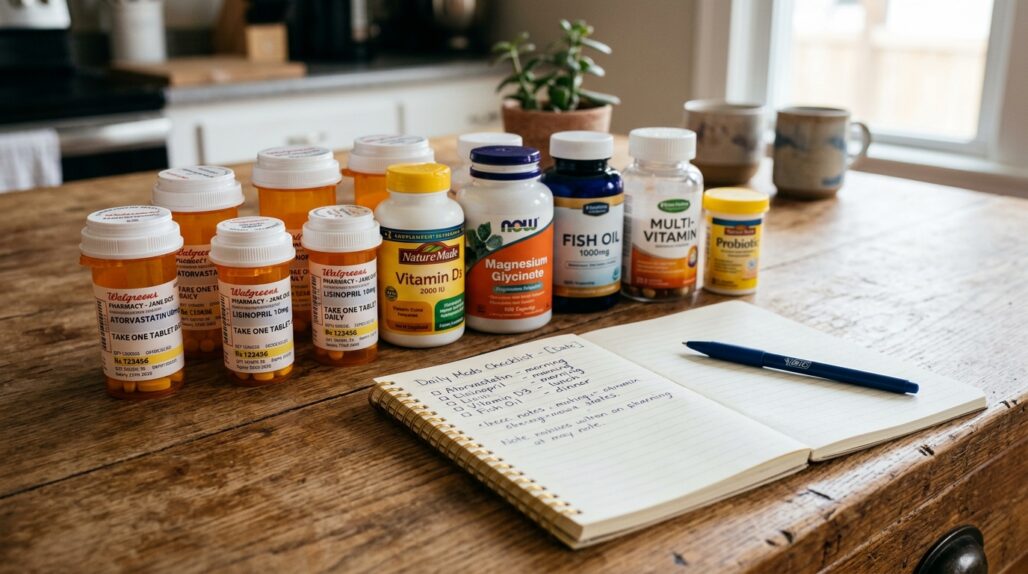
How to gather everything in one sitting
The fastest way to a complete list is to physically collect everything first, then write it down. This is the same move behind the AHRQ Brown Bag Medicine Review, where a patient brings every medicine in a bag so a pharmacist can see the real picture rather than a remembered one.
Set aside half an hour and work through these steps with your parent:
- Empty every spot. Check the kitchen counter, the bathroom cabinet, the nightstand, a purse or bag, the fridge, and the car. Pull out prescription bottles, supplement jars, eye drops, patches, and inhalers.
- Include the occasional ones. Bring the bottle even if it is used twice a year, and even if it looks expired. An old bottle still tells you what was prescribed and by whom.
- Copy straight from each label. Write the name, strength, and directions exactly as printed. Do not paraphrase the dose.
- Get the pharmacy printout. Most pharmacies will print a full medication history on request, often for free. This catches anything a bottle has lost or that got refilled elsewhere.
- Fill any blanks with a phone call. If you cannot tell what something is for or who ordered it, the pharmacist or prescribing office can confirm. The FDA suggests checking with a pharmacist when a detail is unclear rather than guessing.
When you are done, you should have one page (or two) that matches the bottles in front of you. That is your master list.
Keep it current, and carry it
A master list is only useful if it reflects today, not last spring. The FDA advises reviewing and updating a medicine list often, and especially whenever something changes: a new prescription, a dose change, or a medicine that was stopped. The simplest habit is to update the list the same day a change happens, before the bottle gets buried in a drawer.
Pick a format your family will actually maintain. A printed page in a kitchen folder works. A note on your parent's phone works. A photo of the list on your own phone, so you have it at the pharmacy counter or in a waiting room, works too. The FDA itself suggests keeping a copy with you, whether on paper or as a phone photo.
Once the manual list exists and you are updating it by hand, the part that slips is keeping it current as new prescriptions arrive from different offices. Some families keep the master list on paper or in a phone note; if you want it to stay current as new prescriptions come in, a free app we make, StackMyMed (our own free app), lets you keep every med and supplement in one place and note which doctor prescribed each one, with the same paper template or phone note working fine as the low-tech backup. It is an organizing tool, not a safety verdict, so anything that looks like a possible duplicate or interaction is still a question for your pharmacist.
Then make the list travel. Bring it to every appointment, including specialists, the dentist, and any urgent care or hospital visit. ASHP's pharmacist guidance notes that any new doctor or pharmacy may ask for a full list of current medicines, and having it ready means the answer is accurate instead of from memory under stress.

Let a pharmacist or primary doctor read the whole list
Building the list is step one. The real value comes when one person who can read it for safety sees the complete page. That is usually a pharmacist or the primary care doctor.
When several specialists prescribe separately, two drugs in the same class can end up on the list under different names. Medication reconciliation, the formal name for comparing the full list against what someone is actually taking, exists to catch exactly this kind of duplicate and the gaps that appear when care moves between offices. A pharmacist looking at the whole page can flag a possible duplicate, a risky combination, or a supplement that does not mix with a prescription.
| Bring this to the review | Why it helps |
|---|---|
| The master list, current | Gives the full picture across every prescriber at once |
| All the actual bottles | Lets the pharmacist match labels to the list and catch leftovers |
| Supplements and OTC products | These interact too and are often left off |
| A short list of questions | Keeps the visit focused on what worries you |
You do not have to diagnose anything yourself. Your job is to make the list complete and accurate. The clinician's job is to judge what it means. If you ever notice a new symptom after a medication change, that is a call to make rather than a thing to wait out.
FAQ
What should I write down for each medication? The name and strength, the dose and timing, what it treats, who prescribed it, which pharmacy fills it, and roughly when it started. The FDA’s My Medicine Record form uses these same fields and is free to print.
Do supplements and vitamins really need to be on the list? Yes. Fish oil, magnesium, a daily multivitamin, and herbal products can interact with prescriptions, so a doctor or pharmacist needs to see them to give safe advice. Leaving them off is a common gap.
My parent uses two pharmacies. Is that a problem? It can be, because each pharmacy only checks for interactions among the drugs it dispenses. Keeping your own complete master list and showing it at every visit is how you cover what no single pharmacy sees. Using one pharmacy where possible also helps.
How often should we update the list? The day anything changes. A new prescription, a stopped medicine, or a dose change all mean the list is out of date until you fix it, so updating on the spot is easier than catching up later.
What if I find two medicines that seem to do the same thing? Do not stop either one on your own. Note both, then ask the pharmacist or primary doctor, since separate specialists may have prescribed them without seeing each other’s orders. They can confirm whether it is a true duplicate.
Should I bring the list or the actual bottles to a review? Both, when you can. The list gives the overview and the bottles let a pharmacist match labels to it and spot leftovers, which is the idea behind a brown bag medicine review.

The bottom line
When a parent sees several doctors, no one office holds the whole picture, so you build the page that does. Gather every bottle and supplement, write down the name, dose, purpose, and prescriber for each, keep it current the day anything changes, and carry it to every appointment.
The single most useful step is the simplest one: make one complete list and put it in front of a pharmacist or the primary doctor, who can read the full set for duplicates and interactions that scattered prescribers cannot see. You keep the list accurate; let a clinician make the judgment calls.
For more on coordinating this with family, see how to handle sharing medication tracking among siblings, whether a parent's supplements are safe alongside their prescriptions, and what to pack for a brown bag medication review. If you want to understand specific combinations, our guide to common drug and supplement interactions is a good next read.
This article is general information, not medical advice. It does not replace a conversation with your own pharmacist or doctor, who know your parent's full history. Never start, stop, or change a prescription on your own.
StackMyMed is made by UsefulVitamins. It helps you organize your list and flag things to discuss with a pharmacist or doctor; it is not a diagnosis or treatment tool and does not replace professional medical advice.
Reviewed by the UsefulVitamins Editorial Team.
