
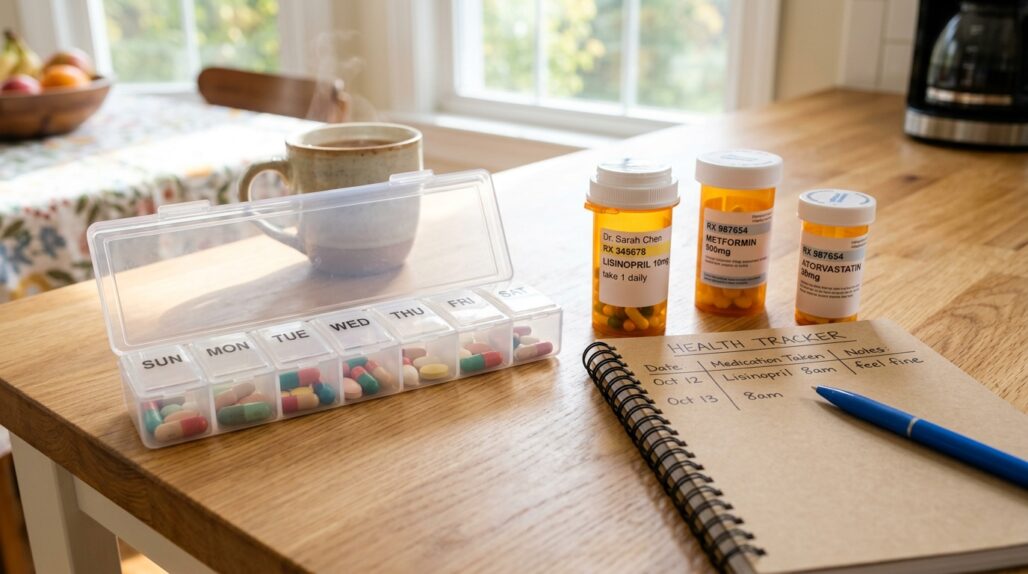
Why this task trips people up
Filling a weekly organizer feels simple until you are holding eight bottles and trying to remember which white oval went where. The hard part is not the box. It is the number of small decisions you make per minute, and one slip can put a morning pill in an evening slot or double a dose.
Caregivers often fill in a hurry, at the kitchen table, while half-listening to something else. That is exactly when look-alike tablets get swapped and an as-needed painkiller ends up sorted in as if it were daily. Pharmacists who study home medication errors point to outdated labels and crowded, distracting conditions as the usual culprits.
The good news is that a quiet, repeatable routine removes almost all of that risk. You are building a small system, not memorizing anything. Once it runs the same way every week, the chance of a mix-up drops sharply.
Set up before you touch a single pill
Start from a current master list, not from memory and not from the bottles alone. The list should show every prescription and over-the-counter item, the dose, what it is for, and the time of day it is taken. The FDA's guidance for talking with your pharmacist stresses keeping one complete, current record of everything a person takes, including vitamins and supplements, and updating it whenever something changes. If you do not have a clean list yet, our walkthrough on how to build one master medication list for a parent who sees several doctors is the place to begin.
Next, pick the conditions. Choose one fixed time each week, like Sunday morning, in a well-lit space with no distractions. No TV, no phone calls, no kids underfoot. Good light matters more than people expect, since many tablets differ only by a faint imprint.
Lay everything out before you begin:
- The written master list, where you can see it the whole time
- All current bottles, caps off, lined up in the same order as the list
- The empty organizer, wiped dry and clearly labeled by day and by time slot
- A small dish or paper cup for any pill you are unsure about
If the person takes pills at more than one time of day, use an AM/PM organizer or a four-slot-per-day box rather than a single-row weekly. A single row cannot hold a morning-and-night schedule without guesswork, and guesswork is what you are trying to remove.
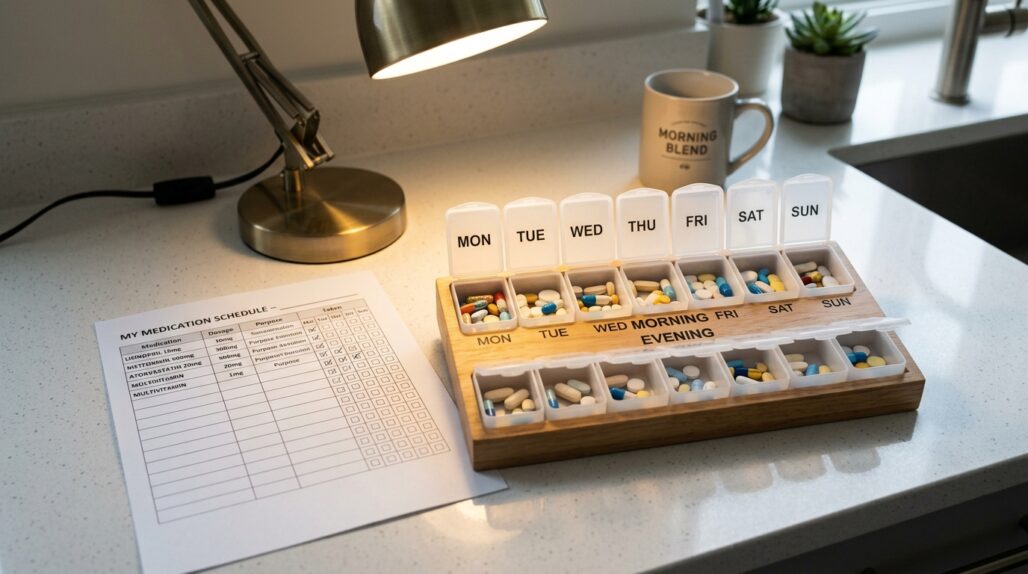
Fill one medication at a time, all the way across
Here is the method that pharmacists recommend most often, and it is worth doing exactly this way.
- Pick up the first bottle. Read the label against your master list. Confirm the name, the strength, and how many go in each slot.
- Place that one medication into every day and time slot it belongs in, across the whole week, before you pick up the next bottle.
- Set that bottle aside, clearly separated from the unopened ones.
- Move to the next medication and repeat.
Working one drug across all seven days, rather than filling Monday completely and then Tuesday, forces your attention onto a single label at a time. It is far easier to notice "this one is once daily" or "this is twice daily" when you are only thinking about one medication. It also makes a missing or extra pill obvious, because each compartment fills up in a predictable pattern.
Handle timing as you go. Some pills belong with food, some on an empty stomach, and some must stay spaced apart from others. The organizer slot is your reminder of when, so put each pill in the slot that matches its real instructions. If you are unsure how a particular schedule should look, our medication and supplement timing guide lays out the common patterns. For exact timing on a prescription, follow the label and confirm with the pharmacist rather than improvising.
Keep as-needed medications out of the daily compartments. A pill taken only for pain or sleep "when needed" does not belong in a Tuesday-morning slot, where it reads as a scheduled dose. Store those separately and note them on the list instead.
Double-check before you close the lid
The check is not optional. It is the step that catches the error you did not notice while filling.
When every bottle is sorted, go back through with the master list one more time:
- Count each row against the list. If the list says four medications every morning, every morning compartment should hold four pills. A compartment with three or five is a flag to stop and recheck.
- Verify look-alike pills. Two small white tablets can be different drugs. If you cannot tell two pills apart by sight, do not guess. Set them aside and check the imprint or call the pharmacy.
- Confirm as-needed versus daily. Scan for anything that drifted into a daily slot that should be taken only when needed.
The table below is a simple before-you-seal pass you can copy onto paper and reuse every week.
| Check | What you are looking for | If something is off |
|---|---|---|
| Row count | Each time slot holds the number of pills the list says | Recount that medication from its bottle |
| Look-alikes | Similar tablets are the right drug in the right slot | Match the imprint or call the pharmacy |
| As-needed | No “when needed” pills sorted as daily doses | Remove and store them separately |
| Splits and forms | Only tablets cleared for splitting were split | Use a whole tablet and check with the pharmacist |
| Empty slots | No compartment accidentally left empty | Compare against the list and fill the gap |
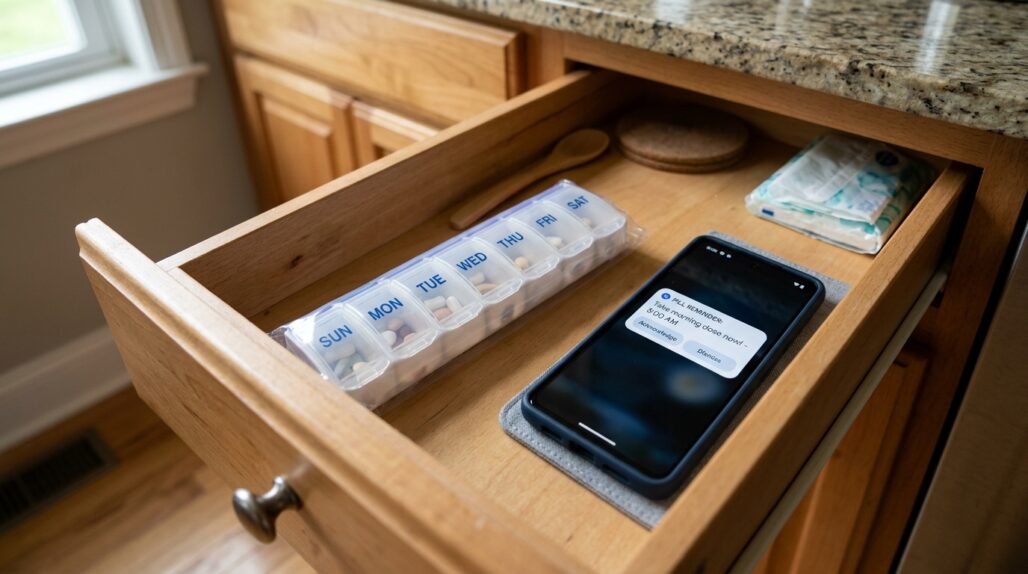
A weekly box answers one question well: did I already take this dose? An open, empty Wednesday-morning slot is a clear yes. What a box cannot tell you is whether a dose is due right now, especially for someone who is forgetful about time of day. That gap is worth planning for, and it is where a daily reminder earns its place. Many caregivers pair the box with a phone alarm, a kitchen note, or a simple wall chart so the "it is time" cue exists alongside the "already taken" cue.
If you want that second layer without setting separate alarms by hand, StackMyMed (our own free app) can send a per-dose reminder and let you check each medication against your saved list before you seal a compartment, while the low-tech version stays a phone alarm and a printed chart. It is an organizing and reminder helper, so for any question about whether a combination is safe or whether a pill can go in the box at all, route that decision to your pharmacist rather than the app.
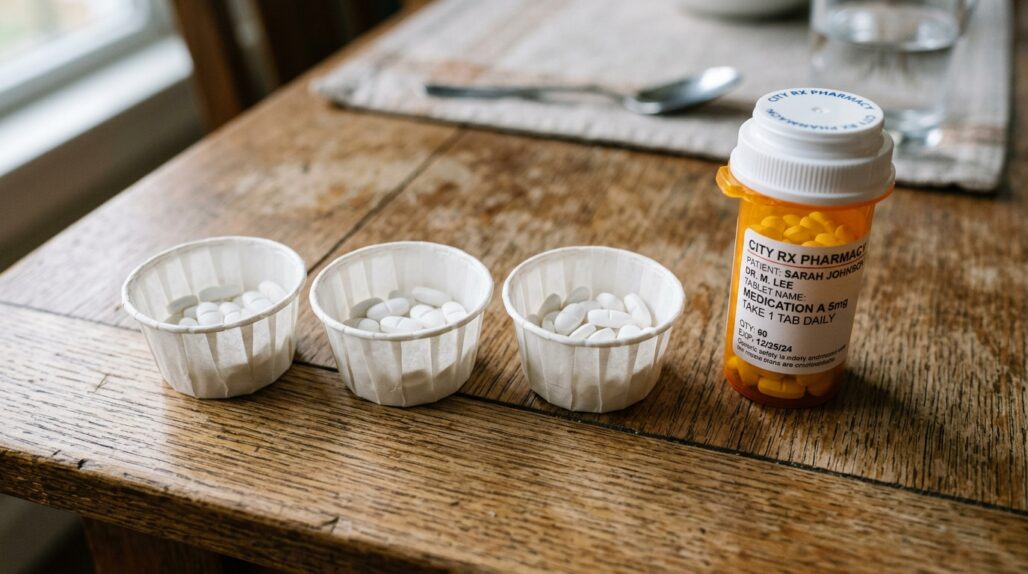
What not to pre-sort, and how to store the box
Not everything belongs in a weekly organizer, and a few items can be harmed by sitting in one.
Do not split or crush a tablet unless you have confirmed it is safe to do so. Extended-release and enteric-coated medications are built to release slowly or to survive stomach acid, and breaking them can dump a full dose at once or destroy the coating. A clinical review on the hazards of altering oral dosage forms describes why crushing certain tablets is unsafe. Watch for label cues such as ER, XR, XL, SR, CR, or EC, and ask the pharmacist before splitting anything. The same caution applies to a few medications that need to stay in their original container for stability. When you are unsure, ask the pharmacist which items can go in the box and which should stay in their bottles.
Storage matters more than people think. MedlinePlus, from the NIH National Library of Medicine, advises keeping medicines in a cool, dry place and out of the bathroom, where shower heat and humidity can degrade them. A filled organizer sitting open on a steamy bathroom counter is asking for trouble. Keep the sealed box in a bedroom drawer or a kitchen cabinet away from the stove and sink, and out of reach of children and pets.
Finally, never change a dose while you are filling. The organizer is not the moment to decide a pill "looks like too many." If the schedule seems wrong, fill from the list as written and raise the question with the prescriber or pharmacist afterward.
When to let the pharmacy do the filling
For a long or complicated regimen, hand-filling every week may not be the safest option. Many pharmacies offer blister packs or multidose packaging, where a technician fills each dose and a pharmacist checks it. A pharmacy medication adherence packaging service study found this kind of pre-packed system can support people taking many medications by removing the weekly sorting step entirely.
This is worth asking about if filling has become stressful, if mistakes have crept in, or if a parent is starting to fill their own box and you are not sure it is accurate. The pharmacist can also flag look-alike risks and confirm what is safe to combine in one pack. If different doctors or pharmacies are involved, it helps to make sure someone has the whole picture, which is also why keeping your own complete list and a system for whether a parent's supplements are safe with their prescriptions is worth the effort.
FAQ
How often should I refill a weekly pill organizer? Once a week at the same time works well for most people, so the box never sits empty and the routine becomes automatic. Refill from your current list, not from last week’s memory.
Can I put supplements and over-the-counter pills in the same organizer as prescriptions? Many people do, and it keeps everything in one place, but list them on your master list too so the pharmacist can check for interactions. If you tend to lose track of whether you already took something, our guide on what to do when you cannot remember if you took today’s pill may help.
Is it safe to crush pills to fit them in the box or make them easier to swallow? Not without checking first. Extended-release and enteric-coated tablets can be dangerous to crush, and the safest move is to ask the pharmacist before altering any pill.
What if two pills look almost identical? Stop and confirm before sorting either one. Match the imprint code, compare against the original bottles, or call the pharmacy. Guessing between look-alikes is one of the more common filling errors.
My parent forgets the box exists. What then? A box only helps if it is seen. Keep it where the person already looks, like next to the morning coffee, and add a separate time-of-day cue such as an alarm or a wall chart so the dose gets a prompt, not just a place to live.
Should I ever adjust a dose if it looks wrong while filling? No. Fill exactly what the list says, then raise any concern with the prescriber or pharmacist. The filling table is not the place to change a prescription.
The bottom line
A weekly organizer becomes safe when it runs the same calm way each time: one current list, one medication sorted all the way across, then a careful count before the lid closes. Keep extended-release tablets whole unless cleared to split, leave as-needed pills out of daily slots, and store the box cool and dry rather than in the bathroom.
The single most useful step is the double-check against the list, because it catches the mistake you did not notice. And when a regimen is long or filling has started to feel risky, ask your pharmacist whether pre-packed blister cards would be the safer choice. The pharmacist is also the right person for any question about what is safe to combine or alter, so route those decisions to them rather than deciding at the kitchen table.
This article is for general information and is not medical advice. It does not replace guidance from your doctor or pharmacist, and you should not start, stop, or change any medication or supplement without talking to a qualified professional.
StackMyMed is made by UsefulVitamins. It helps you organize your list and flag things to discuss with a pharmacist or doctor; it is not a diagnosis or treatment tool and does not replace professional medical advice.
Reviewed by the UsefulVitamins Editorial Team.
