
Affiliate disclosure: this article contains affiliate links. As an Amazon Associate, UsefulVitamins.com earns from qualifying purchases at no extra cost to you.
Where the creatine hair-loss fear actually came from
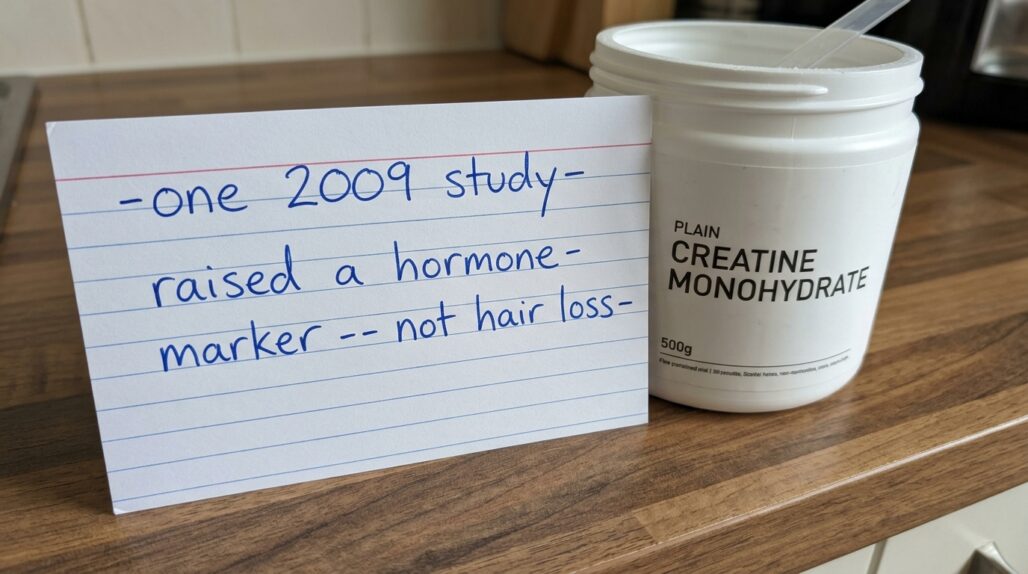
The fear is real, but it rests on a single study. In 2009, researchers measured dihydrotestosterone (DHT) in 20 college-aged rugby players who loaded creatine, and the number went up. The internet did the rest.
That study never weighed, counted, or photographed anyone's hair. It looked at a hormone in the blood and stopped there. Everything since has been people connecting two dots that the research itself never connected.
So the honest version is this: creatine raising a DHT reading is not the same as creatine causing baldness, and for fifteen-plus years no trial has closed that gap. Below is what the famous study did and did not show, and what the newer, better-designed work found when it finally looked at hair directly.
What the 2009 rugby study really measured
The paper is van der Merwe and colleagues, published in the Clinical Journal of Sport Medicine in 2009 (PMID 19741313). It was a placebo-controlled crossover design in 20 male rugby players, run over three weeks.
The dose was aggressive by everyday standards: a 7-day loading phase of 25 g/day followed by 14 days of maintenance. After loading, DHT rose about 56% from baseline and stayed roughly 40% above baseline through the maintenance phase. The DHT-to-testosterone ratio climbed about 36%, then settled near 22% above where it started.
Here is the part that gets dropped in every gym argument. Testosterone itself did not rise. And no hair outcome of any kind was recorded – not shedding, not density, not follicle health.
Why a DHT rise is not the same as hair loss
DHT matters for hair because of a specific chain. The enzyme 5-alpha-reductase converts testosterone into DHT, and in people who are genetically prone to pattern baldness, DHT binds receptors in scalp follicles and shrinks them over years, a process called miniaturization (Androgenetic Alopecia, StatPearls/NCBI).
But that same source is blunt about the prerequisite: without the genetic susceptibility, DHT alone does not produce androgenetic alopecia. Blood DHT and scalp DHT activity are also not the same measurement.
A single small study showing a blood-marker bump, with no genetic screening and no hair data, is a starting hypothesis. It is not proof of a hair effect.
What happened when someone finally looked at hair
For years the obvious follow-up did not exist. Then in 2025, a 12-week randomized controlled trial did the thing the 2009 study never attempted: it measured the hair (J Int Soc Sports Nutr, PMC12020143).
Thirty-eight resistance-trained men, split roughly evenly, took either 5 g/day of creatine monohydrate or a maltodextrin placebo. The team tracked total testosterone, free testosterone, and DHT, and they assessed the scalp with trichogram testing and FotoFinder imaging at the vertex.
The result was flat across the board. There were no group-by-time differences for any hormone or any hair outcome – not DHT, not the DHT:T ratio, not hair count, density, or the anagen-to-telogen balance. The authors called it strong evidence against the claim that creatine contributes to hair loss.
| Study | Year | Participants | Creatine dose | Measured DHT? | Measured hair? | Hair result |
|---|---|---|---|---|---|---|
| van der Merwe et al. (rugby) | 2009 | 20 men | 25 g/day load, then maintenance | Yes – rose about 56% | No | Not assessed |
| 12-week RCT (hair endpoints) | 2025 | 38 men | 5 g/day | Yes – no change vs placebo | Yes – trichogram and imaging | No difference vs placebo |
The wider literature agrees. A 2021 review in the same journal put it plainly: the current body of evidence does not indicate that creatine raises total testosterone, free testosterone, or DHT, or that it causes hair loss (Common questions and misconceptions about creatine, J Int Soc Sports Nutr 2021). One study reported a DHT change; no study has replicated it for any hair outcome.
The form question, settled quickly
People worried about hair sometimes go hunting for a "safer" creatine. There is nothing to buy your way out of here, because the form does not change the question.
Creatine monohydrate is the form that all of this research used. The 2009 DHT finding, the 2025 hair trial, and the decades of safety data all sit on monohydrate. It is, per the ISSN, the most studied creatine since the early 1990s.
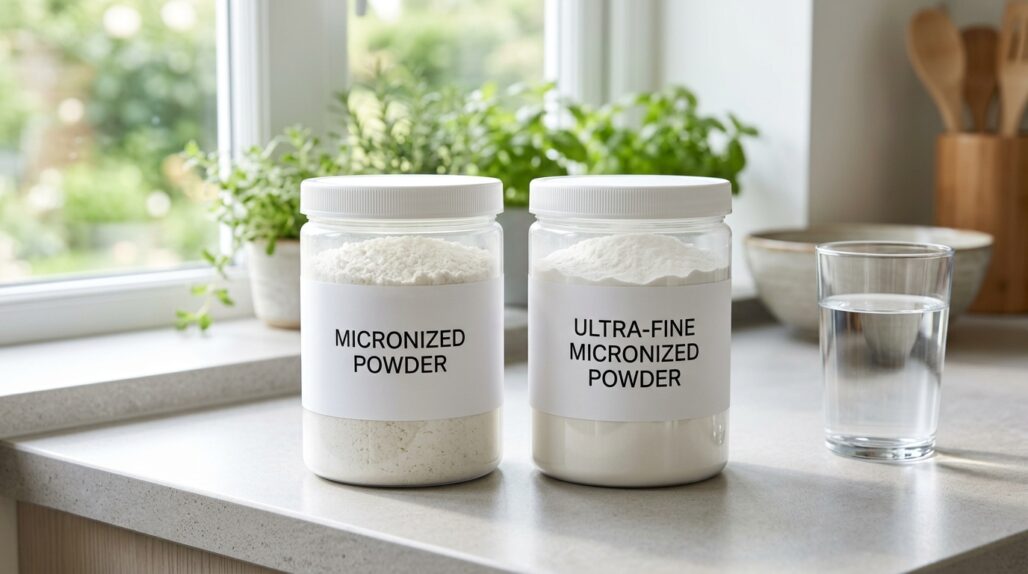
Hydrochloride, "buffered" blends, and other premium versions have never been shown to be superior, and none of them were the form behind the DHT scare. If you want to take creatine and you are nervous about hair, the studied, cheap, plain monohydrate is the rational pick – not a marketing variant.
If you want to dial in your exact grams and whether to bother loading, our creatine timing and loading guide walks through the protocol so you do not have to guess.
Who, realistically, should still think about it
Honesty cuts both ways. The 2025 trial was a real improvement, but it had limits worth naming.
The American Hair Loss Association pointed out that the trial enrolled 38 people, did not screen for genetic baldness risk, and did not measure DHT activity at the scalp where pattern loss actually happens (American Hair Loss Association commentary). It is reassuring, not the last word.
So who might pause? A short, honest list:
- Men with a strong family history of male-pattern baldness who are already watching a receding hairline. The biology that drives their hair loss is DHT-sensitive, so the theoretical concern is least far-fetched in this group.
- Anyone already on or considering a DHT-related treatment for hair, who wants to keep the picture clean.
For everyone else – women, men without that predisposition, recreational lifters – the evidence does not support skipping a useful supplement over this. Whether to use it is a personal risk-tolerance call, not a settled medical contraindication. If hair is a particular concern for you, our best creatine for women breakdown covers the same monohydrate evidence from that angle.
What the safety data actually shows
It helps to zoom out. Creatine is one of the most studied supplements in existence.
The ISSN position stand reports that supplementation has been safe and well tolerated in healthy people at intakes up to 30 g/day for as long as five years, across ages from infants to older adults (ISSN position stand, J Int Soc Sports Nutr 2017). The main everyday effects people notice are some water weight and the occasional stomach grumble, which usually tracks with dose and timing – covered in our rest-day creatine guide.
That is the backdrop against which the hair worry should be read: a large, reassuring safety record versus one unreplicated hormone marker.
Which creatine to buy if you want the studied option
You do not need a special "hair-safe" product. You need plain creatine monohydrate at a fair price, ideally third-party tested for purity.


As an Amazon Associate, UsefulVitamins.com earns from qualifying purchases at no extra cost to you.
Some links below are affiliate links; UsefulVitamins may earn a commission at no extra cost to you. Prices are approximate as of writing – check the current price.
A standard monohydrate tub covers the studied 3-5 g/day dose for months. Micronized Creapure is the same molecule, milled finer so it mixes more easily and carries a tighter purity spec, which is the only meaningful upgrade for most people. A value tub does the identical job for less per serving. None of these change the hair question, because the molecule is the same one every study used.
For a deeper walk-through of forms, dosing, and the full evidence base, our complete guide to creatine is the home base.

FAQ
Does creatine cause hair loss? No study in humans has shown that it does. The concern comes from a single 2009 trial that found a rise in the hormone DHT but never measured hair, and a 2025 trial that did measure hair found no difference from placebo.
Did the 2009 study show people losing hair? No. It measured a roughly 56% rise in DHT and a higher DHT-to-testosterone ratio in 20 rugby players on a 25 g/day loading dose. It recorded no hair count, density, or shedding data at all.
Should I stop creatine if I am worried about my hairline? Stopping a supplement that works on the strength of one unreplicated hormone reading is a weak trade. If you are seeing real shedding or thinning, that is worth a dermatologist’s assessment rather than a quiet guess about creatine.
Is a special creatine form safer for hair? No. Creatine monohydrate is the form used in the DHT study, the hair trial, and the long-term safety research. Hydrochloride and “buffered” versions have not been shown to be superior or different on this question.
Does creatine raise testosterone? Reviews of the evidence find no consistent rise in total or free testosterone. The 2009 study that drew attention saw a shift in DHT, not in testosterone itself.
What if I am genetically prone to male-pattern baldness? That is the one group where the theoretical concern is least far-fetched, because their hair loss is DHT-driven. The evidence still does not show a creatine effect, so it becomes a personal risk-tolerance call best discussed with a dermatologist.
The bottom line
The creatine-causes-baldness story is built on one small 2009 study that measured a hormone and never looked at hair. When researchers finally did look, in a 2025 trial, creatine changed neither DHT nor any hair outcome versus placebo.
The practical move is unfussy: take plain creatine monohydrate at 3-5 g a day, the same form and dose the science is built on, and judge it on results. If you have genuine hair concerns or a strong family history, the right next step is a dermatologist, not a decision to drop a well-supported supplement over a single number.
This article is general education, not medical advice. It is not a diagnosis or a treatment plan, and supplements are not a substitute for care from a qualified clinician. Talk to a pharmacist or doctor about your own situation, medications, and any new or worsening symptoms before making changes.
Reviewed by the UsefulVitamins Editorial Team.
