
Affiliate disclosure: this article contains affiliate links. As an Amazon Associate, UsefulVitamins.com earns from qualifying purchases at no extra cost to you.
Why biotin causes a lab problem, not a body problem
Biotin (vitamin B7) is water-soluble, which means your body holds onto very little of it and flushes the rest out in urine. The NIH Office of Dietary Supplements notes that the adult Adequate Intake is just 30 mcg a day, and there is no Tolerable Upper Intake Level because no convincing human toxicity has been documented even at high intakes.
So the side effect that matters with biotin is not damage to you. It is interference with the machines that read your blood. That is a strange thing to say about a B vitamin, but it is the honest headline here.
Many popular hair, skin, and nail products pack 5,000 to 10,000 mcg per serving, and some go higher. The TCTMD summary of the FDA warning notes products on the market with up to 20 mg of biotin, which is several hundred times the daily Adequate Intake. At those amounts the vitamin is still well tolerated, but the blood level gets high enough to confuse certain tests.
If you want to compare what reasonable daily amounts look like, our guide to the best biotin supplements walks through typical doses and why bigger is rarely better.
How biotin fools the test
A lot of common lab tests use a biotin-streptavidin binding step inside the assay. Streptavidin grips biotin extremely tightly, and labs use that bond to pull the thing they are measuring out of your sample.
When your blood is flooded with extra biotin from a supplement, that loose biotin competes for the same binding sites. The AACC/ADLM scientific guidance explains the result in plain mechanics. Depending on the assay design, the readout comes back falsely high or falsely low.
The direction is not random:
- Sandwich immunoassays (used for things like TSH and troponin) tend to read falsely low when biotin interferes.
- Competitive immunoassays (used for some small hormones like free T4) tend to read falsely high.
That is why a person on high-dose biotin can show a lab pattern that mimics Graves' disease (low TSH, high thyroid hormones) when their thyroid is perfectly fine. A 2023 case report in the NCBI/PMC literature documented exactly this kind of misleading result, a patient on high-dose biotin whose suppressed TSH with falsely elevated free T4 and free T3 mimicked an overactive thyroid.
Which tests get skewed
This is broader than most people expect. The AACC/ADLM guidance lists a long roster of affected assays, and the categories worth knowing are below.
| Test category | Common examples | Why it matters |
|---|---|---|
| Thyroid panel | TSH, free T4, free T3, thyroglobulin | Can fake a hyperthyroid pattern and trigger needless workups |
| Hormones | Testosterone, estradiol, cortisol, PTH, prolactin, DHEA-S | Wrong numbers can derail fertility, endocrine, or hormone decisions |
| Cardiac markers | Troponin, NT-proBNP | A falsely low troponin can hide a real heart attack |
| Other immunoassays | Ferritin, PSA, vitamin B12, 25-OH vitamin D, some tumor markers, hCG | Results may not match how you actually feel |
Tests that do not use biotin chemistry, such as many mass-spectrometry assays, are generally unaffected. The catch is that you usually have no idea which method your lab runs. That is why disclosure beats guessing.
The troponin angle is the dangerous one
Troponin is the blood marker doctors use to confirm a heart attack. The FDA safety communication on biotin flagged this as the most serious concern, and it carries real weight.
The FDA reported one patient death linked to a falsely low troponin result in someone taking high-dose biotin, where a heart attack went unrecognized. In a sandwich-style troponin assay, extra biotin pushes the number down, so a person having a genuine cardiac event can look reassuringly normal.
If you ever land in an emergency room with chest pain, do not stop taking your supplement and stay quiet. Say out loud, early, that you take biotin. That single sentence lets the team account for it.
How long to stop biotin before a blood test
This is the practical part. Biotin clears fast – its half-life is roughly 2 hours, per Quest Diagnostics – so it does not take long to wash out for most people. The right pause depends on your dose.
| Your daily biotin dose | Suggested pause before the draw | Notes |
|---|---|---|
| Under 1,000 mcg (a multivitamin amount) | About 8 hours, or skip the morning dose | Multivitamin-level biotin rarely causes reported interference |
| 5,000 to 10,000 mcg (hair and skin formulas) | At least 72 hours (2 to 3 days) | The most common interference scenario in everyday supplement users |
| 100 mg or more (prescribed therapeutic doses) | Often a week, only if a clinician says it is safe to pause | Never stop a prescribed dose on your own; ask the prescriber |
A simple default for a typical hair-and-skin user is to hold biotin for 2 to 3 days before routine blood work. If you have reduced kidney function, biotin clears more slowly, so a longer pause may be sensible – a good thing to raise with your doctor.
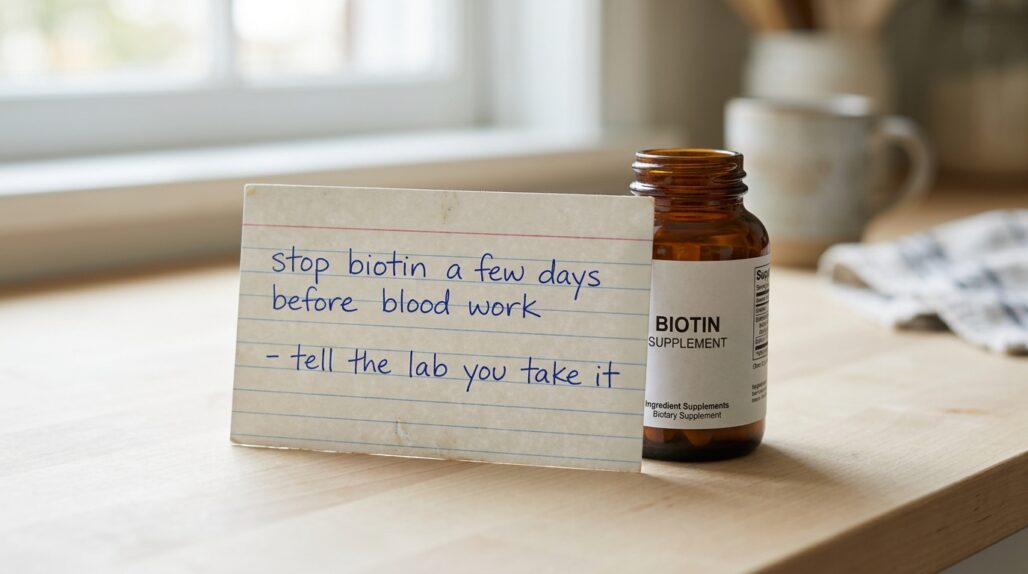
Two habits cover almost every case. First, mark a reminder a few days out so you remember to pause – a note on the calendar or phone is enough. Second, tell the lab and the ordering clinician that you take biotin, even after you have paused it, so an odd result gets a second look.
For a broader picture of how biotin sits inside the wider B-vitamin family and where it commonly hides in stacks, see our explainer on the vitamin B complex.
Who should be extra careful
A few groups have more at stake than the average hair-gummy user. If any of these describe you, the pause-and-disclose habit is not optional.
- Anyone with a thyroid condition being monitored by TSH and free T4. A biotin-skewed panel can look like your dose needs changing when it does not, and a real medication change should never ride on one suspect result.
- People in fertility or hormone workups, where estradiol, LH, FSH, and progesterone numbers steer timing and treatment decisions.
- People with reduced kidney function, who clear biotin more slowly, so the usual washout window may be too short.
None of this means biotin is unsafe. It means the number on the report has to be trusted, and that trust depends on the lab knowing you take it. When a result clashes with how you feel, biotin interference is worth raising before anyone acts on it.

The hidden-stacking trap
Biotin shows up in more products than people realize: dedicated hair gummies, multivitamins, energy and beauty blends, and many B-complex formulas. Stack two or three and your total can quietly climb into the interference zone without any single label looking alarming.
Before any planned blood work, it pays to read every label you take and add up the biotin. A quick way to check whether your stack is layering biotin on top of other interactions is our drug and supplement interaction checker, and our deeper reference on medications and false lab results covers the same interference from the other direction.
Which form to buy if you take biotin at all
Here is the honest part. For most people, the smartest move is not a fancier biotin – it is a smaller dose. The hair and nail benefits of mega-dose biotin in people who are not deficient rest on thin evidence, and the NIH ODS says the small studies are too preliminary to recommend biotin for hair or nails.
A few sensible directions:
- If you mainly want insurance, not megadosing: a modest 1,000 mcg biotin or a B-complex with a sane biotin amount keeps your lab risk low.
- If you want a beauty formula anyway: fine, just treat the higher biotin as a flag to pause before any blood test.
- If you only need general B coverage: a balanced B-complex usually carries far less biotin than a standalone hair product.
The products below route to a reasonable-dose biotin, a B-complex with modest biotin, and a hair-and-skin formula if that is what you are set on. The lower-dose options simply give you less to wash out before a test.
We may earn a commission from links on this page, at no extra cost to you. We only recommend products we would be comfortable suggesting to a friend.

![NatureWise Vitamin B Complex for Women and Men - with Folic Acid Biotin B1 B2 B3 B6 B12 - Support Cellular Energy & Mental Clarity - Gluten & Dairy Free - 150 Softgels[5-Month Supply]](https://m.media-amazon.com/images/I/41btFd8n5FL._SL160_.jpg)

As an Amazon Associate, UsefulVitamins.com earns from qualifying purchases at no extra cost to you.

FAQ
Does biotin damage your liver or kidneys at high doses? There is no good evidence that biotin harms the liver or kidneys, and the NIH ODS notes no established toxic level. The real concern at high doses is skewed lab results, not organ damage.
How long do I need to stop biotin before a blood test? Roughly 2 to 3 days for common 5,000 to 10,000 mcg hair-and-skin doses, and often about 8 hours for multivitamin-level amounts under 1,000 mcg. When in doubt, pause longer and tell the lab.
Will biotin make my thyroid test wrong? It can. High-dose biotin can push TSH down and thyroid hormones up on many assays, which can mimic an overactive thyroid even when your thyroid is normal. Disclose your biotin so an odd result gets rechecked.
Can biotin really hide a heart attack? In theory yes, because high biotin can falsely lower a troponin result on some assays, and the FDA linked one death to this. If you have chest pain, get evaluated and tell the team you take biotin – do not stay home or stop disclosing it.
Is a normal multivitamin amount of biotin a problem? Usually not. Biotin under about 1,000 mcg has not generally been reported to cause immunoassay interference, though skipping your morning dose on the day of a draw is an easy precaution.
Should I stop my prescribed high-dose biotin before testing? Not on your own. Therapeutic doses used for certain neurological conditions are very high, so ask the prescriber whether and how long to pause, and let the lab know either way.
The bottom line
Biotin is genuinely well tolerated, so the side effect to respect is not in your body – it is in the lab. High-dose hair-and-skin biotin can falsely raise or lower thyroid, hormone, and troponin results, and a wrong troponin is the one that can cause real harm.
The fix is boring and effective. Pause biotin for about 2 to 3 days before routine blood work (longer for very high doses, only with clinician sign-off), and tell both the lab and your doctor that you take it. If you do not actually need a mega-dose, a smaller biotin or a balanced B-complex sidesteps most of this.
Your next step: check every label you take, add up the biotin, and put a reminder on the calendar before your next blood draw.
This article is general education, not medical advice. It does not diagnose, treat, or replace care from your own clinician. Never start, stop, or change a prescription based on a web page, and route any real decision about lab tests or a cardiac workup to a pharmacist or doctor.
Reviewed by the UsefulVitamins Editorial Team.
