
Affiliate disclosure: this article contains affiliate links. As an Amazon Associate, UsefulVitamins.com earns from qualifying purchases at no extra cost to you.
What a gummy can and cannot fit
A gummy is a small candy base carrying nutrients, and that base has limited room. There is only so much you can dissolve into pectin or gelatin before it stops setting, tastes off, or falls apart.
A capsule or tablet has no such ceiling. That is why a pill-form multivitamin can carry the full spectrum of roughly 22 vitamins and minerals that the NIH Office of Dietary Supplements describes for full-coverage products, while a gummy version of the "same" brand often drops several of them.
So the real question is not whether chewing is worse than swallowing. It is whether the gummy version still contains what you bought it for. Often it carries less, and sometimes it skips the one mineral you most wanted.
The three honest tradeoffs
Gummies lose on three measurable points and win on one that matters more than people expect. Here is the short version before the detail.
- Fewer nutrients per serving. The candy matrix cannot hold a full multi, so gummies thin out the list.
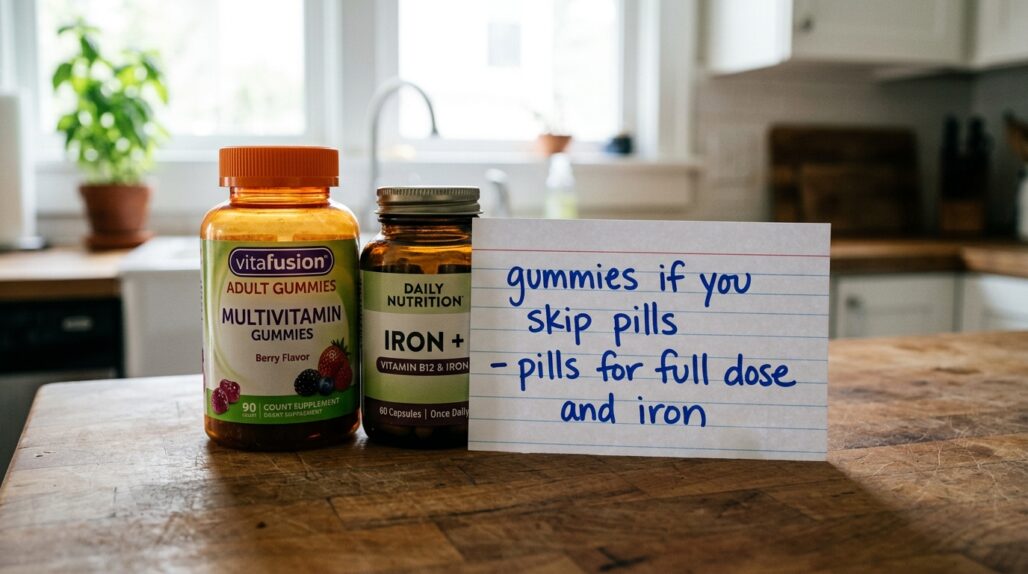
- Almost always no iron. Iron tastes metallic and chewing keeps it in your mouth, so makers leave it out.
- Added sugar. Most gummies carry a couple of grams each, and the dose is two or three a day.
- Better adherence. A gummy you enjoy is a gummy you take, and the best supplement is the one you do not skip.
Fewer nutrients, smaller doses
University Hospitals puts it plainly: a gummy multivitamin may not carry the full potency of a comprehensive pill-form multi. The gummy is the trimmed-down edition, not a swap.
For a healthy adult eating a varied diet this gap is rarely a problem, since a multivitamin is insurance rather than a treatment. But if you chose a multi specifically to plug a known gap, read the supplement facts on the gummy and the pill side by side before assuming they match.
The iron problem
Iron has a sharp metallic taste, and a gummy sits in your mouth long enough that no flavoring fully hides it. Scripps Health notes that few gummies contain iron for exactly this reason.
There is a safety reason too. Iron is left out of children's gummies partly to avoid an overdose if a child eats a handful, since the products look like candy. If you take a multivitamin to cover iron – common for menstruating women, vegetarians, or anyone told they run low – a gummy will quietly leave you uncovered.
The sugar adds up
Most gummies carry one to four grams of added sugar each, and the serving is usually two or three gummies. That is a small daily sugar habit dressed up as a vitamin.
A Scripps physician compared a daily gummy to eating a piece of candy 365 days a year. Sugar-free gummies exist, but they often swap in sugar alcohols like sorbitol that can loosen stools at higher counts. If you are watching sugar, a tablet sidesteps the whole issue.
The label-accuracy issue is real
This is where gummies have a documented track record, not just a vibe. The candy base is less stable than a coated pill, so the nutrients inside drift over the product's shelf life.
In a ConsumerLab review of multivitamins, gummies were the format most likely to fail testing. Every gummy multi they selected had a potency miss: one held far less vitamin D than labeled, and three carried close to double their stated folate.
There is even a regulatory blind spot. As ConsumerLab explains, USP standards let gummies overshoot – up to 245% of labeled folate and 250% of labeled vitamin C – while tablets and capsules are held to about 50% over. Makers add that overage on purpose to offset degradation, but it means the number on a gummy label is a looser promise than the number on a pill.
The practical takeaway is not panic. It is to favor gummies that carry third-party testing (USP, NSF, or an independent lab) so the dose drift is at least being watched.
A side-by-side on the things that matter
Use this as a quick gut check, then choose by your own goal rather than by which is trendier.
| Factor | Gummy | Pill (tablet or capsule) |
|---|---|---|
| Nutrients per serving | Fewer; trimmed list | Can carry a full ~22-nutrient multi |
| Iron included | Almost never | Available with iron |
| Added sugar | ~1-4 g each, 2-3 per day | None |
| Label accuracy | Higher failure rate; bigger overages allowed | More stable; tighter standard |
| Shelf life | Shorter; degrades with heat and humidity | Longer; coated and stable |
| Ease of taking | Best; no swallowing, tastes good | Harder for pill-averse people and kids |

The adherence counterpoint, which is not nothing
Here is the case for gummies, and it is stronger than the criticism suggests. A multivitamin only works if you take it, and a pill sitting untouched in a cupboard delivers exactly zero nutrients.
University Hospitals makes the point directly: if a pleasant-tasting gummy is what gets someone to take a daily multi, that is a win for their health, not a compromise. Surveys of supplement users consistently show taste drives whether people stick with a routine.
So if you have abandoned three bottles of capsules because you hate swallowing them, a gummy you will actually finish is the better real-world choice. A slightly lighter dose you take beats a complete dose you skip. That is the whole honest argument, and it holds.
Which format and product to buy
Match the format to the person, not the marketing. Most of this comes down to two questions: do you need iron or full coverage, and will you take a pill at all.
- Lean pill if you want a complete multi, need iron, are pregnant or trying to conceive, or are watching sugar.
- Lean gummy if you are pill-averse, have trouble swallowing, or are buying for a child who refuses tablets (kept well out of reach).
- Either is fine for a healthy adult who eats reasonably and just wants light insurance.
Whatever you pick, our deeper take on whether a daily multi earns its place is worth reading first – some people do not need one at all, and we walk through that in our look at whether multivitamins are a waste of money. For format-and-dose picks by need, our vetted lists for the best multivitamin for women and the best multivitamin for men compare the actual nutrient panels. And if a popular gummy brand is on your shortlist, see our breakdown of whether MaryRuth's multivitamin is worth it.


As an Amazon Associate, UsefulVitamins.com earns from qualifying purchases at no extra cost to you.
We may earn a commission from purchases made through the links above, at no extra cost to you. We only suggest formats we would take ourselves.

What to watch for, whichever you choose
A few habits keep either format honest. None of these is complicated.
- Check for iron if you bought the multi to cover it – most gummies will not have it.
- Read the sugar line and multiply by the serving size, not per gummy.
- Prefer third-party tested products so label drift is being checked by someone.
- Store gummies cool and dry, since heat and humidity speed their breakdown.
On safety, there is no real risk for a healthy adult taking either format at the labeled serving. The one genuine hazard is children. Gummies look like candy, and the FDA warns that accidental iron overdose is a leading cause of fatal poisoning in children under six.
That risk is not theoretical. A JAMA Pediatrics study found that unit-dose packaging of iron supplements cut child iron-poisoning deaths after it was introduced. Keep any vitamin – gummy or pill – up high and capped, and call poison control if a child gets into a bottle.
FAQ
Do gummy vitamins actually work? Yes, for the nutrients they contain, as long as the product is accurately dosed. The catch is that gummies often hold fewer nutrients and have a higher rate of failing potency tests, so a third-party-tested product matters more here than with pills.
Why don’t gummy vitamins have iron? Iron has a strong metallic taste that is hard to mask in something you chew, and leaving it out lowers the overdose risk for children who might eat gummies like candy. If you need iron, choose a tablet or capsule that lists it.
Is the sugar in gummy vitamins a problem? For most people a gram or two a day is minor, but it adds up if you take two or three gummies daily over years. If you are watching sugar or blood glucose, a pill avoids it entirely, or look for a sugar-free gummy and mind the sugar alcohols.
Are gummies safe for kids? At the age-appropriate serving, yes, but they look like candy and must be kept out of reach. Dosing decisions for children should go through a pediatrician, and iron-containing products in particular need to be locked away.
Are pills more accurate than gummies? On the testing record, yes. Coated pills are more stable, held to a tighter overage standard, and fail potency checks less often than gummies, which degrade faster and are allowed larger label overages.
Can I just take more gummies to match a pill’s dose? No. That stacks up sugar and can push some nutrients past the labeled serving, and it still will not add the iron a gummy never had. If you need a fuller dose, switch formats rather than doubling up.
The bottom line
Gummies are not as complete as pills, and that is the honest verdict: they fit fewer nutrients, almost always skip iron, add a little sugar, and miss potency on testing more often. If you need iron or full-dose coverage, reach for a tablet or capsule.
But the format only matters if you take it. If a gummy is the difference between a daily habit and an untouched bottle, the gummy wins for you, and that is a fair call rather than a cop-out.
Your next step is simple. Decide whether you need iron, then pick a third-party-tested product in the format you will actually finish, and check the supplement facts before you buy.
This article is general education, not medical advice. It does not diagnose, treat, or replace guidance from your own clinician. Talk to a pharmacist or doctor before starting a supplement, especially if you are pregnant, anemic, give supplements to a child, or take prescription medicine.
Reviewed by the UsefulVitamins Editorial Team.
