
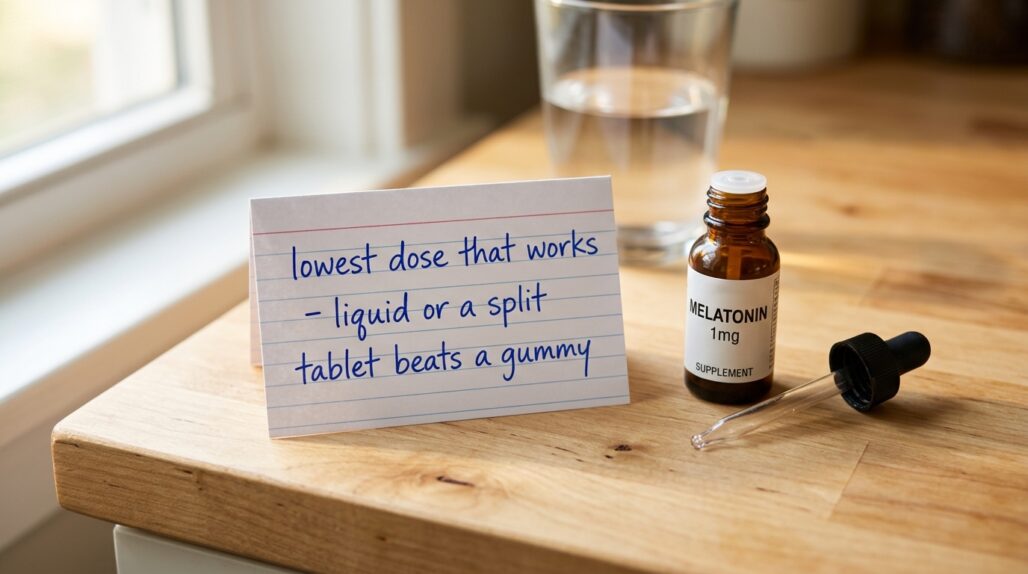
Affiliate disclosure: this article contains affiliate links. As an Amazon Associate, UsefulVitamins.com earns from qualifying purchases at no extra cost to you.
Why the dose decides the format
Most people buy melatonin like a vitamin and reach for whatever tastes best. That instinct is backwards. With melatonin, the dose is the whole game, and the format is just the tool that helps you hit it.
The amount your body needs to nudge sleep is tiny. Controlled studies have found that doses as low as 0.3 to 1 mg shorten the time it takes to fall asleep in healthy adults, and that going higher rarely adds benefit. A controlled study in healthy young adults (Zhdanova et al., Sleep, 1996) found that 0.3 to 1 mg significantly shortened the time it took to fall asleep, with no added benefit from larger pharmacologic doses.
So the real question is not "gummy or pill," it is "which format lets me take a small, repeatable dose?" Once you frame it that way, the answer sorts itself out fast.
What a good melatonin dose actually looks like
Store shelves are loaded with 5 mg and 10 mg products, which is five to thirty times more than the studied low dose. More is not stronger here; it is just more.
The American Academy of Sleep Medicine reviewed the evidence and issued a weak recommendation against using melatonin as a routine treatment for chronic insomnia in adults, in part because trials at common doses showed only a small reduction in time-to-sleep, on the order of a few minutes. The Academy points to cognitive behavioral therapy for insomnia as the first-line approach for an ongoing problem.
That does not mean melatonin is useless. It means timing and a low dose matter more than the milligram count on the front of the bottle. For jet lag or a shifted schedule, a small dose taken at the right hour is the point. If you want the milligram target for your situation, our melatonin buying guide walks through the low-dose logic in more detail.
There is a second reason format matters: melatonin is a sleep signal, not a sedative. It works by telling your body the night has started, so when you take it changes the result as much as how much. Most people do best taking a small dose about 30 to 60 minutes before bed, and a format you can take consistently at that hour beats a stronger one you take erratically.
The practical takeaway: pick a format that can deliver under 1 mg cleanly and that fits your nightly routine. Here is how the three common formats stack up against that test.
| Format | Typical dose sold | Easy to dose low? | Main tradeoff |
|---|---|---|---|
| Liquid drops | 0.5 to 1 mg per dropper, adjustable | Yes, best for microdosing | Taste, and you must measure carefully |
| Tablet or pill | 0.5 to 10 mg, some scored | Yes if you buy a low or splittable one | Big tablets are hard to halve evenly |
| Gummy | 2.5 to 10 mg, fixed | No, you cannot split it well | Sugar, candy-like, label drift |
Liquid drops: the easiest way to start low
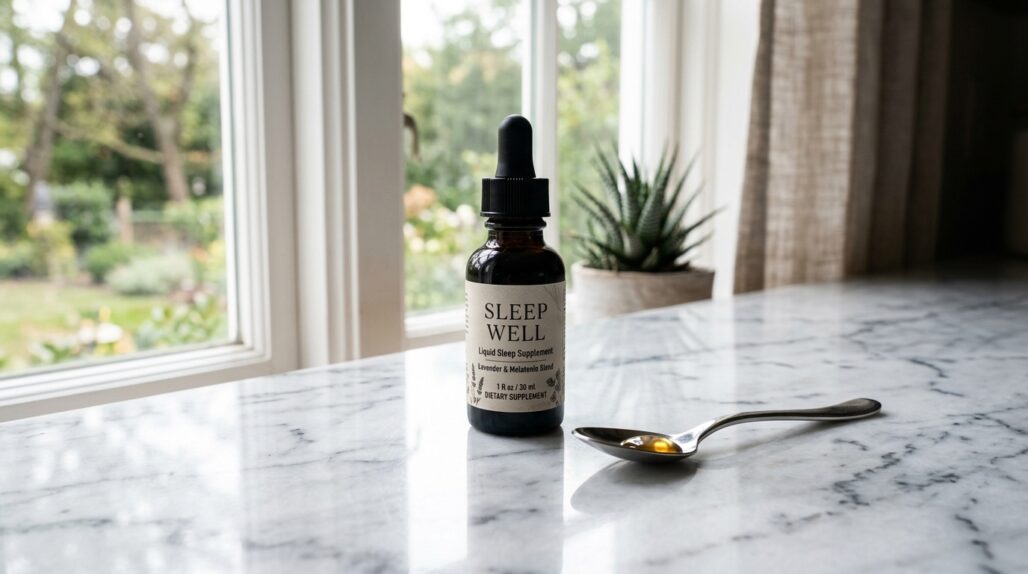
If you want to microdose and titrate, liquid is the format that bends to you. A dropper lets you take half a serving, then adjust up only if you need to, which is exactly how a low-dose plan should work.
That flexibility matters because the lowest amount that works is personal. Some people respond to 0.3 mg; others land at 1 mg. With a tablet you are stuck on its fixed step; with drops you control the step.
The downsides are real but minor. Liquids can taste bitter, and you have to measure honestly instead of eyeballing it. Keep the bottle capped and stored as the label says so the dose stays consistent over time.
Liquid also suits anyone who does not want to swallow a pill at all, and it lets you find your number over a few nights rather than committing to whatever a tablet or gummy decided for you. If 0.5 mg leaves you groggy in the morning, you can step down to a partial dropper the next night. That kind of fine adjustment is hard with any solid format.
Tablets and pills: cheap, precise, splittable
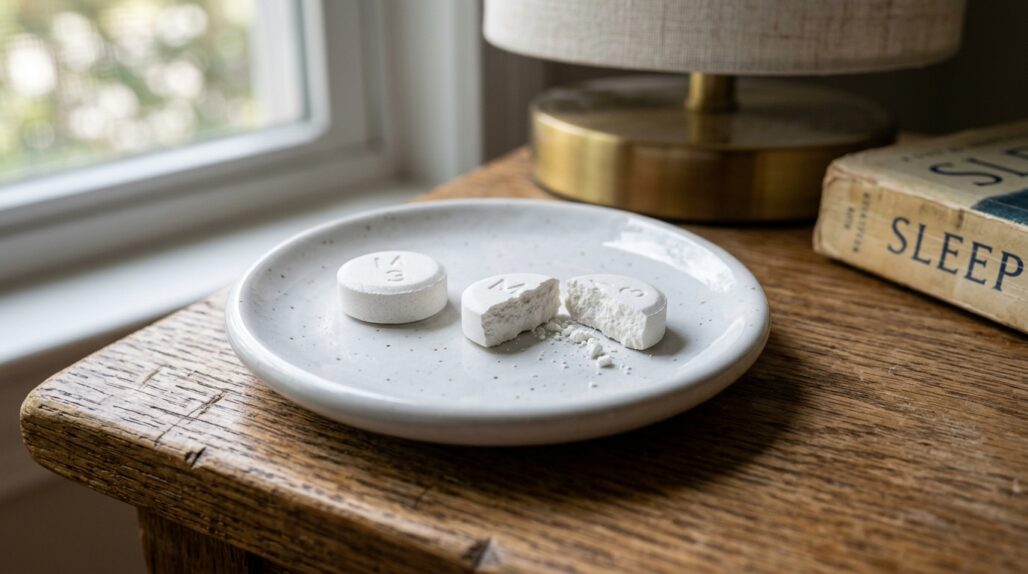
A plain low-dose tablet is the value pick. They cost little, the dose printed on a quality tablet is reliable, and a scored 1 mg tablet snaps into a tidy 0.5 mg.
Pills also travel well and skip the sugar entirely, which matters if you are taking something most nights. The catch is that a chunky 5 or 10 mg tablet does not halve cleanly, and breaking it into a true low dose is guesswork. Buy the low number to begin with rather than trying to chip a big one down.
Tablets are also the easiest format to confirm against independent testing, which we get to below. For most adults who already know their dose, a scored low-dose tablet is the simplest honest choice.
Gummies: easy to like, hard to dose low
Gummies are the format people reach for, and they have one genuine strength: you will actually take something that tastes like a fruit chew. But melatonin is the wrong supplement to optimize for flavor.
The dosing problem is structural. Gummies come in fixed 2.5 to 10 mg portions that you cannot split, so the format pushes you toward more melatonin than the evidence supports. You also swallow added sugar every night, which is not what you want right before sleep.
Then there is label accuracy. A 2023 research letter in JAMA tested 25 melatonin gummy products and found 22 of 25 were inaccurately labeled. The measured melatonin ranged from 74% to 347% of the labeled amount, and one product contained no detectable melatonin at all. If you read more about why high numbers are a problem in our explainer on whether 10 mg of melatonin is too much, the gummy variability makes the gamble worse, because you may be getting far more than the label claims.
The pediatric angle nobody mentions on the front of the jar
Gummies look like candy, and children treat them that way. The CDC reported that pediatric melatonin ingestions reported to poison control rose 530% between 2012 and 2021, climbing from about 8,300 to over 52,000 a year, with a sharp rise in unsupervised ingestions by young children.
If gummies are in your house, treat them like medicine: store them up high and out of reach, with the cap fully closed. This is the one safety point where the format genuinely changes the risk.
None of this makes gummies dangerous for an adult at a sensible dose. The point is narrower: the gummy format quietly works against the two things that make melatonin useful, a low dose and a known dose. If you can take a drop or a small tablet instead, you give up nothing real and you skip the sugar.
Which format to buy
Match the format to how you actually plan to use it. The honest order of preference for most adults is liquid or a low-dose tablet first, with gummies a distant third reserved for people who simply will not take anything else.
- Want to start low and fine-tune? Liquid drops give you the most control over a sub-milligram dose.
- Want cheap and simple? A scored 0.5 to 1 mg tablet is the value play and the easiest to verify.
- Pill-averse or only willing to take a chew? A low-dose gummy beats taking nothing, as long as you keep it away from kids and accept the sugar.
Whatever you pick, look for the USP Verified mark or another independent test seal. The U.S. Pharmacopeia program confirms that a product contains what its label says, which is exactly the gap the JAMA gummy findings exposed.
We may earn a commission if you buy through the links below, at no extra cost to you. We only suggest formats that fit the low-dose approach above.


As an Amazon Associate, UsefulVitamins.com earns from qualifying purchases at no extra cost to you.
If you are weighing melatonin against a gentler nightly option, our comparison of magnesium versus melatonin for sleep covers when a mineral may suit a long-run routine better than a hormone.

FAQ
What is the best melatonin format for getting a low dose? Liquid drops are the easiest to take below 1 mg because you control the amount, and a scored low-dose tablet is a close second. Gummies are the hardest to dose low because they come in fixed 2.5 to 10 mg portions you cannot split.
Are melatonin gummies accurate? Often not. A 2023 JAMA analysis of 25 gummy products found 22 were inaccurately labeled, with actual melatonin from 74% to 347% of the stated dose and one product containing none. Choosing a USP Verified product reduces that uncertainty.
How much melatonin should I actually take? Low-dose studies point to roughly 0.3 to 1 mg, taken about an hour before bed, and higher amounts rarely work better. For the dose that fits your situation, start at the bottom of that range and read our melatonin buying guide rather than guessing high.
Is it safe to take melatonin every night? Short-term use looks safe for most adults, but the NIH notes that long-term safety data are limited and that melatonin is a hormone. Our deeper look at whether melatonin is safe to take every night covers the nightly-use question, and needing it most nights for more than a couple of weeks is a reason to talk with a doctor.
Can I give melatonin gummies to my child? Talk to a pediatrician first, because melatonin is a hormone and the right approach for children is not the same as for adults. Keep all gummies stored high and out of reach, since pediatric ingestions have risen sharply and gummies look like candy.
Does melatonin interact with other medicines? It can. Blood thinners, sedatives, and seizure medicines are the common concerns, so the NIH advises anyone on prescription medication to check with a health care provider before adding melatonin.
The bottom line
With melatonin, the format is downstream of the dose. Because the studied dose is low, the formats that let you take a small, repeatable amount win, and that means liquid drops or a scored low-dose tablet for most people.
Gummies are the convenient choice and the worst fit for the actual goal: they push you toward higher doses, add sugar, have a documented label-accuracy problem, and create a real risk around children. They make sense only when the alternative is taking nothing.
Pick a USP Verified low-dose product, take the smallest amount that works, and keep it short-run. If you are dosing a child, mixing it with prescription medicine, or reaching for it most nights, route that decision to a pharmacist or doctor before changing anything.
This article is general education, not medical advice, and it does not replace guidance from your own clinician. Do not start, stop, or change any prescription based on what you read here.
Reviewed by the UsefulVitamins Editorial Team.
