
Affiliate disclosure: this article contains affiliate links. As an Amazon Associate, UsefulVitamins.com earns from qualifying purchases at no extra cost to you.
Cellulite is one of those things the supplement aisle loves, because almost everyone has it and almost everyone wishes they did not. So before any pick, here is the honest frame: between 80 and 90 percent of women past puberty have some cellulite, it is not a sign of poor health, and it shows up on lean bodies too. A few supplements have real trial data behind them. None of them sand the dimples away. What they can do, slowly, is firm the skin's scaffolding enough to soften the look a little.
What actually causes the dimpling
The pucker is structural, not just "too much fat." Underneath the skin, fibrous bands called septae anchor the skin down to deeper tissue. Fat sits between those bands. According to the Cleveland Clinic's overview of cellulite, when fat pushes up against the skin while the septae pull down, you get the quilted, dimpled surface.
Two things make it worse in women specifically. The connective bands run mostly straight up and down (in men they crisscross, which hides the effect), and estrogen, thinner skin, weaker dermal collagen, and slower microcirculation all stack the odds. So the leverage points for a supplement are narrow but real: build a denser dermal layer, support the connective tissue, and nudge circulation and fluid balance.
That is the lens for grading what follows. A pick earns its spot if it plausibly firms the dermis or the septae and has human data, not just a nice mechanism on paper.
The 3 supplements with the most cellulite data


As an Amazon Associate, UsefulVitamins.com earns from qualifying purchases at no extra cost to you.
Heads up: the product picks below are affiliate links. We earn a small commission if you buy through them, at no extra cost to you, and it never changes which ingredient we rank first.
Ranked by how directly the human evidence ties to cellulite, strongest first. I have graded each one plainly so you can see where the science is solid and where it is thin.
1. Bioactive collagen peptides – the best human evidence (still modest)
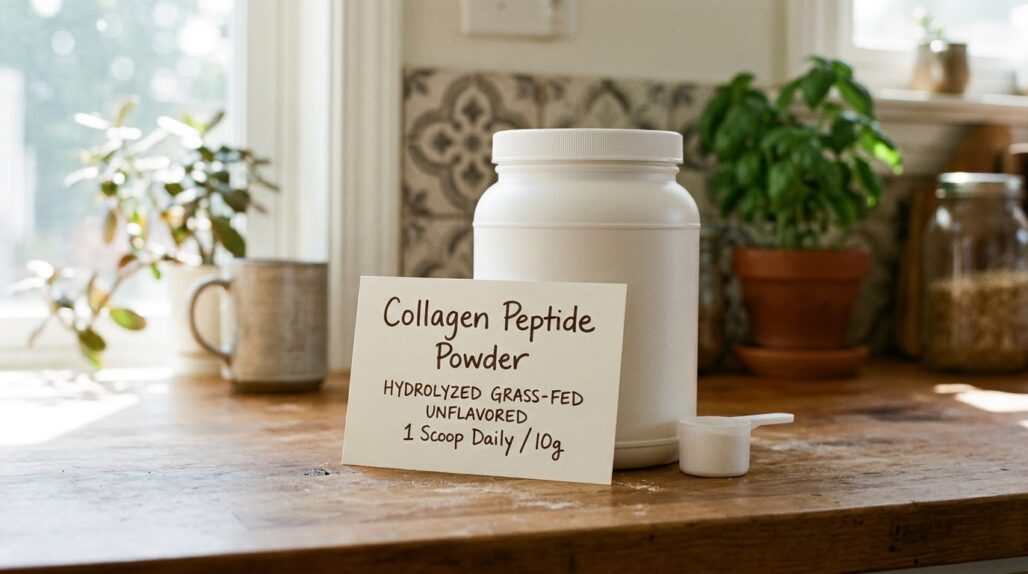
This is the top pick because it has the cleanest trial pointed straight at cellulite. In a randomized, double-blind, placebo-controlled study published in the Journal of Medicinal Food (Schunck and colleagues, 2015), 105 women aged 24 to 50 took either 2.5g of specific collagen peptides or a placebo daily for six months. The collagen group saw a statistically meaningful drop in cellulite scores and about an 8 percent reduction in skin waviness on the thighs, with better results in women at a normal BMI than in those above 25.
Evidence grade: moderate. One good RCT, decent size, a real placebo arm, published in a peer-reviewed journal. The catch is that it is essentially a single trial line on one branded peptide, and the effect was a few percentage points, not a transformation. The likely mechanism is more dermal collagen, which thickens and firms the skin layer sitting over the fat.
Typical dose: 2.5g of bioactive collagen peptides once a day, mixed into water, coffee or a smoothie. Give it three months before you judge it, six to match the trial. Who it suits: anyone willing to take a daily scoop consistently, especially at a normal-to-modest BMI where the trial showed the bigger effect. If you are already taking collagen for skin or joints, you are likely close to this dose. Our complete guide to collagen covers types and absorption, and our roundup of the best collagen peptides lists products that hit the studied form.
2. SOD-rich melon concentrate (Dimpless) – promising but one small, conflicted trial
You will see this sold as SOD B Dimpless or "Cellu" formulas: a dried French melon juice concentrate standardized for superoxide dismutase, an antioxidant enzyme. The pitch is that it eases the fibrosis and oxidative load around the septae.
The data is genuinely the thinnest of the three, so I will not dress it up. The supporting study was a double-blind, placebo-controlled trial of 41 women, run and funded by the ingredient's manufacturer, reported via industry coverage of the SOD B Dimpless trial. At 40mg a day, thigh cellulite measured about 9.5 percent lower at 28 days and 11.3 percent at 56 days, with no useful effect on the stomach.
Evidence grade: weak to preliminary. Small sample, manufacturer-funded, not replicated by an independent group. The percentages look good on a slide, but one conflicted trial of 41 people is a starting point, not proof. Typical dose: 40mg of the standardized melon SOD concentrate daily, the amount used in the study. Who it suits: someone who has the budget, wants to try the newest ingredient with a trial behind it, and goes in with low expectations. If money is tight, this is the one to skip.
3. Gotu kola (Centella asiatica) – good for vein and connective tissue, indirect for cellulite
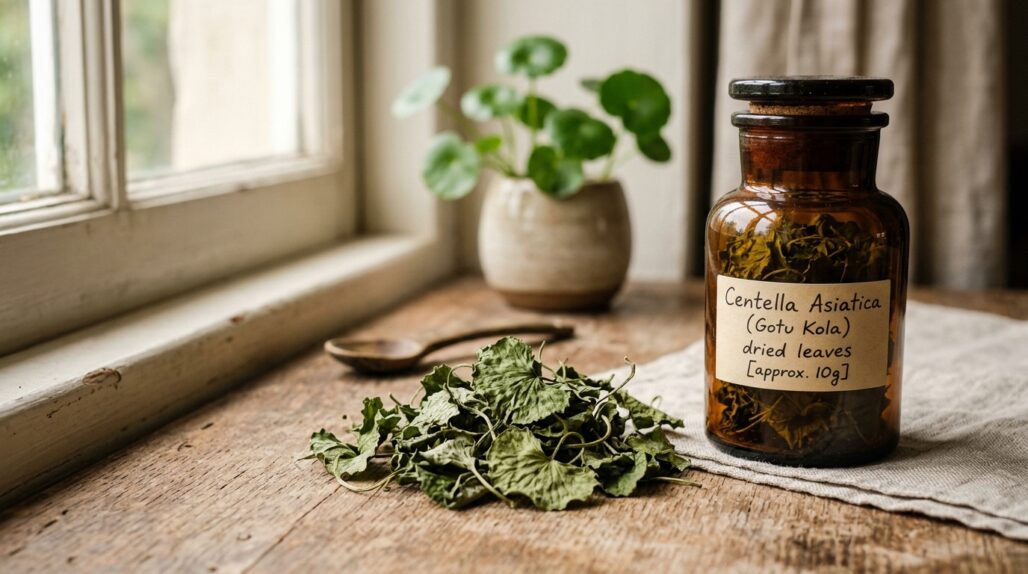
Gotu kola has a long traditional use for skin and circulation, and its triterpenes (asiaticoside and madecassoside) do plausible things: they support collagen and fibroblast activity and help vein and capillary tone. The honest problem is that almost none of the strong research is on cellulite itself.
The best evidence is for chronic venous insufficiency. A systematic review of eight randomized trials (Chong and Aziz, 2013) found Centella improved microcirculation and ankle swelling, though the authors stressed several trials had unclear bias risk and the conclusions need caution. Cellulite has a microcirculation and connective-tissue angle, so this is a reasonable adjacent bet, but you are extrapolating.
Evidence grade: weak for cellulite, moderate for the underlying vein and tissue effects. Typical dose: studies of the triterpenic fraction used roughly 60 to 120mg a day; common standardized extracts land in that range. Who it suits: people who also notice heavy, achy legs or visible surface veins and want one supplement doing double duty. If that is you, our pages on gotu kola for circulation and the best supplements for spider veins are the better fit, since the vein evidence is stronger than the cellulite evidence. Important: skip gotu kola in pregnancy and breastfeeding, and if you have liver issues talk to your doctor first.
| Supplement | Evidence | Typical dose | Best for |
|---|---|---|---|
| Bioactive collagen peptides | Moderate – one good 6-month RCT (n=105) | 2.5g daily for 3 to 6 months | The all-rounder; normal-to-modest BMI |
| SOD-rich melon (Dimpless) | Weak – one small manufacturer-funded trial (n=41) | 40mg standardized SOD daily | Trying the newest option with low expectations |
| Gotu kola (Centella asiatica) | Weak for cellulite; moderate for vein and tissue tone | 60 to 120mg triterpenes daily | Also dealing with heavy legs or surface veins |
The free fix that does more than any pill
Here is the part the single-product brand blogs leave out, because it sells nothing. The most reliable way to soften the look of cellulite is muscle under the skin, not a capsule.
Resistance training for the thighs, hips and glutes (squats, lunges, hip thrusts, step-ups) builds tone that fills out the surface and changes how the dimpling reads. Twice a week is enough to start. It will not delete the septae, but firmer underlying muscle and a steady body composition do visibly more over a few months than most supplements, and the trial on collagen above showed bigger effects in leaner women for a reason.
A few more no-cost moves that genuinely help:
- Hydrate steadily. Better-hydrated skin sits a little plumper and smoother over the fat layer.
- Dry brushing or firm massage gives a short-lived microcirculation bump and a temporary tightening. It is a nice ritual, not a cure, so treat the "results" as the hour or two after, not permanent.
- Keep diet and weight steady rather than chasing crash cycles, which can make skin laxity and dimpling look worse.
If you want the supplement to pull its weight, pair it with this. Collagen plus regular leg training is a far better plan than collagen alone.
What does not work, and the honest ceiling
Topical "cellulite creams" mostly deliver temporary tightening from caffeine or a moisturizing effect, and even prescription-strength retinol takes six-plus months for a small change. Detox teas and "fat-flushing" supplements do nothing for the structural cause. And no oral supplement removes a dimple, because the dimple is a band of connective tissue tethering your skin – only in-office procedures that cut or release those bands (the dermatology route) change that architecture directly.
So the realistic ceiling for everything on this page is a modest, gradual smoothing. If a product promises to "erase" cellulite, that is your cue to close the tab.
When to see a doctor
Cellulite is harmless. The lookalikes are not. See a doctor if you get sudden one-sided leg swelling, or dimpling that comes with pain, warmth, redness or skin changes. That pattern is not cosmetic cellulite and can point to lymphedema, lipedema, or a blood clot, all of which need real assessment rather than a supplement.
Also check in with a clinician before starting these if you are pregnant or breastfeeding (skip gotu kola entirely), if you take blood thinners or have liver disease, or if you are managing a chronic condition. Supplements are not regulated like medicines, and "natural" does not mean risk-free. Never stop or change a prescription to make room for one of these.
FAQ
Can supplements get rid of cellulite completely? No. The dimpling comes from fibrous bands anchoring your skin, and no oral supplement cuts those bands. The best you can realistically expect is a modest smoothing of the surface over several months.
Which supplement has the strongest evidence for cellulite? Bioactive collagen peptides at 2.5g a day. A six-month randomized trial in 105 women found a measurable reduction in cellulite and skin waviness, strongest in women at a normal BMI.
How long before I see anything? Plan on three months minimum and judge it at six, which matches the collagen trial. SOD melon studies ran about eight weeks. Anything faster than that is likely temporary water or massage effect.
Is gotu kola safe to take long term? For most healthy adults short courses are well tolerated, but avoid it in pregnancy and breastfeeding, and with liver problems. Many people cycle it rather than take it indefinitely. Ask your doctor if you take other medications.
Does collagen work better with exercise? The evidence and the mechanism both favor pairing them. Collagen may firm the dermis while resistance training builds the muscle underneath, and the trial’s bigger effect in leaner women hints that body composition matters.
Are cellulite supplements worth the money? If you want a low-risk daily habit and accept a small, slow effect, collagen is a fair bet. If you expect dramatic results, save your money and put the effort into leg training instead.
The bottom line
If you only take one thing from this page: bioactive collagen peptides at 2.5g a day have the best human data for cellulite, and even then the effect is a modest smoothing over months, not removal. Gotu kola and SOD melon are reasonable experiments for the right person, but their cellulite evidence is thin, so go in clear-eyed. The free move – regular resistance training for the legs plus steady hydration – quietly outperforms most of the aisle. And if dimpling ever shows up suddenly on one leg, with swelling or pain, treat that as a medical question, not a cosmetic one.
This article is for general information and is not medical advice. Talk to a qualified clinician before starting any supplement, especially during pregnancy, on blood thinners, or with a health condition.
Reviewed by the UsefulVitamins Editorial Team.
