
If you are searching for a supplement that supports memory and circulation, you have probably seen gotu kola described as everything from "the herb of enlightenment" to a basic vein tonic. The honest answer is somewhere in between: gotu kola has better clinical evidence than most plant-based supplements, particularly for chronic venous insufficiency and mild cognitive complaints, but its cognitive effects are less consistent than bacopa and the human trial database is smaller than its reputation suggests. This article covers what the research actually shows, who is most likely to benefit, how the active compounds work, and the interaction and liver risks that many product listings do not mention. You will also get a plain-language breakdown of what "standardized to triterpenes" means and why it matters more than the brand on the label.
Affiliate disclosure: this article contains affiliate links. As an Amazon Associate, UsefulVitamins.com earns from qualifying purchases at no extra cost to you.
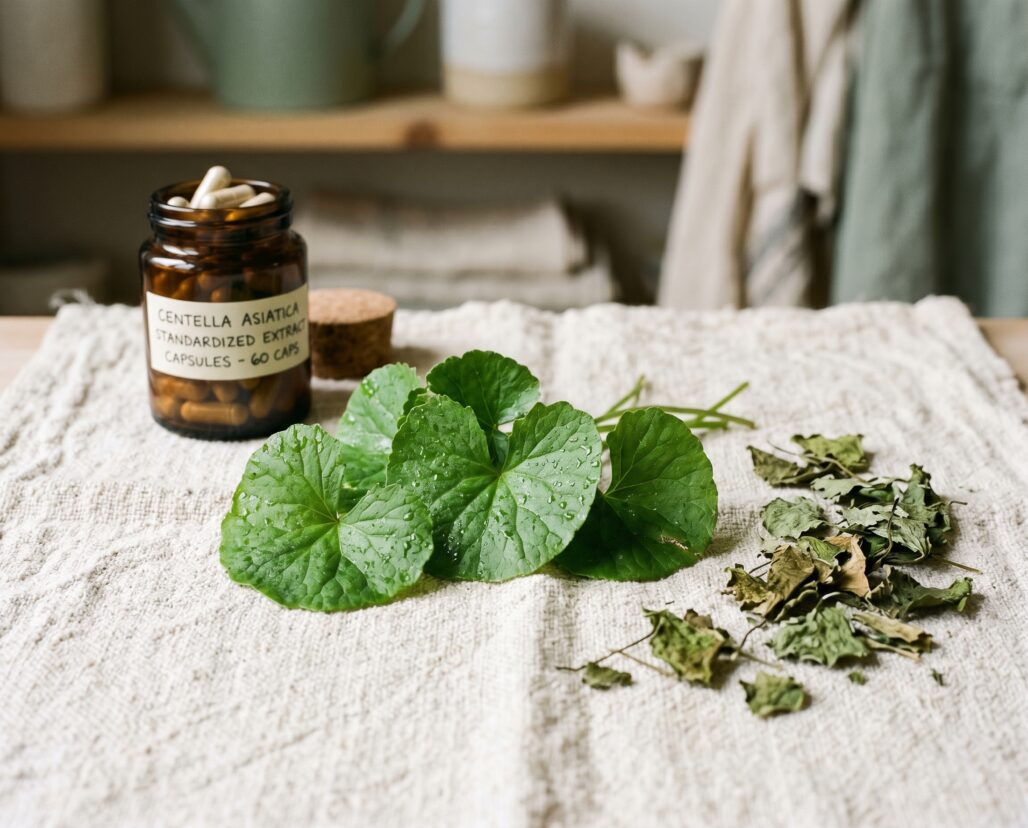
Summary: quick answer on gotu kola
Best for: Adults with chronic venous insufficiency (leg swelling, varicosities), older adults with mild memory complaints, people seeking a low-stimulant cognitive support herb.
Not ideal for: Anyone with a history of liver disease or elevated liver enzymes, people on anxiolytic or sedative medication (additive CNS depression possible), those expecting bacopa-level cognitive effect sizes within the first month.
What to look at before buying: Look for "standardized to 8-10% total triterpenes (asiaticoside + madecassoside)" on the certificate of analysis. A product listing "whole herb" or "herbal powder" without a standardization percentage tells you nothing about active-compound content.
Decision shortcut: If your primary goal is vein health or leg edema, gotu kola has the cleanest evidence base. If your primary goal is memory, bacopa has larger and more replicated cognitive RCTs. If you want both, some formulas combine them, though interaction data for the combination are limited.
What you'll find in this guide
- What gotu kola actually is
- Active compounds and why standardization matters
- What the research actually shows
- Who it is for and who should skip it
- Dosing ranges from clinical trials
- Side effects, drug interactions, and the liver warning
- Product picks
- Frequently asked questions
What gotu kola actually is {#what-gotu-kola-is}
Gotu kola (Centella asiatica) is a small creeping wetland plant native to South and Southeast Asia, common in marshy areas across India, Sri Lanka, Sri Lanka, China, and Indonesia. It belongs to the parsley family (Apiaceae), not the cola or caffeine family. This is worth stating clearly: gotu kola contains no caffeine and has no botanical relationship to kola nut (Cola nitida), which is the caffeine source used historically in cola beverages. Calling it "kola" is a naming coincidence.
In Ayurvedic medicine, Centella asiatica is called mandukaparni and classified as a medhya rasayana (brain-rejuvenating tonic). In Traditional Chinese Medicine it appears as ji xue cao, used to clear heat and resolve toxicity, particularly for skin conditions and wound healing. Traditional use is historical context, not clinical evidence. That said, the traditional indications for cognitive support and wound healing have been the starting point for most of the modern trial research.
The plant grows so densely in some regions of India and Sri Lanka that it is eaten as a salad green or blended into fresh juice. Supplement forms, however, concentrate specific compounds rather than delivering the whole food matrix, which is why standardization labels matter.
Active compounds and why standardization matters {#active-compounds}
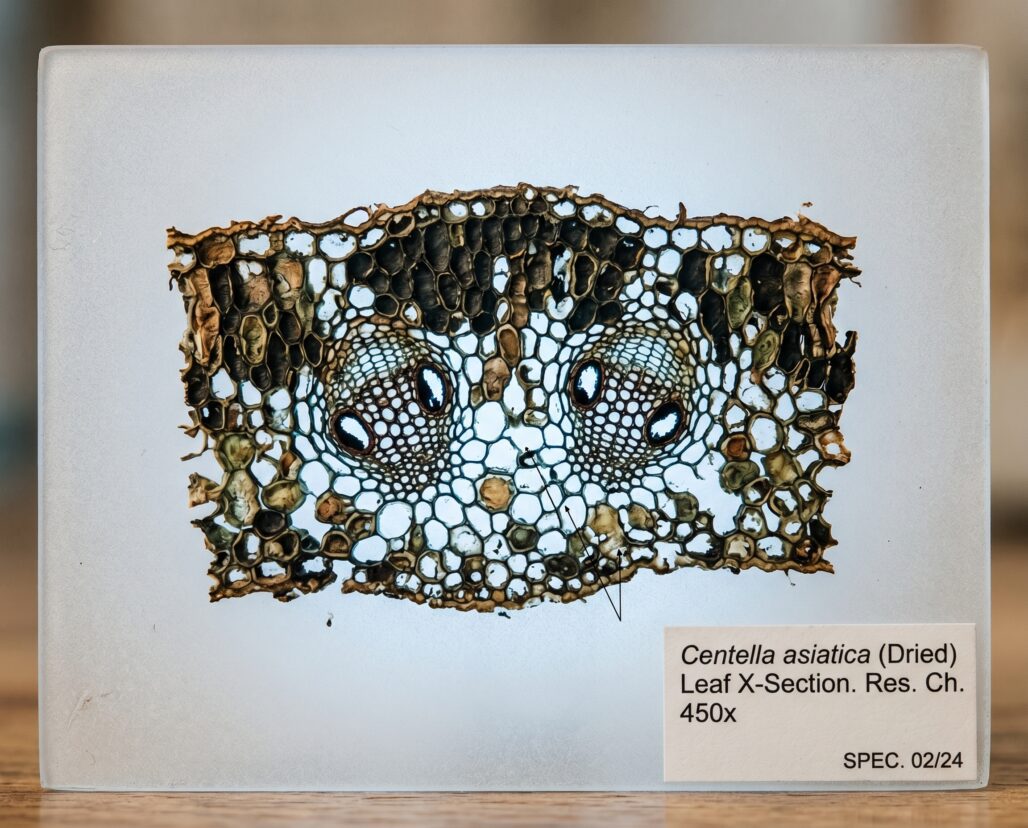
The pharmacologically active components are a family of pentacyclic triterpenes: primarily asiaticoside and madecassoside (glycoside forms), along with their aglycone forms asiatic acid and madecassic acid. Collectively these are referred to as TECA (titrated extract of Centella asiatica) or TTFCA (total triterpenic fraction of Centella asiatica) in older European pharmaceutical literature.
These triterpenes are responsible for the two best-supported mechanisms:
- Collagen synthesis stimulation in vascular walls, relevant to venous insufficiency outcomes.
- Neurotrophic and antioxidant effects in the central nervous system, relevant to cognitive outcomes, studied mainly via BDNF and acetylcholinesterase inhibition pathways in animal models, with modest human confirmation.
Think of asiaticoside as gotu kola's "active load" the same way withanolides are ashwagandha's. A product standardized to 8-10% total triterpenes delivers a known quantity of that active load. "Gotu kola leaf powder" with no standardization disclosure is like buying an olive oil bottle that says "contains olives" without specifying oleic acid percentage. The label tells you what plant is in it, not whether a therapeutic dose is achievable.
Actionable takeaway: When comparing products, request or find the certificate of analysis. Any reputable brand selling a standardized extract can produce one. If the listing only specifies milligrams of "whole herb" without a triterpene percentage, that product has not cleared the most basic transparency threshold.

What the research actually shows {#what-research-shows}
Chronic venous insufficiency: the strongest evidence
Gotu kola's cleanest clinical evidence comes from chronic venous insufficiency (CVI), the condition in which blood pools in the lower legs due to weakened vein walls, causing edema, heaviness, and eventual varicosities.
The Belcaro group, conducting a series of Italian placebo-controlled trials in the 1990s and 2000s, provides the foundational dataset. In a 1994 placebo-controlled trial (Belcaro et al., n=87), TTFCA at 60 mg three times daily for 60 days significantly reduced perimalleolar edema versus placebo, with statistically significant improvement in venoarteriolar reflex flux. A subsequent 2001 RCT (Cesarone et al., n=80) confirmed microcirculation improvement in patients with CVI and diabetic microangiopathy. These are not small pilot studies: the CVI literature includes several independent replications.
A 2013 Cochrane-registered systematic review on Centella asiatica for CVI concluded the evidence was promising but noted heterogeneity in trial populations and TTFCA concentrations, calling for larger standardized trials. As of 2026, no pivotal multi-center RCT has been published to fully settle the question, but among herbal interventions for CVI, gotu kola sits at the top of the evidence tier alongside horse chestnut seed extract.
Cognitive function: promising, less consistent
The cognitive evidence base is smaller and less uniform than the CVI data, and smaller than bacopa's cognitive RCT library.
In a 2016 RCT (Wattanathorn et al., n=28) in older adults with mild cognitive impairment, 500 mg and 750 mg daily doses of Centella asiatica extract showed dose-dependent improvements in working memory and spatial working memory versus placebo at 2 months. Effect sizes were modest: the 750 mg group showed statistically significant improvement on the Spatial Working Memory task versus baseline (p < 0.05), but the placebo group also improved, narrowing the between-group difference.
A 2021 pilot RCT (Doknark et al., n=30) in healthy older adults (60+ years) found that 500 mg/day of standardized Centella asiatica for 90 days improved cognitive composite scores and reduced anxiety on the State-Trait Anxiety Inventory versus placebo. Sample size limits interpretation.
For anxiety specifically, a 2000 human trial (Bradwejn et al., n=40) found that a single 12g dose of gotu kola significantly attenuated acoustic startle response (a physiological anxiety marker) versus placebo. This is an acute-dose design, not a chronic-use trial, but the finding supports the anxiolytic signal seen in animal models.
What the research does not support
The real question is not whether gotu kola works in lab rats, it is whether the human dose proves out. Animal models of Centella show BDNF upregulation and neuroprotection at doses that do not translate directly to human supplement formats. No large RCT (n > 200) has replicated the cognitive findings in a general adult population. The evidence for cognitive support in younger or non-impaired adults is particularly thin.
Traditional use in Ayurveda for "meditation enhancement" or "enlightenment" has no clinical backing. Framing it that way is a marketing decision, not a scientific one.
Actionable takeaway: If cognitive support is your primary goal and you need the strongest available evidence, bacopa (Bacopa monnieri) has a larger body of replicated RCTs. For a head-to-head comparison of these two herbs, including effect size tables and population fit, that article covers both in detail.
Who it is for and who should skip it {#who-its-for}
Strong fit:
- Adults with chronic venous insufficiency, leg edema, or early-stage varicosities looking for a non-prescription adjunct (not replacement for compression therapy or medical care).
- Older adults (60+) with mild memory complaints and no liver history, based on the Wattanathorn and Doknark trial profiles.
- Adults with mild anxiety who prefer a low-stimulant, non-sedating herbal option at doses consistent with the Bradwejn acoustic startle study.
Skip if:
- You have a history of liver disease, elevated ALT/AST, or are on hepatotoxic medications. Rare but documented hepatotoxicity cases have been reported with high-dose, long-term use (see drug interactions section below).
- You take benzodiazepines, barbiturates, zolpidem, or other CNS depressants. Gotu kola has additive sedative effects.
- You are pregnant or breastfeeding. No adequate human safety data exist; animal models suggest it should be avoided in pregnancy.
- You take cholesterol-lowering statins or fibrates. CYP enzyme inhibition reports, discussed below, may affect drug metabolism.
Dosing ranges from clinical trials {#dosing-ranges}
In the Belcaro CVI trials, TTFCA was administered at 60 mg three times daily (total 180 mg/day of standardized triterpene fraction), for 8-12 weeks. This is the best-replicated dose range for venous outcomes.
In the Wattanathorn 2016 cognitive trial, the doses were 500 mg and 750 mg daily of a standardized leaf extract (not TTFCA), representing a much higher total herb dose but with different standardization. Product labels standardized to 10% triterpenes at 500 mg capsule weight deliver approximately 50 mg of total triterpenes per capsule, which is below the Belcaro therapeutic range.
Most of the published cognitive trials used 500-750 mg/day of extract for 8-12 weeks. No clinical trial data support doses above 1,000 mg/day; the safety database thins considerably above that range, and the hepatotoxicity cases involve long-term high-dose use.
Frame this as a range derived from existing trials, not a prescription: the reviewed studies ran 8-12 weeks, with no RCT establishing long-term efficacy or safety beyond that window. If you see no effect at 12 weeks of standardized extract at trial-consistent doses, the herb is unlikely to work for you.
Side effects, drug interactions, and the liver warning {#side-effects-interactions}
Common adverse effects in trials
In the Belcaro CVI trials and Wattanathorn cognitive trial, adverse events were mild and uncommon: nausea, headache, and transient sedation were the most frequently reported. No serious adverse events were reported in these short-term controlled settings.
Drug interactions
Sedatives and anxiolytics (additive CNS depression): Gotu kola has documented sedative properties, supported by the Bradwejn acoustic startle data and animal model pharmacology. Combining it with benzodiazepines (alprazolam, diazepam, lorazepam), barbiturates, zolpidem, or other CNS depressants may produce additive sedation. The NCCIH Centella asiatica page and Memorial Sloan Kettering's integrative herbs database entry for gotu kola both flag this interaction. This is not a theoretical concern.
CYP enzyme interactions (cholesterol medications and others): Centella asiatica extracts have shown CYP3A4 and CYP2C9 inhibitory activity in in vitro studies. Whether this produces clinically significant drug-drug interactions at supplement doses remains unclear; human PK studies are limited. The practical implication: if you are on CYP3A4-metabolized drugs (including many statins, some calcium channel blockers, and certain immunosuppressants), flag gotu kola to your prescriber. The interaction signal exists, even if the magnitude in humans is not fully quantified.
Diuretics: Some traditional formulations used gotu kola for fluid balance; diuretic co-use may theoretically amplify fluid-loss effects.
Liver warning (CRITICAL)
Gotu kola is associated with rare but documented cases of hepatotoxicity. Multiple case reports in the published literature describe elevated liver enzymes (ALT, AST) and, in some instances, jaundice and frank drug-induced liver injury (DILI) in patients taking high-dose, long-term gotu kola preparations. The World Health Organization's monograph on Centella asiatica notes hepatotoxicity as a potential risk, and Memorial Sloan Kettering's database documents case reports of reversible DILI.
This is not a common outcome in short-term, dose-appropriate use, but it is a documented outcome. It elevates gotu kola's risk profile above most adaptogens for anyone with pre-existing liver conditions, alcohol use disorder, or concurrent hepatotoxic medications. Taking gotu kola at high doses for extended periods (beyond 12 weeks) without medical supervision is inadvisable based on the current safety database.
If you notice dark urine, jaundice (yellowing of skin or eyes), or right upper-quadrant abdominal pain while taking gotu kola, stop use and consult a physician promptly.
Pregnancy and breastfeeding
No adequate human trials. Animal models suggest the herb should not be used in pregnancy. Avoid.
Actionable takeaway: Gotu kola has a real interaction and safety profile. An adaptogen brand can have impressive marketing and still omit the hepatotoxicity risk from product copy. Check the MSK integrative herbs database directly before combining with other medications or using long-term.
Product picks {#product-picks}
When comparing gotu kola products, prioritize:
- Standardization disclosure: "Standardized to X% triterpenes (asiaticoside/madecassoside)" visible on the label or certificate of analysis.
- Dose per serving: Cross-reference with the Belcaro trial's 180 mg/day triterpene fraction or the Wattanathorn trial's 500-750 mg extract. Many products under-dose.
- Third-party testing: USP Verified, NSF Certified for Sport, or Informed Sport certification addresses identity and contamination, though not always triterpene potency.
- Form: Alcohol-based tinctures extract triterpenes reasonably well; dried whole-herb capsules without standardization are the weakest delivery.
Standardized to 8-10% total triterpenes is the benchmark marker. "Gotu kola root powder" alone tells you nothing about the dose of active compound you are actually getting.
Frequently asked questions {#faq}
Is gotu kola the same as kola nut or the "nut" in old cola drinks?
No. Gotu kola (Centella asiatica) is a leafy wetland plant in the parsley family. Kola nut (Cola nitida or Cola acuminata) is an entirely different plant from the mallow family (Malvaceae), native to West Africa, and contains caffeine. The naming similarity is coincidental. Gotu kola is caffeine-free.
How long does gotu kola take to work?
The CVI trials showed measurable circulation improvement at 8-12 weeks of daily use. The cognitive trials used 8-12 week durations as well, with the Wattanathorn study showing statistically significant working memory improvement at 2 months. Expecting results in 2-3 weeks is not consistent with the trial timelines.
Can I take gotu kola with bacopa?
No RCTs have tested the combination. Mechanistically, they target overlapping but distinct pathways (triterpene-based for gotu kola, bacoside-based for bacopa). Many nootropic formulas combine them without documented interaction risks, but also without documented synergy evidence. The comparison of lion's mane vs bacopa discusses bacopa's cognitive evidence base separately if you are deciding between the two herbs.
Does gotu kola cause drowsiness?
At doses used in the acoustic startle trial (12g, acute), sedative effects were observed. At the standard supplement doses of 500-750 mg/day, some users report mild relaxation, but clinical trial populations did not show significant sedation at those doses. The practical concern is additive sedation with other CNS depressants, not standalone drowsiness at typical doses.
What is TTFCA vs standardized extract?
TTFCA (total triterpenic fraction of Centella asiatica) is a semi-purified pharmaceutical-grade fraction used in the Belcaro CVI trials. It is dosed in terms of triterpene milligrams directly (e.g., 60 mg TTFCA). Standardized extracts (e.g., "500 mg standardized to 10% triterpenes") deliver 50 mg of triterpenes per capsule, plus the remaining plant matrix. TTFCA is closer to a pharmaceutical product; standardized extracts are the common over-the-counter supplement form.
Is gotu kola safe to take every day long-term?
Short-term (up to 12 weeks) at standard doses, the clinical trial adverse-event profile is mild. Long-term safety data beyond 12 weeks is limited, and the hepatotoxicity case reports are associated with prolonged or high-dose use. Taking periodic breaks (e.g., 12 weeks on, 4-6 weeks off) and monitoring liver enzyme markers with a healthcare provider is the conservative approach for anyone using it for more than 3 months continuously.
Can I take gotu kola if I am on a statin?
Flag it to your prescribing physician first. The CYP3A4 inhibitory signal from in vitro studies means there is a theoretical basis for drug-drug interaction with statins metabolized through that pathway (lovastatin, simvastatin, atorvastatin). Human PK data are insufficient to quantify the real-world risk, which makes pre-emptive disclosure to your prescriber the correct approach, not avoidance or assumption of safety.
Conclusion: the bottom line on gotu kola
Gotu kola has a better evidentiary foundation than many adaptogens in the wellness market, particularly for chronic venous insufficiency, where the Belcaro trial series provides replicable, placebo-controlled data at a specific triterpene dose. Its cognitive benefits are real but modest, less consistent than bacopa's, and most clearly supported in older adults with existing mild impairment rather than in healthy younger populations.
The two caveats that need to sit alongside any product recommendation: first, the liver risk is documented and should not be buried in fine print; second, the standardization gap in the supplement market means the product you buy may deliver a fraction of the triterpene dose used in clinical trials, making the label's milligram count unreliable without a standardization percentage.
Next steps:
- If chronic venous insufficiency is your primary concern, look for a product standardized to 8-10% triterpenes and cross-reference the dose against the Belcaro protocol (180 mg/day of TTFCA equivalent).
- If cognitive support is your primary concern, read our complete guide to adaptogens to compare gotu kola's cognitive evidence tier against bacopa, lion's mane, and ashwagandha.
- If you are on sedative medication, a statin, or have any history of liver issues, bring the MSK integrative herbs database entry to your next prescriber visit before starting.
- For a direct comparison of the cognitive-herb landscape, see Lion's Mane: A Complete Guide to the Nootropic Mushroom and Ashwagandha for Women: Stress, Hormones, and What the Research Shows.
As an Amazon Associate, I earn from qualifying purchases. Product recommendations are based on real reviews and independent research.
Related reading
- The Complete Guide to Adaptogens: What They Are, What the Evidence Shows, and How to Choose
- Lion's Mane vs Bacopa: Two Cognitive Adaptogens, One Honest Comparison
- Lion's Mane: A Complete Guide to the Nootropic Mushroom
- Ashwagandha for Women: Stress, Hormones, and What the Research Shows
This article is for informational purposes and not medical advice. Gotu kola (Centella asiatica) has documented interactions with sedatives, anxiolytics, and CYP3A4-metabolized drugs, and rare but reported cases of hepatotoxicity with high-dose or long-term use. Herbal adaptogens, even traditional ones, can interact with thyroid medication, antidepressants, anticoagulants, immunosuppressants, blood-pressure drugs, and more. Consult a licensed physician before starting gotu kola, particularly if you have a history of liver disease, are on prescription medications, are pregnant, or are nursing.
As an Amazon Associate, I earn from qualifying purchases. Product recommendations are based on real reviews and independent research.
This article is for informational purposes and not medical advice. Herbal adaptogens, even traditional ones, can interact with thyroid medication, antidepressants, anticoagulants, immunosuppressants, blood-pressure drugs, and more. Consult a licensed physician before starting any adaptogen, particularly if you are pregnant, nursing, taking prescription medications, or managing a chronic condition.
