
If you're on Wegovy (or semaglutide generics) and eating plant-based, the short answer is: yes, plant protein powders can fully cover your GLP-1 protein needs, but only if you choose blends, not single-source powders. This guide covers what makes a plant protein work for muscle preservation during caloric restriction, which six products are worth your money, and one you can skip. You'll also get a plain-English explanation of why pea protein alone is not a complete story, and how to tell whether a "premium" brand is earning its price.
Affiliate disclosure: this article contains affiliate links. As an Amazon Associate, UsefulVitamins.com earns from qualifying purchases at no extra cost to you.
TL;DR: Best Plant-Based Protein for Wegovy Users
Top Pick: Garden of Life SPORT Organic Plant Protein — NSF Certified for Sport, complete amino acid profile, 30 g protein per serving. The right call for most Wegovy users who want verified label accuracy.
- Best for: Plant-based GLP-1 users who want third-party verification and leucine content that clears the 2.5 g threshold.
- Not ideal for: Stevia-sensitive readers or people who want an unflavored powder for cooking.
- Decision shortcut: Below 0.8 g protein/kg/day on Wegovy, a powder is a practical fix. Above 1.2 g/kg/day from food alone, you likely don't need one.
Who This Is For (and Who Should Skip It) {#who-its-for}
Strong fit: Adults on semaglutide or tirzepatide eating plant-based who can't reliably hit 0.8-1.2 g protein/kg/day from whole foods. Also: people avoiding whey for lactose or ethical reasons.
Skip if: You're already hitting 100+ g/day from tempeh, legumes, and edamame. Or if you have a soy allergy — several picks use soy lecithin as an emulsifier. These are protein supplements, not meal replacements.
Why Plant Protein Is Harder on GLP-1s (and How to Fix It) {#why-harder}
Wegovy creates a specific nutritional problem: you're eating far less, but your body's need for leucine and essential amino acids doesn't fall with calorie intake. Think of skeletal muscle like a retention pond — it holds steady when protein inflow is consistent, but drains fast when inflow drops. GLP-1 appetite suppression cuts protein intake at exactly the moment muscle catabolism risk is highest.
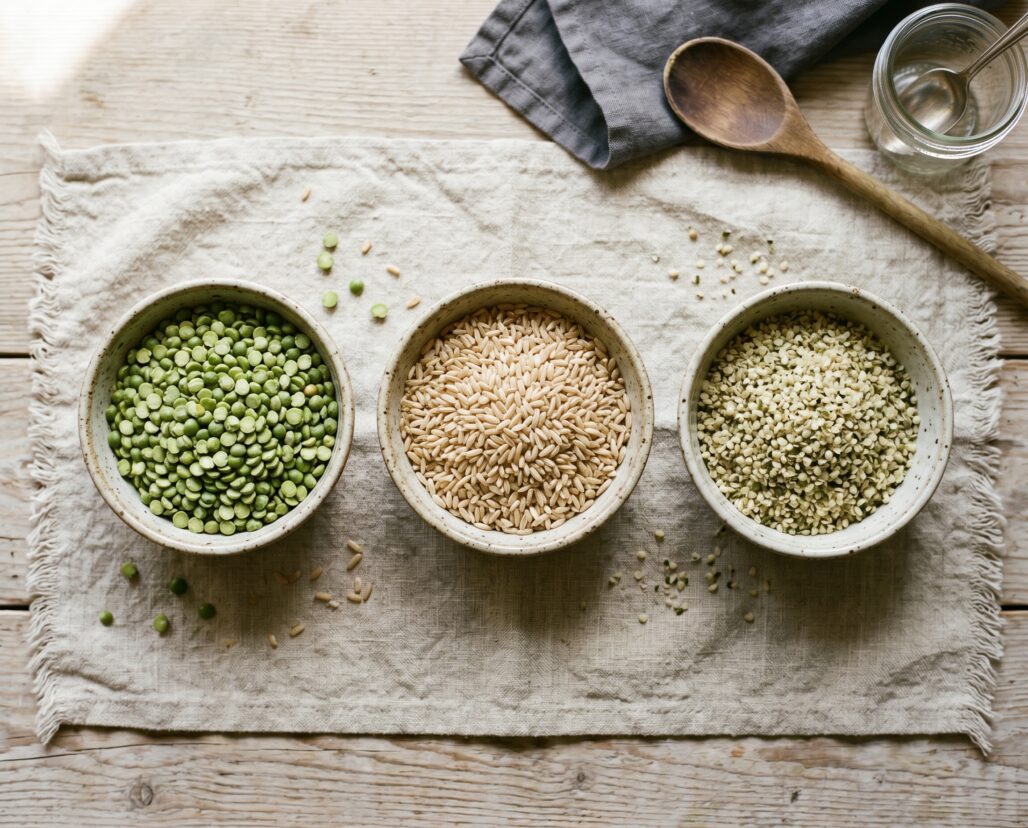
The secondary issue with plant proteins is amino acid completeness. Every protein source gets a DIAAS score (Digestible Indispensable Amino Acid Score) — whey sits near 1.0. Pea protein alone scores around 0.67 on DIAAS, per a 2020 analysis in Nutrients, limiting in methionine. Brown rice is limiting in lysine. Combined in roughly a 70:30 pea-to-rice ratio, the blend scores close to 0.9 — near whey territory. That's why this guide focuses on multi-source blends. Single-source pea powders are fine for general snacking; for muscle preservation during a caloric deficit on a GLP-1, the amino acid gaps matter.
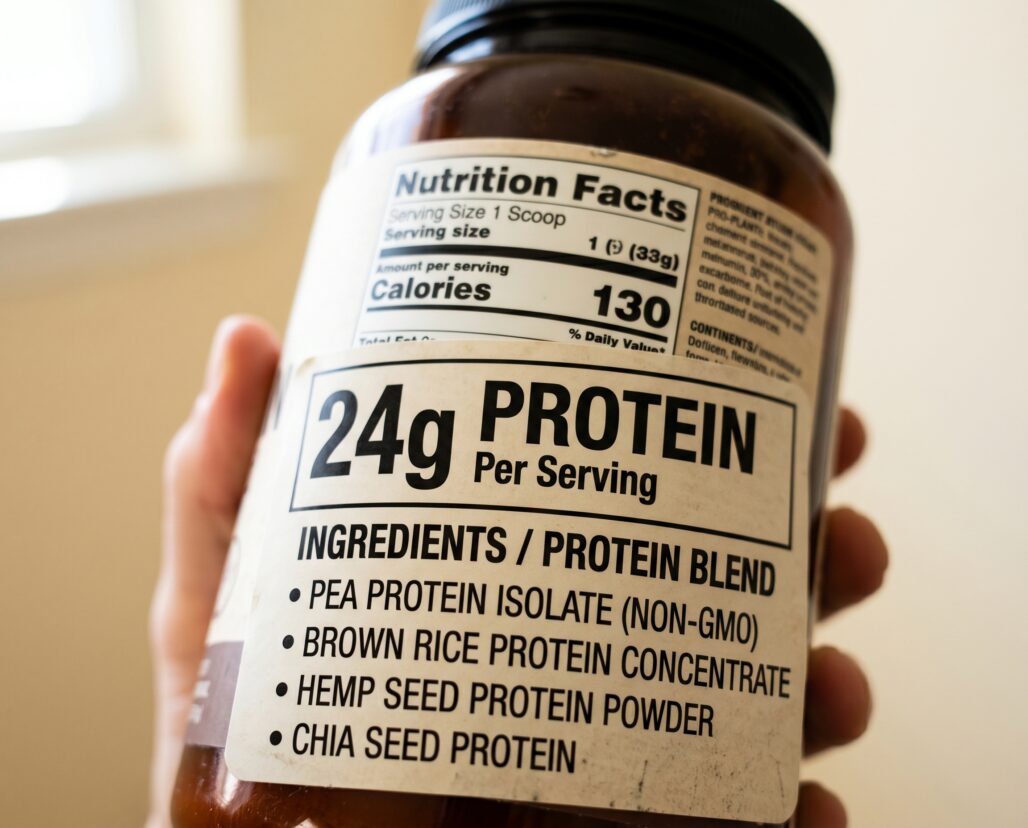
Actionable takeaway: When reading a plant protein label, look for at least two protein sources from this list: pea, brown rice, hemp seed, pumpkin seed, chia. If the label lists only pea protein isolate, that's a signal to keep looking.
How We Picked {#how-we-picked}
We filtered the most-reviewed plant protein powders against five criteria: (1) multi-source blend for a near-complete amino acid profile, (2) at least 25 g protein per serving, (3) leucine at or above 2.5 g, (4) third-party verification from NSF, Informed Sport, or USP, and (5) transparent per-ingredient labeling with no proprietary blends. Cross-referenced ConsumerLab data where available. Ingredient and label analysis is the primary methodology.
Comparison Table {#comparison-table}
| Brand | Source(s) | Protein per serving | Complete amino profile | Cost/serving | Third-party verified | Best for |
|---|---|---|---|---|---|---|
| Garden of Life SPORT | Pea + sprouted grain blend | 30 g | Yes | ~$2.00 | NSF Certified for Sport | Most Wegovy users |
| Vega Sport Premium | Pea + pumpkin + sunflower + alfalfa | 30 g | Yes | ~$2.50 | Informed Sport | Athletes, competitive sport |
| KOS Organic Plant Protein | Pea + flax + quinoa + chia + pumpkin | 20 g | Yes | ~$1.50 | No (USDA Organic) | Budget-conscious, low appetite |
| Orgain Organic Plant Protein | Pea + brown rice + chia | 21 g | Yes | ~$1.20 | No (USDA Organic) | Sensitive stomachs, value shoppers |
| Sunwarrior Warrior Blend | Pea + hemp + goji | 19 g | Partial (goji is low dose) | ~$2.20 | No (self-certified clean) | Raw/minimalist ingredient crowd |
| ALOHA Plant Based Protein | Pea + brown rice + hemp | 18 g | Yes | ~$2.80 | NSF Certified | Clean-label priority buyers |
Our Picks {#our-picks}
Top Pick: Garden of Life SPORT Organic Plant Protein
Sources: Pea protein + sprouted navy bean, lentil, garbanzo, cranberry seed, hemp, chia
Protein per serving: 30 g
Leucine: ~2.7 g per serving (label-disclosed)
Cost per serving: ~$2.00
Third-party verified: NSF Certified for Sport
Why we picked it: NSF Certified for Sport means every batch is tested for 270+ banned substances and confirmed to match the label, dose for dose — which matters when you're on a prescription GLP-1. The multi-source blend hits a near-complete DIAAS profile. At 30 g per scoop it's the highest yield in this roundup, useful when GLP-1 suppression limits total meals.
The trade-off: Flavor leans sweet (stevia), and it clumps in cold water without a blender.
Skip if: You react to stevia or find sprout-based blends earthy.
Actionable takeaway: The pick for most Wegovy users who want verified label accuracy and the highest per-serving protein dose in the plant category.
Premium Choice: Vega Sport Premium Protein
Sources: Pea protein + pumpkin seed + sunflower seed + alfalfa
Protein per serving: 30 g
Leucine: ~2.5 g per serving
Cost per serving: ~$2.50
Third-party verified: Informed Sport
Why we picked it: Vega Sport is the Informed Sport-certified option for anyone in regulated sport or who wants a different testing body than NSF. The four-source blend covers the methionine gap (pumpkin seed) and lysine gap (pea + alfalfa).
The trade-off: At $2.50 per serving, you're paying $0.50 more per scoop than Garden of Life for the same 30 g yield — for Informed Sport certification, not clinical superiority. Both deliver near-complete amino profiles.
Skip if: You're cost-sensitive or already using Garden of Life. Switching certifications alone isn't warranted unless your sport specifically requires Informed Sport.
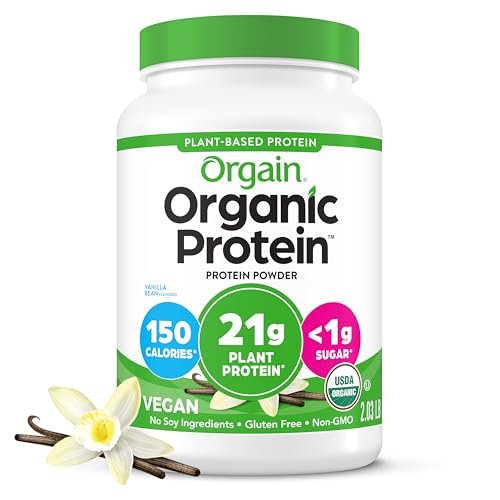
Budget Pick: Orgain Organic Plant Protein
Sources: Pea protein + brown rice protein + chia seed
Protein per serving: 21 g
Leucine: ~2.0 g per serving (estimated from PDCAAS breakdown)
Cost per serving: ~$1.20
Third-party verified: USDA Organic (not NSF/USP)
Why we picked it: Orgain's pea-plus-rice combination delivers a near-complete amino acid profile. At $1.20/serving it's the most accessible option by cost, and it's stocked at Costco and most major grocery chains, which matters for daily habit-building.
The trade-off: No NSF or USP verification — that's the gap you're accepting for the $0.80/serving saving. The 21 g dose puts leucine close to but not clearly above the 2.5 g signaling threshold. For aggressive muscle-preservation goals, this matters.
Skip if: Powder is carrying 40%+ of your daily protein. At 21 g, you'd need two scoops to match the 30 g picks, which removes the budget advantage.
Best for Muscle-Building: KOS Organic Plant Protein
Sources: Pea protein + flaxseed + quinoa + chia seed + pumpkin seed protein
Protein per serving: 20 g
Leucine: ~2.1 g per serving
Cost per serving: ~$1.50
Third-party verified: USDA Organic; no NSF/USP
Why we picked it for muscle-building: KOS's five-source blend covers the broadest amino acid profile in the budget-to-mid tier. Quinoa contributes independently complete protein; pumpkin seed rounds out sulfur amino acids. For someone doing resistance training alongside Wegovy, the coverage depth reduces single-point amino acid deficiency risk more than a straight pea-rice blend.
The trade-off: At 20 g per serving, leucine likely sits just below the 2.5 g threshold. For serious muscle-preservation goals, use 1.5 scoops. USDA Organic covers ingredient sourcing, not contaminant testing.
Skip if: You're not doing resistance training. The five-source premium over Orgain isn't warranted for general satiety support.
Best for Sensitive Stomach: ALOHA Plant Based Protein
Sources: Pea protein + brown rice protein + hemp protein
Protein per serving: 18 g
Leucine: ~2.0 g per serving
Cost per serving: ~$2.80
Third-party verified: NSF Certified
Why we picked it: ALOHA uses a short, transparent ingredient list — no soy lecithin, no gums, minimal additives. For Wegovy users managing nausea or GI sensitivity from the medication, a low-additive powder reduces variables. NSF certification verifies label accuracy.
The trade-off: Eighteen grams per serving is the lowest here, and at $2.80/serving it's the most expensive per gram. You're paying for minimal additives and NSF testing. If your stomach is tolerating GLP-1 side effects well, this premium isn't necessary.
Skip if: GI tolerance is fine and your goal is maximizing protein per dollar. Garden of Life SPORT delivers 12 more grams per serving for $0.80 less.
Also Considered: Sunwarrior Warrior Blend
Sources: Pea protein + hemp protein + goji berry
Protein per serving: 19 g
Cost per serving: ~$2.20
Third-party verified: No independent certification
The pea-hemp combination covers most amino acid gaps. The goji berry inclusion contributes more to marketing narrative than amino acid completeness — goji adds roughly 1-2% of total protein at typical inclusion rates, making "triple-source" technically true but not meaningfully different from pea-hemp. No NSF or Informed Sport certification. Adequate for general use; not our pick for people on a prescription drug who benefit from verified label accuracy.
Brands and Products to Skip {#skip-these}
Skip: Single-Source Pea Protein Isolates
Any product listing only pea protein isolate — no secondary source — should be skipped for Wegovy muscle-preservation. The methionine gap is real, and on a caloric deficit from semaglutide it compounds. You'll see these ranked highly on Amazon because they're cheaper to produce. '#1 Best Seller' is not evidence of amino acid completeness.
Skip: Products with Proprietary Protein Blends
If the label says "Proprietary Protein Blend — 22 g" without per-ingredient gram disclosure, skip it. The structure lets manufacturers list impressive multi-source ingredients while loading the blend with the cheapest source (usually pea) and using trace amounts of the others for label credibility. Without per-source grams, you cannot verify leucine dose or amino acid completeness.
How to Use Plant Protein on Wegovy {#how-to-use}
Timing: Within 30 minutes post-workout on training days. On rest days, spread protein across 2-3 meals rather than a single shake — muscle protein synthesis has a per-meal ceiling.
Leucine and dose: Plant proteins require 28-35 g total protein per serving to reliably clear the ~2.5 g leucine threshold, given lower leucine density than whey. Products under 25 g per scoop should be dosed at 1.5 scoops. If mixing your own pea-plus-rice blend, a 70:30 ratio by weight produces the most complete amino acid profile.
Daily protein target: 0.8-1.2 g/kg/day, per a 2022 position statement from the International Society of Sports Nutrition. GLP-1 appetite suppression can easily cut intake below 60 g/day in the first 3-6 months of dose escalation.
Mixing note: Plant proteins clump in cold water. Ten ounces of oat milk or plant milk in a blender bottle improves texture and adds 2-4 g of protein.
Side Effects and Interactions {#side-effects}
GI effects: Pea protein is generally well-tolerated, but bloating or gas in the first 1-2 weeks is common with higher-fiber blends containing chia or flaxseed. This typically resolves. If it persists, ALOHA's minimal-additive formula is worth trying.
Semaglutide-specific consideration: Wegovy slows gastric emptying. A thick, high-fiber shake can amplify nausea during early dose escalation. Starting with a half-scoop in plant milk (not a full scoop in water) reduces GI load while still delivering 10-15 g of protein.
Drug interactions: No known direct pharmacokinetic interactions between plant protein powders and semaglutide. If a product contains added vitamin K (some greens-enhanced proteins do) and you're also on warfarin, check with a pharmacist before using.
FAQ {#faq}
How much plant protein should I take per day on Wegovy?
Target 0.8-1.2 g of total protein per kg of body weight per day from all sources combined. For most adults, one serving (25-30 g) per day bridges the GLP-1 appetite-suppression gap.
When should I take it?
Post-workout within 30 minutes has the strongest muscle-protein-synthesis signal. On rest days, spreading protein across 2-3 meals matters more than specific timing.
Can I take plant protein with my Wegovy injection?
Yes. No interaction exists between plant protein powders and semaglutide.
How long before I notice muscle preservation effects?
Protein supplementation prevents loss rather than adding visible mass on a caloric deficit. Body composition changes may show on DEXA or tape measurements at 4-12 weeks, not through subjective feeling.
Is a cheap generic pea protein just as good as a $2.50 premium blend?
For single-source pea protein: probably not, because the amino acid gap is the problem. For a pea-plus-rice blend from a generic vs. a named brand, the molecule is the same — the premium buys third-party testing and label accuracy, not a different protein. Orgain at $1.20/serving is a reasonable trade-off for short-term use.
As an Amazon Associate, I earn from qualifying purchases. Product recommendations are based on real reviews and independent research.
Related Reading {#related-reading}
- Supplements for GLP-1 Muscle Loss: What the Evidence Shows — full muscle-preservation evidence base for semaglutide and tirzepatide users
- Peptides for Vegans: Which Options Are Actually Plant-Derived — plant-based bioactive peptides and collagen alternatives
- Best Protein Powder for GLP-1 Users: All Types Compared — whey, casein, collagen, and plant side by side
- Best Greens Powder for Reduced Appetite — pairs naturally with plant protein when total food volume is low
Conclusion: The Bottom Line on Plant Protein for Wegovy {#conclusion}
Plant-based protein works for GLP-1 muscle preservation if you choose a multi-source blend, clear the leucine threshold, and verify the label with third-party testing. Garden of Life SPORT is the most defensible choice. Orgain is right if cost is the binding constraint and you're supplementing whole-food protein rather than replacing it. A single-source pea powder with a "plant-based" badge does not clear the bar — the amino acid gaps are real at the protein doses Wegovy users need.
Next steps:
- Calculate your target: body weight in kg x 0.8 (minimum) and x 1.2 (ceiling)
- Subtract current whole-food protein intake; the gap is what powder covers
- One scoop of Garden of Life SPORT covers 30 g
- For the full muscle-loss evidence base, see Supplements for GLP-1 Muscle Loss
This article is for informational purposes and not medical advice. Supplements — including protein powders — can interact with medications and health conditions. Consult a licensed physician before starting any supplement, particularly if you are pregnant, nursing, taking prescription medications, or managing a chronic condition. Wegovy and semaglutide are prescription medications; protein supplementation strategies should be discussed with the prescribing clinician.
As an Amazon Associate, I earn from qualifying purchases. Product recommendations are based on real reviews and independent research.
