
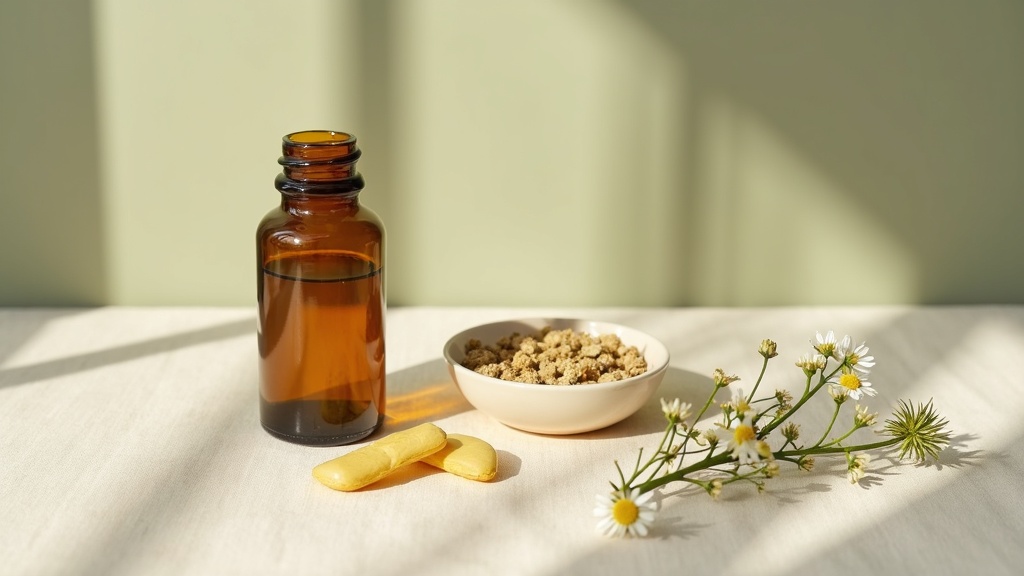
If you searched for apigenin supplement because Andrew Huberman mentioned a 50 mg pre-bed dose on a podcast, you are not alone, and you deserve a straight answer on whether the molecule has the evidence to justify a new bottle on the nightstand.
Before you decide
Who should NOT take apigenin: anyone who is pregnant or trying to conceive (apigenin has measurable estrogenic and antiestrogenic activity, and chamomile is a pregnancy-caution herb), anyone taking a benzodiazepine, Z-drug, or other GABAergic prescription, and anyone on warfarin or another anticoagulant without a clinician's review.
Do this FIRST before adding apigenin: walk through the evening basics that move sleep more than any supplement, which is caffeine cutoff, screen and light hygiene, alcohol after dinner, and a consistent sleep window. If a sleep complaint has lasted more than 3 months and is interfering with daytime function, the door is cognitive behavioral therapy for insomnia (CBT-I), not a flavonoid.
What apigenin actually is
Apigenin is a flavone with the formal name 4',5,7-trihydroxyflavone. It shows up in chamomile (Matricaria chamomilla and Matricaria recutita), parsley, celery, oranges, and a handful of other plants. A standard cup of chamomile tea contains roughly 1 to 2 mg of apigenin depending on the cultivar, brew time, and flower-head ratio. A 50 mg encapsulated dose is a different order of magnitude from the traditional tea exposure, and a 1,500 mg standardized chamomile extract at 1.2 percent apigenin delivers about 18 mg of apigenin alongside the rest of the plant matrix.
Mechanistically, the molecule is interesting for three pathways the supplement marketing leans on. First, Avallone and colleagues showed in 1996 that apigenin binds the benzodiazepine site of the GABA-A receptor in rat brain membranes and produces mild anxiolytic and sedative effects in rodents. The binding is real, the affinity is in the micromolar range, and the in vivo effect at oral doses is far weaker than a clinical benzodiazepine. Second, the Salehi 2019 review catalogues apigenin's downregulation of COX-2 and iNOS, which is the anti-inflammatory case. Third, the same review discusses mTOR modulation and effects on cellular senescence markers, which is where the longevity framing comes from.
Mechanistically, apigenin downregulates pro-inflammatory cytokine signaling and binds the benzodiazepine site of the GABA-A receptor. Both are coherent stories for someone who feels wired at bedtime. Whether that translates to a clinical sleep effect at 50 mg of isolated apigenin in humans is a separate question, and the answer in the current literature is that we do not have the trial to know.
Where the sleep marketing came from

The popular 50 mg apigenin sleep stack traces to Andrew Huberman's public protocol discussions on the Huberman Lab podcast, where apigenin appears alongside magnesium L-threonate and theanine as a pre-bed combination. Momentous, a brand Huberman partners with, sells a 50 mg isolated apigenin capsule. Pure Encapsulations and a few other practitioner-channel brands now offer isolated apigenin, and the Amazon listings have multiplied accordingly.
The 50 mg dose is an extrapolation from chamomile dosing rather than a tested protocol. There is no published randomized controlled trial of 50 mg isolated apigenin for sleep onset, sleep maintenance, or any validated sleep outcome in adults. That is not damning on its own, since many supplement doses live in this evidence gap, but it is the right context for a reader deciding whether to commit to a months-long habit.
A supplement built on a podcast extrapolation can still be useful. It can also be a placeholder for a real intervention. The real question isn't whether apigenin "works" in a generic sense, it's whether the 50 mg isolated dose moves the needle on your specific sleep complaint, and that is currently an n-of-one experiment, not an evidence-backed protocol.
The actual chamomile trials
The cleanest human data on the apigenin-containing plant matrix is in chamomile extract for generalized anxiety, not sleep, and the doses are much higher than the isolated apigenin supplements on the market.
The Amsterdam 2009 RCT randomized 57 adults with mild to moderate generalized anxiety disorder to 8 weeks of standardized chamomile extract (1.2 percent apigenin) titrated from 220 mg to 1,100 mg daily, versus placebo. The chamomile arm showed a clinically meaningful reduction in Hamilton Anxiety scores, and the trial is a foundational piece of the chamomile anxiety literature. The Mao 2016 long-term RCT extended the work to 179 adults with GAD on 1,500 mg per day for 38 weeks. It found that chamomile reduced moderate-to-severe GAD symptoms with a favorable safety profile, though it did not reduce relapse rate versus placebo in the maintenance phase.
For sleep specifically, the Zick 2011 pilot gave 270 mg of chamomile extract twice daily for 4 weeks to 34 adults with chronic primary insomnia. The trial found modest, non-significant trends toward improved daytime functioning and sleep diary outcomes, but no statistically clean sleep effect. The author's honest takeaway was that the dose, duration, or sample size may have been inadequate, and that a larger trial was needed. That larger trial has not yet been published.
Traditional Ayurvedic and European herbalism dosing of chamomile uses 1 to 4 grams of dried flower per cup of tea, 2 to 4 cups per day, with the evening cup the one most often pointed at sleep. Modern RCTs use 220 to 1,500 mg of a 1.2 percent-apigenin standardized extract. The 50 mg isolated apigenin capsule is a third intervention that has not been studied in either traditional or trial frames. These are not the same intervention, and reading them as interchangeable is the most common mistake I see in podcast-driven supplement protocols.
Bioavailability and form
Apigenin is poorly water-soluble, and the Tang 2017 pharmacokinetics review describes oral bioavailability as low, with most absorbed apigenin rapidly conjugated to glucuronide and sulfate metabolites in the gut wall and liver. Plasma apigenin concentrations after a normal oral dose are in the low nanomolar range, which is well below the micromolar concentrations needed to engage the GABA-A binding described in the Avallone work.
Two practical implications. First, an isolated 50 mg apigenin capsule taken alone is unlikely to reach pharmacologically meaningful concentrations in the central nervous system. Second, the matrix of the whole chamomile extract (other flavonoids, sesquiterpenes, and the slightly buffered pH of the infusion) may help apigenin's effective exposure in a way the isolated capsule cannot replicate. This is a hypothesis, not a settled finding, but it is consistent with why the chamomile-extract trials show signal where the isolated-molecule literature does not.
Liposomal apigenin and piperine-enhanced formulations have started to appear and may improve absorption on paper. None of these enhanced forms have been tested in a randomized sleep trial. If you experiment, set the expectation that you are running a personal pilot, not following a tested protocol.
What to look for if you do buy apigenin
If you decide a 4-week trial is worth your time and money, the buying criteria are straightforward.
- Identity disclosure. The label should specify "apigenin" with the milligram dose per capsule, ideally with source plant (most are extracted from parsley). Avoid products that hide apigenin inside a proprietary "sleep complex."
- Third-party testing or COA on request. Isolated apigenin is a relatively new retail category, and quality testing is inconsistent. Practitioner-channel brands (Pure Encapsulations Apigenin, Designs for Health) and brands with Certificates of Analysis on request (Momentous) are a cleaner starting point than generic Amazon listings.
- Skip the bundled stacks unless you understand the math. A "sleep blend" with 50 mg apigenin plus 100 mg magnesium plus 200 mg L-theanine plus 0.5 mg melatonin is making four interventions at once, which makes it impossible to know what is working and what is doing nothing.
- Reasonable price per dose. Isolated apigenin at 50 mg runs roughly 25 to 60 cents per dose at fair retail. Standardized chamomile extract at 1,500 mg per day runs about 30 to 50 cents per day, and is the better-evidenced version of the same plant.
Actionable takeaway: if your goal is honest evaluation, do not stack apigenin with melatonin, magnesium, or theanine for the first 4 weeks. A clean single-variable trial tells you whether the molecule itself is doing anything for your sleep. Bundled stacks tell you only that something in the bundle is helping or nothing in the bundle is.
When apigenin is the wrong tool
If sleep is short, restless, or anxious for more than 3 months, occurs at least 3 nights a week, and interferes with daytime function, that is chronic insomnia disorder, and the AASM 2021 guideline names cognitive behavioral therapy for insomnia (CBT-I) as first-line treatment. CBT-I outperforms every supplement currently on the US market for chronic insomnia outcomes at 6 and 12 months. A flavonoid extracted from chamomile is not in that category.
Other refer-out signals worth naming. New-onset anxious arousal at bedtime with palpitations, weight loss, and heat intolerance is a thyroid workup, not a supplement. Loud snoring with witnessed pauses in breathing is a sleep study. Persistent low mood and early-morning waking for more than 2 weeks is a depression screen. Severe distressing anxiety that limits work or relationships is a conversation with a clinician about combined therapy and, if indicated, a guideline-recommended medication, with botanicals as a possible adjunct second.
For the population that has tried the basics, knows their sleep complaint is mild and stress-flavored, and wants to add one botanical for a defined window, apigenin or, more defensibly, standardized chamomile extract is a reasonable experiment. It is not a treatment for insomnia.
Safety and interactions
The pregnancy issue is the one most readers do not see flagged. Apigenin has measurable estrogenic and antiestrogenic activity in cell and animal models, and the Memorial Sloan Kettering About Herbs chamomile entry and the Drugs.com chamomile monograph both flag chamomile as a pregnancy-caution herb with case reports of uterine contractions and a theoretical concern for estrogen-sensitive conditions. Anyone who is pregnant, trying to conceive, nursing, or living with an estrogen-sensitive condition should consult their OBGYN before any apigenin or chamomile product. This is not a hedge, it is the standard naturopathic caution.
Drug interactions worth knowing. Apigenin and chamomile may potentiate benzodiazepines, Z-drugs, and other GABAergic medications through additive activity at the GABA-A receptor, per the Memorial Sloan Kettering entry, which is grounds for clinician review before stacking with prescription sleep medication. Chamomile has documented anticoagulant interactions with warfarin in case reports, per the Drugs.com monograph, and apigenin is a documented in vitro inhibitor of several CYP450 enzymes (notably CYP3A4 and CYP1A2), which is a theoretical concern for any reader on a CYP3A4-metabolized medication such as certain statins, calcium channel blockers, or immunosuppressants.
If you are on a prescription medication and want to add apigenin, that decision belongs in a conversation with the clinician who prescribes the medication, not on a podcast comments thread.
FAQ
Does apigenin help you sleep?
There are no published randomized controlled trials of isolated apigenin at the popular 50 mg dose for sleep outcomes. The mechanistic case (GABA-A benzodiazepine-site binding shown by Avallone 1996) is real, and chamomile extract has a small pilot for insomnia (Zick 2011) that did not reach statistical significance. The honest framing is mechanism-plausible adjunct for pre-sleep anxious arousal, with the evidence base built on chamomile extract, not the isolated molecule.
Is apigenin safe to take every night?
For most adults without the contraindications listed above (pregnancy, GABAergic prescriptions, anticoagulants, CYP3A4-metabolized medications), short trials of apigenin at the marketed 50 mg dose have not produced serious safety signals in the limited published data. Long-term daily use has not been studied. A defined 4-week trial with a clear stop-decision is a more honest pattern than indefinite nightly use.
How much apigenin is in a cup of chamomile tea?
Roughly 1 to 2 mg per cup, depending on cultivar, brew time, and flower-head ratio. A traditional 2 to 3 cup evening intake delivers 2 to 6 mg of apigenin in a complex plant matrix. The 50 mg isolated capsule is a different intervention, and the 1,500 mg standardized chamomile extract trials deliver about 18 mg of apigenin plus the rest of the chamomile compound profile.
What is the best brand of apigenin?
Apigenin is a young retail category and brand quality is inconsistent. Practitioner-channel options with Certificates of Analysis available on request (Pure Encapsulations Apigenin, Momentous, Designs for Health) are a defensible starting point. Generic Amazon listings without a COA are not worth the savings. None of these brands have published independent third-party assays through ConsumerLab as of this writing.
Can I take apigenin with melatonin or magnesium?
Pharmacologically the three are not contraindicated for short trials in healthy adults, and several podcast-popularized stacks combine them. The practical problem is that a stack obscures which ingredient is doing anything. If you want to know whether apigenin earns its spot in your evening, run it alone for 4 weeks before adding the others.
Conclusion: the bottom line on apigenin
Apigenin is a real flavonoid with a coherent GABA-A mechanism and a small but credible chamomile-extract literature for anxiety, and it has essentially zero direct human RCT evidence at the 50 mg isolated dose that the supplement market has settled on. The popular pre-bed protocol is a podcast extrapolation from chamomile dosing, not a tested intervention. For a reader with mild, stress-flavored, pre-sleep anxious arousal who has already handled the evening basics, a 4-week trial of either standardized chamomile extract at 1,100 to 1,500 mg per day or isolated apigenin at the marketed 50 mg dose is a defensible experiment. It is not a treatment for diagnosed insomnia, it is not safe in pregnancy without clinician review, and it should not be stacked with prescription GABAergic medication or anticoagulants without one.
Food and tea first: a couple of cups of well-brewed chamomile tea in the evening is the lowest-cost, longest-history version of this intervention and the one with the most coherent traditional framing, even if the apigenin dose is small.
Next steps:
- If you choose to trial apigenin, run a 4-week single-variable experiment at 50 mg about 60 minutes before bed, with no other new supplements introduced in that window.
- For the methodology behind how we rank botanical supplements, see how we review supplements.
- If sleep is the actual question, the chamomile evidence base for sleep specifically is summarized in chamomile for sleep, what the evidence shows, and the broader Huberman-style stack is dissected in best supplements from the Huberman Lab protocols.
For more on the botanical-and-naturopathic side of UV's coverage, see the Jonathan Reynolds author page.
This article is for informational purposes and not medical advice. Apigenin and chamomile may interact with benzodiazepines, Z-drugs, anticoagulants such as warfarin, and CYP3A4-metabolized medications, and chamomile is a pregnancy-caution herb with documented estrogenic activity. Consult a licensed clinician before starting any supplement, particularly if you are pregnant, nursing, trying to conceive, taking prescription medications, or managing a chronic condition.
Reviewed by Jonathan Reynolds, ND, focused on botanical and naturopathic protocols.
