
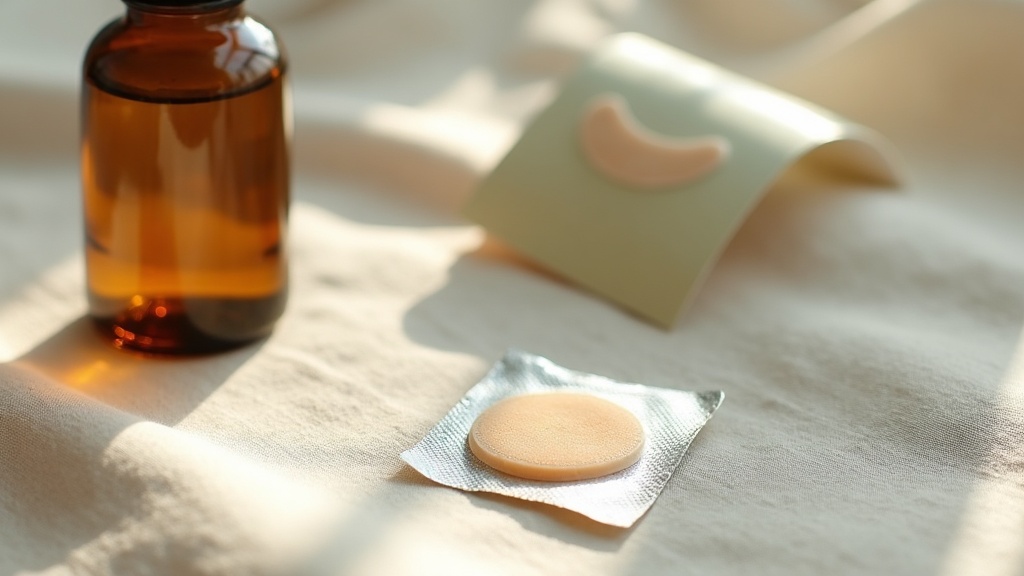
If you typed do vitamin patches work into Google, you probably just scrolled past a TikTok ad for a sticker-sized patch promising to deliver B12, a multivitamin, or a "hangover defense" complex straight through your skin and skip your gut entirely.
Before you decide
For confirmed B12 deficiency, pernicious anemia, or a malabsorption syndrome (post-bariatric surgery, Crohn's, celiac, long-term metformin or PPI use), the conversation is with your primary-care clinician for confirmatory labs and an evidence-backed treatment plan, not with a sticker on a wellness brand's checkout page.
The Claim
The commercial claim across the vitamin-patch category is consistent. Your gut "destroys" oral vitamins, oral absorption is "only" 10 to 20 percent, and a transdermal patch worn for 8 to 24 hours delivers 90 percent or more of its labeled dose straight into your bloodstream by bypassing the digestive tract. Common claims include B12 patches for energy, multivitamin patches as a daily pill replacement, vitamin D3 patches for sun-deprived adults, "hangover defense" patches, weight-loss patches, melatonin sleep patches, and menstrual-support patches. The format is usually a small round adhesive that looks medical, sold in monthly subscription kits at $20 to $60 per box.
The honest read on that claim has three problems. First, "90 percent bioavailability" is almost never tied to a published, peer-reviewed bioavailability study against an oral comparator with actual serum and urine measurements over time. Second, the "your gut destroys oral vitamins" framing misrepresents the real oral pharmacokinetics, which are well-mapped for B12, D3, and most micronutrients and are perfectly adequate for repletion in the large majority of users. Third, the patches are typically built on adhesive technology, not formulation science. They do not contain the permeation enhancers, lipid carriers, microneedle arrays, or iontophoretic current that real transdermal drug-delivery systems use to push molecules across the skin. They are a sticker with vitamin powder under it.
The Evidence

Here is what the actual skin physiology and the actual literature say.
Your skin's outer layer, the stratum corneum, is a 10-to-40-micrometer-thick wall of dead, flattened corneocytes embedded in a multilayer lipid bilayer of ceramides, cholesterol, and free fatty acids. That lipid bilayer is the rate-limiting barrier for any molecule trying to enter the bloodstream from a topical product. The transport rules for crossing it have been characterized for decades in the pharmaceutical-formulation literature.
The most widely cited summary is the "500 Dalton rule" from Bos and Meinardi 2000: for a molecule to cross intact stratum corneum at clinically meaningful rates, it generally needs a molecular weight under about 500 daltons and a moderate-to-high lipophilicity (log P in roughly the 1-to-3 range). Above 500 daltons, passive permeation drops sharply. Hydrophilic molecules also struggle because the lipid bilayer is not their preferred environment. Reviews of transdermal drug delivery by Prausnitz and Langer 2008, and by Alkilani and colleagues 2015, reach the same conclusion and note that successful FDA-approved transdermal products all fall well inside those constraints.
Plot the common patch ingredients against those rules and the category falls apart.
Vitamin B12 (cyanocobalamin) is roughly 1,355 daltons. That is nearly three times the soft cutoff for passive transdermal permeation, and the molecule is hydrophilic, water-soluble, and has a complex cobalt-centered corrin ring. Mechanistically there is no realistic pathway by which a passive adhesive patch delivers meaningful B12 across intact stratum corneum into the systemic circulation. Methylcobalamin is in the same molecular-weight range and faces the same problem.
Most B-complex vitamins are small but water-soluble. Thiamine, riboflavin, niacin, pyridoxine, folate, and pantothenic acid are all hydrophilic, which makes them poor candidates for passive transdermal absorption even at low molecular weights. They cross the lipid bilayer slowly at best.
Vitamin C (ascorbic acid) is 176 daltons, which is small, but it is highly hydrophilic and unstable. Topical vitamin C in cosmetic serums has measurable epidermal effects on local skin, which is a different question from systemic absorption sufficient to replete a deficient adult.
Vitamin D3 (cholecalciferol) is 384 daltons and lipophilic. On paper that is the most plausible candidate in the consumer vitamin-patch category. However, there is no published randomized comparator trial showing that a commercial D3 patch produces equivalent rises in serum 25-hydroxyvitamin D to a standard oral D3 dose at the labeled IU. Oral D3 is exhaustively characterized in the literature (see Holick 2014 and many others), inexpensive, and reliable, which is the comparator a patch would need to beat to earn shelf space.
Fat-soluble multivitamins combine these problems. Even where one component is plausibly transdermal, the rest of the formulation is not, and the patch is marketed as a single replacement.
Compare that against the molecules that actually work in FDA-approved transdermal patches. Nicotine is 162 daltons and lipophilic. Nitroglycerin is 227 daltons and lipophilic. Estradiol is 272 daltons and lipophilic. Scopolamine is 303 daltons and lipophilic. Fentanyl is 337 daltons and lipophilic. All of them sit well inside the 500-dalton soft cutoff, all of them have favorable log P values, and all of them were formulated with engineered adhesive matrices, permeation enhancers, and rate-controlling membranes, then validated in pharmacokinetic studies that the FDA reviewed against an oral or injectable comparator before approval. None of those characteristics describes a consumer vitamin patch.
There are real research-stage technologies that try to push larger or hydrophilic molecules across skin, including microneedle arrays, iontophoresis, sonophoresis, and electroporation, summarized in reviews like Sharma and colleagues 2012. Some of these are promising for insulin, vaccines, and peptide drugs. None of the consumer vitamin patches sold on Instagram or in subscription boxes uses these technologies. They are passive adhesives with vitamin powder under them.
The category also has a regulatory shadow. The Federal Trade Commission has taken enforcement action repeatedly against transdermal vitamin and weight-loss patch marketers for unsupported absorption and efficacy claims, including prior cases against diet-patch sellers and a high-profile multi-million-dollar settlement against the Le-Vel Thrive marketers over their transdermal "DFT" patch claims. When a category triggers repeat FTC settlements, the pattern is itself evidence.
Actionable takeaway: if a patch label claims 90 percent bioavailability without citing a published, peer-reviewed comparator pharmacokinetic study against an oral or sublingual reference, the number is marketing. Ask for the trial. The companies almost never have one.
The Verdict
Your skin is not a substitute for your digestive tract. It is a highly selective lipid barrier with well-characterized rules for what crosses it, and those rules rule out most of the molecules in the consumer vitamin-patch category before the clinical question is even asked. The patches that work in real medicine (nicotine, nitroglycerin, estradiol, testosterone, scopolamine, fentanyl) work because they deliver small, lipophilic molecules through engineered formulations validated in pharmacokinetic studies. The patches sold as vitamin replacements are usually passive adhesives with hydrophilic or oversized molecules under them, no permeation enhancer, no microneedle array, and no published bioavailability comparator. The visible "effect" people report is almost always a combination of the placebo of doing something, the suggestion of the price tag, and the same daily-ritual benefit any visible health behavior produces.
The legitimate uses of true transdermal delivery are all prescription, all engineered, and all narrow. Hormone replacement therapy patches are real. Nicotine cessation patches are real. Scopolamine for motion sickness is real. Fentanyl for chronic severe pain is real. None of those is a wellness sticker, none is the patch on the shelf at a smoothie bar, and none of them is a vitamin.
If a product sticks to your skin, has no published comparator pharmacokinetic study, and is sold on Instagram with a discount code, default to no.
What Works Instead
If the underlying complaint is "I want reliable B12, D3, or general micronutrient coverage and I don't love swallowing pills," the interventions with actual evidence are unglamorous and inexpensive. They also actually deliver what their labels say.
Sublingual B12 for general supplementation. Sublingual cyanocobalamin or methylcobalamin tablets dissolve under the tongue and absorb through the oral mucosa, which is a real, validated route for B12. For repletion in most adults, sublingual and oral B12 are comparable in trial data, and the Cochrane review on oral versus intramuscular B12 by Wang and colleagues 2018 found oral cyanocobalamin at 1,000 micrograms daily comparable to intramuscular injection for raising serum B12 in deficient adults.
Oral cyanocobalamin or methylcobalamin tablets. A daily oral dose of 500 to 1,000 micrograms is well-validated for most adults, including older adults with reduced gastric acid, per Andres and colleagues 2005 and the Kuzminski 1998 trial on oral cobalamin in deficient adults. Pernicious anemia is a separate clinical case and belongs with a clinician.
Intramuscular B12 injection for confirmed deficiency or malabsorption. For pernicious anemia, severe deficiency with neurological symptoms, or documented absorption disorders, IM cyanocobalamin or methylcobalamin under a clinician's care remains the most reliable route. This is what your primary-care doctor can prescribe and is decisively not a $30 patch.
Oral vitamin D3 (cholecalciferol). Inexpensive, exhaustively studied, well-absorbed, and reliable. A daily 1,000 to 2,000 IU dose is a reasonable adult maintenance range for most people, with higher doses tied to confirmed deficiency on a 25-hydroxyvitamin D lab. For a full breakdown see the complete guide to vitamin D.
A varied food-first diet. Animal protein, eggs, dairy, fortified plant milks, leafy greens, legumes, whole grains, fruit, nuts, and seeds cover the large majority of micronutrient needs in a healthy adult. A daily multivitamin in pill form is a reasonable insurance policy for known gaps. Read the dose per serving, not the marketing.
A clinician for symptom evaluation. If the underlying search is "I'm exhausted and want B12," the real first step is a basic lab panel (CBC, ferritin, TSH, B12, 25-hydroxyvitamin D, and possibly methylmalonic acid for borderline B12). Treating an unknown deficiency with a patch is a stack of guesses; treating a confirmed deficiency with an evidence-backed route is medicine.
For a related debunker on the topical-magnesium category, where the same skin-permeation physics largely applies, see is magnesium spray effective. For the methodology behind how UV evaluates each of these claims, see how we review supplements.
FAQ
Do vitamin patches actually work?
As a class, no. There is no published peer-reviewed bioavailability evidence that consumer multivitamin or B12 patches deliver their labeled dose into the systemic circulation, and the basic skin-permeation rules summarized by Bos and Meinardi 2000 rule out most of the molecules in the category. Nicotine, hormone, and scopolamine patches work because they are small, lipophilic, and engineered. Vitamins are not.
What about B12 patches specifically?
Vitamin B12 is roughly 1,355 daltons and water-soluble, well outside the soft cutoff for passive transdermal absorption. For B12, sublingual tablets, oral cyanocobalamin at 500 to 1,000 micrograms daily, or an intramuscular injection from a clinician are the validated routes per the Cochrane review by Wang 2018 and the Andres 2005 paper.
Are vitamin D3 patches different?
Vitamin D3 is small enough and lipophilic enough to be a more plausible transdermal candidate on paper. In practice, there is no published comparator pharmacokinetic trial showing that a commercial D3 patch matches a standard oral D3 dose for raising 25-hydroxyvitamin D. Oral D3 is the validated, inexpensive, reliable choice.
Why do some patches work, like nicotine or hormone patches?
Those drug molecules are small (under 350 daltons) and lipophilic, the patches are engineered with permeation enhancers and rate-controlling membranes, and they were validated in pharmacokinetic studies that the FDA reviewed. Vitamin patches share none of those features.
Could there ever be a real vitamin patch?
With microneedle, iontophoretic, or other active-delivery technology, larger and hydrophilic molecules might one day cross skin in measurable amounts, and some research-stage products exist. Today's passive adhesive vitamin patches are not that technology.
Conclusion: the bottom line on whether vitamin patches work
The consumer vitamin-patch category is, as a class, marketing built on a misread of skin permeation. There is no published, peer-reviewed bioavailability evidence that commercial B12, multivitamin, or "hangover defense" patches deliver their labeled doses into the systemic circulation, and the basic 500-dalton-and-lipophilic rule for passive transdermal absorption rules out most of the headlined ingredients. The real transdermal medications that do work (nicotine, nitroglycerin, estradiol, testosterone, scopolamine, fentanyl) are small, lipophilic, and engineered. Vitamin patches are none of those.
If your underlying goal is reliable B12, D3, or general micronutrient coverage, the evidence-backed moves are sublingual or oral B12, an intramuscular B12 injection from a clinician for true deficiency or pernicious anemia, oral vitamin D3, and a varied food-first diet. These are unglamorous, inexpensive, and they actually deliver what their labels promise.
Next steps:
- If you are tempted by a vitamin patch, ask the brand for a published comparator pharmacokinetic study against an oral or sublingual reference. If they cannot produce one, the bioavailability number on the label is marketing.
- If you suspect a real B12 deficiency, ask your primary-care clinician for a B12 and possibly methylmalonic acid lab and let the result guide whether sublingual, oral, or intramuscular B12 is the right route.
- For the methodology behind how UV grades these claims, see how we review supplements, and for the broader botanical-and-naturopathic side of the coverage, the Jonathan Reynolds author page.
This article is for informational purposes and not medical advice. Some prescription transdermal patches (hormone replacement, fentanyl, scopolamine, nicotine) are real engineered medical products with real interactions, side effects, and prescribing considerations and should only be used under clinician guidance. Confirmed vitamin B12 deficiency, pernicious anemia, and post-bariatric or malabsorption-related micronutrient deficiencies belong in a primary-care or specialist evaluation, not on a wellness checkout page. Consult a licensed clinician before starting any supplement, particularly if you are pregnant, nursing, taking prescription medications, or managing a chronic condition.
Reviewed by Jonathan Reynolds, ND, focused on botanical and naturopathic protocols.
