
Affiliate disclosure: this article contains affiliate links. As an Amazon Associate, UsefulVitamins.com earns from qualifying purchases at no extra cost to you.
Colostrum is the thick, antibody-rich first milk a cow produces right after calving. As a supplement it has been around for decades in the sports-nutrition aisle. What changed is the marketing.
In the last couple of years it jumped from gym lockers to your social feed, repackaged as a glow-up powder. So the fair question is simple. Does any of it hold up, or are you paying premium prices for fancy milk powder?
Where the colostrum glow-up trend came from
The current wave traces back to a few telegenic brands and a wall of influencer testimonials. Brands like ARMRA, WonderCow, and Miracle Moo turned a sports supplement into a beauty and wellness ritual, and celebrity endorsements did the rest.
The promised list got long fast. Clearer skin, faster hair growth, less bloating, more energy, fewer sick days, "sealed" gut lining. One brand even leaned on being the most-recommended product on a video app as if that were a clinical credential.
Here is the gap. None of those glossy claims rests on a trial of that specific product. A watchdog review by Truth in Advertising on cow colostrum supplements found brands citing general literature reviews, not the randomized human trials the FTC treats as the standard for health claims. The same piece notes the FDA has historically sent warning letters when colostrum marketing crossed into unapproved drug claims.
That does not make colostrum useless. It means the loudest claims and the actual data are two different conversations. Let us separate them.
What bovine colostrum actually is
Colostrum is not regular milk. It is packed with immunoglobulins (mostly IgG antibodies), lactoferrin, growth factors, and antimicrobial peptides that a newborn calf uses to jump-start its immune system.
The supplement is that first milk, collected, pasteurized, and dried into a powder or pressed into capsules. The theory behind taking it is that some of those bioactive proteins survive digestion and act locally in your gut.
That theory is plausible and partly supported. The honest catch is how much intact IgG actually reaches and affects the adult gut lining is still debated, and a calf's needs are not yours. Keep that in mind as the claims get bigger.
The evidence, graded honestly
Let us go claim by claim, and label what kind of evidence sits behind each one. Not all studies are equal. A human randomized controlled trial (RCT) is worth far more than a petri dish, an animal model, or a testimonial.
Gut barrier and "leaky gut": decent early human data
This is colostrum's strongest card. Hard exercise temporarily loosens the gut lining and lets more pass through, and a 2024 meta-analysis of ten randomized trials found that bovine colostrum significantly reduced intestinal permeability, measured by the lactulose-to-rhamnose and lactulose-to-mannitol ratios.
You can read the meta-analysis of colostrum and intestinal permeability for the specifics. The authors were clear that the signal is real but preliminary, and that trials varied in quality, dose, and duration.
So: real human RCT evidence, but early. It applies most to athletes with exercise-stressed guts, not to a general "heals your leaky gut" promise for everyone.
Fewer sick days in athletes: real, but modest and shaky
Endurance training suppresses immunity, and colostrum has been studied for that. A systematic review of five RCTs in exercising adults found colostrum cut upper-respiratory symptom days by about 44 percent versus placebo (rate ratio 0.56).
That number sounds dramatic, so read the fine print in the meta-analysis on colostrum and upper-respiratory symptoms. It covered just 152 people, four of five studies had moderate-to-high risk of bias, symptoms were self-reported with no lab confirmation, and the authors flatly said a larger, better-designed trial is still needed.
There is a twist worth knowing. A separate review of ten trials found colostrum did not reliably move the immune markers (blood IgA, IgG, salivary IgA) you would expect to explain the benefit. The review of immunological outcomes in physically active people means the mechanism is murkier than the marketing suggests, even if the symptom data lean positive.
Exercise recovery: plausible, thinner
Some trials report better performance maintenance and recovery markers with colostrum during heavy training blocks. The data here are smaller and more mixed than the gut and respiratory work. Call it promising for athletes, not settled.
Skin, hair, and anti-aging: little to nothing in humans
This is where the trend and the science part ways hardest. There is no rigorous published human data showing bovine colostrum regenerates skin, regrows hair, or slows aging. The growth factors it contains are exciting in a test tube. That is not the same as a glow-up after a daily scoop.
When you see a creator credit their skin to colostrum, that is anecdote, and it sits at the bottom of the evidence ladder. Better sleep, the same. Plausible, unproven, easy to chalk up to other changes.
Here is the side-by-side.
| The claim | What the human evidence shows | Evidence grade |
|---|---|---|
| Reduces gut permeability (“leaky gut”) | Meta-analysis of 10 RCTs shows a real reduction, mostly in exercise-stressed guts | Human RCTs, early but decent |
| Fewer colds and respiratory symptoms | 5 RCTs, ~44% fewer symptom days in athletes, but small and bias-prone | Human RCTs, modest and shaky |
| Boosts measurable immune markers | 10 trials found no reliable change in blood or saliva immunoglobulins | Human RCTs, largely null |
| Faster workout recovery | A few small trials hint at it; results are mixed | Small human trials, thin |
| Clearer skin, hair growth, anti-aging | No rigorous human trials; growth-factor logic plus testimonials only | Lab logic and anecdote |
How to spot an underdosed or low-quality colostrum
If you do try it, the product matters more than with most supplements, because colostrum quality varies wildly by nature and by processing.
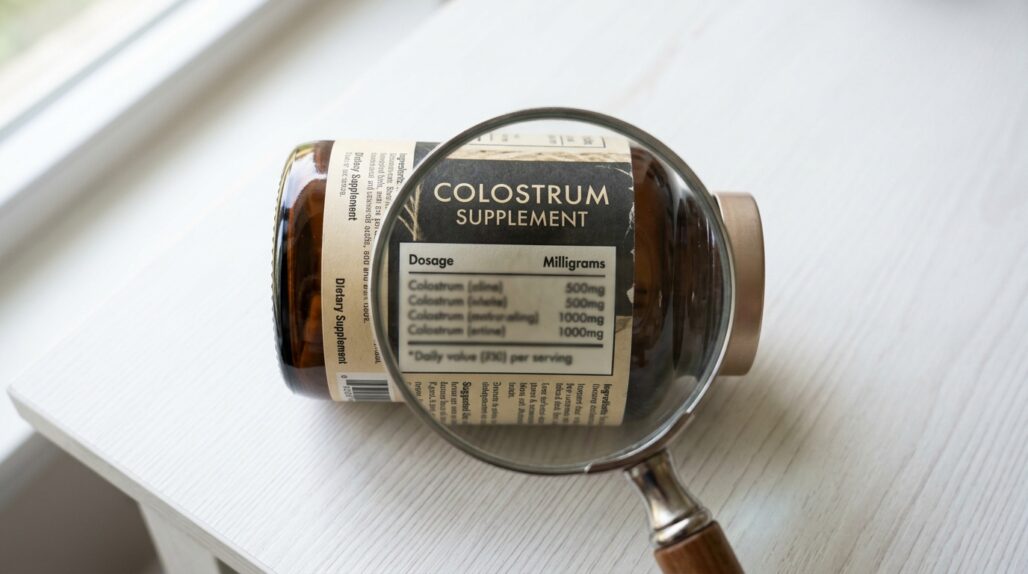
The single biggest tell is dose. The trials that showed anything used roughly 10 to 20 g a day. A 500 mg capsule, or a "pinch" serving, is a rounding error against that. Many capsule products would have you swallow a dozen pills to reach a studied dose.
The second tell is IgG content. Natural IgG in bovine colostrum ranges from about 41 to 200 g per liter, a huge spread, per a review of factors affecting colostrum immunoglobulin content. A serious product states its standardized IgG percentage. A vague one hides behind "premium" and proprietary language.
Quick screen before you buy:
- Stated, studied dose. The label should let you reach 10 to 20 g a day without taking a fistful of capsules.
- Declared IgG percentage. Look for a standardized figure, not just "rich in immunoglobulins."
- Third-party testing. A seal from NSF, Informed Sport, or USP, or a published certificate of analysis. This matters extra for an animal-derived powder.
- Sourcing transparency. Grass-fed, and ideally colostrum collected after the calf has fed, not instead of it.
- Honest claims. A label promising it fixes skin, hair, energy, and immunity at once is a marketing tell, not a quality cue.
One more caveat that gets glossed over. Colostrum still contains 2 to 6 percent lactose plus casein and whey proteins, so if you have a dairy allergy or significant lactose intolerance it can cause real symptoms. Allergy means skip it outright.
Who it might genuinely help, and who is wasting money
Match the verdict to the person.
It is a reasonable experiment if you are a heavy-training endurance athlete, someone who gets sick during big training or travel blocks, or someone with exercise-triggered gut distress. That is exactly where the human data sit.
You are likely wasting money if you are buying it for clearer skin, thicker hair, "detox," general anti-aging, or because a video told you to. None of that is backed in humans, and a daily scoop is not cheap.
This is a supplement, not a treatment. If you have a diagnosed gut condition like IBD or celiac, colostrum is not a substitute for medical care and should be discussed with your clinician first. Same goes for a persistent cough or recurrent infections that need a real diagnosis.
Cost versus value
Premium colostrum runs anywhere from around $45 to $90 a month at studied doses as of writing, so check current pricing before you commit. The branded, flavored, single-scoop tubs sit at the top of that range and often deliver less actual colostrum per serving.
For the athlete use cases, that can be a fair trade for a possible edge. For the beauty claims, you are paying a premium for hope. If gut health is your real goal, a tested probiotic or simply more fiber may give you more for your money. Our complete guide to probiotics covers what actually has support there.

If you want to try it, get a tested one
If the athletic or gut-barrier case fits you, buy quality and dose it properly. The picks below are screened for third-party testing, a declared IgG content, and a serving size that can reach the studied range, rather than the prettiest tub.


As an Amazon Associate, UsefulVitamins.com earns from qualifying purchases at no extra cost to you.
Heads up: the links above are affiliate links. If you buy through them we may earn a small commission at no extra cost to you, and it never changes our verdict or which products we flag as tested.
For deeper comparisons, see our roundup of the best colostrum supplements, and if you came here because of one brand in particular, our breakdown of whether ARMRA colostrum is worth it and the cheaper ARMRA colostrum alternatives on Amazon will save you money.
FAQ
Does bovine colostrum actually heal leaky gut? It can lower gut permeability in human trials, mostly in athletes whose guts are stressed by hard exercise. The evidence is real but early, and “leaky gut” as a catch-all diagnosis is still loosely defined, so treat it as supportive rather than a cure.
Will colostrum give me clearer skin or thicker hair? There is no rigorous human data behind those claims. The before-and-after posts are anecdotes, and the growth factors that sound promising have only been studied in the lab, not in people taking a daily scoop.
How much colostrum should I take? The trials that showed benefits used roughly 10 to 20 g a day. Many capsule products fall far short of that, so check whether the serving on the label actually reaches a studied amount before you buy.
Can I take colostrum if I am lactose intolerant or dairy-allergic? It still contains lactose and milk proteins, so it can trigger symptoms. If you have a true dairy allergy, skip it; if you are mildly lactose intolerant, ask your doctor and watch how you react.
Is colostrum the same as a probiotic? No. A probiotic adds live bacteria; colostrum supplies antibodies, growth factors, and other proteins. They target gut health differently, and for general gut support a tested probiotic is often better value.
Is bovine colostrum safe? For most adults without a dairy allergy it is generally well tolerated, with mild gas or bloating the most common complaint. It is not a treatment for any disease, so route real gut or immune problems to a clinician.
The bottom line
Bovine colostrum is the rare trend that is part substance, part hype. The gut-barrier and respiratory data in athletes are genuine, if early and modest. The skin, hair, and anti-aging claims that made it go viral are not backed in humans.
If you fit the athletic or gut-stress profile, it is a fair low-risk experiment, provided you buy a third-party-tested product, check the IgG content, and reach a 10 to 20 g daily dose instead of a token pinch. If you are chasing a glow-up, your money is better spent elsewhere.
This article is for general information and is not medical advice. Talk to a qualified healthcare professional before starting any supplement, especially if you have a dairy allergy, a gut condition, or take medication.
Reviewed by the UsefulVitamins Editorial Team.
