
Affiliate disclosure: this article contains affiliate links. As an Amazon Associate, UsefulVitamins.com earns from qualifying purchases at no extra cost to you.
Drops are often labelled in IU while softgels use mcg. Convert between the two before comparing cost per dose.
All three formats deliver the same molecule
Drops, softgels, and spray all carry the same active nutrient: usually vitamin D3 (cholecalciferol), the form your body makes in sunlight. The packaging changes, not the vitamin.
So the first thing to settle is the form of the molecule, not the format of the bottle. D3 raises blood 25(OH)D more reliably than D2 (ergocalciferol); a systematic review and meta-analysis in the American Journal of Clinical Nutrition found D3 the stronger choice for lifting serum levels. Buy D3 in whatever format you like, and you have already made the decision that matters most.
After that, the real differences come down to three things: how precisely you can dose, how much you pay per IU, and whether you will actually take it. The rest of this page walks each format through those filters.
Why fat matters more than format
Vitamin D is fat-soluble, which is the single fact that drives how to take any of these. According to the NIH Office of Dietary Supplements, absorption relies on the same machinery your gut uses for dietary fat.
That is not theory. In a randomized trial, healthy adults given a single 50,000 IU dose with a high-fat meal reached roughly 59% higher serum 25(OH)D at two weeks than those who took it with a low-fat meal, as reported in this trial published in the International Journal of Endocrinology. A separate clinic study found that simply moving the dose to the largest meal of the day raised levels about 50%, per Mulligan and Licata in the Journal of Bone and Mineral Research.
Here is the practical takeaway for your format choice:
- Softgels already include an oil base, so the vitamin arrives pre-dissolved in fat.
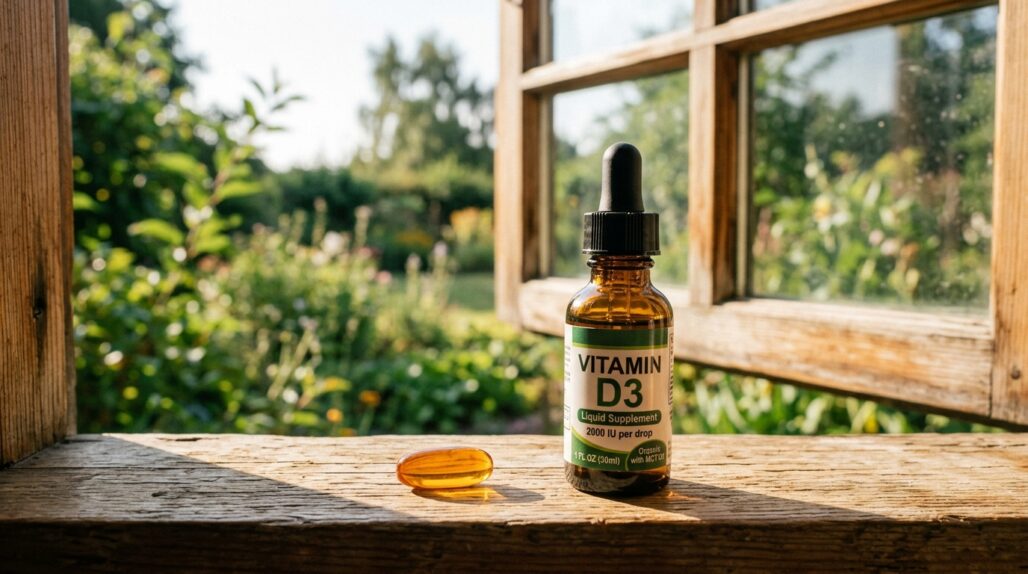
- Drops are usually suspended in an oil such as MCT or olive oil too.
- Spray is often water- or alcohol-based, which is part of why taking it near a meal still helps.
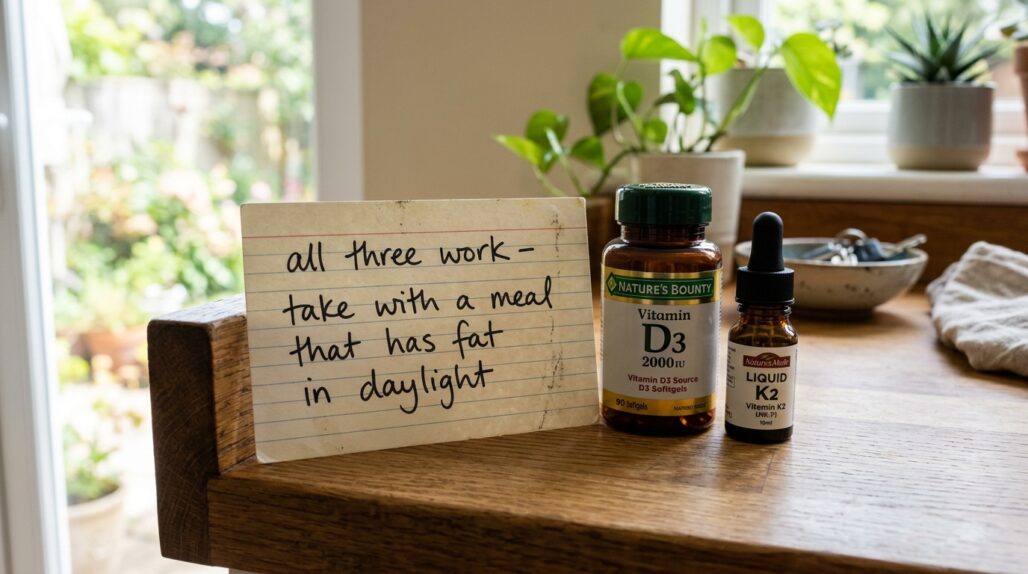
In every case, the food rule wins. Take your vitamin D with a meal that has some fat in it and the format becomes a secondary detail.
The format-by-format breakdown
Each format has a job it does best. None of them is a scam, and none is a magic upgrade.
Softgels: the value default
A standard D3 softgel is the cheapest reliable way to get a fixed dose. The IU is locked in per capsule, the oil base handles the fat-solubility issue for you, and a bottle often lasts months.
The trade-off is flexibility. You get the dose printed on the label, not a custom one, and a softgel is still a pill to swallow. For most adults who want a steady 1,000-2,000 IU, this is the boring, correct answer.
Drops: flexible dosing and good for kids
Liquid drops shine when you need to fine-tune the dose. One drop might be 400 IU, so you can step a child from a low starting amount or titrate an adult toward a target without buying three bottle strengths.
Drops are also the obvious pick for anyone who cannot or will not swallow a pill, including young children and older adults. The catch is that dropper measuring is less precise than a sealed softgel, and an oily liquid can go rancid faster once opened, so store it cool and finish it before the expiry.
Spray: convenient, with a real evidence base
Oral spray gets dismissed as a gimmick, but the data is better than its reputation. In a crossover trial published in the British Journal of Nutrition, healthy adults taking 3,000 IU/day as a spray raised their 25(OH)D about as much as the capsule (a 44% rise versus 51%, with no statistically significant difference).
There is even a setting where spray looks ahead: in people with intestinal malabsorption, a buccal spray outperformed a softgel in a study by Satia and colleagues, likely because some absorption happens in the mouth rather than the gut. For healthy people, treat spray as roughly equal to a capsule and a fair pick if you hate pills. It usually costs more per IU than a softgel.
| Format | Best for | Dosing precision | Cost per IU | Main trade-off |
|---|---|---|---|---|
| Softgel | Value, set-and-forget daily dose | Fixed per capsule | Lowest | A pill to swallow, no fine-tuning |
| Drops | Kids, titration, pill-averse | Flexible by drop count | Moderate | Dropper less exact, oil can spoil faster |
| Spray | Pill-averse, on-the-go, some malabsorption | Per-spray, fixed | Highest | Pricier per IU than a softgel |
How long until any format works
Switching format will not speed up results, because all three move your blood level on the same biological clock. A daily oral dose typically takes 6 to 8 weeks to reach a new steady state in your serum 25(OH)D.
That timeline is worth setting in your head before you judge a product. If you started a drop or a spray two weeks ago and feel nothing, that is normal; the level is still climbing. Vitamin D is a slow correction, not an instant one, regardless of how it is packaged.
If you are correcting a measured deficiency, your clinician may use a higher loading dose for a stretch and then a maintenance dose. That is a decision for a blood test and a professional, not a format swap.

Which one should you actually buy?
Pick by your situation, then lock the dose separately.
- Want the best value and you can swallow a capsule: a plain D3 softgel.
- Dosing a child, or you want to titrate up slowly: liquid drops.
- You hate pills or want a travel-friendly option: a spray (or drops).
Whatever you choose, the IU number is the part to get right, and it is personal: it depends on your latitude, skin, body weight, sun exposure, and current blood level. Rather than guess, use our vitamin D dose calculator to get your target number, then buy the format that hits it. This page is the format decision; the calculator is the dose decision, and you want both.
If you want the full background on what vitamin D does and how levels are tested, our complete guide to vitamin D covers it. And if you are weighing a cheaper D2 product, read why D3 generally beats D2 on bioavailability before you save a dollar in the wrong place.
UsefulVitamins is reader-supported. The picks below may earn us a commission at no cost to you, and we only suggest products we would buy ourselves.


As an Amazon Associate, UsefulVitamins.com earns from qualifying purchases at no extra cost to you.
When you compare products, check the IU per softgel, per dropper-full, or per spray, the form (D3, not D2), and third-party testing. Format is a convenience call; the label dose and quality are what you are really paying for.
Do not let format talk you past the upper limit
Here is the one safety line that holds across all three formats. The NIH Office of Dietary Supplements sets the tolerable upper intake level for adults at 4,000 IU (100 mcg) per day from all sources combined, while the RDA is far lower at 600 IU (800 IU after age 70).
A convenient spray or a tasty drop can make it easy to lose count, and vitamin D toxicity is almost always caused by over-supplementing, not by food or sun. The Merck Manual notes that toxicity shows up as hypercalcemia, with serum 25(OH)D usually above 150 ng/mL, producing nausea, excessive thirst, frequent urination, and in severe cases kidney damage. You can read more on the warning signs of taking too much vitamin D.
None of this should scare you off a sensible daily dose. It is a reminder that the right move is to dose to your number and stop there, no matter how easy the format makes it to take more.

FAQ
Does vitamin D spray absorb better than a softgel? In healthy adults the two come out roughly equal in trials, so spray is a convenience choice rather than an absorption upgrade. Spray may help more in people with gut malabsorption, which is a conversation for their doctor.
Do I really need to take vitamin D with food? It helps a lot. Because vitamin D is fat-soluble, taking it with a meal that contains some fat raised blood levels meaningfully in trials, so pair any format with your largest or fattiest meal.
Are drops better for absorption than capsules? Not inherently. Drops win on flexible dosing and on being easy for kids or pill-averse adults, but a softgel taken with food works just as well for most people.
Why is D3 recommended over D2? Pooled trial data show D3 raises serum 25(OH)D more reliably than D2, especially with bolus dosing. Most quality supplements in all three formats already use D3.
How long before I feel a difference? Expect about 6 to 8 weeks for a daily dose to reach a steady blood level, and remember that switching format does not change that timeline.
Can I take too much if I use a spray or drops? Yes, the 4,000 IU/day upper limit for adults applies no matter the format. Count your total intake and ask a pharmacist before going higher.
The bottom line
Drops, softgels, and spray all work when you take the right IU of D3 with a fat-containing meal, so this is a cost-and-convenience decision rather than an absorption hunt. Softgels are the value default, drops are best for kids and fine-tuning, and spray is a fair, evidence-backed pick if you hate pills.
The smarter sequence is to settle your dose first, then pick the format that fits your life. Run your numbers through the vitamin D dose calculator, keep your total under the 4,000 IU adult limit, and buy the format you will actually use every day.
This article is general education, not medical advice. It does not diagnose, treat, or replace care from your own clinician. Do not start, stop, or change any supplement or prescription based on this page; talk with a pharmacist or doctor about your situation, your blood levels, and your medicines.
Reviewed by the UsefulVitamins Editorial Team.
