
The list price on a GLP-1 prescription can hit your inbox before the ink is dry on your diagnosis, and the number is startling: somewhere between $900 and $1,400 per month at the pharmacy counter, depending on the drug and the dose. What that sticker price has to do with what you will actually pay is a genuinely complicated question, one where the right answer depends on your insurer, your employer, your income, your Medicare status, and which of the FDA-approved GLP-1 drugs your physician prescribed. The FDA-approved peptides overview documents which drugs carry actual regulatory approval; this guide is about what they cost and what levers exist to reduce that cost. It also covers what the Inflation Reduction Act actually changed for Medicare beneficiaries — which is less than most people think for GLP-1 drugs specifically — and why the compounded-pharmacy price you may have seen advertised online reflects a product, not a discount. See the guide on buying peptides legally for the regulatory framework that underlies every cost scenario here.
Summary
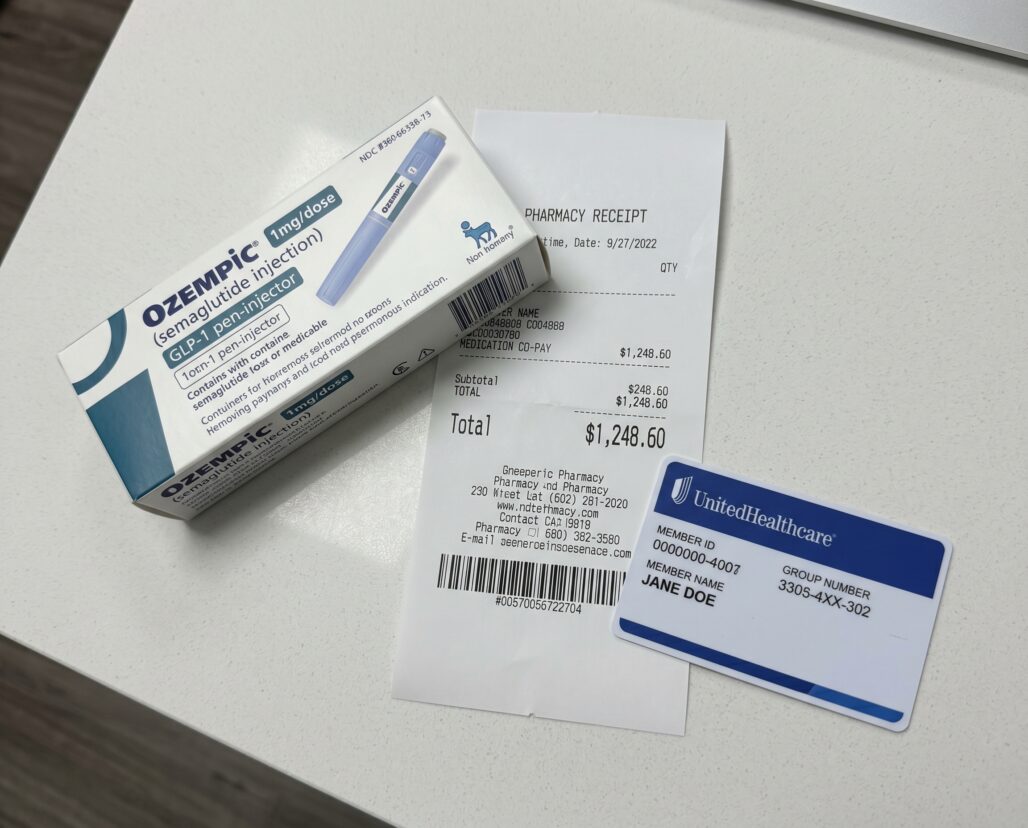
GLP-1 drugs carry list prices between $900 and $1,400 per month. What patients actually pay depends on commercial insurance tier placement, prior authorization approval, Medicare coverage rules, manufacturer savings card eligibility, and whether a compounded alternative is legally available. The IRA $35 monthly cap applies to insulin only; semaglutide and tirzepatide are not subject to it as of 2026.
- List prices: Ozempic approximately $970/month; Wegovy approximately $1,350/month; Mounjaro approximately $1,060/month; Zepbound approximately $1,060/month (2025 WAC pricing, subject to change).
- What insured patients pay: Widely variable. Many commercial plans place GLP-1s on specialty tiers with 25-33% coinsurance, meaning $250-$460/month before out-of-pocket limits kick in.
- Medicare Part D: Most standard Part D plans cover Ozempic and Mounjaro for type 2 diabetes with prior authorization. Coverage for obesity without diabetes requires the Medicare GLP-1 bridge program, which runs through December 2027 at a $50 copay per fill.
- IRA reality: The IRA capped insulin out-of-pocket costs at $35/month for Medicare beneficiaries. Semaglutide and tirzepatide are not capped. The IRA drug price negotiation program's 2026 list does not include GLP-1s.
- Manufacturer savings: Novo Nordisk and Lilly offer savings cards that can reduce cost to as low as $25/month for commercially insured patients. Medicare and Medicaid beneficiaries are generally excluded from these programs.
- Compounded GLP-1 cost: Compounded semaglutide was legal during the FDA shortage period; the FDA declared that shortage resolved. Compounded products currently marketed for weight loss at sharply lower prices reflect unverified-source product, not legitimate cost savings.
GLP-1 List Prices vs. What People Actually Pay
List price and what you pay are two different numbers connected by a tangle of pharmacy benefit contracts, formulary tiers, prior authorization rules, and cost-sharing structures. The list price — formally the Wholesale Acquisition Cost, or WAC — is the manufacturer's published price to wholesalers, and it is the number a patient without insurance or a qualifying savings program will see at the pharmacy window.
| Drug | Active ingredient | Primary FDA indication | Approximate monthly WAC (2025) |
|---|---|---|---|
| Ozempic (0.5-2 mg SC) | Semaglutide | Type 2 diabetes | ~$970 |
| Wegovy (2.4 mg SC) | Semaglutide | Chronic weight management | ~$1,350 |
| Rybelsus (7-14 mg oral) | Semaglutide | Type 2 diabetes | ~$940 |
| Mounjaro (2.5-15 mg SC) | Tirzepatide | Type 2 diabetes | ~$1,060 |
| Zepbound (2.5-15 mg SC) | Tirzepatide | Chronic weight management | ~$1,060 |
For the clinical details on each drug, the semaglutide complete guide and the tirzepatide complete guide cover mechanism, trial data, and dosing.
With commercial insurance, the actual payment depends on which formulary tier the drug lands on. Most large commercial plans classify GLP-1s as specialty drugs, the highest tier in standard formulary structures. Specialty tiers typically carry 25% to 33% coinsurance rather than a flat copay, which means a patient whose plan places Wegovy on a specialty tier with 33% coinsurance pays roughly $445/month before hitting their annual out-of-pocket maximum. The out-of-pocket maximum for most employer-sponsored plans in 2026 is approximately $9,100 for an individual, meaning a patient paying full specialty-tier coinsurance on Wegovy could exhaust their OOP maximum in roughly four to five months and pay nothing for the remainder of the plan year.
The practical reality for many patients, however, is that their plan either excludes GLP-1s entirely for weight management or requires prior authorization before coverage begins at any tier. KFF tracking data from 2024 found that a meaningful share of employer-sponsored plans specifically carved out anti-obesity medications from pharmacy benefits, meaning the employer's contract with the pharmacy benefit manager explicitly excluded coverage regardless of medical necessity.
Insurance Coverage by Drug and Diagnosis
The FDA indication on the prescription determines far more about insurance coverage than the molecule itself. Ozempic and Mounjaro are approved for type 2 diabetes. Wegovy and Zepbound are approved for chronic weight management. The same molecule at the same dose can be covered or excluded depending solely on whether the patient has a diabetes or obesity diagnosis driving the prescription.
Commercial insurance: Most major commercial plans cover Ozempic and Mounjaro for type 2 diabetes after prior authorization. Coverage for Wegovy and Zepbound for obesity is more variable. A 2024 employer benefits survey found roughly 60% of large employers covered anti-obesity GLP-1s, though that number reflects plan availability, not whether individual members successfully obtained coverage through prior authorization.
Medicaid: Coverage varies by state. States set their own formularies within federal guidelines. Some states cover GLP-1s for diabetes but not obesity; some cover both with prior authorization; a smaller number have broad restrictions. Patients in Medicaid programs should check their state program's preferred drug list directly.
Medicare Part D (diabetes indication): Most Part D plans cover Ozempic and Mounjaro for type 2 diabetes with prior authorization. The 2024 Part D redesign under the Inflation Reduction Act introduced a $2,000 annual out-of-pocket cap for all Part D drugs, which meaningfully limits catastrophic-tier exposure for patients whose GLP-1 is covered and whose plan places them in higher cost-sharing tiers.
Medicare Part D (obesity indication): Standard Medicare Part D plans are prohibited by statute from covering drugs used "for the purpose of weight loss." Wegovy and Zepbound fall into this exclusion unless the beneficiary also has an obesity-related comorbidity covered by a separate provision. The CMS bridge program, extended through December 2027, provides a temporary pathway: Medicare beneficiaries who meet clinical criteria can access GLP-1 obesity medications at a $50 copay per fill through participating Part D plans. The program's future after December 2027 is not yet determined; CMS delayed its broader BALANCE model after plan participation fell below targets, in part because the projected cost — estimated at $25 to $35 billion over ten years even with a manufacturer discount of roughly $245 per unit — made financial risk difficult for plans to absorb.
Medicare Part B: GLP-1 drugs are administered subcutaneously by patients themselves, not infused in a clinical setting. Part B covers physician-administered drugs, not self-administered injectables, so GLP-1 injections fall under Part D, not Part B.
Prior Authorization Tactics That Work
Prior authorization (PA) is the process by which an insurer requires clinical documentation before approving coverage of a drug. For GLP-1s, PA requirements are near-universal for commercial plans that cover the drugs at all. The PA request fails most often not because the clinical case is weak, but because the documentation submitted does not match the insurer's specific criteria.
Get the insurer's PA criteria before submitting. Every plan must provide its coverage criteria on request. Call the member services number and ask specifically for the clinical criteria document for the drug in question. Many denials happen because a prescriber submits documentation addressing general medical necessity while the insurer's criteria require proof of prior treatment with a specific alternative drug (step therapy) or a specific BMI threshold combined with an obesity-related comorbidity.
Use the correct diagnosis codes. Obesity is coded under ICD-10 E66.xx; morbid obesity is E66.01. Type 2 diabetes is E11.xx. If the prescription is for diabetes management and the PA is requested under the diabetes indication, the diagnosis codes must be consistent. A mismatch between the ICD-10 on the PA form and the diagnosis in the prescriber's chart notes is a common and avoidable denial trigger.
Document step therapy completion explicitly. Many plans require a patient to have tried and failed at least one other drug — often metformin for diabetes, or a documented weight-management program for obesity — before a GLP-1 is approved. The PA submission should include specific dates of prior treatments, the dose and duration, and the reason for discontinuation or inadequate response. Vague language about prior therapy ("patient has tried other options") is frequently insufficient.
Request peer-to-peer review on denial. When a PA is denied, the prescriber has the right to request a peer-to-peer review with the insurer's medical reviewer within a specified window, typically 24 to 72 hours for urgent cases and five to ten business days for standard reviews. Peer-to-peer review gives the prescriber the opportunity to make the clinical case directly. Denial reversal rates after peer-to-peer are meaningfully higher than denial appeal rates through paperwork alone.
File a formal appeal. If peer-to-peer review does not produce approval, the patient has the right under the Affordable Care Act and most state laws to file a formal internal appeal. If the internal appeal fails, an independent external appeal is generally available. For Medicare, the appeals process runs: redetermination (the plan), reconsideration (an independent organization), Administrative Law Judge hearing, Medicare Appeals Council, then federal district court. Persistence through the early stages resolves a significant share of cases.
Do not submit false clinical information. Prior authorization tactics that involve misrepresenting a patient's diagnosis, clinical history, or prior treatment attempts expose both the patient and the prescriber to fraud liability. Every tactic above is a documentation and process tactic, not a falsification tactic.
Manufacturer Savings Programs
Both Novo Nordisk (Ozempic, Wegovy, Rybelsus) and Eli Lilly (Mounjaro, Zepbound) operate savings programs that can dramatically reduce out-of-pocket cost for eligible patients.
Novo Nordisk savings cards: Novo Nordisk has offered savings programs that allow eligible patients to pay as little as $25/month for Ozempic and historically similar thresholds for Wegovy. The eligibility rules are specific: patients must have commercial or private insurance, must not be enrolled in any federal or state government health insurance program (Medicare, Medicaid, CHIP, TRICARE, or any other government-funded healthcare program), and must meet any income eligibility thresholds the program specifies at the time of enrollment. The program terms change; always verify current eligibility and program specifics at NovoCare (novonordisk-us.com) before assuming you qualify. Patients without any insurance coverage may qualify for separate patient assistance programs that provide medication at no cost based on income and other eligibility factors.
Eli Lilly savings programs (LillyDirect, Lilly Insulin Value Program): Lilly has offered comparable savings cards for Mounjaro and Zepbound for commercially insured patients, with out-of-pocket caps that have varied between $25 and $150 per month depending on program terms and dose. The same government program exclusion applies: Medicare and Medicaid beneficiaries are not eligible for commercial savings cards. Lilly's Insulin Value Program — which caps insulin at $35/month out of pocket for all patients regardless of insurance status — applies to insulin only and does not extend to tirzepatide.
What savings cards do not cover: Savings cards issued by manufacturers are discounts applied at the pharmacy counter. They cannot be used when the primary payer is a federal or state program. They do not reduce the insurer's cost or affect your plan's out-of-pocket maximum calculation for the year. If you use a manufacturer savings card to pay a copay, the amount paid via the card may or may not count toward your plan deductible depending on your state's law and your plan's specific terms — this is worth confirming with your insurer.
The IRA Medicare Cap Reality
The Inflation Reduction Act of 2022 made several changes to Medicare drug costs that are widely misunderstood, particularly in discussions of GLP-1 affordability.
What the IRA actually changed:
The IRA capped Medicare out-of-pocket costs for insulin at $35 per month. This cap applies to all covered insulin products under Part D beginning January 1, 2023, and under Part B beginning July 1, 2023. It is one of the most consequential affordability provisions in recent Medicare history for diabetic patients who use insulin.
The IRA also introduced a $2,000 annual out-of-pocket cap for all Part D drugs beginning in 2025, replacing the old structure where there was no hard cap and catastrophic-tier spending could continue indefinitely.
What the IRA did not change for GLP-1s:
The $35 insulin cap applies to insulin only as of 2025. Semaglutide (Ozempic, Wegovy, Rybelsus) and tirzepatide (Mounjaro, Zepbound) are not subject to the $35 cap. A Medicare beneficiary whose Part D plan covers Ozempic for type 2 diabetes pays their plan's standard cost-sharing for that drug, which varies by plan but is not capped at $35. The $2,000 annual out-of-pocket cap does apply to GLP-1 drugs covered by Part D plans, providing meaningful protection against catastrophic-tier spending once it is reached.
The IRA established the Medicare Drug Price Negotiation Program, which allows CMS to negotiate prices directly with manufacturers on high-spend Part D drugs. The first ten negotiated drugs, with negotiated prices taking effect January 1, 2026, cover blood thinners, diabetes medications, and other high-utilization drugs. Semaglutide and tirzepatide are not in the first negotiation cohort. Given their relative recency of approval and the IRA's statutory exclusion of drugs within their initial market-exclusivity period, GLP-1s are unlikely to enter negotiation before the late 2020s at the earliest.
The bottom line for Medicare beneficiaries: the IRA substantially improved insulin affordability and introduced a meaningful annual OOP cap. It did not create a GLP-1 price cap, and GLP-1s will not benefit from negotiated prices in the near future. The bridge program at $50/fill for obesity is the primary affordability lever for Medicare patients who need GLP-1s for weight management and lack a qualifying diabetes diagnosis.
The Compounded GLP-1 Cost Trap
Compounded versions of semaglutide and tirzepatide surged during the 2022-2025 shortage period, when the FDA's shortage list designation provided a legal basis for 503A and 503B compounding pharmacies to prepare copies of these drugs. At peak shortage, compounded semaglutide was available at prices substantially below the WAC of Ozempic — in some cases $200 to $300 per month — and telehealth platforms built entire business models around prescribing and dispensing compounded GLP-1s.
The legal basis for widespread compounding changed when the FDA declared the semaglutide shortage resolved and subsequently declared the tirzepatide shortage resolved. Once a drug exits the shortage list, most compounders no longer have a legal basis to produce copies at scale. The FDA took enforcement action against compounders continuing to produce semaglutide after the shortage resolution, and the legal landscape for compounded GLP-1s shifted substantially in 2025 and into 2026.
The price gap reflects unverified-source product, not legitimate cost savings. A compounded GLP-1 offered at a fraction of the branded drug's WAC by a vendor operating outside the 503A/503B regulatory framework does not represent a genuine market discount. It represents a product manufactured without FDA oversight of purity, potency, or sterility, and in many cases using bulk drug substances whose safety profile was not tested in the clinical trials that established semaglutide's or tirzepatide's risk-benefit profile. The FDA issued explicit warnings during the shortage period about compounders using unapproved salt forms of semaglutide — semaglutide sodium and semaglutide acetate — that have not been shown to be safe or effective. Serious adverse events, including hospitalization, were reported in association with compounded GLP-1 products, in part due to dosing errors facilitated by multi-dose vial formats that differ from the auto-injector pen configuration of the approved drugs.
Personal importation of prescription GLP-1 drugs from foreign pharmacies is generally not permitted under FDA policy. The FDA has enforcement discretion to allow personal importation for drugs not available in the U.S. for a serious condition, but GLP-1 drugs are available through the U.S. pharmacy system. Importing prescription drugs from foreign pharmacies is not an endorsed or recommended pathway. The safety of drugs purchased from foreign online pharmacies cannot be verified.
For patients exploring alternatives to branded GLP-1 pricing, the legitimate paths are: manufacturer savings cards (if commercially insured and eligible), patient assistance programs (if income-eligible), and working with the prescriber on therapeutic alternatives that may carry lower cost-sharing under the patient's specific formulary.

Frequently Asked Questions
Why is Wegovy more expensive than Ozempic if it is the same molecule?
Ozempic and Wegovy are both semaglutide, but they carry separate FDA approvals, separate NDAs, and are manufactured and marketed for different indications. Wegovy is approved for chronic weight management at a higher weekly dose (2.4 mg vs. up to 2 mg for Ozempic). Novo Nordisk prices each product independently. Insurance formulary placement also differs: Ozempic lands on diabetes drug tiers; Wegovy on anti-obesity medication tiers, which often carry different coverage rules.
Does my employer have to cover GLP-1 drugs?
No federal law currently requires employer-sponsored health plans to cover anti-obesity medications. Employers and their pharmacy benefit managers set their own formularies within broad federal guidelines. The ACA's essential health benefit requirements apply to individual and small-group markets, not to self-funded large employer plans, which cover most U.S. workers. GLP-1 exclusions from employer plans are legal and common.
Can I use a manufacturer savings card with a high-deductible health plan?
It depends on the type of HDHP and whether you have a Health Savings Account. IRS rules have historically prohibited the use of manufacturer coupons for drugs that count toward a deductible in an HSA-qualified HDHP, because the coupon constitutes third-party payment. Some plans have workarounds; others do not. Verify with your benefits administrator before applying a savings card in an HDHP-with-HSA situation.
What happens to GLP-1 costs if I become pregnant?
GLP-1 drugs including semaglutide and tirzepatide should be discontinued before a planned pregnancy, and the prescriber should be consulted immediately if pregnancy occurs during treatment. This is a clinical decision that also has cost implications: if the drug is discontinued, the insurance PA and any associated out-of-pocket spending is interrupted. Resuming coverage after pregnancy typically requires a new prior authorization submission.
Can I split doses to reduce cost?
Dose manipulation should only occur under a prescriber's supervision. GLP-1 auto-injector pens deliver fixed doses; attempting to split or redose a pen in ways not specified in the prescribing information introduces dosing error risk and may void any applicable savings card terms. If cost is driving a desire to reduce dose, that conversation belongs with the prescriber, not with a workaround at the pharmacy counter.
Conclusion
The GLP-1 cost picture in the U.S. is genuinely complex, and the complexity runs in both directions. The list price is high. But the actual price paid by an insured patient with a successful prior authorization, a qualifying employer plan, and an active manufacturer savings card can be a fraction of that number. The complexity also cuts the other way: a patient on Medicare who needs a GLP-1 for obesity without a diabetes diagnosis faces real structural barriers that the IRA's insulin cap and negotiation program do not address. The bridge program through December 2027 provides a temporary pathway, but it is not a permanent fix.
Working through the cost systematically — starting with the prescriber's office to identify the correct indication and diagnosis coding, then verifying the plan's specific prior authorization criteria before the first submission, then exploring savings card or patient assistance eligibility — is more productive than comparing list prices. The compounded pharmacy market, which appeared to offer an easy bypass of those barriers, has shifted legally, and the price gap it offered was never a reflection of equivalent product safety. Navigating the legitimate system is the more durable strategy, even when it requires persistence through multiple prior authorization submissions and appeals.
For further reading on the regulatory landscape for peptides that underlies these cost considerations, see FDA-approved peptides and how to buy peptides legally.
This article is for informational purposes only. It does not constitute medical, legal, or financial advice. GLP-1 drugs are prescription medications that require diagnosis and supervision by a licensed healthcare provider. Insurance coverage rules, drug prices, and program eligibility terms change frequently; verify current information with your insurer, prescriber, and the relevant manufacturer programs. Nothing in this article should be used as a basis for misrepresenting clinical information to an insurer or payor.
