
If you're searching "is Hydrant worth it," the honest answer depends on one number: $2.50 per stick. At that price, Hydrant sits above most Amazon alternatives and below Liquid IV, delivering a middle-ground electrolyte formula that works well for everyday hydration but falls short for serious athletic use. This review breaks down exactly what you're getting per stick, what the subscription actually commits you to, and where Hydrant's formula holds up versus where the Reddit crowd is right to be skeptical.
Affiliate disclosure: this article contains affiliate links. As an Amazon Associate, UsefulVitamins.com earns from qualifying purchases at no extra cost to you.

What is Hydrant?
Hydrant was founded in 2017 by John Sherwin and Jai Jung Kim, both former Oxford University bioscience students. The founding story is central to how the brand positions itself: a scientifically-informed hydration product built around the World Health Organization's Oral Rehydration Solution (ORS) framework, adapted for everyday consumers rather than clinical dehydration treatment.
The brand's core claim is "Rapid Hydration" — a phrase that implies a meaningful physiological mechanism rather than simply dissolving electrolytes in water. The ORS connection is real: the product does use a sodium-glucose co-transport mechanism, where a small amount of sugar (4 g of cane sugar) facilitates faster sodium and water absorption in the small intestine compared to plain water. This is established physiology, not marketing language.
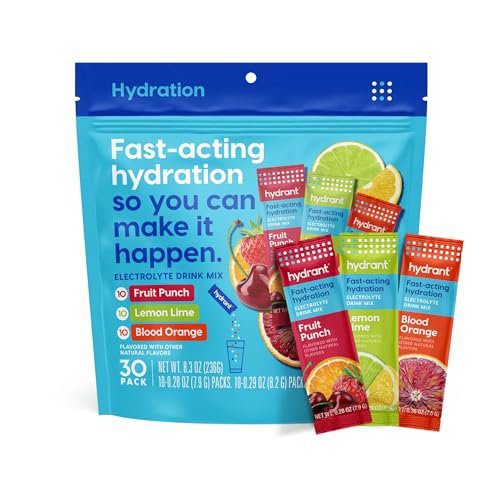
Hydrant is sold as a DTC subscription product and is also available on Amazon. The product comes in stick pack format — single-serve sachets designed to mix into 8-16 oz of water — in multiple flavors including Blood Orange, Lemon Lime, Watermelon, and Grapefruit.
What do you actually get?
Each Hydrant stick pack delivers:
- Sodium: 260 mg
- Potassium: 200 mg
- Magnesium: 75 mg
- Zinc: 5 mg
- Sugar: 4 g (from cane sugar)
- Calories: 15-20 kcal per serving
The formula is plant-based and uses no artificial sweeteners — a real differentiator from many competitors that lean on sucralose or acesulfame potassium.
To put those numbers in context: the American College of Sports Medicine recommends 500-700 mg of sodium per liter of fluid for athletes exercising in moderate conditions, scaling to 1,000 mg or more in high-heat or high-intensity situations. Hydrant's 260 mg per stick provides about half the ACSM low-end recommendation per serving. If you're mixing into 16 oz (about 475 mL), you're getting roughly 260 mg per half-liter — adequate for sedentary-to-light activity hydration, not enough to fully replace what a hard workout sweat loss demands.
Potassium at 200 mg covers about 4% of the daily adequate intake (4,700 mg), meaningful as a supplement but not a primary potassium source. Magnesium at 75 mg is about 18% of the RDA — a legitimate contribution.
The zinc at 5 mg (45% of the RDA) is an unusual inclusion for a hydration product. Hydrant positions it as an immune support add-on. It's not a hydration electrolyte in any conventional sense; it's a secondary positioning element that adds label credibility without harming the formula.
The 4 g of cane sugar is the smallest functional dose needed to trigger the sodium-glucose co-transport mechanism. This is a considered formulation choice — enough glucose to drive faster absorption, small enough that it won't meaningfully spike blood sugar in most adults.
The price math
Here is where the review gets concrete. Hydrant's standard subscription is approximately $30 per 12-pack box, auto-shipped monthly. That works out to exactly $2.50 per stick. Most people drink one stick per day, so a single box lasts 12 days. To cover a full month at one stick per day, you need two to three boxes, putting your monthly spend at $60-$90 per month on subscription.
The brand's site and packaging often emphasize "$30/box" without surfacing that number clearly. If you're comparing Hydrant to a $30/month budget benchmark, you are not comparing like-for-like unless you're using less than one stick per day.
Compare that to Amazon alternatives at current pricing:
| Product | $/stick (approx.) | $/month (30 sticks) |
|---|---|---|
| Hydrant (subscription) | $2.50 | $75 |
| Liquid IV | $1.56 | $47 |
| Cure Hydrating Mix | $1.80 | $54 |
| Generic Amazon electrolyte tabs (e.g., Nuun) | $0.65-$0.90 | $20-$27 |
Hydrant's $2.50/stick is not indefensible — the formula is clean, the sourcing is transparent, and the taste reviews are consistently good. But you are paying a meaningful premium over Amazon equivalents that deliver comparable or higher electrolyte loads.

What works
The taste is genuinely good. This is not a small thing. The most common reason people stop using daily hydration products is flavor fatigue or an unpleasant aftertaste from artificial sweeteners. Hydrant's cane sugar base and light flavor profiles (Blood Orange is the standout) read as clean and lightly sweet without the chemical edge you get from sucralose-sweetened competitors. Reddit's r/HydroHomies threads that flag the formula as "weak" still consistently compliment the taste.
The sugar-free-adjacent positioning is accurate. Four grams of sugar is low enough that Hydrant is often grouped with sugar-free options, while actually delivering the physiological benefit that glucose provides in the ORS mechanism. This is a formulation win.
The formula is genuinely middle-ground. LMNT delivers 1,000 mg of sodium per stick and is designed for keto dieters and endurance athletes. Liquid IV delivers 500 mg of sodium and 11 g of sugar. Hydrant at 260 mg sodium and 4 g sugar is a legitimate third option for people who find LMNT too salty and Liquid IV too sweet. That's a real product-market niche, not just marketing positioning.
Zinc inclusion is a practical bonus. At 5 mg per stick (45% RDA), Hydrant functions incidentally as a light zinc supplement. Most adults don't reach the RDA through diet alone. If you're using one stick daily, you're closing a common micronutrient gap without adding another capsule to your routine.
Magnesium at 75 mg contributes to daily intake. Magnesium deficiency is widespread — the NHANES data puts roughly 48% of Americans below the EAR. A daily 75 mg addition is not a remedy but it is a consistent, low-effort contribution.
What doesn't work
The sodium dose is too low for athletes. This is the central Reddit critique, and it's correct. If you're running more than 45 minutes in moderate heat, cycling hard, or working through a gym session with visible sweat, 260 mg of sodium per serving is not a meaningful electrolyte replacement. You'd need to drink three or four Hydrant sticks to approach what a single LMNT stick or a proper sports drink delivers. At $2.50 per stick, that is $7.50 to $10 to replace what a $1.50 tab would cover. The product is not designed for that use case — the problem is that the marketing doesn't say so clearly.
The per-stick cost is high relative to performance. The Reddit community's "flavored water with extras" characterization is uncharitable but not wrong. At $2.50/stick, Hydrant costs nearly twice what Liquid IV costs per stick and delivers about half the sodium. The premium over Cure or generic electrolyte tabs is harder to justify on formula alone. You are partly paying for brand, packaging, and origin story.
The subscription math is obscured. A $30/box entry price feels reasonable. A $75/month actual usage cost (at one stick per day) is a different conversation. That is $900 per year for what is, at its core, a light electrolyte drink. This is not a criticism unique to Hydrant — Liquid IV has the same structural issue — but it matters for anyone evaluating the true cost of a daily habit. The subscription is a 30-day commitment that auto-renews; the $30 number on the landing page is a 12-day supply.
Cancellation requires account navigation. Hydrant's cancel process runs through the account dashboard — not an automatic one-click cancellation, not an email loop (they removed email-only cancellation as of 2024), but a multi-step account-portal flow. This sits in the low-to-medium friction category: easier than calling a number, harder than a single "cancel" button. If you start a subscription to trial the product and decide it's not for you, budget 5-10 minutes to locate and execute the cancel sequence before the next billing date. That window matters: if you miss it and a box ships, you're holding $30 in product you didn't want.
Who should buy it
Hydrant makes sense if you want a clean, low-sugar daily hydration habit and you're willing to pay for taste and transparency. Specifically:
- You do light-to-moderate exercise (walking, yoga, casual cycling) and want to support daily hydration without a heavy electrolyte dose
- You've tried Liquid IV and found it too sweet
- You've tried LMNT and found it too salty or too expensive at scale
- You care about no artificial sweeteners and want a plant-based formula
- You drink a single stick per day — not multiple — so the $75/month figure doesn't apply to you
If you're buying one box per month ($30) and using one stick every other day, the cost per use is more defensible and the commitment is lighter.
Who should skip it
Skip Hydrant if your primary use case is athletic electrolyte replacement. The 260 mg sodium dose is not enough to matter for active sweat loss. You're better served by LMNT (1,000 mg sodium, $1.50/stick on Amazon), Precision Hydration (tiered sodium options designed for athletes), or even Nuun Sport tabs at $0.75/tablet with 300-700 mg sodium depending on the product.
Skip it if you're price-sensitive. There is no meaningful formula argument for Hydrant over Cure at $1.80/stick or Liquid IV at $1.56/stick if cost is your primary constraint. Cure in particular uses a comparable clean-label, organic-sourced positioning with slightly lower sodium but a more competitive price.

Skip it if you want a no-commitment purchase model. Hydrant's best pricing is behind a subscription. Committing to a monthly auto-ship — even a cancel-able one — means you are managing one more recurring charge, one more account login, and one more cancellation window to track. If you prefer buying on Amazon when you need it and skipping when you don't, that flexibility costs you roughly $0.50 more per stick compared to the subscription price. Worth doing the math against the friction of managing the subscription itself.

Verdict
Hydrant is a well-formulated, honest product in a crowded market. The ORS mechanism is real science, the taste is genuinely one of the best in the category, and the absence of artificial sweeteners is a legitimate differentiator. For casual daily hydration — a stick in the morning, a stick during an afternoon slump — it does what it says.
The problem is cost structure and context. At $2.50/stick and $75/month for daily use, Hydrant is a premium product that delivers a light electrolyte load. It is not an athletic electrolyte product. It is not the most cost-effective clean-label option on the market. And the subscription model — while not punitive — requires active management if you want to exit before the next billing cycle hits.
If you're comparing Hydrant to Liquid IV, you're choosing between more sodium and more sugar (Liquid IV) versus less of both (Hydrant). That's a real trade-off, and for some people Hydrant wins. If you're comparing Hydrant to Cure or to Amazon alternatives in the $1.50-$1.80/stick range, the formula difference does not justify the price gap.
The bottom line: Hydrant is worth trying. It is worth the $30/box entry price as a trial. It is worth committing to as a subscription only if you have confirmed you'll use it daily, you prefer the taste over alternatives, and you've calculated what "daily use" actually costs per month — which is not $30.
Once you have picked a product, our companion app, StackMyMed, scans its label and tracks it alongside everything else you take, with timing and interaction checks built in.
Related reading
- The best Hydrant alternatives on Amazon
- Hydrant vs Liquid IV: which is actually better?
- How we review supplements
For 2026 pricing across DTC supplement subscriptions and their Amazon equivalents, see our DTC supplement pricing reference.
As an Amazon Associate, I earn from qualifying purchases. Product recommendations are based on real reviews and independent research.
This article is for informational purposes and not medical advice. Electrolyte supplements can interact with medications and health conditions. Consult a licensed physician before starting any supplement, particularly if you are pregnant, nursing, taking prescription medications, or managing a chronic condition.
As an Amazon Associate, I earn from qualifying purchases. Product recommendations are based on real reviews and independent research.
Editorial independence note: UV earns affiliate commissions from Amazon and (selectively) from DTC brand affiliate programs. Commissions never determine our recommendations — top picks are chosen first; affiliate links are added second. Read our full methodology and editorial independence policy →
