
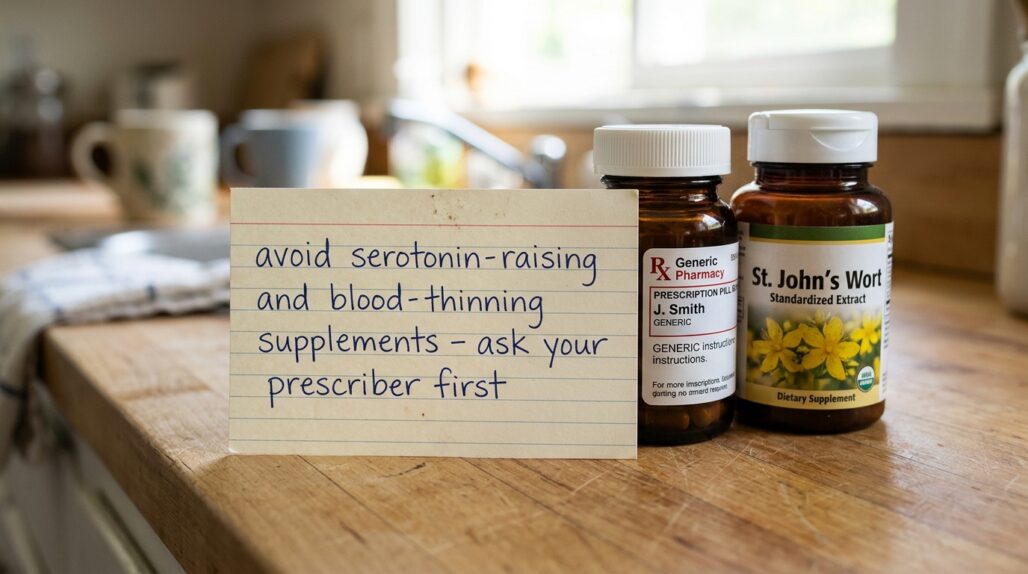
Before you decide
This is general information, not medical advice for your situation. SNRIs are prescription medicines, and the supplement questions around them are genuinely about safety rather than preference. Read this, then take it to the person who prescribed your medication.
Cymbalta and Effexor belong to a drug class called SNRIs – serotonin-norepinephrine reuptake inhibitors. The generic names are duloxetine (Cymbalta) and venlafaxine (Effexor). Other SNRIs include desvenlafaxine (Pristiq), levomilnacipran (Fetzima) and milnacipran. The cautions below apply across the class.
The people at highest risk are those combining more than one serotonin-raising product, anyone also taking a triptan for migraine or tramadol for pain, and people already on blood thinners or daily NSAIDs. If that describes you, the case for a pharmacist review before adding anything is strong.
How SNRIs interact with supplements: two risk buckets
There are two separate problems to keep straight, and they call for different responses.
The first bucket is serotonin overload. SNRIs work by leaving more serotonin active in your nervous system. Add a supplement that also pushes serotonin up, and the combined effect can tip into serotonin syndrome – a reaction that ranges from uncomfortable to life-threatening. This is the bucket where the answer is usually a flat no.
The second bucket is bleeding. Serotonin helps platelets clump and form clots. By tying up serotonin, SNRIs make platelets less sticky, which is why this drug class is linked to a measurable rise in gastrointestinal bleeding in a systematic review and meta-analysis in the British Journal of Clinical Pharmacology. Layer a blood-thinning supplement on top and that risk climbs further.
A third, smaller concern applies mainly to duloxetine: the liver. We will cover that below.
The serotonin syndrome list: avoid these
These supplements raise serotonin or its precursors. Combined with an SNRI, each one adds to the same chemical load. Treat them as off-limits unless your prescriber says otherwise.
- St. John's wort (Hypericum perforatum). The single most documented offender. It raises serotonin and is widely flagged for serotonin syndrome when paired with SSRIs and SNRIs. It also speeds up drug metabolism, which can change how your other medicines work.
- 5-HTP (5-hydroxytryptophan). A direct precursor your body converts straight into serotonin. Sold for mood and sleep, it is one of the riskier stacks with an SNRI.
- L-tryptophan. The amino acid one step upstream of 5-HTP, so it feeds the same pathway. Same core risk.
- SAM-e (S-adenosylmethionine). A popular mood supplement with serotonergic activity of its own. Some research has tested it as a prescription add-on, but only under supervision – not as a self-directed combination.
Two of these, SAM-e and St. John's wort, deserve extra emphasis because people often assume "natural" means low-risk. It does not. We cover SAM-e's mania risk and its especially dangerous pairing with older antidepressants in our piece on SAM-e and MAOIs for anxiety, and the broader serotonin-precursor picture in antidepressants, 5-HTP and serotonin syndrome.
Beyond supplements, the same caution extends to over-the-counter products that act on serotonin, including some cough remedies containing dextromethorphan and the migraine triptans. If you are unsure whether a product is serotonergic, that is exactly the question a pharmacist can answer in two minutes.
Serotonin syndrome: the warning signs
Knowing what serotonin syndrome looks like matters more than memorizing the supplement list, because the symptoms are what send you to care.
According to StatPearls on the NIH Bookshelf, the reaction usually appears fast – most cases show up within 6 to 24 hours of starting or increasing a serotonergic agent. That timing is a useful clue: a cluster of symptoms soon after adding a new supplement is a red flag.
The features fall into three groups.
| Symptom group | What you might notice | Severity signal |
|---|---|---|
| Mental state | Agitation, restlessness, confusion | Often the earliest change |
| Nerve and muscle | Tremor, shivering, muscle twitching, clonus (rhythmic jerking), overactive reflexes | Clonus is a hallmark finding |
| Autonomic | Fast heartbeat, sweating, high blood pressure, fever | High fever signals a medical emergency |
Clinicians lean on a tool called the Hunter criteria, in which features like spontaneous clonus, or tremor with overactive reflexes, or a temperature above 38 C with rigidity and clonus point to the diagnosis. You do not need to apply those rules yourself. The takeaway is simpler: if you feel agitated, shaky and hot, with a racing heart, after adding a supplement to your SNRI, stop the supplement and get medical help. Severe cases need urgent care.

The bleeding-risk list: be cautious, not necessarily abstinent
Because SNRIs already make platelets less effective, supplements with their own blood-thinning effect deserve a real conversation before you combine them.
- Fish oil (omega-3s). At higher doses, omega-3s have a mild antiplatelet effect. Modest doses are widely used without problems, but this is worth raising if you are also on aspirin, an anticoagulant or daily NSAIDs.
- Ginkgo biloba. Linked to bleeding in case reports, though larger reviews have been mixed. The uncertainty itself is the reason to ask before stacking it with an SNRI.
- High-dose vitamin E. Large supplemental doses can interfere with clotting. Ordinary multivitamin amounts are not the concern; standalone high-dose vitamin E is.
The pattern here is different from the serotonin list. These are not automatic no's for everyone. The risk depends heavily on what else you take and your personal bleeding history, which is why your medication and supplement picture as a whole drives the answer. Anyone on a blood thinner should treat all three as a prescriber decision.
Duloxetine and the liver: one more caution
If your SNRI is specifically duloxetine (Cymbalta), there is a liver angle to know about.
Per the NIH LiverTox entry on duloxetine, the drug can cause mild, usually self-limited rises in liver enzymes, and in rare cases clinically apparent liver injury, typically within the first one to six months. Separately, the Cymbalta (duloxetine) prescribing information cautions against use in people with substantial alcohol use or evidence of chronic liver disease.
That makes a supplement like kava a poor partner for duloxetine. The NIH LiverTox kava entry describes kava as a recognized cause of liver injury, serious enough that several countries have restricted or banned it. Two products that can each stress the liver are not a combination to stack on your own. The same logic applies, more loosely, to other heavily marketed liver-stressing botanicals.

What is generally fine – and the rule that matters most
Plenty of common supplements carry no serotonin or major bleeding flag with SNRIs.
Magnesium and vitamin D are good examples. Neither raises serotonin, and both are used routinely. The NIH Office of Dietary Supplements magnesium fact sheet puts the upper limit for supplemental magnesium at 350 mg a day, above which loose stools become common – a tolerance issue, not an SNRI interaction. The NIH ODS vitamin D fact sheet sets an upper intake of 4,000 IU a day for most adults. Routine multivitamins, vitamin C and ordinary mineral doses generally sit in the safe zone too.
But "generally fine" is not the same as "fine for you," and that is where the one rule worth following comes in: tell your prescriber and pharmacist about every supplement you take, before you add the next one. They hold your full medication list, your dose, and your other risk factors. A combination that is harmless for one person can matter for another on a blood thinner or with liver disease.
If you want a simple way to keep that list current between appointments, a stack-logging tool like StackMyMed lets you record what you take and flag possible conflicts to raise with a pharmacist. It is a prompt for that conversation, not a substitute for clinical judgment.
For a wider view, see our ultimate guide to drug and supplement interactions, run your own combination through the drug-supplement interaction checker, and read how we review supplements to see the standards behind these articles.
FAQ
Can I take St. John’s wort with Cymbalta or Effexor? No. St. John’s wort raises serotonin and is the most documented supplement linked to serotonin syndrome when combined with SNRIs. It can also alter how your other medicines are processed. Avoid it unless a clinician directs otherwise.
Is fish oil safe with an SNRI? Modest fish oil doses are widely used without trouble, but SNRIs themselves nudge bleeding risk upward, so higher doses deserve a check first – especially if you also take aspirin, an anticoagulant or daily NSAIDs.
What does serotonin syndrome feel like? A cluster of agitation, fast heartbeat, sweating, shivering, tremor or muscle twitching, and sometimes fever, often within 6 to 24 hours of adding a serotonergic agent. A high fever with these symptoms is a medical emergency.
Are 5-HTP and L-tryptophan the same risk? Effectively yes. L-tryptophan converts into 5-HTP, which converts into serotonin, so both feed the same pathway. Both are risky to combine with an SNRI without supervision.
Why does duloxetine specifically have a liver caution? Duloxetine can occasionally raise liver enzymes or, rarely, cause liver injury. That makes pairing it with liver-stressing supplements like kava a poor idea, and heavy alcohol is also discouraged.
Are magnesium and vitamin D OK with SNRIs? Generally yes – neither raises serotonin or thins the blood meaningfully at usual doses. Stay within the NIH upper limits and still mention them to your prescriber so your full list is accurate.
Conclusion: keep the two risk lists straight, and loop in your prescriber
With Cymbalta or Effexor, two rules cover most of the danger. Avoid the serotonin-raisers outright – St. John's wort, 5-HTP, L-tryptophan and SAM-e – because they can push you toward serotonin syndrome. Treat the bleeding-risk supplements – fish oil, ginkgo, high-dose vitamin E – as a conversation to have before you combine them, and add kava to the avoid list if you are on duloxetine.
Everyday nutrients like magnesium and vitamin D are usually fine within normal doses. The next step is the same either way: bring your full supplement list to your prescriber or pharmacist before you add anything new, and know the warning signs well enough to act fast if they appear.
This article is general information and does not replace personalized advice from your doctor or pharmacist. Do not start, stop or change any prescription medication based on what you read here.
Reviewed by the UsefulVitamins Editorial Team.
