
Affiliate disclosure: this article contains affiliate links. As an Amazon Associate, UsefulVitamins.com earns from qualifying purchases at no extra cost to you.
Before you buy
The real question here is not "which brand is good." Both are. The question is how much you want to pay per gram of the omega-3 that actually does the work, and how much the softer extras – lemon flavor, a famous name, a thinner softgel – are worth to you.
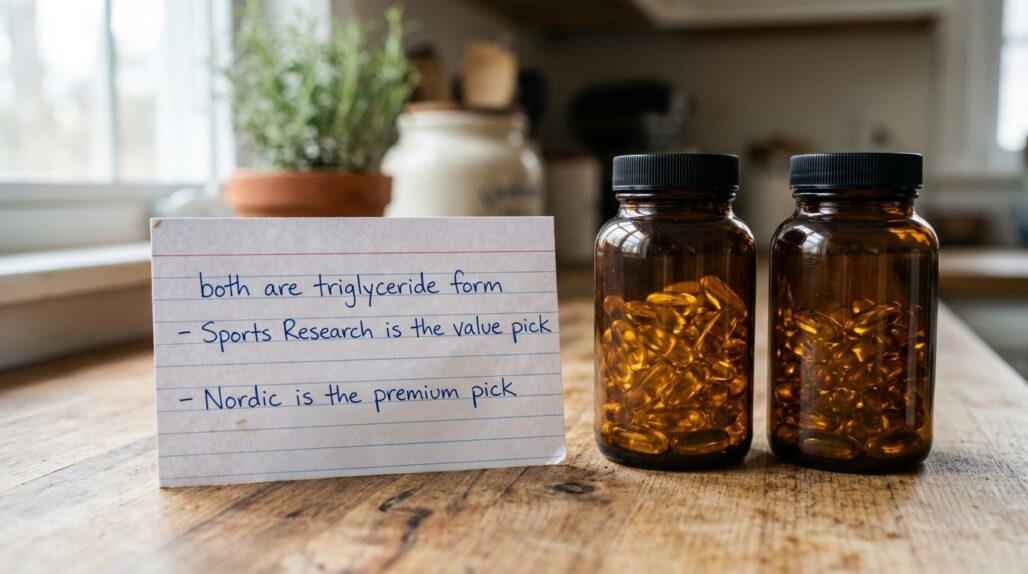
Nordic Naturals Ultimate Omega and Sports Research Triple Strength both use the triglyceride molecular form, which absorbs a little better than the cheaper ethyl-ester oils many drugstore brands use. So you are not choosing between a "good" and a "bad" oil. You are choosing between a value pick and a premium pick that do nearly the same job.
If you take fish oil most days, small per-serving gaps add up fast. A 45-cent difference per day is over $160 a year. That is the entire decision in one number.
This is a buying guide, not medical advice. High-dose omega-3 can thin the blood and interact with anticoagulants, so if you take a blood thinner, check our drug and supplement interaction checker and talk to your doctor before starting.
What you are actually comparing
These two products are built differently, even though both end up in an amber softgel.
Nordic Naturals Ultimate Omega is a two-softgel serving. Per serving you get 1,280 mg of total omega-3s, split as 650 mg EPA and 450 mg DHA, made from wild-caught sardines and anchovies. The oil is delivered in re-esterified triglyceride and triglyceride form, per the brand's official Ultimate Omega page.
Sports Research Triple Strength packs its dose into one larger softgel. Each softgel carries about 1,040 mg of omega-3s, with roughly 690 mg EPA and about 260 to 310 mg DHA depending on the batch and listing, sourced from wild Alaska pollock using the AlaskOmega concentrate, per the Sports Research product page.
Two things jump out. First, Sports Research leans heavily toward EPA, the omega-3 most studied for heart and mood support. Second, it hits a near-1-gram dose in a single capsule, while Nordic Naturals needs two softgels to reach a comparable number.
That single-versus-double-softgel detail matters more than it sounds. If swallowing pills is a chore, one bigger capsule a day may beat two smaller ones – or it may be the reverse if a large softgel is hard for you to get down.
Why triglyceride form matters (and why it is not magic)
You will see both brands brag about being "triglyceride form." Here is the honest version.
Triglyceride-form omega-3 is the shape fish oil takes naturally, and your body absorbs it somewhat more efficiently than the synthetic ethyl-ester form. A 2010 bioavailability study and later trials found re-esterified triglyceride oils raised blood EPA and DHA more than ethyl esters did. One often-cited randomized trial on membrane incorporation examined how re-esterification affects uptake into cell membranes.
But the NIH Office of Dietary Supplements omega-3 fact sheet is blunt about the size of the effect: every form, including ethyl esters, significantly raises plasma EPA and DHA. Triglyceride form has an edge, not a monopoly.
So the takeaway is simple. Since both products here are already triglyceride form, that talking point is a wash between them. It does not break the tie. The price does.
For a deeper look at how the forms stack up against each other and against krill, see our breakdown of omega-3 TG vs EE vs krill bioavailability.
The numbers side by side
Here is where the decision actually gets made. Note that prices move, so treat these as ballpark figures – always check current price before you buy.
| Dimension | Nordic Naturals Ultimate Omega | Sports Research Triple Strength |
|---|---|---|
| Serving size | 2 softgels | 1 softgel |
| EPA per serving | 650 mg | ~690 mg |
| DHA per serving | 450 mg | ~260-310 mg |
| Total EPA+DHA per serving | ~1,100 mg | ~950-1,000 mg |
| Molecular form | Triglyceride (rTG/TG) | Triglyceride (rTG) |
| Fish source | Sardines, anchovies | Wild Alaska pollock |
| Approx. price per serving | ~$0.72 | ~$0.29 |
| Approx. cost per gram EPA+DHA | ~$0.65 | ~$0.24 |
| Flavor | Lemon, low burp | Burpless, no added flavor |
Read that bottom row again. On cost per gram of usable omega-3, Sports Research costs roughly a third of what Nordic Naturals does. The two deliver a similar daily EPA-plus-DHA load, so you are buying nearly the same outcome for very different money.
Nordic Naturals does give you more DHA per serving, which matters more for brain and eye support and during pregnancy. If DHA is your specific goal, that narrows the gap.

Third-party testing and freshness
This is the one place Nordic Naturals earns part of its premium, and it is worth understanding the difference.
Sports Research markets an IFOS 5-star rating on its Triple Strength oil. IFOS, run by the lab Nutrasource, tests batch by batch for omega-3 content, contaminants, and oxidation, and publishes the results. The Nutrasource IFOS program page explains that a 5-star rating means the oil meets the strictest freshness and purity thresholds. A current IFOS report is the strongest single proof a fish oil is fresh and clean – if it matters to you, look up the exact lot before buying.
Nordic Naturals takes a different route. It does not stamp an IFOS 5-star logo on Ultimate Omega. Instead it publishes a certificate of analysis for every batch, holds Friend of the Sea certification for sustainability, and appears in the Nutrasource certified-products listing. The transparency is real; the specific seal is just different.
The practical verdict: both are well-tested, mainstream-clean oils. Neither one is the right place to worry about contaminants. Freshness comes down to how fast you go through the bottle and storing it cool, not which brand you pick.
Cost per serving and who should buy which
Let's turn the price into a yearly number, because that is how this lands in real life.
- Sports Research at about $0.28 to $0.30 a day runs roughly $105 a year.
- Nordic Naturals at about $0.72 a serving runs roughly $263 a year.
That is close to a $155 annual gap for a daily user, in exchange for lemon flavor, more DHA, and a brand you have heard of. For most people, the value math points hard at Sports Research.
There are real reasons to pay up for Nordic Naturals, though:
- You want noticeably more DHA per serving, for brain, eye, or prenatal reasons.
- You strongly prefer a lemon-flavored, easy-burp softgel and find the brand easier to swallow.
- You want a household name backed by a long published-testing history and do not mind paying for it.
And there are clear reasons to choose Sports Research:
- You take fish oil every day and care about the long-run cost.
- You want one capsule, high EPA, rather than two smaller softgels.
- You are happy to verify the IFOS lot yourself and pocket the difference.
If you want the full case on the premium pick on its own, read our standalone look at whether Nordic Naturals Ultimate Omega is worth it.

Top picks
For a daily, value-first fish oil, Sports Research Triple Strength is the pick – high EPA, one softgel, lowest cost per gram. Choose Nordic Naturals Ultimate Omega if more DHA, flavor, or the brand reassurance is worth the higher price to you.


As an Amazon Associate, UsefulVitamins.com earns from qualifying purchases at no extra cost to you.
We may earn a commission from purchases made through links on this page, at no extra cost to you. This never changes our verdicts.
A quick reminder before you add either to cart: fish oil at these doses can interact with blood thinners and some blood-pressure medicines. Run your full list through the ultimate drug and supplement interactions guide if you take any prescription daily.
FAQ
Is Nordic Naturals or Sports Research better for the heart? Both supply EPA and DHA in absorbable triglyceride form, so either works for general heart support. Sports Research is more EPA-heavy, which is the omega-3 most studied for cardiovascular and mood outcomes, while Nordic Naturals gives you more DHA per serving.
Which is cheaper per gram of omega-3? Sports Research, by a wide margin. It runs around $0.24 per gram of EPA plus DHA versus roughly $0.65 for Nordic Naturals as of writing, so it is close to a third of the cost for a similar daily dose. Check current prices, since they move.
Are both triglyceride form? Yes. Nordic Naturals uses re-esterified and natural triglyceride oil, and Sports Research uses the AlaskOmega re-esterified triglyceride concentrate. Because both are already in this better-absorbed form, that feature does not separate them.
Is Sports Research really IFOS 5-star? Sports Research markets an IFOS 5-star rating on its Triple Strength oil. Ratings are issued batch by batch, so if it matters to you, look up the report for your specific lot on the Nutrasource site before relying on it.
Does Nordic Naturals not being IFOS-stamped mean it is lower quality? No. Nordic Naturals publishes a certificate of analysis for every batch and holds Friend of the Sea certification; it simply uses its own testing program rather than the IFOS seal. Both products are mainstream-clean oils.
Can I take fish oil with my medications? Often yes, but high-dose omega-3 can increase bleeding risk with anticoagulants and may affect blood pressure. Check our interaction tools and ask your doctor or pharmacist before starting.
The verdict
Strip away the marketing and this comes down to one honest line: two genuinely good triglyceride-form fish oils, priced very differently for a similar result.
Buy Sports Research Triple Strength if you take fish oil daily and want the most omega-3 for your money – high EPA, one capsule, roughly a third the cost per gram. For a regular user, that is the smart default and the one we recommend.
Buy Nordic Naturals Ultimate Omega if you specifically want more DHA, prefer the lemon-flavored softgel, or value the brand's long testing history enough to pay the premium. It is not overpriced for what it is; it is just the more expensive way to hit a similar number.
Next step: pick based on your real priority – cost or DHA – then verify the current price and, if you take any prescription, run it through the drug and supplement interaction checker before your first dose.
This article is for general information only and is not medical advice. Supplements can interact with medications and health conditions. Talk to your doctor or pharmacist before starting any new supplement.
Reviewed by the UsefulVitamins Editorial Team.
