
Affiliate disclosure: this article contains affiliate links. As an Amazon Associate, UsefulVitamins.com earns from qualifying purchases at no extra cost to you.
Before you buy
The real decision here is not "marine versus collagen." It is whether you will actually take a clinically meaningful dose, every day, for long enough to judge it. Marine collagen is Type I, the kind that dominates skin, and the peptides tend to be small and well-absorbed. That is the good part.
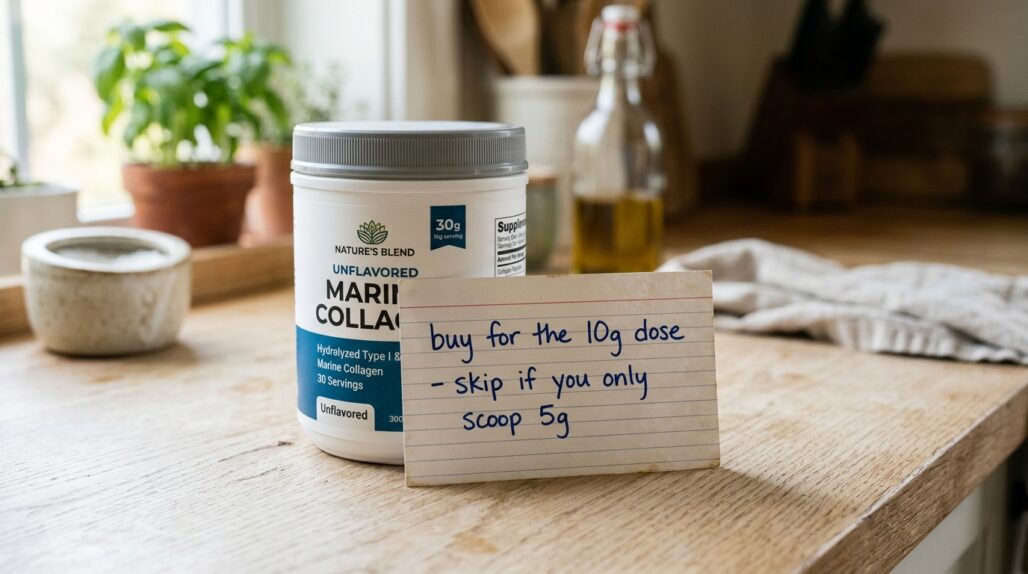
The catch is that skin trials use roughly 2.5g to 10g a day for 8 to 12 weeks, and most of the better-known results sit at the 10g end. A tub that looks cheap can quietly cost more if its "serving" is only 5g and you have to double-scoop to match the research.
So the question worth answering before you add anything to a cart is simple. Will you hit 10g daily for three months? If yes, buy on cost per 10g serving and pick a powder that mixes cleanly. If you are not sure you will stay consistent, a cheaper bovine peptide will get you most of the skin benefit for less money.
This guide ranks three popular Amazon-available marine picks on what matters for skin: dose, sourcing, taste, testing, and the only number that decides value, cost per real serving.
Why marine collagen for skin
Skin is mostly Type I collagen, and marine collagen is almost entirely Type I. Bovine peptides give you a Type I and III mix, which is also fine for skin, but if you want the cleanest match to what your dermis is made of, fish-derived peptides are the closer fit.
Marine peptides also tend to be lower molecular weight, meaning shorter chains that dissolve and absorb easily. That is partly marketing and partly real chemistry; hydrolyzed peptides under about 3 kDa mix into water without clumping and carry less of a lingering aftertaste.
The other reason people choose it is dietary. Marine collagen is pescatarian-friendly and works for people who avoid beef or pork on religious or personal grounds. If that describes you, this is the category to shop, and our broader collagen alternatives roundup covers the non-fish options if you change your mind.
One honest caveat up front. Marine collagen is not magic for wrinkles, and the research is more modest than the ads suggest. Here is what the trials actually found.
What skin trials actually used
The dose that shows up most often in skin research is 10g of hydrolyzed collagen daily. A randomized, triple-blind, placebo-controlled trial published in the Journal of Cosmetic Dermatology gave participants 10g of hydrolyzed collagen daily for 12 weeks and reported a 35% reduction in wrinkle score from baseline, with a smaller but significant edge over placebo on facial measurements.
Elasticity is a weaker story. In that same trial, overall elasticity improvement was not statistically significant between the collagen and placebo groups. A subgroup of women aged 45 to 54 did see meaningful gains, which suggests older skin may respond more, but that is a smaller slice of evidence.
Step back to the bigger picture and the message holds. Systematic reviews of collagen and skin aging, including work published in journals like the American Journal of Medicine, find modest improvements in hydration and elasticity with consistent daily use, not dramatic reversal. Many of the underlying studies are industry-funded, so read the bold "before and after" claims with healthy skepticism.
The practical takeaways for shopping:
- Aim for 10g a day if you want to match the stronger results; 2.5g to 5g may help hydration but the evidence thins out.
- Give it 8 to 12 weeks before deciding. Skin turnover is slow.
- A powder is only worth buying if you will take it consistently at that dose.
Collagen is broadly considered safe, and the FDA regulates supplements for safety and labeling but does not verify that any skin claim on the tub is true. That is on you to vet.
Top marine picks compared
Three powders cover most of the demand: Vital Proteins Marine, Further Food Wild-Caught Marine, and Amandean Premium Marine. All three are hydrolyzed, wild-caught, and Type I (Further Food labels Types I, II and III). They differ most on serving size, tub size, and price, which is exactly where value is won or lost.
Here is how they stack up. Prices are approximate, as of writing – check current price, since collagen pricing moves often and Subscribe and Save changes the math.
| Product | Collagen per serving | Tub size | Approx. price | Approx. cost per 10g | Sourcing and testing |
|---|---|---|---|---|---|
| Amandean Premium Marine | 10g per scoop | 500g, ~50 servings | ~$48 (from ~$55) | ~$0.96 | Wild-caught North Atlantic whitefish; third-party lab tested |
| Vital Proteins Marine | ~10-12g per serving | 7.8 oz or 14.5 oz | ~$39 / ~$59 | ~$1.40-1.80 | Wild-caught white fish; Non-GMO Project Verified per listing |
| Further Food Wild-Caught | ~12g per serving | ~168g, ~14 servings | ~$30 (sub lower) | ~$1.80-2.10 | Wild-caught North Atlantic cod; cGMP, third-party tested |
Amandean Premium Marine – the value top pick
Amandean is the one that does the dose math in your favor. A 500g tub runs around $48 (down from about $55), with 10g per scoop and roughly 50 servings (as of writing; check current price). That puts you near $0.96 per studied 10g serving, the cheapest real serving of the three.
The collagen is wild-caught North Atlantic whitefish (cod, pollock, haddock and hake), it is Type 1 and 3, and the brand says batches are third-party lab tested. It mixes cleanly and is unflavored, with the usual faint marine note. If you are going to take 10g daily for three months, this is the one we would buy first.
Vital Proteins Marine – the easy default
Vital Proteins is the brand most people already trust and the easiest to find in stores. Per the official product page, the 7.8 oz tub is around $39 and the 14.5 oz is around $59, and the powder is Non-GMO Project Verified per its Amazon listing, sourced from wild-caught white fish.
The downside is value. The small tub is expensive per gram, and even the larger size runs roughly $1.40 to $1.80 per 10g depending on which you buy. Buy it if convenience and brand trust matter more than squeezing the price, and lean toward the 14.5 oz size with Subscribe and Save. For the standard bovine line, see how it compares in our NativePath versus Vital Proteins breakdown.
Further Food Wild-Caught – good, but a small tub
Further Food earns points for transparency. It is wild-caught North Atlantic cod, the brand states it is cGMP-made and consistently third-party tested, and it carries Non-GMO and Kosher claims. Solubility is good and the taste is mild.
The problem is the tub. At around $30 for roughly 168g, you get only about 14 servings, so the cost per real 10g serving climbs to the top of this group. Pick it for the testing transparency or a single-pack trial, but for daily long-term use the larger Amandean tub is the cheaper habit.


As an Amazon Associate, UsefulVitamins.com earns from qualifying purchases at no extra cost to you.
UsefulVitamins is reader-supported. We may earn a commission from purchases made through the links below, at no extra cost to you. This never changes our rankings or verdicts.
Sourcing, taste, and sustainability
All three use wild-caught cold-water fish (cod, pollock, whitefish), which is the cleaner end of marine sourcing and tends to carry a milder odor than warm-water or scale-heavy collagen. None of these three is labeled as MSC-certified at the time of writing, so if certified-sustainable sourcing is a dealbreaker, look specifically for an MSC mark on the tub rather than assuming "wild-caught" means certified.
On taste, marine collagen has a reputation for a fishy note, and it is fair but overstated for these. Hydrolyzed peptides this small dissolve well in coffee, smoothies, or juice, where any faint marine flavor disappears. Plain water is where you might notice it.
A few practical notes:
- Take it with or without food, hot or cold; heat does not destroy hydrolyzed peptides.
- Pair with vitamin C if you like; some trials combined collagen with vitamin C, though the independent effect is unproven.
- If the marine taste bothers you in water, mix it into something with flavor and the problem usually goes away.
If you want to see how marine stacks up against a popular bovine option on price and mixability, our Vital Proteins versus Sports Research comparison is the closest head-to-head.
Cost per serving and the top pick
Value comes down to dollars per real 10g serving, not the sticker price. By that measure the order is clear.
- Amandean is the value winner at roughly $0.96 per 10g serving.
- Vital Proteins (large tub) lands in the middle, near $1.40 to $1.80.
- Further Food is the priciest per serving here, mostly because the tub is small.
If your budget is the deciding factor and you do not need a fish source, know that a bovine peptide is usually cheaper per gram and works for skin too. We walk through the cheapest reliable options in our budget collagen alternatives guide, and a budget Amazon-native brand gets a full workup in our Live Conscious Beyond Collagen review.
For a marine pick specifically, Amandean is the top choice: studied dose per scoop, third-party tested, and the lowest cost per serving of the group.

FAQ
What is the best marine collagen powder for skin? For most people the best marine pick is Amandean Premium Marine, because it gives you the studied 10g per scoop, is third-party tested, and costs the least per real serving. Vital Proteins is the more convenient default if you value brand familiarity over price.
How much marine collagen should I take for skin? Skin trials most often use about 10g of hydrolyzed collagen daily, taken for 8 to 12 weeks. Lower doses around 2.5g to 5g may help hydration, but the stronger wrinkle and elasticity results cluster at the 10g dose.
Is marine collagen better than bovine collagen for skin? Marine collagen is almost entirely Type I, which matches what skin is mostly made of, and its peptides tend to be small and well-absorbed. Bovine collagen gives a Type I and III mix and works for skin too, usually at a lower cost per gram.
Does marine collagen taste fishy? Hydrolyzed marine peptides from cold-water fish are mild and dissolve well, so any fishy note is faint and mostly disappears in coffee, a smoothie, or juice. You are most likely to notice it in plain water.
How long until marine collagen works for skin? Plan on 8 to 12 weeks of daily use before you judge it, since skin turnover is slow. The clearer trial results, such as a 35% wrinkle-score drop from baseline, were measured at 12 weeks.
Is marine collagen safe? Collagen is generally well tolerated, and the FDA regulates supplements for safety and labeling. It does not verify skin claims on the label, and anyone with a fish allergy should avoid marine collagen entirely.
The verdict
Marine collagen is a reasonable, evidence-backed pick for skin, with the honest caveat that the benefits are modest improvements in hydration and elasticity over months, not a wrinkle reset. The category works only if you take a real dose consistently.
Among the three popular Amazon-available powders, Amandean Premium Marine is the top pick: 10g per scoop, wild-caught whitefish, third-party tested, and the lowest cost per studied serving. Vital Proteins is the convenient, brand-trusted default if you would rather grab a familiar tub, and Further Food is a fine, well-tested choice held back only by its small size.
Your next step is simple. Decide whether you will hit 10g a day for three months. If yes, buy Amandean and give it 12 weeks. If you are unsure you will stay consistent, save your money and start with a cheaper bovine peptide instead.
This article is for general information and is not medical advice. Supplements are not evaluated by the FDA for the treatment or prevention of any condition. Talk to a qualified clinician before starting any new supplement, especially if you are pregnant, nursing, taking medication, or have a fish allergy.
Reviewed by the UsefulVitamins Editorial Team.
