
Affiliate disclosure: this article contains affiliate links. As an Amazon Associate, UsefulVitamins.com earns from qualifying purchases at no extra cost to you.
Before you buy
The real question with Just Thrive is not whether it "works." It is whether you need the specific thing it does well, which is survive the trip through your stomach.
Most probiotics on the shelf are Lactobacillus and Bifidobacterium strains. Those are fine bacteria with plenty of research behind them. The catch is that a chunk of the live cells die in stomach acid before they reach your gut, which is why so many standard probiotics are sold refrigerated and dosed at tens of billions of CFU to compensate.
Just Thrive uses Bacillus spores instead. Spores are dormant, shelled, and built to shrug off acid and heat, so the company can sell a low-count, shelf-stable capsule and still claim a high percentage arrives alive. That is the entire pitch.
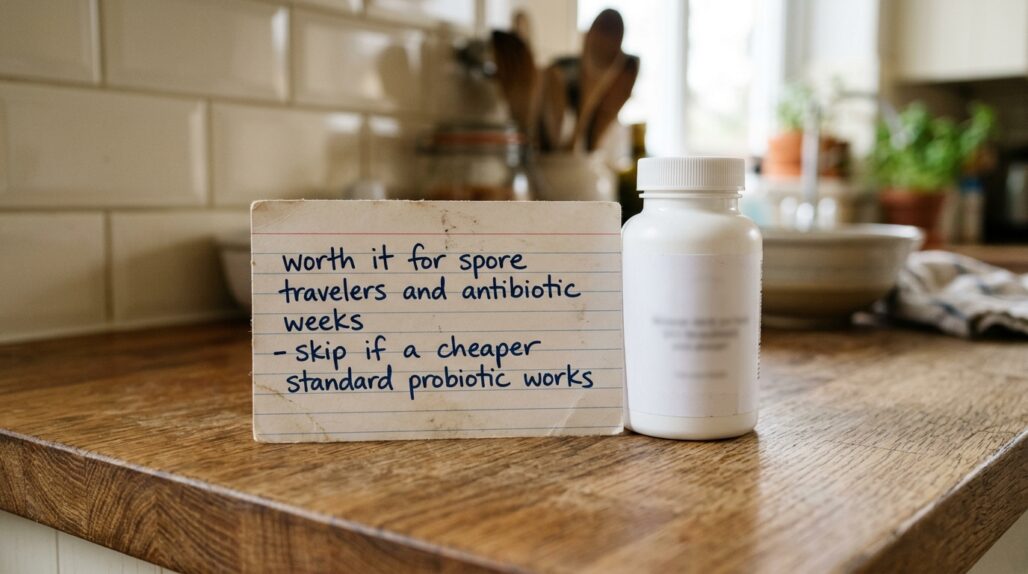
So before you pay premium money, decide which camp you are in. If you want plain daily gut support and your current probiotic agrees with you, you probably do not need to switch. If you travel constantly, keep forgetting the fridge bottle, or want something steady through an antibiotic week, the spore design is a real reason to look closer.
What spore-based probiotics actually are
A spore-based probiotic uses Bacillus species rather than the more familiar Lactobacillus and Bifidobacterium. The difference matters more than the marketing makes it sound.
Bacillus strains form endospores – a tough protective coat that keeps the organism dormant until it hits the right conditions in your intestine. That coat is why these strains can sit on a warm shelf for months and pass through stomach acid largely intact.
According to the NIH Office of Dietary Supplements probiotics fact sheet, probiotic effects are strain-specific, not class-wide. In other words, "spore-based" is not automatically better than "Lactobacillus." It is better at one thing: surviving the journey. Whether that survival translates into a benefit you feel depends on the exact strains and what you are using them for.
A 2024 review in the journal Fermentation on Bacillus subtilis applications makes the same point – spore-formers have clearly superior shelf and gastric stability, but the actual health effect is strain- and indication-specific. Hold onto that, because it is the honest frame for everything below.

What is inside Just Thrive
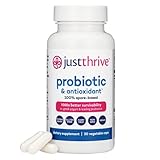
Just Thrive Probiotic is a four-strain blend delivering 3 billion cells per capsule, one capsule a day with your largest meal. That CFU number looks tiny next to a 60-billion Lactobacillus product, and that is intentional – the company's argument is that more spores survive, so you need fewer.
The four strains, per the official Just Thrive product page:
- Bacillus subtilis HU58 – the strain with the most human data in this blend.
- Bacillus coagulans (SC-208) – studied alongside HU58 for digestive support.
- Bacillus clausii (SC-109) – notable for tolerating some antibiotics.
- Bacillus indicus HU36 – marketed for producing antioxidants and carotenoids in the gut.
The capsule is vegan (cellulose), and the brand lists it as non-GMO, gluten-free, dairy-free, soy-free, and nut-free. It is made in a GMP-certified facility, which speaks to manufacturing process, not to independent testing of the finished bottle.
One honest note: the formula is sold as a proprietary blend, so the brand publishes the total 3 billion cells but not the exact split per strain. That is common in this category, but it does mean you are trusting the brand's ratios rather than reading them off the label.
The evidence behind the strains
This is where Just Thrive holds up better than a lot of premium probiotics. The two lead strains have real human and lab data, not just brand testimonials.
A randomized, double-blind, placebo-controlled trial published in Beneficial Microbes tested B. subtilis HU58 in children with antibiotic-associated diarrhea and reported improvements in stool consistency and gastrointestinal wellbeing over a placebo. Separately, work published in the journal Microorganisms using an M-SHIME gut model found the HU58 plus coagulans SC208 combination reduced markers of antibiotic-induced microbiome disruption.
What that evidence does and does not say:
- It supports the antibiotic-disruption use case reasonably well.
- It does not prove the broad "fixes everything" claims you see in social media clips.
- Most of the strongest data is on the two lead strains, not equally across all four.
So the science is above average for the category, but it is not a reason to expect a miracle. Treat it as solid support for gut resilience during stress, and as preliminary for general daily wellness.
Shelf stability and the no-fridge advantage
This is the part that is unambiguously true and genuinely useful. Because the strains are spores, Just Thrive needs no refrigeration and tolerates heat.
You can leave it in a hot car, a gym bag, or a checked suitcase and it stays viable. You can break a capsule into a smoothie, or bake with it, without killing the dose. For a refrigerated Lactobacillus product, that same treatment would wreck a meaningful share of the live cells.
If you travel, work out of a bag, or simply will not babysit a fridge bottle, the convenience is real and hard to put a price on. It is the single best practical reason to choose this over a standard refrigerated probiotic. If your current probiotic already lives happily in a cupboard, this advantage shrinks.
What it costs vs a standard probiotic
Here is the uncomfortable math. Just Thrive runs around $49.99 for a 30-capsule bottle one-time, or roughly $45 on subscription, as of writing – check the current price. At one capsule a day, that is about $1.50 to $1.67 per serving.
A well-reviewed standard multi-strain probiotic costs a fraction of that. A 60-billion-CFU bottle from a major Amazon brand often lands near $0.40 to $0.80 per serving after coupons or Subscribe and Save.
| Factor | Just Thrive Probiotic | Typical standard multi-strain |
|---|---|---|
| Bacteria type | Bacillus spores (4 strains) | Lactobacillus / Bifidobacterium (10+ strains) |
| CFU per dose | 3 billion cells | 25 to 60 billion CFU |
| Survives stomach acid | High (spore shell) | Variable, often acid-protected capsule |
| Refrigeration | Not needed | Often required for live count |
| Cost per serving | ~$1.50 to $1.67 | ~$0.40 to $0.80 |
| Best fit | Travel, antibiotics, no-fridge life | Everyday general gut support |
The 3-billion versus 60-billion gap is not the gotcha it looks like, because CFU only counts cells in the bottle, not cells that reach your gut alive. But the price gap is real, and over a year it adds up to a few hundred dollars.

Value pick and cheaper alternatives
If you want the spore design, Just Thrive is a defensible buy and the lead strains have data behind them. For most people chasing general daily gut support, a cheaper standard probiotic does the job for less, and a shelf-stable standard formula closes much of the convenience gap too.

As an Amazon Associate, UsefulVitamins.com earns from qualifying purchases at no extra cost to you.
UsefulVitamins may earn a commission from qualifying purchases made through links on this page, at no extra cost to you. This never changes our verdicts.
A few honest ways to think about the swap:
- Want spores specifically? Just Thrive is the cleaner, better-documented spore product than most. It earns its slot here.
- Want value daily support? A 10-strain, 60-billion standard probiotic at well under a dollar a dose covers most general goals. See how the categories differ in our prebiotics, probiotics, and synbiotics breakdown.
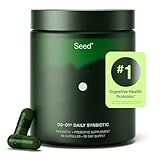
- Want a premium synbiotic with a prebiotic built in? That is a different design from spores, and we compare the two head to head in Just Thrive vs Seed DS-01.
If your real question is "spore or strain-heavy synbiotic," it is worth reading the Ritual Synbiotic+ vs Seed DS-01 comparison before you commit, since those pick a very different path from Just Thrive. And for a low-cost Amazon staple that many people do fine on, our Physician's Choice probiotic review lays out the budget case plainly.
FAQ
Is Just Thrive worth the price? It is worth it if you specifically want a spore-based, no-fridge probiotic or you take it through antibiotic courses. For plain daily gut support, a standard probiotic at a third of the cost is the smarter buy.
Why is the CFU count only 3 billion? Spores survive digestion far better than fragile Lactobacillus, so Just Thrive argues fewer cells reach the gut alive at a lower count. High-CFU standard products dose big partly to make up for cells lost in stomach acid.
Does Just Thrive really survive stomach acid? The spore shell does make these Bacillus strains highly acid- and heat-resistant, which is well established for spore-formers. The brand’s exact 100 percent survival figure comes from company-commissioned testing, so treat the headline number as a marketing claim built on a real biological advantage.
Can I take it during antibiotics? The lead strains have data in antibiotic-associated diarrhea, and Bacillus clausii is noted for tolerating some antibiotics. Still, ask your doctor or pharmacist about timing, since antibiotics and probiotics interact and your situation may differ.
Does it need refrigeration? No. Shelf stability is its strongest practical feature – it tolerates heat, travel, and even baking without losing potency, unlike many refrigerated Lactobacillus products.
Is it third-party tested? Just Thrive states it is made in a GMP-certified facility and is non-GMO and allergen-friendly, but we did not find an independent NSF or USP certification seal on the product as of writing. Confirm current testing claims on the brand page before buying.
The verdict
Just Thrive is one of the more credible premium probiotics out there. The spore design is genuinely acid- and heat-resistant, the no-refrigeration convenience is real, and the two lead strains have actual human and lab data rather than only testimonials.
But credible is not the same as necessary. At about $1.50 to $1.67 per capsule, you are paying three to four times a solid standard probiotic for an advantage that only matters if survivability, shelf stability, or antibiotic-week resilience is your actual goal.
Buy Just Thrive if you want spores on purpose. If you just want everyday gut support, start with a cheaper standard probiotic and only move up if it does not agree with you. Either way, run a new probiotic past your clinician if you are pregnant, immunocompromised, or on antibiotics.
Remember that supplements are regulated as food, not drugs, by the FDA's dietary supplement framework, so the burden is on you to match the product to the goal.
This article is for general information only and is not medical advice. Supplements are not intended to diagnose, treat, cure, or prevent any disease. Talk to a qualified healthcare provider before starting any probiotic, especially if you are pregnant, nursing, immunocompromised, or taking medication.
Reviewed by the UsefulVitamins Editorial Team.
