
Affiliate disclosure: this article contains affiliate links. As an Amazon Associate, UsefulVitamins.com earns from qualifying purchases at no extra cost to you.
Before you buy
The real question with MaryRuth's is not whether it is a "good brand." It is whether a liquid at 2 billion CFU is the right tool for your actual goal.
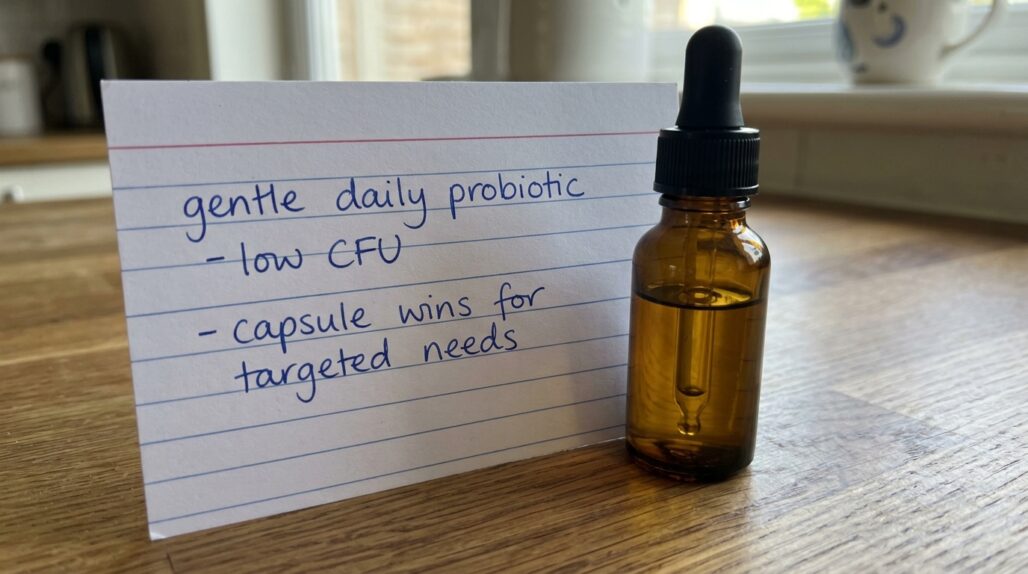
Most people buy a probiotic for one of two reasons. Either they want a light daily habit for general gut health, or they are trying to fix something specific – gas, bloating, irregularity, or rebuilding after antibiotics. MaryRuth's is built for the first group and stretched thin for the second.
If you are shopping for a child who cannot swallow capsules, or you simply dislike pills, this is a reasonable pick. If you have a defined complaint, the dose is the deciding factor, and there are cheaper capsules that hit harder.
This review covers what is actually inside the bottle, what the "up to 2 billion CFU" label really means, what the strains have evidence for, the cost per serving against capsule rivals, and the honest call on who should buy it.
What MaryRuth's Liquid Probiotic actually is
MaryRuth Organics sells an Organic Liquid Probiotic in 2 oz and 4 oz dropper bottles. It is an oil-based liquid – the carrier is organic medium-chain triglyceride oil plus organic alfalfa grass – not a water-based drink.
The headline spec on the official MaryRuth Organics product page is "up to 2 billion CFU per serving" across 13 strains, all listed as a single proprietary blend led by Bacillus coagulans Unique IS-2.
The dose scales by age:
- Ages 1 to 3: 0.75 mL
- Ages 4 to 13: 1.5 mL
- Ages 14 and up: 3 mL
That age-scaled design is the product's real strength. One bottle covers a whole household, including young children, which is unusual. It is vegan, dairy-free, gluten-free, soy-free, and unflavored, so it mixes into water or juice without a fight.
The catch is in the wording. "Up to" 2 billion CFU is a ceiling, not a guarantee. It describes potency at manufacture, and live cultures in a liquid lose viability over time faster than freeze-dried cultures in a capsule.

The CFU question – why "up to 2 billion" is the whole story
Here is the part that decides whether this product is right for you.
Two billion CFU is low by current standards. A typical drugstore capsule runs 10 billion, and popular Amazon bottles advertise 50 to 60 billion. So why does MaryRuth's sit so far below them, and does it matter?
It matters less than the big numbers suggest, but it still matters. The NIH Office of Dietary Supplements is clear that a probiotic's effect is strain-specific and condition-specific – the right strain at a modest dose can beat a huge dose of the wrong strain. A bigger CFU number is not automatically better.
But there are two real problems here.
First, the format works against the count. Live cultures suspended in a liquid decline faster than dormant freeze-dried cultures sealed in a capsule. Manufacturers like NOW Foods note that CFU counts fall over shelf life, and the rate climbs once a bottle is opened and stored warm. So the "up to 2 billion" you start with quietly drifts downward across the weeks you use the bottle.
Second, the proprietary blend hides the per-strain dose. With 13 strains splitting a 2 billion CFU pool, no single strain is present at a researched, effective amount. You are getting a sprinkle of many things rather than a meaningful dose of one studied strain. That is fine for general maintenance and poor for targeting a specific problem.
So the honest read: this is a wellness-habit dose, not a therapeutic one.
The strains, and what they have evidence for
The 13-strain blend leans on familiar, well-tolerated species – several Lactobacillus (including acidophilus, rhamnosus, plantarum, and casei), several Bifidobacterium (lactis, longum, breve, bifidum, infantis), Streptococcus thermophilus, and the spore-forming Bacillus coagulans Unique IS-2.
A few of these have real research behind them as individual strains. The problem is the dose, not the lineup.
- Bacillus coagulans Unique IS-2 is a hardy spore-former with real single-strain evidence for bloating and IBS – its main trial gave 2 billion CFU a day on its own for 8 weeks (Madempudi 2019). The catch here is that MaryRuth's spreads that same 2 billion total across 13 strains, so the IS-2 portion is only a fraction of the studied dose.
- Lactobacillus rhamnosus has strong evidence as a standalone strain, which is exactly why Culturelle sells it at 10 billion CFU on its own. Here it is one of thirteen sharing 2 billion.
- The Bifidobacterium strains are reasonable for general gut support but, again, not dosed individually here.
If you want a strain that has been studied for a specific job, you want it named and dosed on its own, not pooled. For broad "be nice to my gut" use, the variety is fine. For a target, it is not. Our guide to picking a single-strain LGG probiotic walks through when one well-dosed strain beats a crowd.
Third-party testing and quality – this part is strong
Credit where it is due. MaryRuth's quality and testing story is better than most.
The brand reports it is USDA Organic, Non-GMO Project verified, B Corp certified, and certified by the Clean Label Project, an independent program that screens for heavy metals and other contaminants. MaryRuth's also publishes heavy-metal testing results linked from the product page.
For a category where label claims are often loose, that is a meaningful trust signal. Probiotic potency is hard for shoppers to verify, so an outside purity check and an organic certification carry weight.
It does not fix the dose problem – purity and potency are different things – but it does mean you are getting a clean, honestly made product. If contaminant testing and organic sourcing rank high for you, MaryRuth's earns points its higher-CFU rivals often cannot match.
Cost per serving vs higher-CFU capsules
This is where the value math gets uncomfortable.
At around $44.95 for the 4 oz bottle on the brand site as of writing (check current price), you get 40 adult servings – roughly $1.10 per serving for "up to" 2 billion CFU. Amazon pricing fluctuates and is often lower, so compare before you buy.
Now line it up against capsule competitors:
| Product | CFU per serving | Strains | Approx. price | Cost per serving |
|---|---|---|---|---|
| MaryRuth’s Organic Liquid Probiotic | Up to 2 billion | 13 (proprietary blend) | ~$44.95 / 40 servings | ~$1.10 |
| Physician’s Choice 60 Billion | 60 billion | 10 + prebiotic | ~$20 to $31 / 60 ct | ~$0.35 to $0.52 |
| Culturelle Digestive Daily | 10 billion | 1 (LGG) | ~$20 / 30 ct | ~$0.67 |
Prices are approximate and shift often; treat them as a snapshot, not a quote.
The pattern is hard to miss. You pay roughly twice as much per serving for a fraction of the CFU. That is the cost of the liquid format, the organic sourcing, and the household-friendly design – not extra potency.
If those features matter to you, the premium is defensible. If you just want gut bacteria per dollar, a capsule wins decisively. See how the value picks stack up in our Physician's Choice probiotic review.

Who should buy it – and who should buy something else
Buy MaryRuth's Liquid Probiotic if you fit one of these:
- You need a probiotic for a child age 4 or older and want one clean bottle the adults can share.
- You cannot or will not swallow capsules.
- You want a light, organic daily maintenance dose and value Clean Label Project testing over raw CFU count.
Buy a capsule instead if:
- You are addressing bloating, irregularity, gas, or IBS-type symptoms and want a real working dose.
- You are recovering from antibiotics and need a higher count for a defined window.
- You care most about cost per CFU – a capsule is far cheaper for far more bacteria.
Whichever way you lean, remember that format and dose should follow your goal, not the marketing. Our explainer on prebiotics, probiotics, and synbiotics helps you match the type to the job before you spend anything.
Value picks and alternatives
If MaryRuth's dose feels too light for your goal, these are the swaps worth comparing on potency and price.


As an Amazon Associate, UsefulVitamins.com earns from qualifying purchases at no extra cost to you.
Some links above are affiliate links. If you buy through them, UsefulVitamins may earn a small commission at no extra cost to you. It does not change our verdicts.
For a higher-CFU value capsule, a 10-strain, 60 billion CFU bottle with prebiotics gives you far more bacteria per dollar for general daily use. For an evidence-first single strain, an LGG capsule is the most-studied option for occasional diarrhea and antibiotic support; weigh single versus multi-strain in our Align versus Culturelle comparison. For kids or pill-avoiders specifically, MaryRuth's liquid still earns its place – the gentle format is the whole point.
FAQ
Is 2 billion CFU enough for a probiotic to work? For general daily maintenance, a low dose of well-tolerated strains can be fine, since effect depends on strain and condition more than raw count. For a specific complaint like bloating or post-antibiotic recovery, 2 billion is on the low side and a 10 to 60 billion CFU product is a better match.
Does MaryRuth’s liquid probiotic need to be refrigerated? The brand markets it as shelf-stable and travel-friendly, but live cultures in any liquid lose potency faster than freeze-dried capsules, especially once opened and stored warm. Keeping it cool and using it before the date helps preserve the count.
Can kids take MaryRuth’s Organic Liquid Probiotic? The adult and kids liquid is dosed by age starting at 1 year, which is a main reason to choose it. For infants under 1, MaryRuth’s sells a separate lower-dose infant formula, and you should check with a pediatrician before giving any supplement to a baby.
Is MaryRuth’s probiotic third-party tested? The brand reports USDA Organic, Non-GMO Project verified, B Corp, and Clean Label Project certification, and publishes heavy-metal testing. Those cover purity and sourcing; they do not independently verify the live CFU count at the time you use it.
Why is MaryRuth’s more expensive than capsule probiotics? You are paying for the liquid format, organic ingredients, and household-friendly dosing, not for higher potency. Per serving it costs roughly twice a strong capsule while delivering a fraction of the CFU.
Is the liquid format better absorbed than capsules? There is no solid evidence that a liquid probiotic is absorbed better than a capsule. The liquid’s real advantage is ease of use for kids and people who dislike pills, not superior delivery.
The verdict
MaryRuth's Organic Liquid Probiotic is a clean, gentle, well-certified product doing exactly what it was designed to do – and nothing more. The Clean Label Project testing, organic sourcing, and one-bottle-for-the-household dosing are real advantages.
But the "up to 2 billion CFU" ceiling is the headline you should not ignore. Spread across 13 strains in a liquid that loses potency over time, no single strain lands at a researched dose. That makes it a maintenance habit, not a fix.
So the honest call: buy it if you want a gentle daily or kids probiotic and value purity over potency. If you have a specific gut goal, a 10 to 60 billion CFU capsule does more for roughly half the cost per serving – start with our Physician's Choice review and match the strain to your goal before you buy.
This article is for general information only and is not medical advice. Supplements are not intended to diagnose, treat, cure, or prevent any disease. Talk to your doctor or pediatrician before starting a probiotic, especially for a child, during pregnancy, or if you have a weakened immune system or a health condition.
Reviewed by the UsefulVitamins Editorial Team.
