

First, take a breath – this is fixable
A few missed days happens to almost everyone. A stressful week, travel, a stomach bug, a bottle that ran empty before the refill came through. The gap itself is rarely the emergency. What people get wrong is the panic move that comes after: trying to make up for lost time by taking everything they skipped.
That instinct is the part worth slowing down. With most medicines, doubling or tripling up to "catch up" does not undo the missed days, and it can push the amount in your body higher than it should be. The calmer, safer reset is almost always to step back onto your normal schedule and move forward.
There is one real exception, and it matters. A handful of medications are less forgiving about gaps, and for those a quick call before you restart is the right step. We will get to exactly which ones below.
The one rule that covers most situations
Here is the rule that applies to the large majority of medicines and supplements: resume your normal schedule, and do not take extra doses to make up for the ones you missed. The U.S. Food and Drug Administration is blunt about the broader point – take your medication exactly as prescribed, and do not change how you take it without first talking to your doctor or pharmacist, according to the FDA's guidance on taking medications as prescribed.
Why does doubling up backfire? Many medicines are designed to keep a steady level in your bloodstream across the day. Two doses crammed close together can spike that level past where it belongs, which is how you trade a missed-dose problem for a side-effect or overdose problem. That is the reason "almost never double up to catch up" shows up across pharmacist guidance.
So the default reset is short:
- Stop trying to account for the missed days. They are gone, and chasing them adds risk.
- Find your next normal dose time. Take your usual amount then.
- Carry on as if the gap had not happened.
That is genuinely the whole plan for most people. The rest of this page is about the situations where that default needs a phone call first, and how to keep the gap from happening again.

The medications that need a call before you simply restart
Some medicines have a narrow margin, which means a missed stretch can matter more than it would with an everyday vitamin. The NHS Specialist Pharmacy Service, in its guidance on missed or delayed doses, groups these higher-risk medicines together precisely because generic "just take it when you remember" advice does not fit them well.
If what you missed falls into one of the groups below, call your pharmacist or prescriber before deciding how to get back on track.
| Medication group | Common examples | Why a gap changes things |
|---|---|---|
| Blood thinners (anticoagulants) | Warfarin, and direct oral anticoagulants | Clotting protection can shift quickly; restarting wrong can swing it too far either way. |
| Seizure (anti-epileptic) medicines | Lamotrigine, levetiracetam, carbamazepine | A break in the steady level can raise the chance of a breakthrough seizure. |
| Heart and blood-pressure medicines | Several rhythm and pressure drugs | Some need careful restarting rather than an abrupt jump back to a full dose. |
| Thyroid medicine | Levothyroxine | Several missed days are worth flagging so your prescriber can guide the restart. |
| Birth control pills | Combined and progestin-only pills | Missed pills can reduce pregnancy protection, and the catch-up steps are pack-specific. |
Warfarin is a clear example of why "just resume" is not universal. MedlinePlus, the consumer drug resource from the National Library of Medicine, gives specific warfarin missed-dose instructions: take the missed dose only if it is still the same day, do not take a double dose the next day to make up for it, and call your doctor if you miss a dose. That is far more particular than the everyday rule, and it is the reason guessing is the wrong approach here.
Seizure medicines sit in the same careful bucket. Brain & Life, a public resource from the American Academy of Neurology, notes in its piece on missing a medication dose that doubling up is almost never the answer, and that missing several doses is a reason to contact your doctor rather than wait and see.
If you genuinely do not know whether your medication belongs in this group, that uncertainty is itself the answer: a 90-second pharmacist call settles it. A large review of patient leaflets in NCBI/PMC found that many products give vague missed-dose advice or none at all, so not finding a clear instruction on your own paperwork is common and not a personal failing.
Where supplements fit
General supplements – a multivitamin, vitamin D, fish oil, magnesium for sleep – are usually lower-stakes to restart after a gap. You typically just begin again at your normal amount and skip the idea of catching up. There is no benefit to taking three days of vitamin D in one sitting, and for fat-soluble vitamins that is the kind of habit worth not starting.
A few supplements deserve the same caution as the medicines above, mostly because of how they interact with prescriptions. If you take something with a known interaction profile, or you are on a blood thinner, raise the restart with your pharmacist the same way you would for a prescription. When in doubt, treat it like a question, not a guess.
If you want to understand how a supplement and a prescription can affect each other, our drug and supplement interaction checker and the longer guide to drug and supplement interactions are good places to look before your call so you arrive with specific questions.
How to rebuild the routine so the gap does not repeat
Getting back on is the easy half. Staying on is where the real work is. Most gaps trace back to a missing cue, not a missing intention, so the fix is building a reliable cue rather than relying on memory.
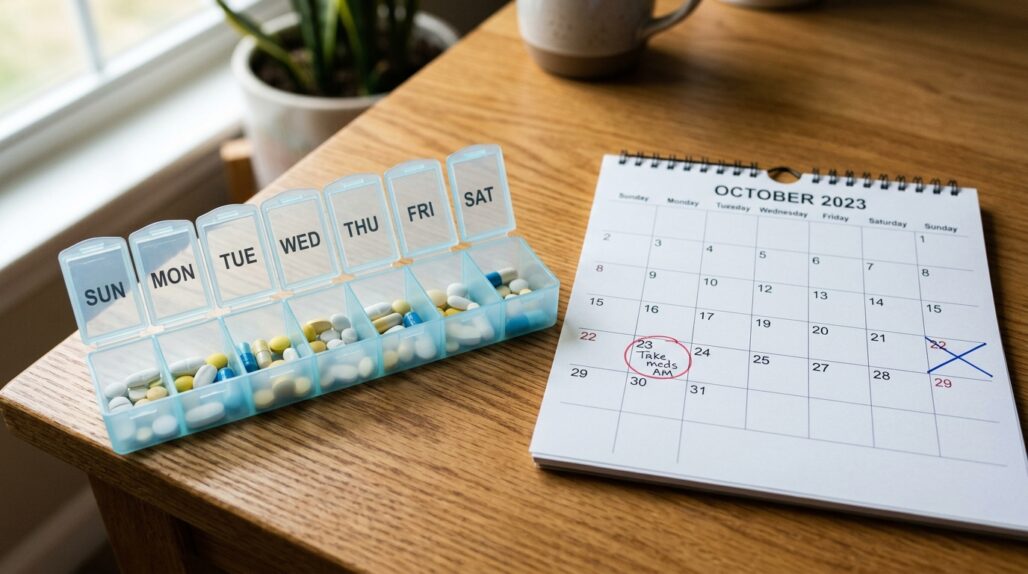
Start low-tech. A weekly pill organizer is one of the most effective tools there is, because it turns "did I take it?" into something you can see at a glance. If today's compartment is still full at bedtime, you have your answer without guessing. Fill it on the same day each week so the refill itself becomes a habit.
Next, anchor each dose to something you already do rather than to a clock you might ignore. "With my morning coffee," "right after I brush my teeth at night," "when I sit down for lunch." Anchored cues hold up far better than a standalone alarm, because the anchor happens whether or not you remember the pill.
Keep a simple log so a missed day stands out fast. This can be as plain as a paper template you tick off:
| Day | Morning dose | Evening dose | Notes |
|---|---|---|---|
| Monday | [ ] | [ ] | |
| Tuesday | [ ] | [ ] | |
| Wednesday | [ ] | [ ] | |
| Thursday | [ ] | [ ] | |
| Friday | [ ] | [ ] | |
| Saturday | [ ] | [ ] | |
| Sunday | [ ] | [ ] |
Copy that grid onto an index card, stick it where you keep your pills, and check off each dose as you take it. It costs nothing and works on day one.
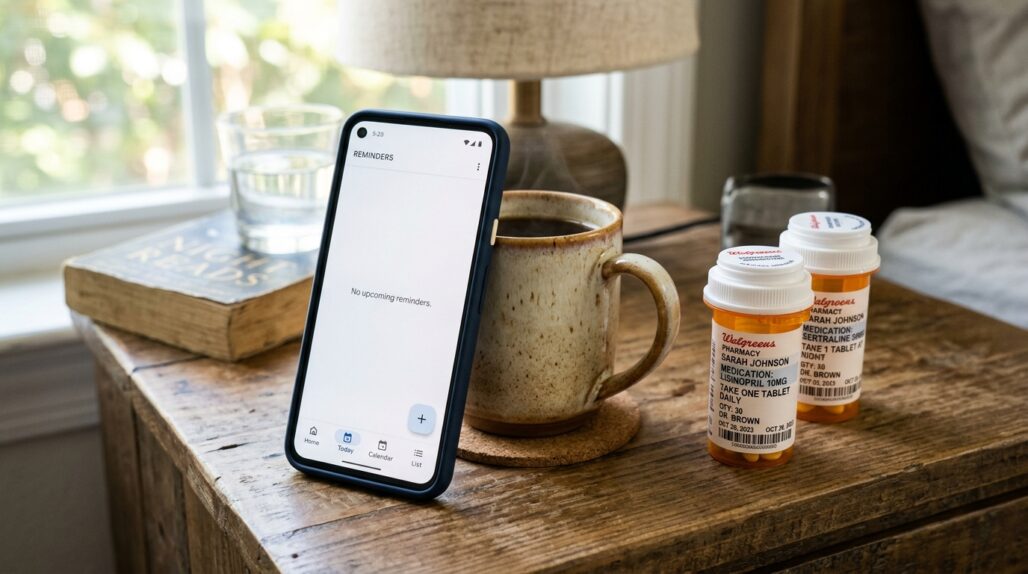
Once you are back on track, the goal is to never let a single missed day quietly stretch into a missed week. A paper log does that, and so does a phone reminder paired with the same organizer. If you would rather keep it on your phone, a dose reminder that logs each entry shows your recent history at a glance, so a missed day is obvious before it becomes a missed week – StackMyMed (our own free app) does this with simple reminders and a visible dose history, and it sits comfortably alongside the low-tech pill box rather than replacing it. For anything timing-sensitive, let the reminder prompt the action and let your pharmacist make the call on how a sensitive medication should be restarted. If a paper card on the bathroom mirror works better for you, that is a perfectly good system too.
For more on the "wait, did I already take this today?" problem, our piece on whether you took your supplement today walks through a few habit fixes, and the medication and supplement timing guide covers how to space doses sensibly once you are back in rhythm.
When the gap is the medical issue, not a habit issue
Sometimes the missed days are not a scheduling slip. If you stopped because the medication made you feel unwell, or you cannot afford the refill, or you are not sure it is still the right drug for you, that is worth a conversation rather than a quiet restart. The FDA stresses that a real connection with your prescriber or pharmacist is part of taking medicine well, and that you should raise new or unusual symptoms with them.
And if the missed medication is one you depend on daily and you feel symptoms returning, treat it as a call to make now, not a problem to solve alone at the kitchen counter. Restarting a critical daily medicine after a gap is exactly the kind of decision a professional should guide.
FAQ
Should I take all my missed pills at once to catch up? No. For the large majority of medicines, doubling or tripling up does not fix the gap and can raise the amount in your body to an unsafe level. Resume your normal dose at the next scheduled time, and call your pharmacist if you are unsure.
How many missed days is too many before I should call someone? A useful rule of thumb is that one missed dose of an everyday medicine is often something your pharmacist can talk you through quickly, while two or more missed doses in a row, especially of a sensitive medication, is a reason to call before restarting.
Which medications actually need a call before I restart? Common ones are blood thinners, certain heart and rhythm drugs, seizure medicines, thyroid medicine, and birth control pills. If you are not sure whether yours qualifies, that uncertainty is your cue to ask a pharmacist.
Is it the same for vitamins and supplements? Usually they are lower-stakes to restart, and you simply begin again at your normal amount without catching up. The exception is any supplement with a known interaction, such as alongside a blood thinner, which is worth raising with your pharmacist.
What if I missed my birth control pills for a few days? The catch-up steps depend on your specific pack and where you are in the cycle, and a gap can affect pregnancy protection. Follow the leaflet that came with your pack and confirm the steps with your pharmacist, since this is one of the timing-sensitive groups.
How do I stop this from happening again? Build a visible cue. A weekly pill organizer plus a dose anchored to something you already do, like morning coffee or brushing your teeth at night, prevents far more missed doses than memory alone.
The bottom line
A few missed days is a common, fixable situation, and the calm reset is almost always the same: step back onto your normal schedule and do not take extra doses to catch up. The single most important action is to know whether your medication is one of the timing-sensitive ones – blood thinner, heart, seizure, thyroid, or birth control – because those deserve a quick call before you restart. When you are not sure, your pharmacist can settle it in a couple of minutes, and that is always the safer choice than guessing on your own.
This article is for general information and is not medical advice. It does not replace guidance from your own pharmacist or doctor, who know your full history. Never start, stop, or change how you take a prescription on your own.
StackMyMed is made by UsefulVitamins. It helps you organize your list and flag things to discuss with a pharmacist or doctor; it is not a diagnosis or treatment tool and does not replace professional medical advice.
Reviewed by the UsefulVitamins Editorial Team.
