
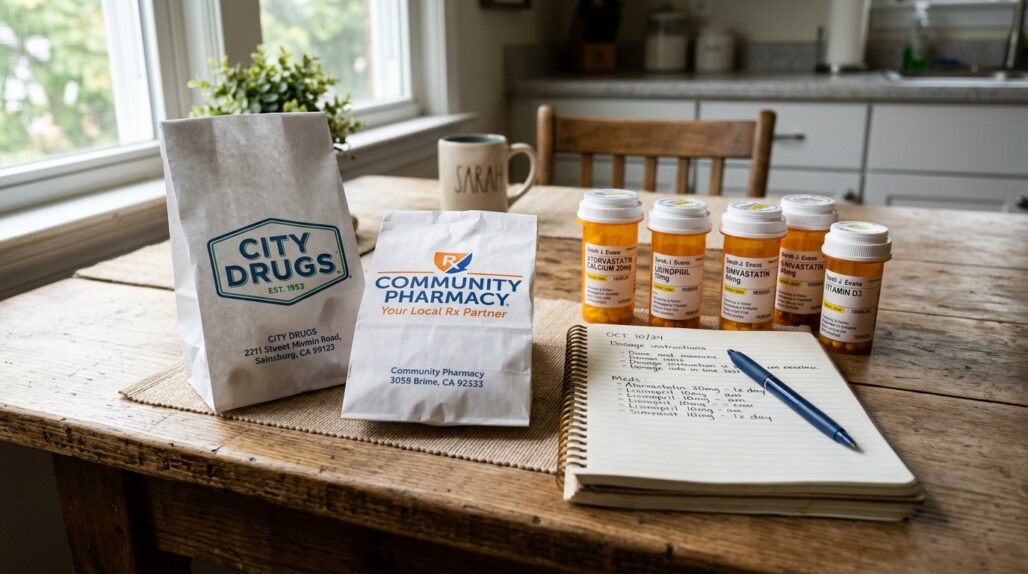
What your pharmacy actually checks
When a pharmacist fills your prescription, their software runs an automatic interaction screen. That screen is genuinely useful, and it catches a lot. But it has a quiet limit that almost nobody explains: it can only compare the new drug against the medications already recorded in that pharmacy's own system.
So if you fill your blood pressure pill at one pharmacy and a new antibiotic at another, the second pharmacy's computer may have no idea the first drug exists. The check runs, comes back clean, and looks complete. It is only complete for the drugs that one store happens to know about.
That gap is small to describe and easy to miss. It is also one of the more common ways a real interaction goes unflagged, and it is worth understanding before it affects you.
Why the gap exists in the first place
Pharmacies are not careless here. The screening tools they use are built to work from a profile, and your profile lives wherever you filled the prescription. There is no single national record that automatically pools everything you take from every source into one view.
A peer-reviewed review of interaction resources made a related point: even the best tools tend to compare drugs two at a time, and no widely available resource captures the overall risk across your full combination of medicines (drug interaction resources still leave gaps, per a review in Australian Prescriber). The software is only as good as the list it is fed.
Three things tend to stay invisible:
- Drugs filled at a different pharmacy. Each store keeps its own profile, and they rarely talk to each other automatically.
- Mail-order and specialty prescriptions. These often sit in a separate system entirely, away from your neighborhood pharmacy.
- Over-the-counter products and supplements. Fish oil, magnesium, St. John's wort, and the rest usually never get entered anywhere, even though some interact with prescription drugs.
The AHRQ patient-safety network has documented how this plays out. In one analysis of duplicate prescriptions, a key factor was that retail pharmacies were not integrated into the shared electronic record, so a medication discontinued in one place stayed active and dispensable in another (AHRQ PSNet on duplicate therapies from fragmented care). Fragmented records, not a single careless step, are usually what let things through.
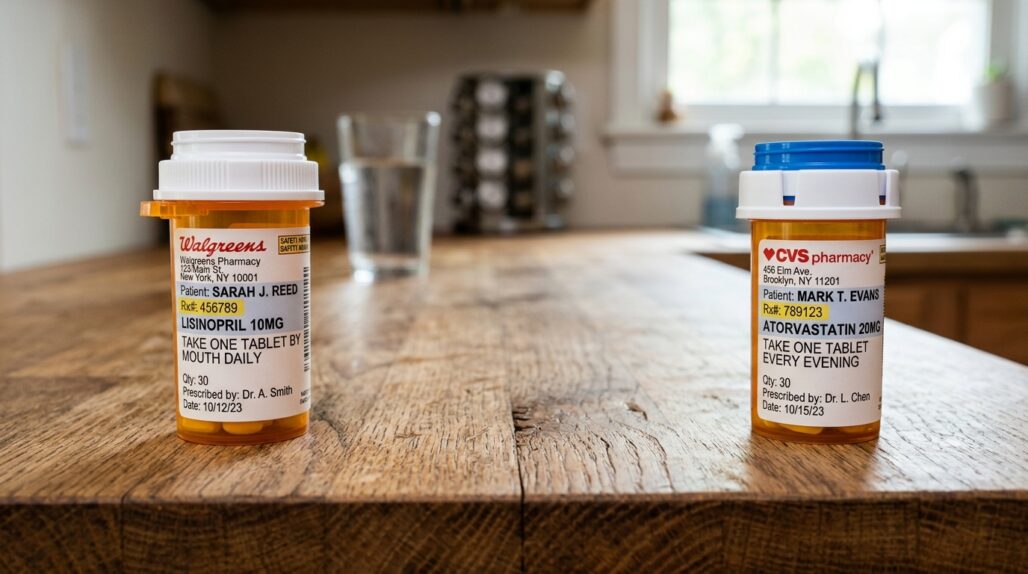
Why people end up split across two pharmacies anyway
If using one pharmacy is safer, why do so many people use two? Usually for reasons that have nothing to do with safety.
- Insurance steers you. A plan may require certain drugs through a mail-order or specialty pharmacy while everyday prescriptions go to a local store.
- A specialty drug needs a specialty pharmacy. Some medications are only stocked through specific channels.
- Convenience and price. A 24-hour pharmacy near work, a cheaper generic at a big-box store, a quick refill while traveling.
- Life changed and the list did not. People move, switch doctors, or pick up an urgent prescription somewhere new and never consolidate.
None of these are mistakes. They just mean the responsibility for seeing the whole picture quietly shifts from the pharmacy's computer to you.
How to close the gap
You have two practical paths, and they work well together.
Path one: consolidate where you can. The simplest fix is to use a single pharmacy for as many of your prescriptions as possible. When everything runs through one profile, the interaction screen has the full set to compare. The FDA makes this point plainly for consumers, noting that problems are most likely when people use more than one pharmacy, and that using one pharmacy lets the pharmacist review everything together (FDA and the Council on Family Health on avoiding drug interactions). If insurance or a specialty drug makes full consolidation impossible, consolidate what you can and treat the rest with path two.
Path two: carry the complete picture yourself. When the system cannot pool your records, you become the place where the full list lives. This is the part that works no matter how many pharmacies, doctors, or supplements are involved. Keep one current list of everything you take, and hand it to whichever pharmacist fills your next prescription so their check has the whole set, not just their slice of it. A free online tool like our own drug and supplement interaction checker can help you spot a pairing worth raising, but the list itself is what makes any check complete.
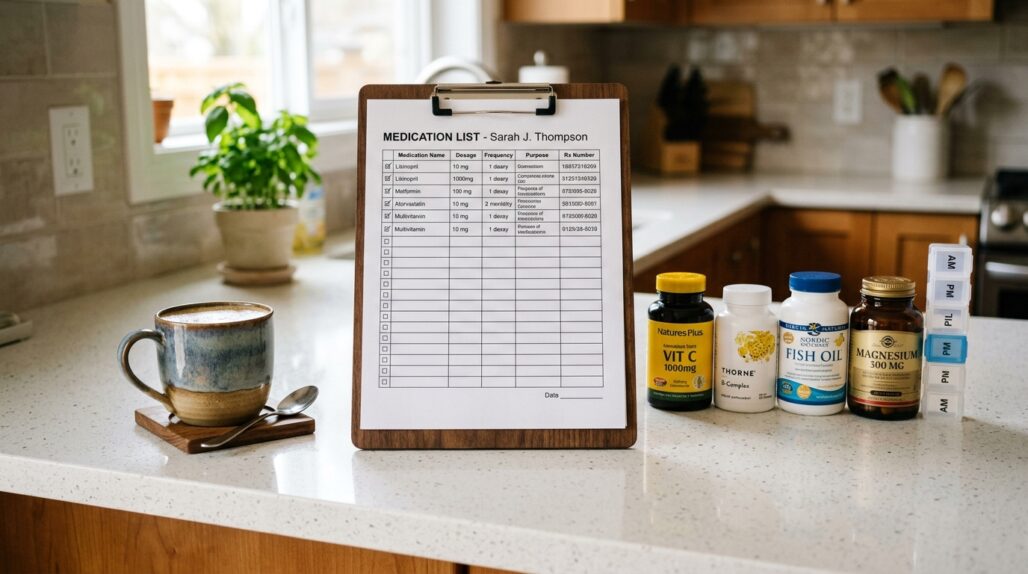
Build your one master list (a method that needs no app)
You can do this on a single sheet of paper or a phone note. The goal is one place that holds everything, kept current, and easy to hand over. Here is a usable template you can copy by hand.
For each item, write down five things: the name (and strength), the dose and how often, what it is for, who prescribed it (or "OTC / my choice"), and which pharmacy fills it. Add the supplements at the bottom in the same format, because to your body a supplement and a drug are both things to screen. If you are not sure a particular vitamin or herb belongs near your prescriptions, our plain-language guide to common drug and supplement interactions is a good place to read up before you ask.
| Name and strength | Dose and timing | What it is for | Prescriber | Pharmacy / source |
|---|---|---|---|---|
| Example – Metformin 500 mg | 1 tablet, twice a day with food | Blood sugar | Dr. Lopez | Corner Pharmacy |
| Example – Levothyroxine 75 mcg | 1 tablet, morning, empty stomach | Thyroid | Dr. Patel | Mail-order plan |
| Example – Calcium + D3 | 1 tablet, evening | Bone support (my choice) | OTC | Grocery store |
Why include the supplements? Because regulators keep stressing it. The NIH Office of Dietary Supplements tells people to bring a written list of every medicine and supplement to each provider, since supplements can interact with prescription drugs (NIH ODS, Dietary Supplements: What You Need to Know). The FDA echoes it: tell your pharmacist about everything you take, including vitamins and supplements, so they can catch a problem before it happens (FDA on how pharmacists help you use medicines safely). A pharmacy's software will not enter these for you. The list is how they get seen. If you are pulling a list together for an older relative whose supplements and prescriptions have never been reviewed side by side, our walkthrough on whether a parent's supplements are safe with their prescriptions covers the same idea from a caregiver's angle.
Use the list so it actually does its job
A list helps only if it is current and if it gets in front of the right person. Build these three small habits.
- Update it the same day something changes. New prescription, stopped drug, dose change, a supplement you started or quit – edit the list that day, while you remember.
- Hand it over at every new fill and every appointment. Give it to the pharmacist filling a new prescription and to any doctor writing one. That single sheet is what turns a partial check into a complete one.
- Keep a copy where you will find it. A photo on your phone, a printout in your wallet or bag, a note your caregiver can also see.
Keeping that list current every day is the part people drop. A pillbox keeps you on schedule but holds none of this detail, and a paper note works well as long as you remember to update it. Because each pharmacy only runs interaction checks against the prescriptions in its own system, it helps to keep the complete picture yourself – a free app we make, StackMyMed (our own free app), lets you log meds from every pharmacy plus your supplements in one place and flags possible interactions to raise with a pharmacist. Treat any flag as a prompt to ask, not an answer: the pharmacist makes the call on whether a combination is safe. Whether you keep your list on paper, in a phone note, or in the app, the point is the same – one current list, shown to the person who can judge it.

When to bring it to a pharmacist, not a search box
A complete list is what makes a professional check trustworthy, and the judgment belongs to the professional. Bring your full list to a pharmacist when you start any new medication, when a new prescriber may not know what others have ordered, or when you simply are not sure two things are safe together. A periodic sit-down review, sometimes called a brown-bag review, is built for this; if you want to know what to gather first, our brown-bag medication review checklist walks through what to bring. Pharmacists are trained for exactly this, and the FDA points out that if two doctors separately prescribe drugs that interact, the pharmacist is often the one positioned to warn everyone before there is a problem – but only if they can see the whole list. Online interaction checkers are fine for raising a question; they are not a substitute for the person holding your full picture.
FAQ
Do two pharmacies share my prescription records automatically? Usually not. Each pharmacy keeps its own profile, and the interaction screen at one store generally cannot see what you filled at another. That is the core of the gap.
Does my mail-order or specialty pharmacy count as a second pharmacy? Yes. Mail-order and specialty prescriptions often live in a separate system from your local store, so they are some of the most commonly missed items. Add them to your master list.
Will the pharmacy catch interactions with my supplements? Only if the supplements are on the profile, and they almost never are unless you say so. Tell the pharmacist about every vitamin and supplement, or list them, so the check includes them.
Is it really safer to use just one pharmacy? For many people, yes, because one profile lets the pharmacist review everything together. If insurance or a specialty drug makes that impossible, keep one complete list and show it at every fill instead.
Can I just use an online interaction checker myself? A checker can help you spot a question worth asking, but no consumer tool sees your full combination or your history the way a pharmacist can. Use it to prompt a conversation, not to clear a combination.
What is the single most useful thing to carry? One up-to-date list with every medication and supplement, the dose, the prescriber, and which pharmacy fills each one. Handing that over makes any pharmacist’s check as complete as it can be.
The bottom line
The interaction screen at each pharmacy is only as good as the list in front of it, and when you use two pharmacies, neither one has the full list. The fix is not high-tech: consolidate to one pharmacy where you can, and where you cannot, keep one complete list of every drug and supplement and show it to whichever pharmacist fills your next prescription. The list is what makes their check complete. Let the pharmacist make the safety call – your job is to make sure they can see everything.
This article is general information, not medical advice. It cannot account for your specific health conditions, medications, or history. Talk to your pharmacist or doctor before starting, stopping, or changing any medication or supplement, and do not adjust a prescription on your own.
StackMyMed is made by UsefulVitamins. It helps you organize your list and flag things to discuss with a pharmacist or doctor; it is not a diagnosis or treatment tool and does not replace professional medical advice.
Reviewed by the UsefulVitamins Editorial Team.
