

A lapse is the rule, not the exception
Routines slip. Life gets busy, a bottle runs empty during a trip, you skip a few days and then it has quietly been a month. If you are reading this feeling vaguely guilty, put that down. Stopping a supplement routine is one of the most common things people do, and it is not a sign that you failed at anything.
The reason this matters is that guilt tends to push people in the wrong direction. Some try to "make up" for lost time by taking extra. Others avoid the whole thing because restarting feels like a chore. Neither is needed. A short break from a daily vitamin is rarely a problem, and getting back on track can be quick if you treat it as a tidy-up rather than a fresh start.
This guide walks through that tidy-up: what you can safely resume, what to check first, and how to set the routine up so it survives the next busy week.
Restart calmly, and skip the catch-up
Here is the part people get wrong most often. You do not double up to make up for the days you missed. With nutrients, there is no benefit to swallowing two days' worth at once, and with fat-soluble vitamins like A, D, E, and K, piling on extra is the kind of thing that can build up rather than help.
For most general-wellness supplements, the calm move is simply to resume your normal amount on the day you start again. That is true for a typical multivitamin, vitamin D, omega-3, magnesium, or a probiotic. The NIH Office of Dietary Supplements is blunt about the broader principle here: with supplements, more is not always better, and some nutrients cause harm at high amounts. Catching up by stacking doses is exactly the move that idea warns against.
A few situations deserve more care than "just resume":
- Anything prescribed. If a prescription was part of what lapsed, that is not a supplement decision and not one to make alone. More on this below.
- A supplement that gave you side effects before. If iron wrecked your stomach last time, you have a clean chance to restart it differently. Note it and ask about it.
- A long gap with a higher-dose product. If you were on a large therapeutic dose a clinician set, confirm the restart plan with them rather than guessing.
The theme across all of these: a normal daily supplement is yours to resume, but anything medical routes back to a professional.
Audit before you reload the shelf
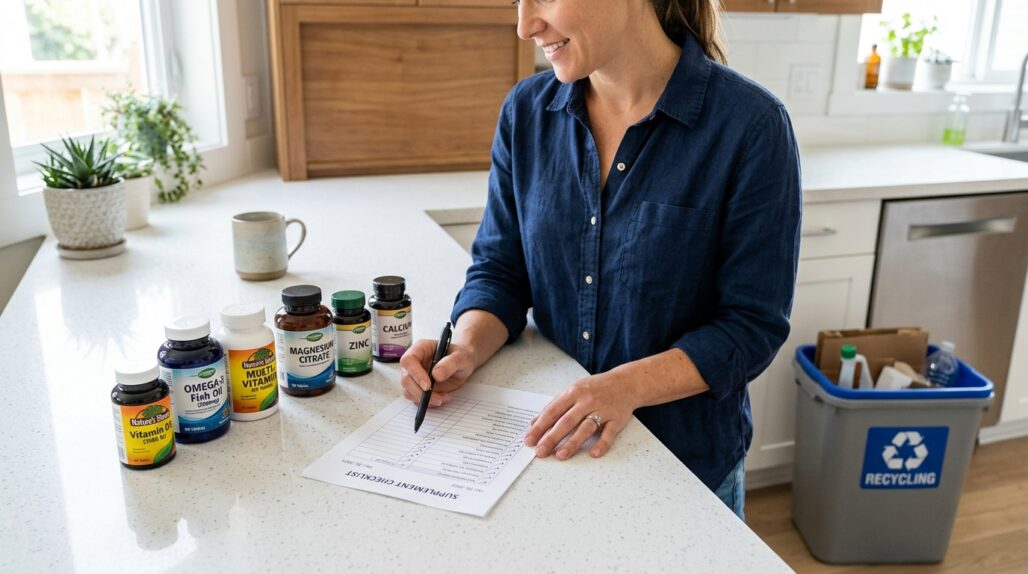
The temptation when restarting is to put every bottle back exactly where it was. Resist that for ten minutes. A lapse is a free chance to drop dead weight, and the two fastest filters are expiry dates and do I still need this.
On dates: an expired vitamin is usually not dangerous. Vitamins do not spoil like food, and most do not turn toxic, according to a review of supplement shelf life by Medical News Today. The real issue is potency. Supplements lose strength over time, which is why a date is printed at all, so a long-expired bottle may simply give you less than the label claims. Worth knowing: the FDA does not require supplement makers to print an expiration date, so an undated bottle is not unusual either. Use these rough rules while you sort:
| What you find | What it usually means | What to do |
|---|---|---|
| Past the printed date | Likely weaker than labeled, rarely unsafe | Replace it if you are relying on the full amount |
| No date printed | Not required; age unknown | Judge by how long you have owned it and how it looks or smells |
| Fish oil or other oils that smell off | Oils can go rancid | Discard; rancid oil can cause stomach upset |
| Discolored, crumbling, or clumped | Heat or moisture damage | Discard and store the replacement somewhere cool and dry |
On need: ask yourself why each bottle is in your hand. If you cannot say what a supplement is for, that is the one to leave off the restart list. Routines balloon because adding is easy and removing never happens. A lapse already did the removing for you, so be choosy about what earns its spot back.
If sorting your shelf turns into "wait, why do I own twelve bottles," our self-audit for taking too many supplements walks through trimming a stack down to what actually serves a purpose.
A restart you can do on paper
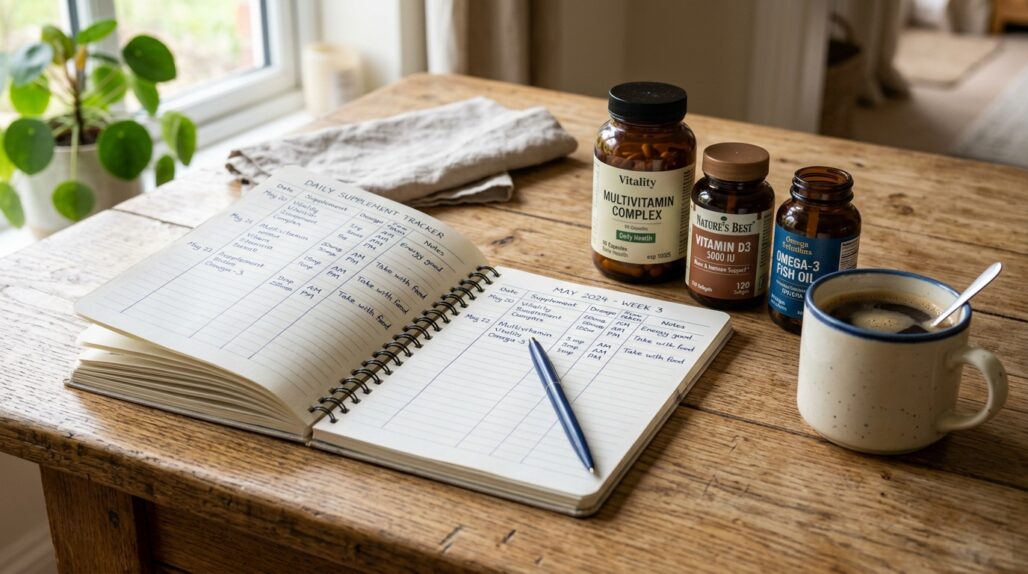
You do not need any tool for this. Grab whatever you have, a notebook page or a phone note, and rebuild the routine in writing first. Seeing it on paper is what keeps you from quietly recreating the bloated version you abandoned.
Here is a five-line method that works with zero apps:
- List only what passed the audit. One line per item: name, amount, and the reason you take it. If a line has no reason, cross it out now.
- Mark the medications. Put a star next to any prescription or paused medicine on the page. Those get a pharmacist conversation, not a self-restart.
- Pick a single anchor. Choose one thing you already do daily without thinking – morning coffee, brushing your teeth, the first meal – and attach the whole routine to it.
- Set a backup. A phone alarm at that time, or a sticky note where the anchor happens, catches the days the habit slips.
- Choose a check-in date. Two weeks out, glance back at the list and ask what is working and what you keep forgetting.
You can copy this layout straight into a notebook as a simple grid:
| Supplement | Amount | Why I take it | When (anchor) |
|---|---|---|---|
| Vitamin D | 1 capsule | Low level on last bloodwork | With breakfast |
| Magnesium | 1 tablet | Sleep and cramps | After dinner |
| Omega-3 | 2 softgels | Diet low in fish | With breakfast |
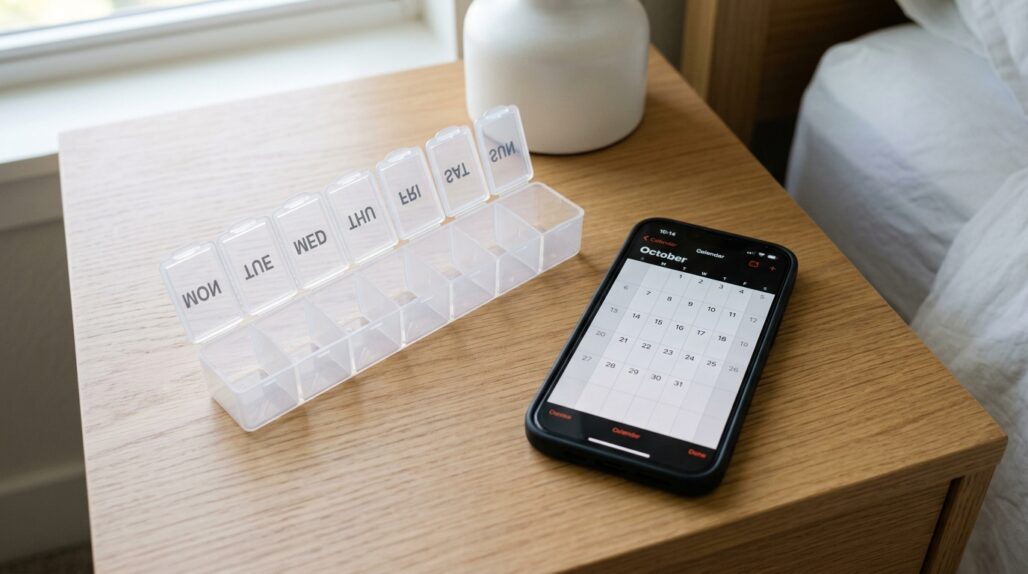
A weekly pill organizer does the same job physically. Fill it Sunday, and an empty compartment tells you at a glance whether today's dose happened. That alone solves the most common doubt, which is whether you already took it. If that is your usual sticking point, our guide to remembering whether you took today's supplement goes deeper on it.
Make it stick this time
Most restarts fail the same way the first run did, so it is worth naming why. Routines built on willpower and a long list tend to collapse. Routines built on a stable cue tend to last. Research on medication and supplement habits points the same direction: a behavior repeated after the same daily cue, again and again, slowly becomes automatic, and the reminder matters most in the stretch before it does. There is no magic number of days, so plan to lean on the cue and the backup for weeks, not until it feels easy after one good Monday.
Three things move the odds in your favor:
- Go smaller than before. A three-item routine you actually take beats an eight-item one you abandon. You can always add later, one at a time.
- Pin it to one reliable cue. The same coffee, the same toothbrush, the same meal, every day. Variety is the enemy here.
- Give yourself a visible backup. An alarm or a pill box covers the days the cue alone is not enough.
Once the paper version is running, the only ongoing job is keeping it current as you add, drop, or swap things. This is the point where most people quietly slide back, because re-entering everything by hand feels like work. A low-tech fix is to keep updating the notebook page or refilling the pill box each week. If you would rather not maintain it on paper, scanning each bottle into StackMyMed (our own free app) gets your whole stack visible in one place, so restarting next time is a ten-minute job instead of a fresh start. Either way the point is the same: the list earns its keep only if it stays up to date, and any safety question it surfaces about a supplement and your medications is one to raise with your pharmacist rather than settle yourself.
If the routine keeps collapsing no matter what you try, the cue itself may be the problem. Why habit stacking breaks covers the common reasons a routine will not hold.
When a prescription is in the mix
This is the one place to slow all the way down. If your break included a prescription, or you take any medication, do not fold it back in on your own judgment.
A paused prescription is a clinical decision. Some medicines need a specific restart plan, and a few can be risky to simply resume after a gap. That conversation belongs with the prescriber or pharmacist who knows your history, not a checklist on a website.
It also matters for the supplements themselves. The FDA notes in its consumer guidance that some supplements can interact with medications, interfere with lab tests, or have effects around surgery, which is why the agency advises talking with a doctor or pharmacist before you use one. A pharmacist is the easiest expert to reach for this. Bring your full restart list, medications included, and ask them to flag anything worth spacing apart or skipping. If your list has grown over time, the interaction checker is a useful starting point before that visit, not a replacement for it.
FAQ
Is it dangerous to stop taking supplements for a while? For most general-wellness supplements, a break is not harmful. The bigger risk is with prescribed medicines, where stopping or restarting on your own can matter, so route those through your prescriber or pharmacist.
Do I need to take extra to make up for the days I missed? No. Resume your normal amount and move on. Doubling up offers no benefit for nutrients and, with fat-soluble vitamins, can push you toward amounts that are not helpful.
Are my expired supplements safe to take? Expired vitamins are usually not toxic, but they may have lost potency, so you could be getting less than the label says. Replace anything you are counting on for the full dose, and discard oils that smell rancid.
How long until the routine feels automatic again? There is no fixed number of days. Habits form by repeating the action after the same daily cue, and a reminder helps most in the weeks before it sticks, so plan to lean on your anchor and backup for a while.
Should I restart everything I used to take? Not automatically. A lapse is a good moment to drop items you cannot give a reason for and to keep the routine small. You can always add things back one at a time.
What if a paused medication was part of my break? Treat that separately from your supplements. Ask the pharmacist or doctor for a restart plan rather than resuming it yourself, since some medications need specific handling after a gap.
The bottom line
Restarting a lapsed supplement routine is mostly a calm tidy-up, not a do-over. For everyday items, resume your usual amount, check dates and drop what you no longer need, then rebuild a smaller routine tied to one reliable cue with a backup reminder. The single most useful habit is keeping one current list so the next restart is quick. And for anything prescribed, or any supplement that might affect your medications, let your pharmacist or doctor make the call.
This article is for general information and is not medical advice. Supplements can affect medications and health conditions, so talk with your doctor or pharmacist about your own situation before starting, stopping, or changing anything you take.
StackMyMed is made by UsefulVitamins. It helps you organize your list and flag things to discuss with a pharmacist or doctor; it is not a diagnosis or treatment tool and does not replace professional medical advice.
Reviewed by the UsefulVitamins Editorial Team.
