
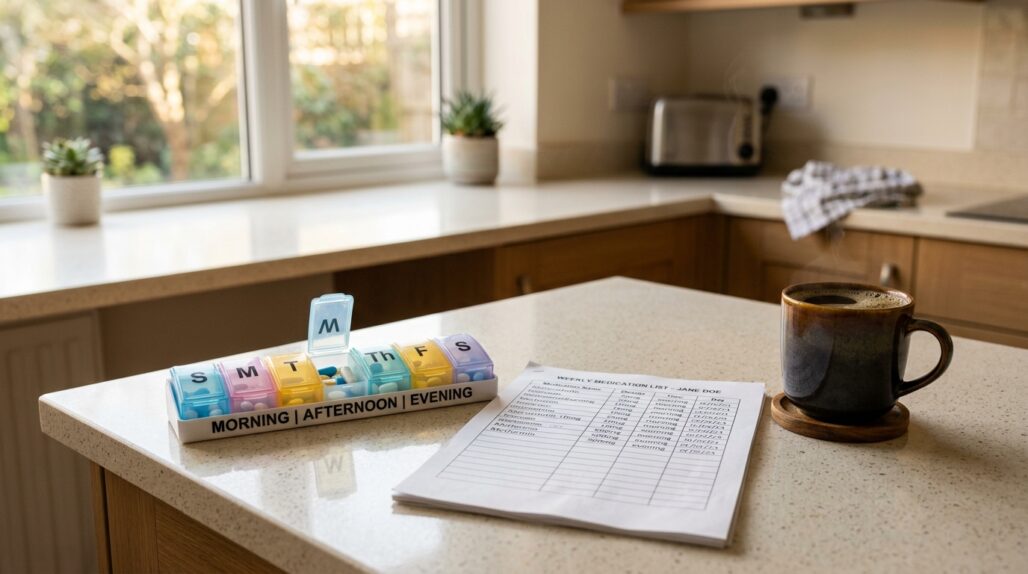
What you can actually do from a distance
If you live an hour or more from the person you are helping, you are a long-distance caregiver, and medication is one of the hardest parts to manage remotely. You cannot watch the morning pills go down. You cannot glance at the bottle on the counter. Most of what you know arrives secondhand, often in a quick phone call where your parent says they are "fine" and "taking everything."
That gap is the real problem, and naming it helps. The core challenge is visibility: you cannot see whether a dose was taken, and the information you do get is filtered through a phone call or a sibling's report. So the goal is not to control the routine from afar. It is to make the routine visible and steady enough that problems surface early, while someone closer to home covers the in-person part.
The good news is that the most useful things you can do remotely do not require being there. According to the National Institute on Aging, a long-distance caregiver can serve as an information coordinator, help organize and update important records, arrange in-home or pharmacy services, and join telehealth visits. Tracking medications fits neatly into that role.
Step one: build one master list everyone shares
Before any reminder or app, you need a single source of truth. Right now the real list probably lives in three places at once: the bottles in the cabinet, your parent's memory, and whatever the last doctor wrote down. A master medication list pulls all of that into one document that you, your parent, and any local helper can see.
The FDA recommends a complete list include the name and strength of each medicine, what it is for, and exact instructions for when and how much to take, plus allergies, emergency contacts, and any vitamins or supplements. That last point matters more than people expect, since an over-the-counter supplement can still interact with a prescription.
Here is a structure you can copy into a shared note or a printed page today. Fill in one row per item, including supplements and as-needed medicines.
| Medicine or supplement | Strength and dose | What it is for | When to take it | Prescriber and pharmacy |
|---|---|---|---|---|
| Example: Lisinopril | 10 mg, 1 tablet | Blood pressure | Morning, with breakfast | Dr. Patel / Main St Pharmacy |
| Example: Vitamin D3 | 2000 IU, 1 capsule | Bone health (self-started) | Morning, with food | Self / drugstore |
| Example: Acetaminophen | 500 mg, as needed | Joint pain | As needed, max per label | Self / drugstore |
Two habits keep this list honest. First, date it every time you change it, so everyone knows which version is current. Second, ask your parent to read the bottles to you over a video call rather than reciting from memory, because the label is the truth and the memory drifts.
For the deeper version of this, especially when several doctors are involved, our walkthrough on building a single master list for a parent with multiple doctors goes step by step.
Step two: turn the list into a visible daily schedule
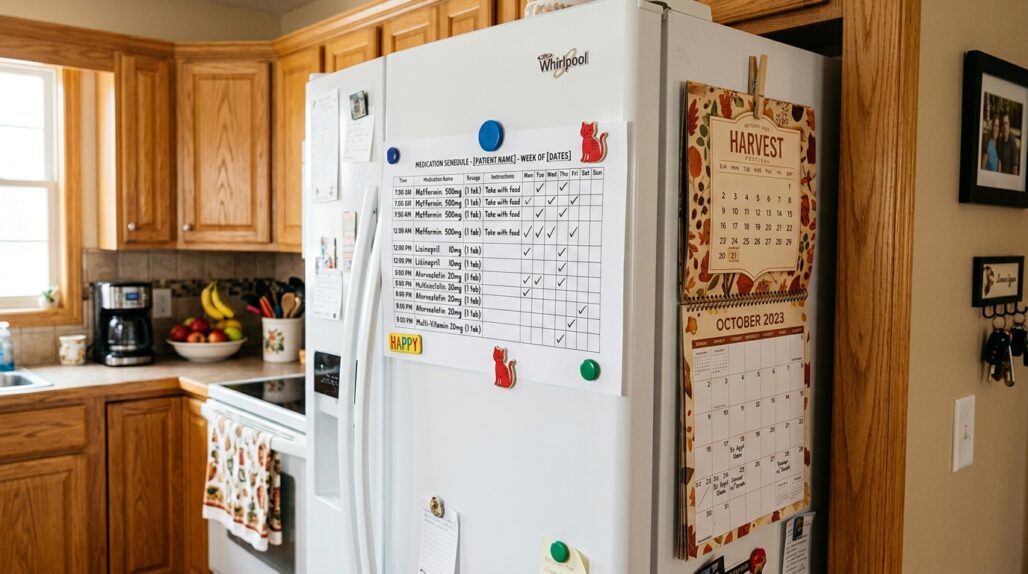
A list tells you what to take. A schedule shows when, and that is what your parent actually uses each day. You do not need software for this. AHRQ publishes a free, printable pill card and My Medicines List that lays out each medicine by time of day, using plain words and pictures, which works well for older adults and for anyone whose eyesight or memory is slipping.
You can recreate the same idea on a single sheet taped to the refrigerator or inside a cabinet door:
- Write four columns for morning, midday, evening, and bedtime.
- Under each, list the exact pills due at that time, with the dose.
- Add a small box your parent can tick, or pair the sheet with a labeled weekly pill organizer.
- Print two copies, one for the fridge and one your local helper keeps.
This printable method is the foundation, and it works with zero technology. A weekly pill organizer filled every Sunday, plus the printed grid, covers most routines on its own. The schedule also makes refills easier to see coming, since you can glance at the organizer and know roughly how many days are left.
If you want help thinking through the order things get taken, the general medication and supplement timing guide is a useful companion, especially after any change in the routine.
Step three: keep the system current every week
Building the list is the easy day. The hard part is keeping it true, because medications change quietly. A doctor adds something, a dose gets cut, a supplement gets bought on a whim, and the master list silently goes stale. A stale list is worse than no list, because everyone trusts it.
So the real work of remote caregiving is the weekly refresh. Pick a recurring time, maybe a Sunday call, and walk through three quick questions: Did anything new get added this week? Did any bottle run low? Did anything cause a new side effect or get skipped? Update the dated master list right then while you are both looking at it.
This is also the moment to set reminders so doses do not slip between calls. A free phone alarm or the built-in calendar handles this fine, and a printed grid plus a pill organizer is a perfectly good low-tech version. If your family would rather keep one shared schedule that everyone can see and edit instead of each person tracking separately, StackMyMed (our own free app) lets the family keep one current list and set per-dose reminders so the routine is visible from anywhere, and anything that looks like a possible interaction is something to raise with the pharmacist rather than judge yourselves. Whichever route you choose, the point is the same: one current list, gentle reminders, and a human who checks in.
When more than one of you is involved, decide early who owns the list, so it does not get updated four different ways. Our piece on sibling coordination over a parent's medications covers how to split that without stepping on each other.

Step four: connect the pharmacy and respect your parent
A remote system runs better when the local pharmacy is part of it. The CDC notes that pharmacists are central to medication adherence and offer services like medication synchronization, which lines up refill dates so all the chronic prescriptions are picked up on one day instead of scattered across the month. That single change removes a lot of the "did we run out?" anxiety from a distance.
For someone managing many medicines, ask the pharmacy about adherence or blister packaging, where each dose is pre-sorted by day and time. One community pharmacy study published in PMC found patients using such a packaging service reported missing fewer doses and feeling more confident managing their medicines. It is worth a conversation with the pharmacist, who can tell you whether it fits your parent's regimen.
Two boundaries matter here. By law you will usually need written permission before a provider or pharmacy shares medical details with you, and the office can give you the form. And your parent is an adult who gets the final say. Your job is to organize and notice, not to override. The NIA frames the remote caregiver as a coordinator, and that framing protects the relationship.
Importantly, none of this involves you changing a dose or telling your parent to start or stop anything. Spotting a possible duplicate or a worrying combination is exactly what you flag for the pharmacist or prescriber. If you are unsure whether your parent's supplements sit well with their prescriptions, start with are my parent's supplements safe with their prescriptions and bring the question to a professional.
When to escalate
A remote list and a weekly call work until they do not. Watch for signs the system has outgrown a phone check-in: organizers found still full at week's end, repeated confusion about what was taken, missed refills on important medicines, or a hospital stay that changed everything at once. Interrupting some medicines, including blood thinners and heart or seizure prescriptions, can be genuinely risky, which is why a gap should prompt a call to the pharmacist, not a wait-and-see.
At that point, escalate. Options include an in-home aide who oversees the morning routine, the pharmacy's blister-packaging or synchronization service, or a formal pharmacist medication review to catch duplicates and interactions. None of these mean you failed at distance caregiving. They mean the level of help finally matches the need.
FAQ
How can I track my parent’s medications if I live far away? Build one dated master list of every medicine and supplement, turn it into a visible daily schedule, and set a weekly check-in to keep it current. A local helper or the pharmacy covers the in-person part, while you coordinate from a distance.
Do I need legal permission to talk to my parent’s pharmacy or doctor? Usually yes. The provider’s office can give you the written-permission form so they can share medical information with you. Set this up before a crisis, so you are not stuck during an urgent call.
What should go on the master medication list? The FDA suggests each medicine’s name and strength, what it is for, and exact dosing instructions, plus allergies, emergency contacts, and any vitamins or supplements. Date it every time something changes so everyone trusts the same version.
What if my parent refuses help or wants to manage it alone? Respect that. Your parent is an adult and keeps the final say. Offer to be the record-keeper and the second set of eyes rather than taking over, and loop in their doctor or pharmacist for any medical decision.
Is an app safer than a paper list and pill organizer? No, the method matters less than keeping it current. A printed schedule plus a weekly pill organizer works on its own. A shared app can help a scattered family see one list, but it is for organizing, not for clearing combinations as safe.
What do I do if I notice a medication running low from afar? Ask the pharmacy about auto-refill and medication synchronization so refills land on one day, and add a low-supply note to your weekly check-in. For anything urgent, the pharmacist can usually arrange an early or emergency fill.
The bottom line
You cannot be in the room, but you can make the routine visible. Build one dated master list, turn it into a simple daily schedule your parent can see, and refresh it on a standing weekly call so nothing drifts. Pair that with the pharmacy through synchronization or packaging, get written permission early, and keep a local backup person for the in-person moments. The single most useful action is the one current list everyone shares. And for any possible duplicate, interaction, or change, route the decision to your parent's pharmacist or doctor, since organizing the information is your job and the medical calls are theirs.
This article is for general information and is not medical advice. Medications and supplements can interact, and individual needs differ, so talk to your parent's pharmacist or doctor before making any change to what they take. Never start, stop, or adjust a prescription on your own.
StackMyMed is made by UsefulVitamins. It helps you organize your list and flag things to discuss with a pharmacist or doctor; it is not a diagnosis or treatment tool and does not replace professional medical advice.
Reviewed by the UsefulVitamins Editorial Team.
