
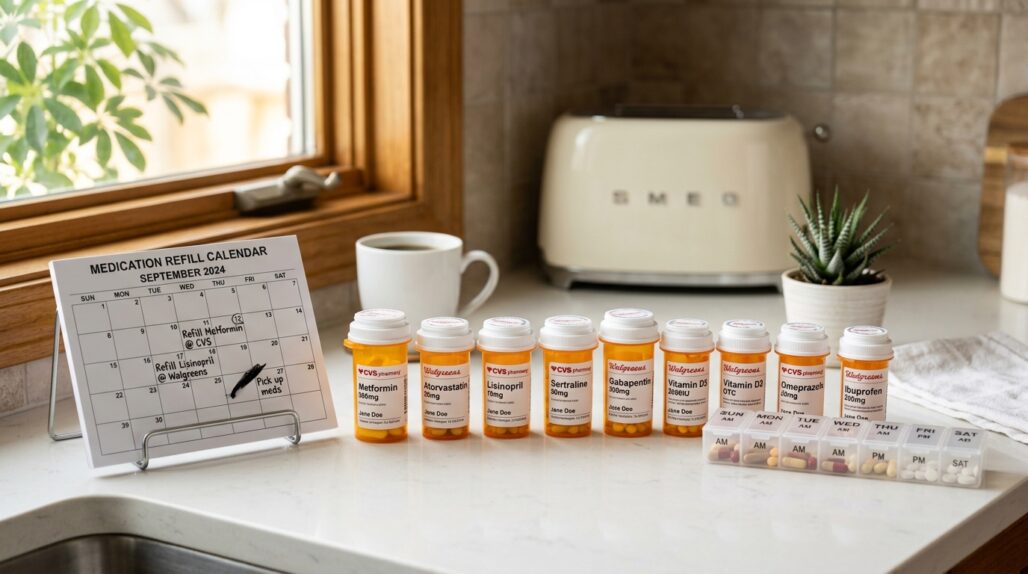
Running out of a prescription is one of the most preventable problems in home caregiving, and it happens constantly. A 90-day bottle empties on a Saturday, the doctor's office is closed, the refill needs prior authorization, and suddenly your parent is two days without a medication they take every morning. Most of these gaps are not about forgetfulness. They are about not seeing the bottle get low until it is already empty.
The fix is a refill system you can run in about ten minutes a week, on paper if you want, with nothing fancier than a calendar and a list. Below is how to build one that catches every medication, not just the easy ones.
Why running out is actually dangerous
For some medications, a missed day is a minor annoyance. For others, an interrupted supply is a real risk, which is why this deserves a system rather than good intentions.
Blood thinners are the clearest example. The Cleveland Clinic explains that anticoagulants work by keeping clotting in a steady, controlled range, and Mayo Clinic notes that consistency matters so much with warfarin that even diet changes are tracked. Letting one of these lapse is not a wait-and-see situation. The same is true for many seizure medications, heart-rhythm and blood-pressure drugs, and several mental-health prescriptions, where steady blood levels are the whole point of taking them daily.
The scale of the problem is larger than most families expect. Research summarized by the National Institutes of Health has found that up to half of older adults do not take their medications as prescribed, and a chunk of that is simply not having the pill on hand. The more medications someone takes, the more often a refill slips through.
So the goal here is narrow and worth getting right: your parent should never be sitting empty-handed, waiting on a pharmacy, for a medication that matters.
Build the master refill list first
You cannot track refills you cannot see. Before any reminders or apps, you need one list of everything your parent takes, in one place. Build it once and you will use it for years.
Write down, for each item:
- The medication name and strength (for example, metoprolol 25 mg).
- How many doses per day, and therefore how long one bottle lasts.
- The last fill date and the refills remaining printed on the label.
- The pharmacy it comes from (some parents use more than one).
- Whether it is daily, as-needed, or a supplement.
That last column matters more than it looks, because it separates the items auto-refill handles from the ones it quietly ignores.
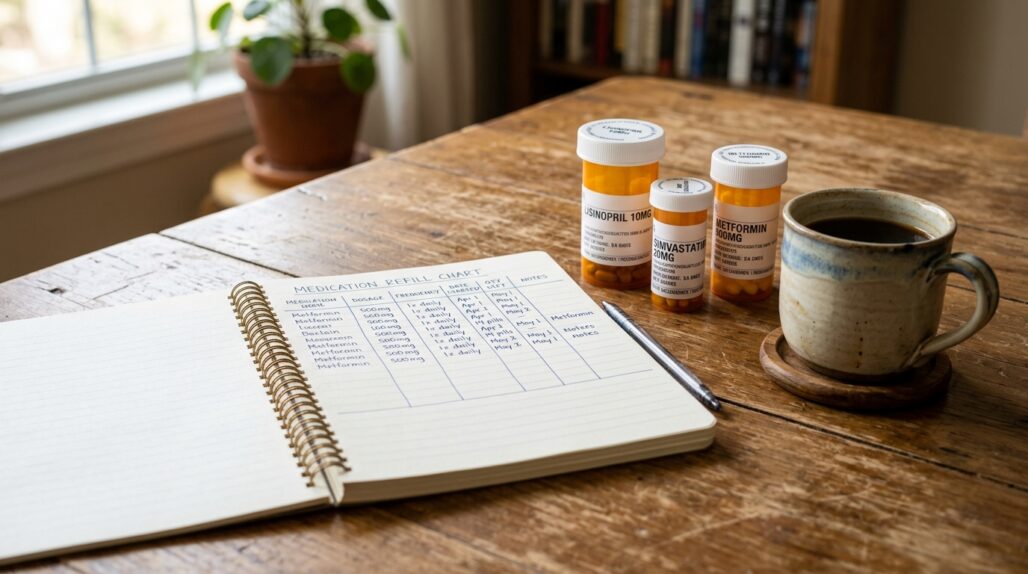
Here is a simple paper template you can copy into a notebook or print. It works with zero technology and is the backbone of everything that follows.
| Medication | Doses per day | Day supply | Refill due date | Pharmacy |
|---|---|---|---|---|
| Example: lisinopril 10 mg | 1 | 90 | Note the date the bottle runs out | Main pharmacy |
| Example: warfarin 5 mg | 1 | 30 | Note the date the bottle runs out | Main pharmacy |
| Example: vitamin D supplement | 1 | Varies | Check bottle count monthly | Bought separately |
To find the refill due date without doing math in your head, look at the fill date on the label and count forward by the day supply. A bottle filled on the 1st with a 90-day supply runs out around the 31st of the third month. Mark that date. If your parent takes the same medication you can also just count the pills left and divide by the daily dose.
Keeping this list current is the part that protects everyone. It is also the list you will hand to a doctor or pharmacist at any visit, so building it once does double duty. If you want help structuring it, our guide to a master medication list for an aging parent with multiple doctors walks through the same idea in more depth.
Turn on auto-refill and 90-day fills where they fit
Once the list exists, lean on the pharmacy to do the heavy lifting. Most pharmacies offer two settings that prevent the majority of run-outs.
Auto-refill tells the pharmacy to prepare a refill before the current bottle runs out, so it is ready when you arrive. 90-day fills stretch the time between trips from once a month to once a quarter, which means fewer chances to forget. For a stable, long-term prescription, a 90-day supply through your pharmacy or a mail-order option is often the single biggest reduction in run-out risk.
A few cautions worth knowing before you switch everything on:
- Auto-refill works best for steady, long-term medications. It does not suit doses that change often or short-course prescriptions.
- Some 90-day fills need the prescriber to write a new prescription for that quantity, so it may take one phone call to set up.
- Insurance can limit which medications qualify for a 90-day supply, so confirm coverage before you assume it.
Do not set auto-refill and then stop looking. It is a helper, not the whole system, and the next section explains exactly what it leaves uncovered.
Catch the gaps auto-refill misses
This is where most refill systems quietly fail. Auto-refill only tracks the prescriptions the pharmacy actively manages on a regular schedule. Several common items fall outside that net.
- As-needed medications. An inhaler, a nitroglycerin spray, or a pain medication taken only sometimes does not trigger a refill on a predictable date, so it can run dry without warning.
- Supplements and over-the-counter items. Vitamin D, fish oil, fiber, and similar items are usually bought separately and tracked by no one.
- Prescriptions from a second pharmacy. If a specialist sent something to a different location, the main pharmacy's auto-refill has no idea it exists.
- New or recently changed medications. Anything started in the last few weeks may not be enrolled in auto-refill yet.
For each of these, you fall back on the master list and a simple habit: once a week, glance at the as-needed and supplement bottles and note anything below about a two-week supply. That is the manual safety net, and it costs you two minutes.
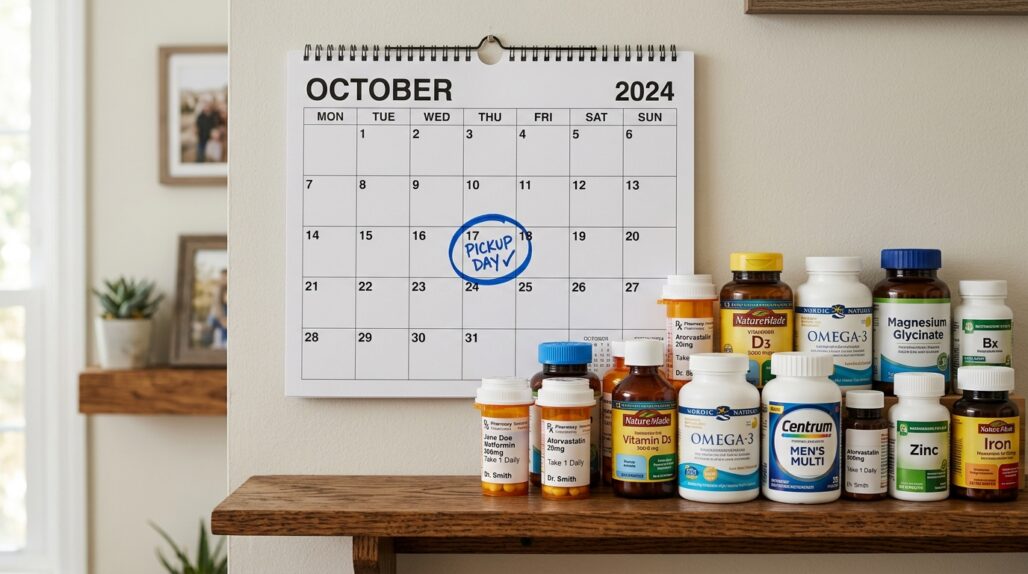
You taught the system above so it runs on paper. Now comes the part that keeps it from slipping when life gets busy. Pick one day a week to scan your list, and for each item set a low-supply reminder roughly seven days before it runs out, on whatever you already use. A wall calendar with a circled pickup day works. A recurring alarm in your phone's reminders app works. Pharmacy auto-refill helps, but it does not catch the as-needed meds or supplements; setting your own low-supply reminders in a free app we make, StackMyMed (our own free app), closes that gap before a bottle runs empty, and if a reminder ever surfaces a question about whether a missed dose matters, that is a call for the pharmacist, not the app. Whichever you choose, the rule is the same: the alert fires a week early, so there is always time to act before the bottle is empty.
Ask the pharmacy to synchronize the refills
If your parent takes several medications, the most useful single conversation is with the pharmacist about medication synchronization, sometimes offered as an Appointment-Based Model.
The idea is straightforward. Instead of refills landing on a dozen different dates, the pharmacy adjusts the cycles so everything is ready on one day each month. The APhA Foundation describes the Appointment-Based Model as a proactive program where staff confirm the medications a week ahead and prepare them together for a single pickup. A peer-reviewed study found that synchronization improved the proportion of days patients had their medications on hand, which is exactly the run-out problem you are trying to solve. Pharmacy Times notes the same approach also creates a regular moment for the pharmacist to review the full list.
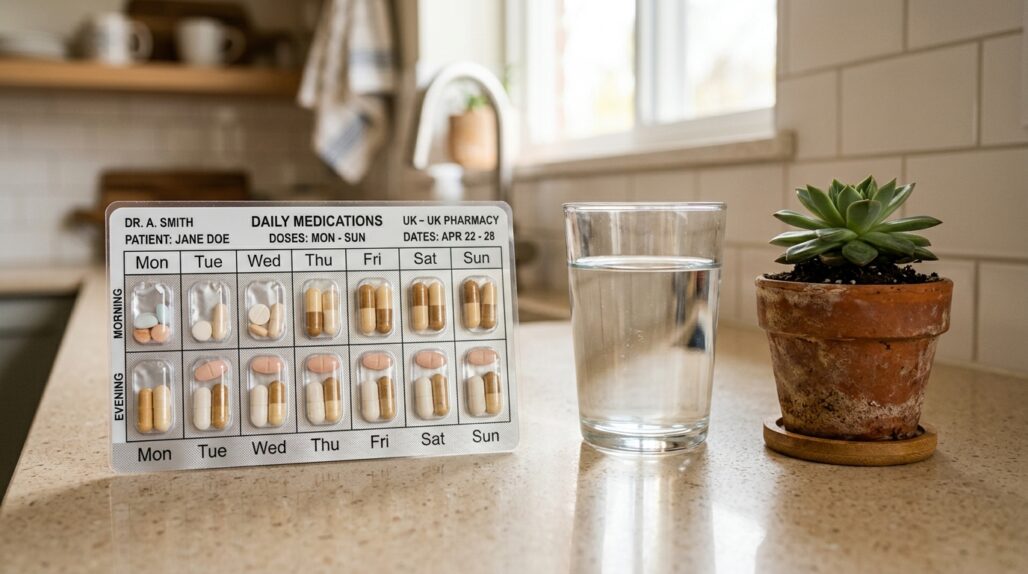
For a parent taking many pills, also ask about blister or multidose packaging, where the pharmacy sorts each dose into a sealed, dated pack. It removes the weekly sorting step and makes a missed or low supply obvious at a glance. A pharmacist fills and checks these, which is safer than hand-sorting from loose bottles. If you would rather keep using a sorter you fill yourself, our guide on how to fill a weekly pill organizer for many medications safely covers doing it without errors.
One thing the pharmacist cannot fix from behind the counter is timing across the day. If you are juggling which pill goes with breakfast versus bedtime, the medication and supplement timing guide is a useful companion to this refill system. And if you are doing this from another city, coordinating with the pharmacy is the heart of long-distance caregiving for a parent's medications.
FAQ
How far ahead should I reorder a refill? A good rule is about a week before the bottle runs out. That leaves room for prior authorizations, back-orders, or a closed pharmacy over a weekend, and most pharmacies can refill a few days early without a problem.
Is a 90-day supply always better than monthly? Not always. A 90-day fill is great for stable, long-term medications because it means fewer trips. For a dose that changes often or a brand-new prescription, a 30-day fill can be smarter so you are not stuck with a large quantity of something that gets adjusted. Your pharmacist can tell you which of your parent’s medications fit each option.
What should I do if my parent already ran out of a medication? Call the pharmacy right away and explain which medication and when the last dose was. Many can provide a small emergency supply or a bridge fill while a refill is processed. Do not have your parent double up later to make up for missed doses, and ask the pharmacist what to do for that specific medication.
Does auto-refill cover everything? No. It generally covers steady, long-term prescriptions the pharmacy manages directly. As-needed medications, supplements, over-the-counter items, and anything filled at a different pharmacy usually need your own tracking, which is why the weekly glance at those bottles matters.
Is blister packaging worth it? For someone taking several medications a day, often yes. It removes the weekly sorting step, makes a low supply visible, and is filled and checked by a pharmacist. Ask whether your parent’s pharmacy offers it and whether their medications are suitable, since some items cannot be packaged this way.
Can I manage all of this from another state? Yes, with the right setup. A shared master list, the pharmacy’s auto-refill and synchronization, and reminders you can act on remotely cover most of it. For doses that need a person present, a local backup or a pharmacist-managed packaging service helps fill the gap.
The bottom line
Running out of a medication is common, and for blood thinners, heart, seizure, and mental-health prescriptions it can be genuinely risky. The most reliable fix is not vigilance, it is a system: one master refill list, a reminder set about a week before each item runs low, and the pharmacy's auto-refill and synchronization doing the rest. Build the list once, glance at it weekly, and the empty-bottle emergencies mostly disappear.
The single most useful step is to call your parent's pharmacist and ask whether refills can be synchronized to one pickup day, and whether blister packaging fits. They see the whole picture, and they are the right person to decide anything about a specific medication.
This article is for general information and is not medical advice. It does not replace guidance from your doctor or pharmacist, and you should not start, stop, or change any medication based on it. Talk to a qualified professional about your parent's specific situation.
StackMyMed is made by UsefulVitamins. It helps you organize your list and flag things to discuss with a pharmacist or doctor; it is not a diagnosis or treatment tool and does not replace professional medical advice.
Reviewed by the UsefulVitamins Editorial Team.
