
Affiliate disclosure: this article contains affiliate links. As an Amazon Associate, UsefulVitamins.com earns from qualifying purchases at no extra cost to you.
Why fish oil makes you burp in the first place
Fish oil burps are not a sign that something is wrong with you. They are a timing problem and, often, a freshness problem.
Two things drive them. First, fat slows down how fast your stomach empties, so a softgel can linger and you end up belching back the smell of the sea. Second, the omega-3 fats in fish oil oxidize very easily, and oxidized oil produces foul-smelling breakdown compounds that taste far worse when they reflux.
That second point matters more than most people realize. A fishy "repeat" is sometimes just timing, but a strong rancid taste usually means the oil itself has degraded. So the answer is partly behavioral – with food, split, frozen – and partly about buying a better product.
The mechanism in plain words
When a standard softgel dissolves in your stomach, the oil mixes with acid before it moves on. Volatile, smelly compounds float up, and that is the burp.
Enteric-coated softgels are built to stay intact through the stomach and dissolve lower down, in the small intestine. By the time the oil is released, it is too far along to come back up as a fishy belch.
Freshness compounds the issue. The omega-3 molecules EPA and DHA are fragile, and they break down with heat, light, and time. Independent testing has repeatedly found a meaningful share of products on shelves already past acceptable freshness, which is why a rancid capsule both tastes worse and gives you a worse burp.
What actually stops the burps
Here is the order to try things, cheapest and simplest first. You do not need all of these – usually one or two solve it.
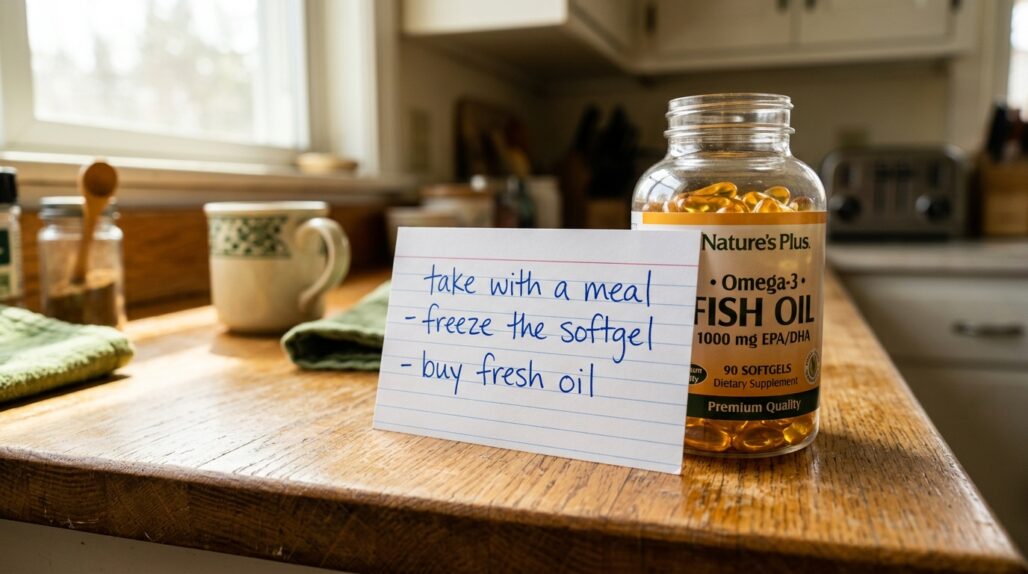
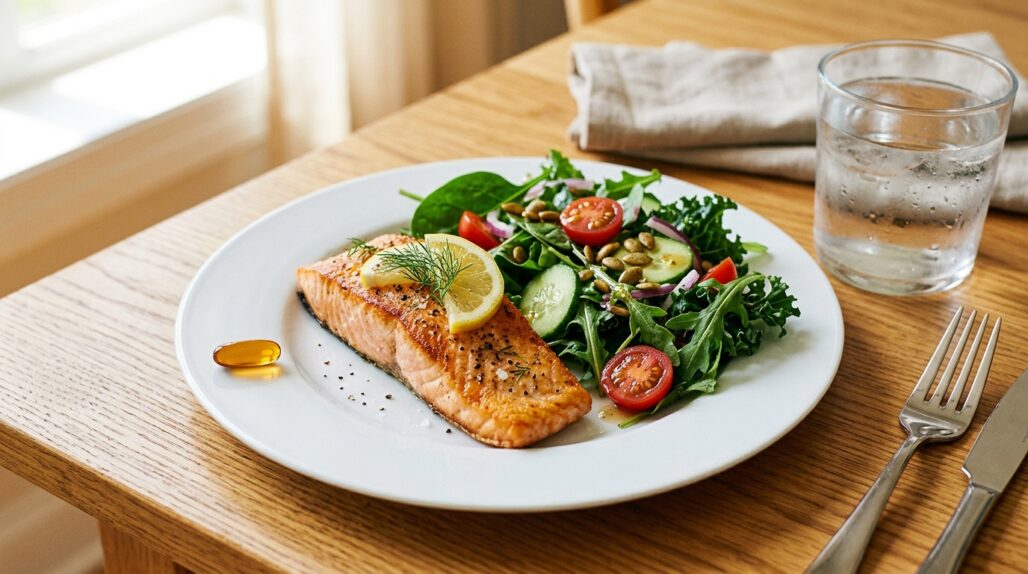
- Take it with a fat-containing meal. Omega-3s absorb better with dietary fat, and food gives your stomach something to work on besides the oil. The Arthritis Foundation suggests taking fish oil with meals in divided doses so your stomach processes less at once.
- Split the dose. Two softgels with lunch and dinner are easier to tolerate than four at breakfast.
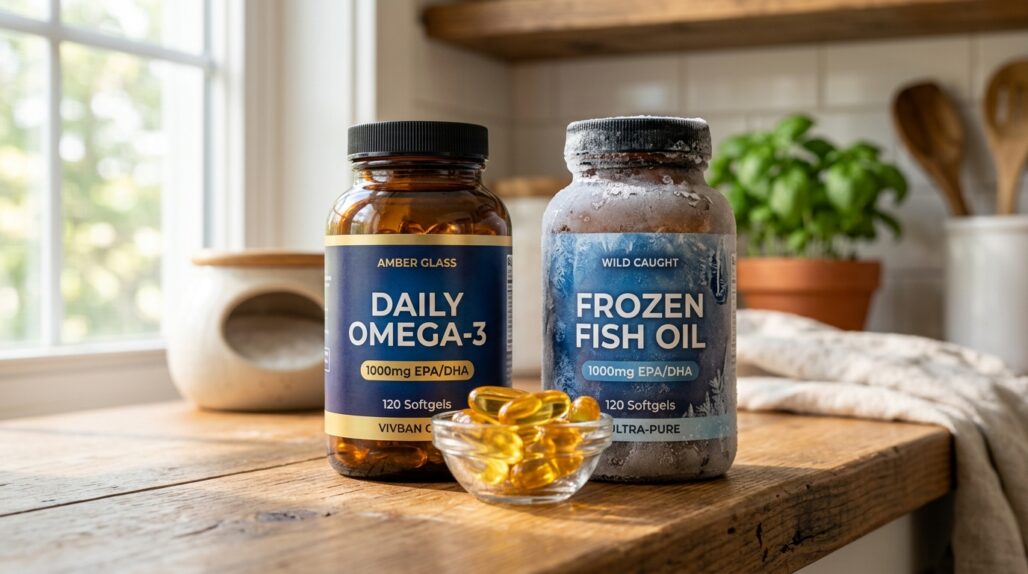
- Freeze the softgels. Frozen capsules break down more slowly in the stomach, which pushes the oil further along before it releases. Keep the bottle in the freezer and swallow them cold.
- Switch to enteric-coated or a clean triglyceride-form oil. This is the product-level fix when the behavioral tweaks are not enough.
- Check the oil is fresh. Bite or break open one softgel. A clean, mild ocean smell is fine. A sharp, paint-like, "off" smell means rancid – stop using that bottle.
One myth worth retiring: taking the softgel right before bed so you "sleep through" the burp usually backfires. Lying down makes reflux easier, not harder. Take it earlier, upright, with food.
A simple troubleshooting timeline
If you are starting fresh or fixing an existing burp problem, this is a realistic sequence. The first three steps cost nothing and usually settle it within a day or two.
| Step | What to change | Why it helps | When you notice |
|---|---|---|---|
| Day 1 | Take softgels mid-meal, never on an empty stomach | Food slows release and improves absorption | Same day or next dose |
| Day 1 to 2 | Split into two smaller doses with two meals | Less oil in the stomach at one time | Within a day |
| Day 2 to 3 | Freeze the softgels and take them cold | Slower stomach breakdown, oil releases lower down | Within a day or two |
| Week 1 | Check freshness, replace if rancid | Rancid oil is the worst-tasting reflux | Next bottle |
| Week 1 to 2 | Move to enteric-coated or clean triglyceride form | Bypasses the stomach or digests more cleanly | From first dose of new product |
If you have gone through every step and still get reflux, the problem may not be the burp mechanism at all – see the section on when to ask a clinician below.
Freshness: the part the label hides
This is where a cheaper product can cost you. Omega-3 oils oxidize, and the industry uses three voluntary freshness markers set by the global omega-3 trade group. As explained in the standard reference on TOTOX values, the usual ceilings are a peroxide value at or below 5, an anisidine value at or below 20, and a combined TOTOX at or below 26.
The catch: most labels do not print these numbers, so you cannot read freshness off the bottle. And shelf reality is not reassuring. A peer-reviewed analysis of 171 North American over-the-counter omega-3 products found that 50% exceeded at least one of those voluntary oxidation limits, with 39% over the TOTOX ceiling and 41% over the anisidine limit. The Arthritis Foundation has cited testing where more than 1 in 10 supplements were rancid or close to it.
There is a quiet trap here too. Enteric coating can genuinely cut burps, but it can also be used to mask oil that has already gone off, since you never taste it. Coating is a tolerability tool, not a quality guarantee – freshness still comes first.
Practical signal: that same study found plain, unflavored softgels tended to oxidize less than flavored products and bulk liquid oils. So a simple unflavored softgel from a reputable brand is often both fresher and less burpy than a sweet "lemon" liquid.
Does the oil's form change tolerability?
Yes, a bit. Fish oil comes mainly as the natural triglyceride (TG) form or the concentrated ethyl ester (EE) form, and they behave differently in the gut.
The triglyceride form is what omega-3 looks like in actual fish, and it tends to absorb more readily and feel gentler. Bioavailability work, including a controlled trial comparing triglyceride, ethyl ester, and free fatty acid forms, points to better uptake from the TG form (about 124 percent relative absorption versus 73 percent for ethyl ester). Ethyl esters can absorb perfectly well, but they lean harder on a fatty meal to do it – another reason the "take it with food" rule keeps coming up.
If your current oil burps no matter what you do, switching to a clean triglyceride-form product is a reasonable next move. We dig into the absorption differences in our guide to triglyceride, ethyl ester, and krill omega-3 bioavailability if you want the deeper comparison before you buy.

Which form or product to buy
Match the product to where the behavioral fixes left you. If with-food plus splitting nearly solved it, a fresh, plain triglyceride-form softgel may be all you need. If burps persist, an enteric-coated softgel that bypasses the stomach is the targeted fix. Whatever you choose, buy from a brand that publishes freshness or third-party testing.
For a goal-based number on how much EPA and DHA to actually aim for, do not eyeball it – use our omega-3 dosage guide to set your target, then pick a product that hits it in as few softgels as possible. Fewer, fresher capsules means fewer chances to burp.


As an Amazon Associate, UsefulVitamins.com earns from qualifying purchases at no extra cost to you.
Disclosure: the picks below are affiliate links. We may earn a commission if you buy through them, at no extra cost to you. Prices change often, so check the current price and the brand's freshness testing before ordering.
If you want a curated shortlist, our roundups of the best burpless fish oil with no fishy aftertaste and the best omega-3 fish oil supplements overall compare freshness, form, and EPA-DHA per softgel side by side.
When to ask a pharmacist or doctor
A mild fishy aftertaste is a tolerability nuisance, not a danger. But a few situations are worth a real conversation rather than a freezer trick.
According to the NIH Office of Dietary Supplements omega-3 fact sheet, common side effects are mild and include a bad taste, bad breath, heartburn, nausea, and loose stools. The FDA has treated marine omega-3 intakes up to 3 g/day of EPA plus DHA as generally recognized as safe, and the agency notes higher intakes may raise bleeding risk.
That bleeding point is the one to flag. Omega-3s can interact with blood thinners and antiplatelet medicines, so if you take one, ask your pharmacist before going to higher doses.
Get medical advice rather than self-managing if you have true heartburn or chest discomfort instead of a simple aftertaste, if reflux is frequent and new, or if you are pregnant or managing a condition with prescription medication. None of the tips here are a reason to start, stop, or change a prescription on your own.
FAQ
Why does freezing fish oil softgels stop the burps? A frozen capsule breaks down more slowly in the stomach, so the oil is released lower in the digestive tract where it is less likely to reflux as a fishy belch. Keep the bottle in the freezer and swallow them cold.
Is enteric-coated fish oil actually better? For burps, often yes, because the coating keeps the capsule intact until the small intestine. The downside is that you cannot taste the oil, so coating can hide a rancid product. Buy a coated oil from a brand that publishes freshness testing.
Does taking fish oil with food really help? It is one of the most reliable fixes. Food slows release and improves omega-3 absorption, and the Arthritis Foundation recommends taking it with meals in divided doses for exactly this reason.
How can I tell if my fish oil is rancid? Break open one softgel and smell it. A mild, clean ocean scent is fine. A sharp, sour, or paint-like smell means the oil has oxidized, and rancid oil both tastes worse and gives the worst burps.
Will a higher dose make burps worse? More oil at once usually means more burping, which is why splitting the dose across two meals helps. It also keeps you under the roughly 3 g per day of EPA plus DHA that the FDA treats as generally safe without checking with a clinician first.
Is fish oil burping a sign of an allergy or something serious? Generally no – it is a timing and freshness issue, not an allergic reaction. But persistent heartburn, chest pain, or new frequent reflux is worth raising with a doctor rather than treating as a simple aftertaste.
The bottom line
Fish oil burps are almost always fixable without giving up omega-3s. Take the softgels with a fatty meal, split the dose, and freeze them – those three free changes solve it for most people within a day or two.
If burps stick around, the product is usually the issue. Move to a fresh, plain triglyceride-form or enteric-coated softgel from a brand that tests for oxidation, and set your target with our omega-3 dosage guide so you take the fewest capsules that still hit your number.
This article is general education, not medical advice. Supplements can interact with medications and are not a substitute for care from your own pharmacist or doctor, especially if you take a blood thinner or are pregnant.
Reviewed by the UsefulVitamins Editorial Team.
