
Affiliate disclosure: this article contains affiliate links. As an Amazon Associate, UsefulVitamins.com earns from qualifying purchases at no extra cost to you.
What 10 mg actually does
Your brain releases a tiny amount of melatonin each night as it gets dark. The signal is small on purpose: it is a timing cue that says "night is here," not a sedative that knocks you out.
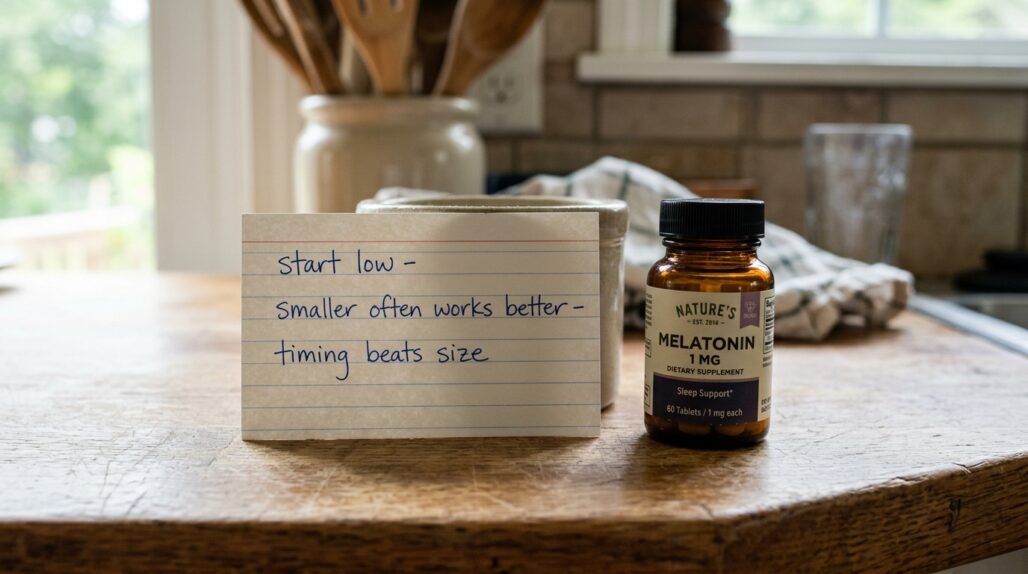
A 10 mg tablet floods your system with roughly 10 to 30 times the amount your body would make on its own. That does not make the night-is-here signal louder in any useful way. It mostly keeps melatonin circulating long past the point where it helps.
Melatonin has a short half-life of about 1 to 2 hours, according to the pharmacology review in StatPearls on the NCBI Bookshelf. A huge dose stretches that window out, which is why a 10 mg pill is more likely to leave you groggy the next morning than a small one.
So 10 mg is not dangerous for a healthy adult in the short term. It is just more than the job requires, and the extra brings side effects without extra benefit.
More melatonin does not mean deeper sleep
This is the part most people get backwards. There is a ceiling effect: once you have enough melatonin to send the timing cue, adding more does nothing for sleep depth.
The cleanest evidence comes from a controlled study by Zhdanova and colleagues in the Journal of Clinical Endocrinology and Metabolism. A 0.3 mg "physiologic" dose restored sleep efficiency in older adults and raised blood melatonin back into the normal nighttime range. The larger 3 mg dose worked too, but it caused mild hypothermia and left melatonin elevated into the daylight hours – the recipe for morning grogginess.
An earlier trial from the same group found that low oral doses cut the time it took healthy young adults to fall asleep, again without a next-day hangover, as documented in their 1996 PubMed-indexed study.
Here is the honest framing on melatonin overall. The 2017 American Academy of Sleep Medicine guideline issued only a weak recommendation against using melatonin for chronic insomnia, reflecting low-certainty evidence rather than a clear benefit. A weak "against" rating does not mean melatonin is useless, but it does mean you should not expect a 10 mg dose to rescue a sleep problem that a 1 mg dose could not.
The side effects you trade for a bigger pill
Take too much and you do not sleep better. You sleep with extra baggage. The NCCIH consumer overview lists the common ones as headache, dizziness, nausea, and daytime sleepiness.
At supraphysiologic doses, StatPearls also notes vivid dreams or nightmares and morning grogginess, and these show up more with high doses and extended-release formulas. None of that is the deep, refreshing sleep people are chasing.
A few things to watch for:
- Morning grogginess that lingers past your first coffee – the most common sign your dose is too high.
- Vivid or unsettling dreams, which tend to fade when you lower the amount.
- A "wired then crashed" feeling if you take it too early, before your body is ready to wind down.
If the dose makes your next day worse than your night was, that is your answer. Cut it down.
Timing beats size every time
Melatonin is a signal, and signals work on schedule. When you take it matters more than how much you take.
The practical window is 30 to 60 minutes before you want to be asleep. NCCIH describes taking it about an hour before the desired bedtime for circadian timing problems. Swallowing 10 mg the moment your head hits the pillow is worse timing than 0.5 mg taken an hour earlier.
If your real issue is a shifted body clock – you cannot fall asleep until 2 a.m. and cannot wake before 10 – a small, well-timed dose is the tool, not a bigger one. If you are weighing melatonin against a non-hormonal option for general restlessness, our comparison of magnesium versus melatonin for sleep walks through when each one makes sense.

How to step down from 10 mg
You do not need to wean off melatonin the way you would a prescription. There is no physical dependence to taper. The goal is simply to find the smallest dose that still works, because that is the one with the fewest side effects.
A reasonable step-down looks like this. Hold each step for about a week so you can judge it fairly, since a single bad night is not the dose talking.
| Step | Target dose | What to notice |
|---|---|---|
| Week 1 | 5 mg (split or buy a 5 mg) | Less morning grogginess, sleep usually unchanged |
| Week 2 | 2 to 3 mg | Most people sleep the same, mornings get clearer |
| Week 3 | 1 mg | Often the sweet spot for everyday use |
| Week 4 | 0.3 to 0.5 mg | The physiologic range studied for clean, hangover-free sleep |
A practical tip while you step down: timing and a dark, screen-free hour do more heavy lifting than the milligram number. Get those right first, then lower the dose into the range that suits you.
One caution on the math. A 2023 research letter in JAMA found that melatonin gummies often contained anywhere from 74% to 347% of the labeled amount. So your "5 mg" gummy might really be 12 mg, which is one more reason a low-labeled tablet or a measured liquid gives you more control than a guessing-game gummy.
Which form makes stepping down easy
This is where the product matters, and the honest pick is the lowest dose and the most adjustable form, not the strongest one.


As an Amazon Associate, UsefulVitamins.com earns from qualifying purchases at no extra cost to you.
UsefulVitamins may earn a commission from purchases made through links on this page, at no extra cost to you. This never changes which products we recommend.
A quick guide to the three formats below:
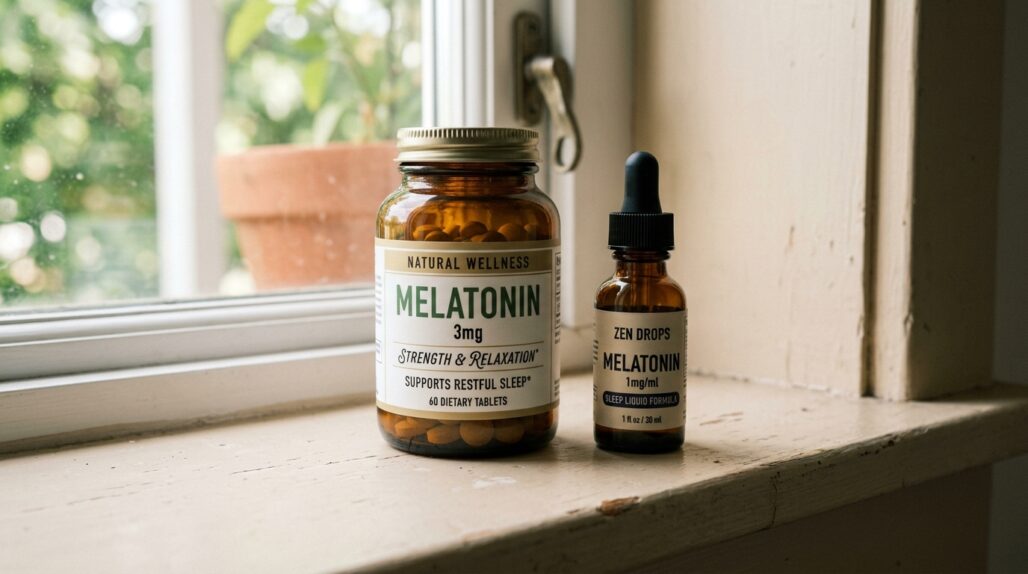
- A low-dose 0.3 to 0.5 mg tablet is the closest match to what your body makes and the simplest landing spot once you have stepped down.
- A 1 mg tablet is a sensible everyday default for people who want a single, predictable dose.
- A liquid melatonin lets you measure tiny amounts by the drop, which is the easiest way to fine-tune below 1 mg without splitting pills.
If you would rather start from a vetted shortlist than sift through the shelf, our roundup of the best melatonin supplements flags low-dose and third-party-tested options. Prices shift, so treat any figure you see as a snapshot and check the current price before buying.

Who should not just lower the dose on their own
Most healthy adults can experiment safely with a smaller amount. Some people should talk to a professional first, full stop.
Anyone on a prescription sleep aid or sedative. StatPearls warns that melatonin should not be combined with benzodiazepines, zolpidem, or eszopiclone because the mix can cause excessive sedation. If you take a sleep medication, do not stack melatonin on top of it – read our explainer on melatonin and Ambien and ask your pharmacist before mixing anything.
Anyone on a blood thinner or with epilepsy, who NCCIH says should use melatonin only under medical supervision. The same goes if you take several supplements or medications at once – our drug and supplement interaction checker is a quick way to flag overlaps to raise with your pharmacist.
Children and anyone pregnant or breastfeeding. Pediatric melatonin ingestions reported to poison control rose 530% between 2012 and 2021, per the CDC's Morbidity and Mortality Weekly Report, driven largely by young kids mistaking gummies for candy. Dosing for a child, or during pregnancy, is a conversation for a doctor, not a self-experiment.
FAQ
Is 10 mg of melatonin dangerous? For a healthy adult taking it occasionally, 10 mg is not considered acutely toxic, and StatPearls notes melatonin has very low acute toxicity. The bigger issue is next-day grogginess and the fact that it works no better than a far smaller dose. Get medical help for any large accidental ingestion, especially in a child.
Why do I feel groggy after taking melatonin? Usually because the dose is too high for melatonin’s short 1 to 2 hour half-life, so it stays in your system into the morning. Lowering the dose to 1 mg or less and taking it 30 to 60 minutes before bed often clears that up.
What is the lowest effective dose of melatonin? Studies have shown benefit at a physiologic dose of about 0.3 mg, with 0.3 to 1 mg working well for most people. A measured liquid or a low-dose tablet makes it easy to land in that range.
Can I just stop taking 10 mg cold turkey? Melatonin does not cause physical dependence, so there is no required taper. Many people simply switch to a smaller dose. If you have been relying on it nightly for a long time, mention that to your doctor.
Does a higher dose help if I keep waking up at night? Not usually. More melatonin does not deepen or lengthen sleep once the timing signal is sent. Frequent night waking is worth discussing with a clinician rather than treating with a bigger pill.
Is the dose on the label accurate? Not always. A JAMA analysis found gummies ranging from 74% to 347% of the labeled amount, so a third-party-tested tablet or liquid gives you more reliable control over how much you actually take.
The bottom line
Ten milligrams is not a poison for a healthy adult, but it is overkill. More melatonin does not buy you deeper sleep – it mostly buys grogginess, odd dreams, and a longer hangover, because the useful signal is small by design.
The fix is dull and effective: step down toward 0.3 to 1 mg, take it 30 to 60 minutes before bed, and let timing and a dark wind-down hour do the work. A low-dose tablet or a measured liquid makes that easy.
If you take a sedative, a blood thinner, or any prescription, or if this is for a child or during pregnancy, route the decision to a pharmacist or doctor before you change anything.
This article is general education, not medical advice, and it is not a substitute for guidance from your own pharmacist or doctor. Do not start, stop, or change any medication based on what you read here.
Reviewed by the UsefulVitamins Editorial Team.
