
Affiliate disclosure: this article contains affiliate links. As an Amazon Associate, UsefulVitamins.com earns from qualifying purchases at no extra cost to you.
Why collagen clumps in the first place
Collagen powder is hungry for water. The moment the outer particles touch liquid they swell into a gel-like skin, and that skin seals the dry powder inside before it can wet through.
That trapped core is your clump. It happens fastest in cold liquid, because cold water dissolves powder slowly, so the surface gels before the inside ever gets wet.
The other trigger is order of operations. Sprinkling a scoop on top of a full glass leaves the powder floating on the surface, where only the bottom layer touches water and the rest rafts together into a lump.
So clumping is a physics problem, not a quality problem. A pricier tub does not dissolve better than a cheap one if you pour it the same wrong way.
The method that actually works
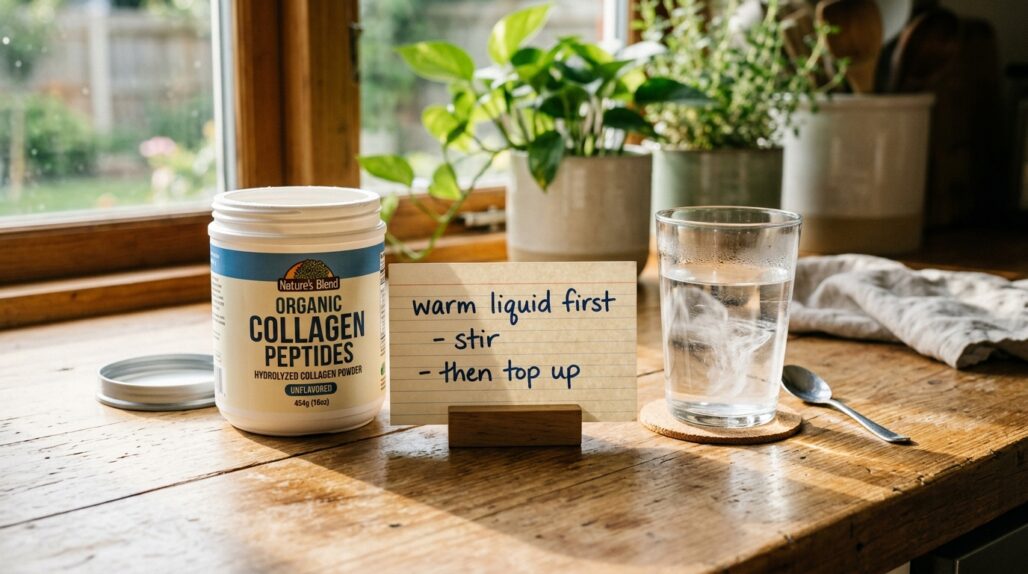
The fix is to wet the powder gradually before it can seal itself. Hydrate the scoop in a little warm liquid first, then add the rest. This is the single change that solves most clumping complaints.
Here is the sequence, start to finish:
- Put a small amount of warm liquid (around two ounces, or a finger of water) in your glass or mug.
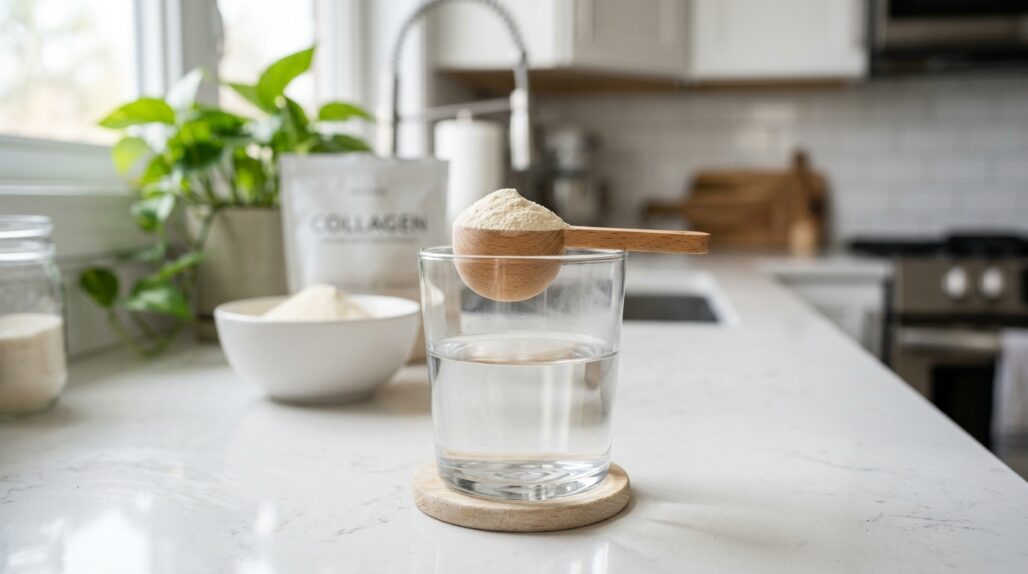
- Add your collagen scoop to that splash, not to a full glass.
- Stir for ten to twenty seconds until the slurry looks smooth and uniform.
- Top up with the rest of your coffee, water, smoothie, or cold drink.
Warm liquid matters because heat speeds dissolution. You are not cooking the collagen; you are just giving the particles enough energy to break apart instead of clinging together.
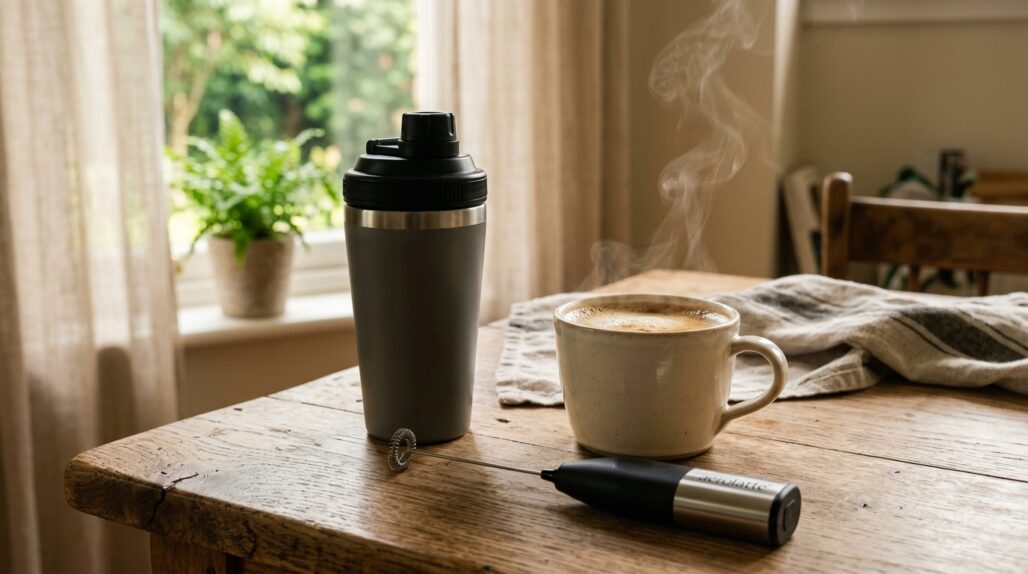
If you want to skip the two-step pour, agitation does the same job. A handheld frother for five seconds, or ten shakes in a sealed shaker bottle, forces the powder to disperse before it can gel.
For cold drinks specifically, the warm-first trick is worth the extra step. Pre-dissolve the powder in a tablespoon of warm water, then pour it into iced coffee or a cold smoothie. The collagen is already in solution, so the cold liquid never gets the chance to seize it.
The order of additions, by drink
| Drink | Best method | Why it works |
|---|---|---|
| Hot coffee or tea | Pour collagen onto the surface, then stir for fifteen seconds | Heat dissolves the powder fast enough that stirring alone clears it |
| Cold or iced coffee | Pre-dissolve in two ounces warm water, then add to the cold cup | Cold liquid gels the surface, so you bypass it with a warm slurry |
| Plain water | Use a shaker bottle or frother for five to ten seconds | No fat or heat to help, so mechanical agitation does the lifting |
| Smoothie or yogurt | Blend it in with everything else | The blender shears any clumps apart before you taste them |
| Oatmeal or soup | Stir in off the heat after cooking | Thick, warm bases dissolve peptides easily with a quick stir |
Hot coffee is fine, and here is why
A stubborn myth says hot coffee destroys collagen. It does not, and understanding why also explains why heat actually helps it mix.
The confusion comes from gelatin versus peptides. Native collagen, the long triple-helix protein in raw skin and bone, unwinds at around body temperature, which is exactly why slow-cooking tough meat melts connective tissue into gelatin.
But the collagen in your tub is hydrolyzed. Manufacturers have already broken those long strands into short peptides, generally in the range of 0.3 to 8 kilodaltons, using heat, water, and enzymes. There is no helix left to unwind.
According to a Healthline review of the research, collagen peptides only begin to degrade around 302 degrees Fahrenheit (150 degrees Celsius). Brewed coffee sits near 195 to 205 degrees Fahrenheit (90 to 96 degrees Celsius), far below that line.
A randomized crossover trial published in Frontiers in Nutrition found that hydrolyzed collagen from fish, pork, and beef all delivered relevant blood levels of the key peptides, independent of source and molecular weight. The takeaway: your coffee mug is not undoing the supplement.
So hot liquid is your friend here. It dissolves the powder cleanly and leaves no grit, and the peptides arrive intact. If you want to confirm the dose you should be drinking in the first place, run your numbers through our collagen dose calculator rather than guessing by the scoop.
Marine versus bovine: a real texture difference
If one tub mixes glassy-smooth and another always leaves specks, the animal source and grind are usually why.
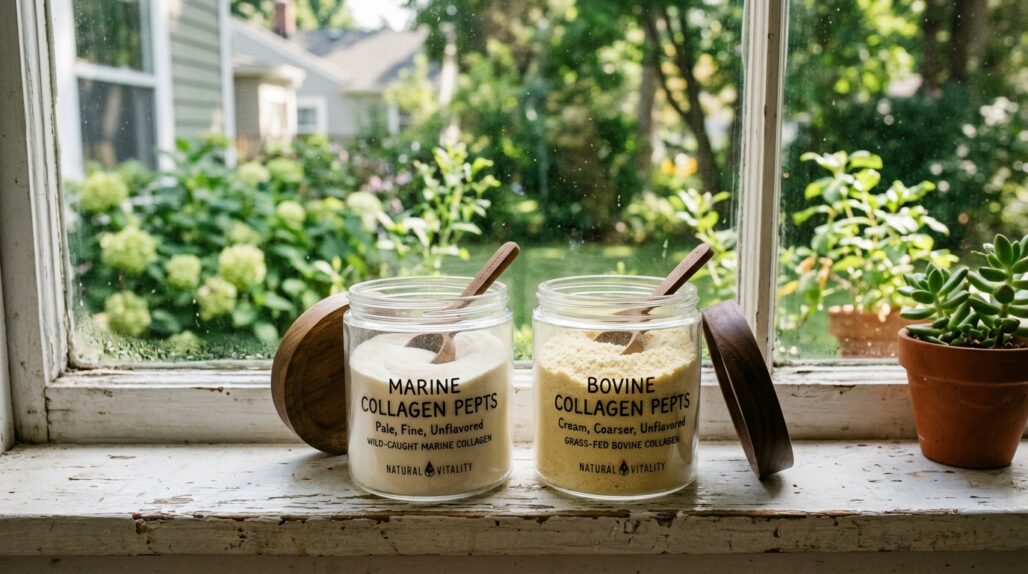
Marine collagen peptides tend to run smaller, often near 2,000 to 3,000 daltons, and the powder is typically finer. That smaller particle wets faster and disperses more evenly, so marine powders frequently mix cleaner in plain water.
Bovine collagen peptides are commonly larger, roughly 3,000 to 8,000 daltons, and the powder can be slightly coarser. It still dissolves well, but it rewards the warm-liquid-first step more than marine does.
One practical quirk worth knowing: with very fine marine powder, adding the powder to the empty glass first and then pouring liquid on top can disperse better than the reverse. With coarser bovine powder, the warm slurry method is the safer bet.
None of this changes how well the collagen works. A controlled crossover comparison of collagen sources found that free hydroxyproline uptake was not affected by the source or molecular weight of the powder, so for everyday use the sources are broadly interchangeable. Texture is a kitchen preference, not a potency ranking. If you are deciding between sources for skin goals, our breakdown of the best marine collagen powder for skin compares the finer-mixing options.
Which product or form to buy
The honest verdict: the cheap fix is a tool, not a fancier powder. A two-step warm pour solves clumping for free, and a five-dollar frother or a shaker bottle solves it for everyone who is in a hurry.
If you are shopping anyway, look for a powder labeled as hydrolyzed collagen peptides rather than gelatin, since peptides are made to dissolve and gelatin is made to set. A finely milled marine peptide is the easiest mixer if grit bothers you, while a standard bovine peptide is the value play and mixes fine with the warm-first method.
Liquid collagen sidesteps mixing entirely, though you usually pay more per gram for the convenience. We weigh that tradeoff in our look at whether liquid collagen is worth it versus powder, and at the bigger picture in whether collagen is really worth taking at all.
UsefulVitamins may earn a commission from purchases made through the links below, at no extra cost to you. We only suggest products that fit the use case described above.


As an Amazon Associate, UsefulVitamins.com earns from qualifying purchases at no extra cost to you.
A quick label note: collagen is not a complete protein. It is low in tryptophan, so the NIH Office of Dietary Supplements protein guidance is a reminder that it supplements, rather than replaces, the protein in your meals. Third-party testing still matters too, since powders vary in purity.
FAQ
Does stirring collagen into hot coffee destroy it? No. Hydrolyzed peptides are already broken down and only degrade near 302 degrees Fahrenheit, while coffee brews around 195 to 205 degrees. The heat actually helps it dissolve.
Why does my collagen clump even when I stir hard? Most likely you are adding the full scoop to a full glass of cold liquid. The surface particles gel and trap the dry powder. Wet the scoop in a warm splash first, then top up.
Can I just use a shaker bottle instead of the warm-water step? Yes. Ten shakes in a sealed shaker or five seconds with a handheld frother disperses the powder before it can clump, even in cold drinks.
Does marine collagen really mix better than bovine? Often, yes, because marine peptides are usually smaller and the powder is finer. Bovine still dissolves well but benefits more from the warm-liquid-first method.
How much collagen should I actually be mixing? Studied skin and joint doses generally fall in the single-digit to low-double-digit grams per day, but the right number depends on your goal and body size. Our collagen dose calculator gives you a personalized figure.
Is clumped collagen still safe to drink? The clumps are just undissolved powder, not spoiled, so they are safe if you swallow them. They are a texture annoyance, not a health risk.
The bottom line
Clumping comes down to temperature and order, not the brand on the tub. Wet the powder in a small amount of warm liquid first, stir, then top up, and most clumps disappear.
If you want it foolproof, a frother or shaker bottle does the work in seconds, and hot coffee is a perfectly good place to add peptides. For source and texture, marine tends to mix finest, but a bovine powder with the warm-first step is just as effective and usually cheaper.
The next step is matching the dose to your goal before you worry about the swirl. Sort the amount with the calculator, pick a hydrolyzed peptide you will actually drink daily, and grab a cheap frother if your spoon keeps losing the battle.
This article is general education, not medical advice. Supplement needs and tolerances vary, so talk with a pharmacist or doctor before starting collagen if you are pregnant, have kidney disease, or follow a protein-restricted diet.
Reviewed by the UsefulVitamins Editorial Team.
