
Affiliate disclosure: this article contains affiliate links. As an Amazon Associate, UsefulVitamins.com earns from qualifying purchases at no extra cost to you.
Most "flaxseed oil vs fish oil" advice for vegetarians dodges the one fact that decides it: how much of the plant omega-3 in flax your body can turn into the forms it actually uses. The short version is "not much." That single number reshapes the whole comparison, so we will lead with it and then sort out who each oil is really for.
What "omega-3 for vegetarians" actually means
There are three omega-3 fatty acids worth knowing. ALA (alpha-linolenic acid) is the short-chain one from plants such as flax, chia and walnuts. EPA and DHA are the long-chain ones your heart, brain and inflammation pathways run on. When research links omega-3 to cardiovascular or cognitive outcomes, it is almost always talking about EPA and DHA, not ALA.
Your body can stretch ALA into EPA and DHA using a chain of enzymes. The catch is that the conversion is slow and leaky, especially the final step to DHA. So the real question for a vegetarian is not "which oil has omega-3" (both do) but "which oil reliably raises the long-chain omega-3 my body needs."
Flaxseed oil bets everything on conversion. Fish oil skips conversion by handing you EPA/DHA directly, but it comes from fish, which rules it out for most vegetarians and all vegans. Hold that tension in mind, because it is why a third option keeps coming up.
Flaxseed oil: plenty of ALA, a narrow conversion gate
Flaxseed oil is one of the richest plant sources of ALA. A tablespoon supplies several grams, and ALA is a legitimately useful fat for the heart and for general essential-fatty-acid needs. If all you wanted was ALA, flax delivers it cheaply and is fully vegan.
The mechanism that matters here is the enzymatic pathway: ALA is converted by desaturase and elongase enzymes, first toward EPA, then onward to DPA and finally DHA. Each step competes with omega-6 fats for the same enzymes, so a typical high omega-6 diet throttles the output further.
How well does it work in people? This is well-studied human evidence, not animal guesswork, and it is sobering. A widely cited tracer study in young women by Burdge and Wootton found net conversion of labelled ALA of about 21% to EPA, 6% to DPA, and 9% to DHA (see the Burdge and Wootton conversion study in young women). The companion data in men were worse: roughly 8% to EPA and effectively no measurable DHA. Cell and dietary work confirms the pattern, with one analysis finding only 0.7% of ALA reaching DHA at a balanced fat ratio (the quantitation of ALA elongation study).
The practical fallout shows up in supplement trials. Flaxseed oil reliably nudges blood EPA upward, but DHA and the overall omega-3 index usually do not budge. A controlled comparison in young women saw EPA rise on flax while DHA stayed flat, and a broader review of ALA conversion concluded that ALA raises EPA but has little effect on DHA or the omega-3 index.
Evidence grade: strong human data, disappointing result. We know flax works for ALA. We also know, from good human studies, that flax alone rarely gets DHA where you want it.

Fish oil: direct EPA/DHA, but not vegetarian
Fish oil skips the conversion problem. It supplies EPA and DHA already made, the exact molecules used by membranes, the cardiovascular system and the pathways that produce inflammation-resolving mediators. There is no enzymatic gate to clear.
How well does it work? This is the most-studied omega-3 source we have. Direct EPA/DHA reliably raises the omega-3 index, and the dose-response is predictable: take more, your level goes up. The NIH Office of Dietary Supplements omega-3 fact sheet treats fish, seafood and fish oil as the primary practical sources of long-chain omega-3, precisely because conversion from plant ALA is unreliable.
The obvious problem for this article: fish oil is an animal product. It is fine for pescatarians and anyone who simply prefers it, but it does not fit a vegetarian or vegan diet. So while fish oil clearly beats flax on the outcome that counts (actual EPA/DHA status), it loses on the constraint that defines the reader: no fish.
Evidence grade: strong human data, strong result, wrong category for many vegetarians.
Head-to-head: the numbers that decide it
The comparison comes down to whether you trust conversion or sidestep it.
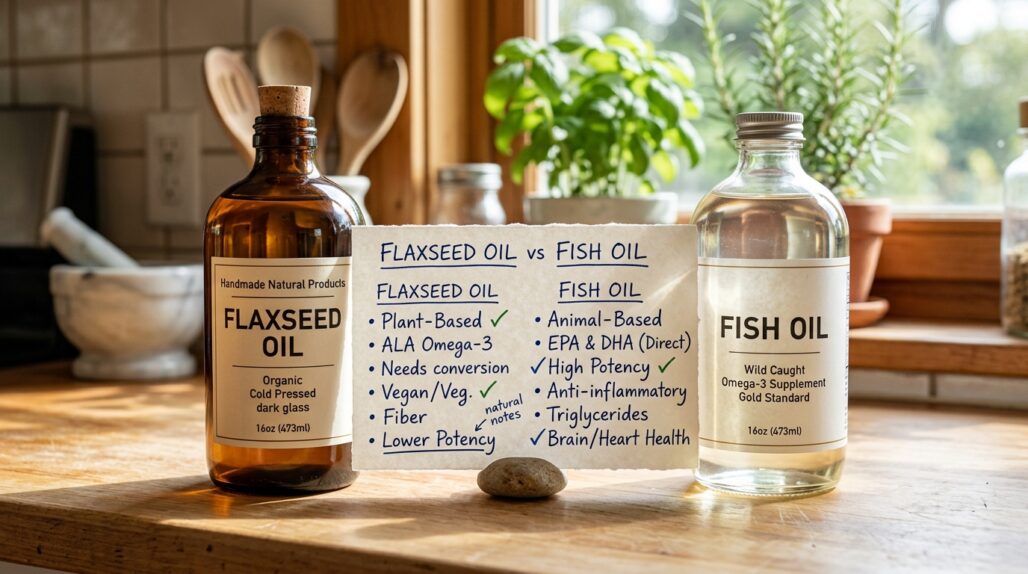
| Factor | Flaxseed oil (ALA) | Fish oil (EPA/DHA) |
|---|---|---|
| Best for | Plant ALA intake; people who want a vegan oil and only need ALA | Direct, measurable EPA/DHA for anyone who eats fish |
| Evidence | Strong human data, but it shows poor DHA conversion and a usually flat omega-3 index | Strong human data; reliably raises EPA, DHA and the omega-3 index |
| Onset | EPA creeps up over weeks; DHA may never meaningfully rise | Blood levels climb within weeks; index responds in 8 to 12 weeks |
| Typical dose | About 1 tbsp oil or 1 to 2 g ALA daily (food-style intake) | Often 250 to 1,000 mg combined EPA/DHA daily; read the EPA/DHA line, not total fish oil |
| Main downside | Barely lifts DHA; conversion is lower in men and on high omega-6 diets | Not vegetarian; possible fishy aftertaste; sourcing and oxidation vary |
Read the table and the verdict writes itself. Flax wins on diet fit but loses on the result. Fish oil wins on the result but loses on diet fit. For a vegetarian set on real EPA/DHA, picking between these two means choosing which compromise to accept, and neither is good.

The third option vegetarians keep landing on: algae oil
EPA and DHA in the ocean do not originate in fish. Fish accumulate them by eating microalgae. You can go straight to that source. Algae oil is grown from marine microalgae and supplies EPA and DHA directly, with no animal involved and no conversion gate. It is the one option that satisfies both the diet constraint and the outcome.
Does it actually work as well as fish oil? Yes, by the evidence we have. A randomized human trial found the bioavailability of DHA and EPA from microalgal oil statistically non-inferior to fish oil (the comparative bioavailability trial of microalgal vs fish oil), and supplementing with it raises the omega-3 index the same way fish oil does. Algae oil is less heavily studied than fish oil overall, so we grade it a notch below for sheer volume of trials, but the head-to-head bioequivalence data are encouraging and consistent.
This is why, for the reader this article is written for, the smart move is to stop arguing flax against fish and route to algae oil instead.
Who should pick which
Pick flaxseed oil if you want a vegan oil purely for ALA, you are happy to treat omega-3 as a general dietary fat rather than a DHA strategy, or you are already eating algae oil for EPA/DHA and want flax on top for variety. Do not rely on it to fix a low DHA level.
Pick fish oil if you are pescatarian or eat fish, want the deepest evidence base, and want a predictable, testable rise in your omega-3 index. It is the wrong call only because of the fish.
Pick algae oil if you are a vegetarian or vegan who wants the EPA/DHA benefits fish oil is known for, without the fish. For most readers here, this is the actual answer.
If you want to translate any of this into grams, our omega-3 EPA and DHA calculator turns a target intake into a daily dose, and the complete guide to omega-3 walks through testing your level and reading labels.

Which to buy
![NatureWise Flaxseed Oil 1200 mg, Fish Free Omega 3 6 9 with 720mg ALA - CCOF Certified Organic Flaxseed Oil - Plant-Based Omega - Cold Pressed, Non-GMO - 240 Softgels[8-Month Supply]](https://m.media-amazon.com/images/I/41r8R2y8-JL._SL160_.jpg)


As an Amazon Associate, UsefulVitamins.com earns from qualifying purchases at no extra cost to you.
Heads up: the picks below include affiliate links. If you buy through them we may earn a small commission at no extra cost to you, and it never changes our verdict.
For direct EPA/DHA, compare options in our best omega-3 fish oil supplements roundup, and for the vegan route see our best vegan algae oil EPA and DHA supplements guide. Prices move, so treat any figure you see as "around that as of writing; check the current price." Whichever you choose, buy on the EPA/DHA milligrams listed, not the headline "fish oil" or "flax oil" weight.
Can you take both flaxseed oil and fish oil together?
Yes, you can combine them, and at normal supplement doses there is no dangerous interaction between flax and fish. But for a vegetarian, combining them is mostly beside the point: flax adds ALA you barely convert, so it does little to improve the EPA/DHA picture that fish oil (or algae oil) already covers.
A few real cautions apply to the long-chain oils, fish and algae alike. Both are mildly blood-thinning. At everyday doses (broadly up to about 3 to 4 g of EPA/DHA daily) the bleeding signal in trials has been small, but if you take warfarin or another anticoagulant or antiplatelet drug, the effect can be additive, and the NIH fact sheet flags the theoretical interaction. The same goes for stacking omega-3 with other blood thinners such as high-dose fish oil plus aspirin or fish oil plus high-dose vitamin E. None of that means start or stop a medication on your own. Talk to your clinician before adding a high-dose omega-3 if you are on a blood thinner, are pregnant, or have surgery scheduled.
The cleaner plan for most vegetarians is simple: drop the flax-versus-fish question, take algae oil for vegan EPA/DHA, and keep ground flax or flax oil in the diet as a bonus ALA source rather than your omega-3 plan.
FAQ
Does flaxseed oil convert to EPA and DHA at all? Yes, but poorly. Human tracer studies put EPA conversion in the rough range of 8% (men) to 21% (women) and DHA conversion at under 1% to about 9%, and flax supplementation often raises EPA a little while leaving DHA and the omega-3 index unchanged.
Is fish oil better than flaxseed oil for omega-3? For raising EPA and DHA, yes, because it supplies them directly instead of relying on conversion. The drawback for this audience is that fish oil is not vegetarian.
What is the best omega-3 for vegetarians and vegans? Algae oil. It is vegan and delivers EPA/DHA directly, with bioavailability shown to be non-inferior to fish oil in a randomized human trial, so it raises the omega-3 index the way fish oil does.
How much algae oil should a vegetarian take? A common target is roughly 250 to 500 mg of combined EPA/DHA daily for general health, higher if a clinician advises it. Dose by the EPA/DHA milligrams on the label, and use our calculator to convert a target into a daily amount.
Can I just eat ground flaxseed instead of taking the oil? Ground flax gives you ALA plus fiber and lignans, which is great, but it runs into the same conversion ceiling. It will not reliably raise your DHA on its own.
Is it safe to take omega-3 with a blood thinner? Omega-3 is mildly blood-thinning and can be additive with anticoagulant or antiplatelet drugs, so the combination needs a clinician’s sign-off rather than a do-it-yourself decision. Do not start or stop any prescription on your own.
The bottom line
For a vegetarian chasing the benefits of omega-3, flaxseed oil and fish oil are the wrong two finalists. Flax gives ALA that converts to EPA/DHA at low and unreliable rates, especially for DHA, and fish oil gives the EPA/DHA you want but is not vegetarian. Pick flaxseed oil only if you truly just need plant ALA, pick fish oil only if you eat fish, and for everyone else use algae oil for direct vegan EPA/DHA. You can take flax and fish together safely at normal doses, but the better move is to skip that debate, choose algae oil, and check with a clinician first if you take a blood thinner or are pregnant.
This article is for general information and is not medical advice. Talk to a qualified clinician about your own situation, medications and supplements.
Reviewed by the UsefulVitamins Editorial Team.
