
Affiliate disclosure: this article contains affiliate links. As an Amazon Associate, UsefulVitamins.com earns from qualifying purchases at no extra cost to you.
What the combined pill actually does to your B vitamins
If you are on a combined oral contraceptive (the kind with both estrogen and a progestin, the standard "pill"), you have probably read that it drains your vitamins. That claim is half true and gets overstated. Some of it is real. A lot of it is recycled from research done decades ago on much higher estrogen doses than today's pills use.
The most consistent finding is that pill users tend to have lower levels of the active form of vitamin B6. Other signals (B12, magnesium, zinc) are weaker and easy to misread. And the one nutrient people worry about most, folate, is the one modern low-dose pills do not seem to meaningfully lower.
This page is education, not a prescription change. Nothing here tells you to start, stop, or alter your pill. The aim is simpler: help you add the right thing safely, skip the dangerous combination, and take your list to a pharmacist who can see your full picture.
What the pill depletes or affects, graded by evidence
Let me separate the strong evidence from the thin evidence, because the difference matters when you are deciding what to actually buy.
Vitamin B6 – well-documented. This is the clearest effect. Women on combined pills show lower plasma pyridoxal-5'-phosphate (PLP), the active coenzyme form of B6. A 2011 review in Nutrition Reviews by Wilson and colleagues looked specifically at modern low-dose formulations and concluded they "may negatively impact vitamin B6 status," and that the dip in PLP likely reflects reduced body stores rather than a lab quirk. This is the one depletion strong enough to plan around.
Folate – not meaningfully depleted by modern pills. This surprises people. Older studies on high-estrogen pills suggested a folate problem, but the same 2011 review found today's low-dose pills do not meaningfully lower folate status. Folate still belongs in this conversation, though, for a different reason: if you stop the pill and become pregnant, healthy folate stores protect early fetal development. So folate here is pregnancy insurance, not a fix for a deficiency the pill caused.
Vitamin B12 – mostly a measurement artifact. You will see scary numbers, like one small study reporting serum B12 roughly 40 to 46 percent lower in pill users. Read the fine print. The pill changes how the liver makes a B12 carrier protein (transcobalamin), so the measured serum number drops while the functional markers (methylmalonic acid and homocysteine) stay normal and there is no anemia. Researchers who described this called it falsely low B12, and levels returned to normal within about a month of stopping the pill. So a low B12 result on the pill is worth a conversation, not a panic.
Magnesium, zinc, selenium – observational and weak. Some studies report these trending down with longer pill use. The data are inconsistent and confounded by diet. This is a "fill a real gap if you have one" situation, not a documented drug depletion.
So the pill does not "drain all your vitamins." It has one solid nutrient signal (B6), one piece of pregnancy-minded insurance (folate), and a lot of noise.
The supplements worth adding, and how to take each
The supplements that make sense here are also among the easiest to take alongside the pill. None of them lower your contraceptive's effectiveness, and none need careful spacing from your dose the way some thyroid or antibiotic combinations do. You can take them with food, at whatever time fits your routine.
UsefulVitamins may earn a commission from links below, at no cost to you. We only suggest supplements that are safe to add alongside this prescription; the products here are not a substitute for it.


As an Amazon Associate, UsefulVitamins.com earns from qualifying purchases at no extra cost to you.
A B6-forward B-complex covers the pill's clearest nutrient gap. Look for one using the active P5P (pyridoxal-5'-phosphate) form of B6 plus methylfolate rather than folic acid. An everyday B-complex dose is fine; you do not need a megadose. One caution that matters: long-term very high B6 (well above 100 mg/day for months) can cause nerve tingling, so respect the label and avoid stacking multiple B6-containing products. The NIH Office of Dietary Supplements B6 fact sheet is a good plain reference for sensible amounts.
Methylfolate (5-MTHF, often 400 to 800 mcg) is the pregnancy-insurance pick. It is most worth it if there is any chance you might stop the pill and conceive, since folate stores matter before you even know you are pregnant. It is safe with the pill and does not interfere with it.
Magnesium glycinate is the gentle option for the observational magnesium dip and for everyday PMS-type cramps and sleep. Glycinate is easy on the stomach, and a modest dose (around 200 mg) is plenty for most people. It does not weaken your pill.
The plan below puts the timing in one place.
| Supplement | What it helps with | How to take it (timing/spacing from your dose) | Caution |
|---|---|---|---|
| B6-forward B-complex (P5P + methylfolate) | The pill’s clearest nutrient gap, low active B6 | With breakfast; no spacing from the pill needed | Do not megadose B6 long term; do not double up with other B6 products |
| Methylfolate (5-MTHF, 400-800 mcg) | Folate stores, mainly pregnancy insurance if you may stop the pill | Any time, with or without food; no spacing needed | Often already inside a good B-complex, so check you are not doubling |
| Magnesium glycinate (around 200 mg) | The observational magnesium dip, plus cramps and sleep | Evening works well; no spacing from the pill needed | Can loosen stools at higher doses; go gentle if you have kidney problems |
One practical habit. You can keep both your pill and any supplement in one place and have overlaps flagged before you add something new, using StackMyMed (our own free app), which lets you log them together so a possible interaction gets surfaced as something to ASK your pharmacist about. It does not give medical advice or diagnose anything; it just helps you notice what to raise. If you would rather not use an app, the low-tech version works just as well: write your full list on paper and show it to your pharmacist.
What to avoid or space apart
This is the part to read twice. A couple of combinations here are not "take them apart" cautions; they are real do-not-mix situations.
St. John's Wort – avoid it entirely on the pill. This herbal mood supplement contains hyperforin, a strong inducer of the CYP3A4 enzyme and the P-glycoprotein transporter that together clear your hormones from your body faster. In a randomized controlled trial of low-dose pill users, adding St. John's Wort reduced contraceptive hormone exposure and shortened the half-life of ethinylestradiol to roughly half. Breakthrough bleeding jumped from 2 of 12 women to 7 of 12. A 2016 systematic review found the same pattern, weak-to-moderate enzyme induction and more breakthrough bleeding, while noting that hard data on actual contraceptive failure are still thin. Individual responses vary, so some people may lose more protection than the averages suggest. The effect starts within days and can linger one to two weeks after you stop. The rule clinicians give is simple: do not take it on the pill, and if you want mood support, ask your prescriber for an option that does not induce these enzymes and use a backup barrier method until you are cleared.
Potassium supplements and "low-sodium" salt substitutes – check first if your pill contains drospirenone. If you take Yaz, Yasmin, or Slynd, your progestin is drospirenone, which has an anti-mineralocorticoid effect roughly comparable to a 25 mg dose of spironolactone and can raise blood potassium. The FDA label for Yaz specifically flags combining them with potassium-raising agents, including potassium supplements, ACE inhibitors, ARBs, potassium-sparing diuretics, NSAIDs, and heparin, and recommends a potassium check in the first cycle for anyone on long-term potassium-raising medicine. So do not add potassium pills or NoSalt-type substitutes on a drospirenone pill without a potassium check. This does not apply to ordinary potassium from food (bananas, potatoes, beans); eat normally.
High-dose vitamin C – a minor, mostly historical concern. Old reports suggested very high-dose vitamin C (over about 1 g/day) could nudge estrogen levels up with the high-estrogen pills of the past. With modern low-dose formulations this is clinically minor. If you megadose vitamin C, keep the dose modest and take it at a different time from your pill. Normal dietary vitamin C and a multivitamin's worth are not a problem.
If you also take an SSRI antidepressant, the St. John's Wort warning doubles up, because the same herb is risky there too. Our guide to supplements for SSRI users covers that overlap.
Can you cover this with food first?
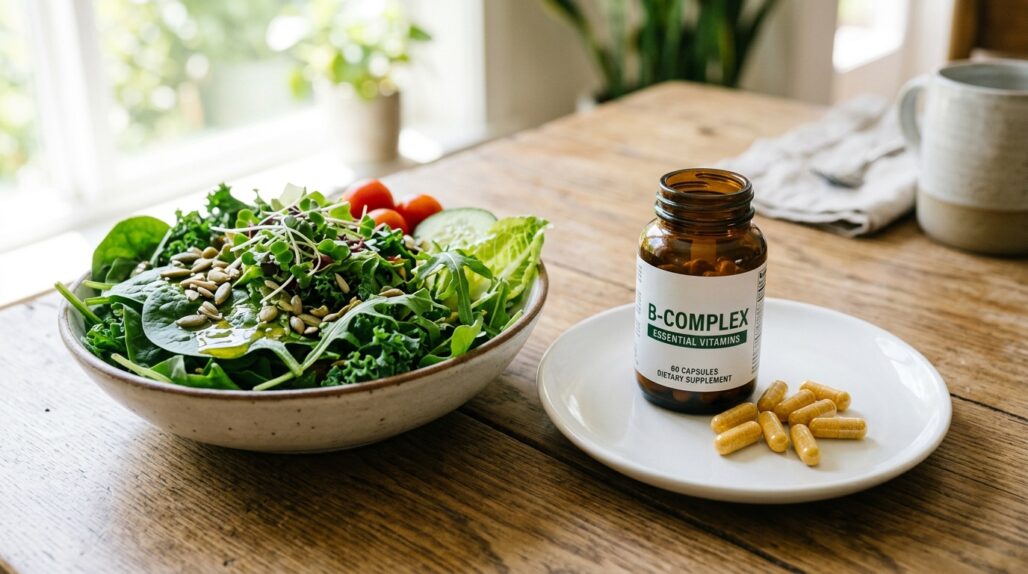
Often, yes, and food should be the starting point. B6 is in poultry, fish, potatoes, chickpeas, and bananas. Folate is in leafy greens, legumes, and fortified grains (and folic-acid fortification is part of why modern pills do not tank folate the way older ones did). Magnesium is in nuts, seeds, beans, and dark greens. Zinc and selenium come from meat, seafood, eggs, and Brazil nuts.
A capsule is for filling a gap a varied diet leaves open, or for the specific pregnancy-insurance reason with folate. It is not a replacement for eating reasonably well, and it is certainly not something your body needs for the pill to work. The pill works on its own.
FAQ
Does the pill cause weight gain because of vitamin loss? No. The B6 link does not explain weight changes, and modern low-dose pills are not strongly tied to weight gain in good studies. If your weight shifts noticeably, talk to your prescriber rather than reaching for a supplement.
Should everyone on the pill take a B-complex? Not necessarily. The B6 evidence is real but modest, and a balanced diet covers most people. A B6-forward B-complex is a low-risk, low-cost option if you want the insurance, especially if your diet is light on B6 foods.
My doctor said my B12 was low. Is that the pill? Possibly, and it is often a falsely low reading caused by changes in a B12 carrier protein rather than a true deficiency. Normal methylmalonic acid and homocysteine point to that. Ask your doctor before loading up on B12, since high-dose B12 can mask the cause of an anemia that should be investigated.
Is it safe to take magnesium for period cramps while on the pill? For most people, yes. Magnesium glycinate at a modest dose does not interfere with the pill. Go gentle if you have kidney problems, and check with your pharmacist if you take other prescriptions.
Can a supplement boost or strengthen my birth control? No supplement boosts, strengthens, or substitutes for your contraceptive, and none is a “natural alternative” to it. Some, like St. John’s Wort, do the opposite and weaken it. If you want to change methods, that is a conversation with your prescriber.
What if I want to stop the pill to get pregnant? That is exactly when folate matters. Many clinicians suggest starting a folate supplement (or a prenatal) before you stop, since folate stores protect very early pregnancy. Plan that with your doctor.

The bottom line
The combined pill has one nutrient effect worth acting on: lower active vitamin B6, which a B6-forward B-complex covers cheaply and safely. Methylfolate is sensible pregnancy insurance, and magnesium glycinate is a gentle option for the softer magnesium signal. None of these weaken your contraception. The interaction to respect above all others is St. John's Wort, which can cut your protection enough to cause breakthrough bleeding or pregnancy, and on a drospirenone pill (Yaz, Yasmin, Slynd) skip potassium supplements and salt substitutes without a potassium check.
One red flag to watch for: if you start any new herbal supplement, especially St. John's Wort or another product that revs up liver enzymes, and you notice breakthrough bleeding or spotting between periods, treat it as a possible sign your protection has dropped. Use a backup barrier method and call your pharmacist or doctor promptly. On a drospirenone pill, muscle weakness, a slow or irregular heartbeat, or palpitations can signal high potassium and need prompt care.
Before you add anything, take your full list (pill plus every supplement) to your pharmacist or doctor. You can compare options in our roundups of the best folate supplements and the best vitamin B12 supplements, and our explainer on birth control and B-vitamin depletion goes deeper on the research behind this page.
This article is for general education and is not medical advice, a diagnosis, or a prescription change. Do not start, stop, or alter any medication or supplement without your own doctor or pharmacist.
Reviewed by the UsefulVitamins Editorial Team.
