
Affiliate disclosure: this article contains affiliate links. As an Amazon Associate, UsefulVitamins.com earns from qualifying purchases at no extra cost to you.
What loop and thiazide water pills do to your potassium and magnesium
Diuretics make your kidneys pass more urine. That is the point, and it is how they lower blood pressure or clear fluid in heart failure. The catch is that some of what leaves in that extra urine is not just water.
Two electrolytes go with it. The FDA prescribing information for hydrochlorothiazide, a common thiazide, lists hypokalemia (low potassium) and hypomagnesemia (low magnesium) among the expected electrolyte disturbances and tells doctors to check serum electrolytes periodically. That is the strongest grade of evidence we have: the regulator acknowledges it on the label. The NIH Office of Dietary Supplements magnesium fact sheet says the same thing plainly, that loop diuretics like furosemide and thiazides like hydrochlorothiazide "can increase the loss of magnesium in urine and lead to magnesium depletion."
Here is the part you cannot skip. Potassium-sparing diuretics do the opposite. Spironolactone, amiloride, triamterene, and eplerenone hold potassium (and magnesium) in, so they push your levels up, not down. The same ODS fact sheet notes that amiloride and spironolactone reduce magnesium excretion. Everything below about adding potassium or magnesium applies only to loop and thiazide diuretics. If you are not sure which one you take, that is the first question for your pharmacist, before any supplement.
One more depletion is worth naming, with an honest grade. High-dose loop diuretics, furosemide in particular, raise urinary loss of thiamine (vitamin B1). This is well-documented in heart-failure patients rather than the general population. A pilot study in heart-failure patients on long-term furosemide and a later focused review in the American Journal of Medicine found meaningful rates of thiamine deficiency, driven mostly by urine flow rate. A study in healthy volunteers showed even low doses of furosemide increase thiamine loss in urine. So thiamine is a real concern at higher loop-diuretic doses, less so at low thiazide doses. Zinc and some B vitamins get mentioned too, but that evidence is thinner and observational, so we are not going to oversell it.
This page is education. It is not a reason to change your dose, skip a pill, or start anything on your own.
The supplements worth adding, and how to take each
These picks cover what a loop or thiazide diuretic actually removes, and they are reasonable to add for most people on those drugs. None of them replaces your water pill or works around it. They sit alongside a prescription you keep taking exactly as directed.
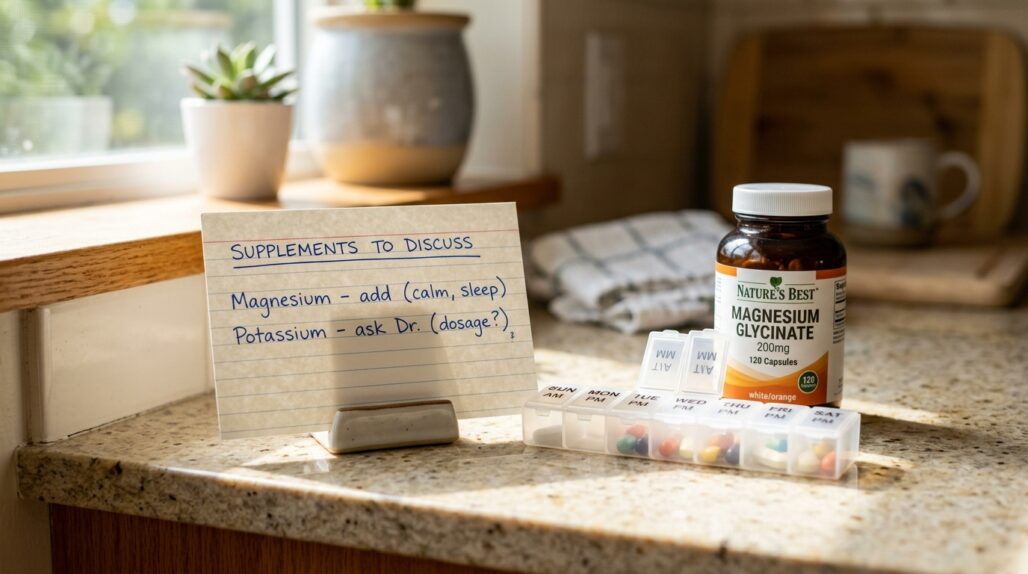
Magnesium glycinate is the one to start with. Loop and thiazide diuretics increase magnesium loss, it runs low more quietly than potassium (you often feel nothing until cramps or palpitations show up), and the glycinate form is gentle on the gut compared with magnesium oxide or citrate, which tend to loosen stools. Low magnesium also makes low potassium harder to correct, so getting magnesium right helps potassium behave. A typical supplemental dose is modest. Take it in the evening, with or without food, and keep it a couple of hours away from any antibiotic, thyroid tablet, or osteoporosis drug it could bind. If you have reduced kidney function, magnesium is one to clear with your doctor first, because impaired kidneys clear it slowly.
Thiamine (vitamin B1) is worth it for one specific group: people on higher-dose, long-term loop diuretics, especially with heart failure. If that is you, raise it with your cardiologist or pharmacist rather than assuming. For a low-dose thiazide user, the case is weaker. Thiamine is water-soluble and well tolerated, taken any time of day with or without food.
A potassium-free or low-potassium electrolyte powder can help if you sweat heavily, exercise, or feel wiped out, and it lets you replace sodium and magnesium without the hazard of self-dosing potassium. Read the label. Check the Supplement Facts before you buy, because many electrolyte powders are deliberately high in potassium – you want a formula that is light on potassium, not a "high-potassium recovery" blend. Mix it in water and sip; do not treat it as a substitute for a measured potassium correction your doctor decides you need.
Notice what is not on this list: a standalone potassium pill or a potassium salt substitute. Potassium is real, your diuretic may lower it, and it still does not belong in a self-serve supplement plan. It is dosed against a blood level by your prescriber. More on why in the next section.


As an Amazon Associate, UsefulVitamins.com earns from qualifying purchases at no extra cost to you.
Some links below are affiliate links. If you buy through them we may earn a small commission, at no extra cost to you. It never changes which supplements we recommend or how we grade the evidence.
Here is the plan in one place. Timing matters mostly for keeping minerals away from medicines they can bind.
| Supplement | What it helps with | How to take it (timing/spacing from your dose) | Caution |
|---|---|---|---|
| Magnesium glycinate | Replaces magnesium that loop and thiazide diuretics flush out; helps potassium correct | Evening, with or without food; keep 2 to 4 hours away from antibiotics, levothyroxine, or bisphosphonates | Clear it first if you have kidney disease; gentler than oxide or citrate but high doses can loosen stools |
| Thiamine (vitamin B1) | Covers thiamine lost in urine on high-dose, long-term loop diuretics (mainly furosemide) | Any time, with or without food; no spacing needed | Strongest case in heart failure or high furosemide doses; weaker for low-dose thiazide; confirm need with your prescriber |
| Electrolyte powder (potassium-free or low-potassium) | Replaces sodium and magnesium during heavy sweat or fatigue without risky potassium loads | Mix in water and sip across the day; not at the same moment as binding minerals | Check the label is genuinely low in potassium; never use a high-potassium “recovery” blend on a diuretic |
For more on choosing and dosing magnesium, our guide to the best magnesium supplement overall walks through the forms, and our roundup of the best electrolyte supplements covers what to look for on a label.

What to avoid or space apart
This is the section that matters most. A water pill is not a drug to experiment with casually, and a few popular supplements are genuinely risky here.
Do not self-dose potassium or use potassium-based salt substitutes if you are on a potassium-sparing diuretic. Spironolactone, amiloride, triamterene, and eplerenone retain potassium. Adding more, whether as a potassium capsule or a "NoSalt"-type salt substitute, can push you into hyperkalemia (dangerously high potassium), which can be fatal. The FDA label for spironolactone is blunt: potassium supplementation, whether as medication or a potassium-rich approach, "should not ordinarily be given" with the drug, and salt substitutes are named as a hyperkalemia risk. This is the whole reason the safe-add list above is for loop and thiazide diuretics only.
Be just as careful if you take a loop or thiazide diuretic plus an ACE inhibitor or ARB. Lisinopril, ramipril, losartan, valsartan, and the like blunt potassium loss and raise hyperkalemia risk. Potassium replacement in that situation is a prescriber decision with blood monitoring, not a supplement-aisle one.
Avoid licorice root (glycyrrhizin) supplements with any diuretic. Glycyrrhizin inhibits an enzyme called 11-beta-HSD2, which produces a state called pseudoaldosteronism: your body retains sodium and dumps extra potassium. Stacked on a diuretic that already lowers potassium, that has caused severe hypokalemia, even hypokalemic paralysis, in case reports. Deglycyrrhizinated licorice (DGL), used for the gut, is the lower-risk form, but still mention it to your pharmacist before adding it.
Space minerals away from medicines they bind. Magnesium, calcium, and zinc can grab onto certain antibiotics, levothyroxine, and bisphosphonates in the gut and cut how much of those drugs you absorb. Take mineral supplements at a different time of day, commonly 2 to 4 hours apart, and confirm the gap with your pharmacist.
Skip "detox" and herbal diuretic stacks. Dandelion, juniper, uva-ursi, and high-dose vitamin C marketed for "detox" all push fluid or electrolytes in unpredictable ways. Layering them on a prescription diuretic adds loss you cannot measure. The evidence here is thin, which is why it is not worth the gamble.
If you also take digoxin, do not change your potassium or magnesium intake on your own. Low potassium and low magnesium make the heart more sensitive to digoxin, so toxicity can occur even at a normal digoxin level. The hydrochlorothiazide label flags this. Your prescriber manages those numbers.
One practical way to keep all of this straight: log both your diuretic and every supplement in one place so overlaps get flagged before you add anything. You can do that with StackMyMed (our own free app), which lets you list your prescription and supplements together and surfaces things to ASK your pharmacist about. It does not give medical advice or diagnose; it points out what is worth raising. If you would rather not use an app, the low-tech version works just as well: write your full list on paper and hand it to your pharmacist. Either way, the decision stays with them.
Can you cover it with food instead
Often, yes, and food is the better starting point for potassium especially. The hydrochlorothiazide label itself points to potassium-rich foods as a first option rather than reaching for pills.
For potassium, that means foods like potatoes, beans, lentils, leafy greens, oranges, bananas, tomatoes, and yogurt. The advantage of food is that it is hard to overshoot from diet alone in a way that supplements can cause, though if you are on a potassium-sparing diuretic or an ACE inhibitor or ARB, even big swings in dietary potassium are worth mentioning to your doctor.
For magnesium, lean on pumpkin seeds, almonds, spinach, black beans, and whole grains. Many people who eat this way still need a modest magnesium supplement on a diuretic, but a good diet lowers how much you need to add.
For thiamine, whole grains, pork, legumes, and fortified cereals carry it, though a heavy furosemide dose can outpace what food replaces, which is why supplementation comes up in that group.
Start with food, add supplements only to fill a gap a blood test confirms, and leave the prescription untouched. That is the order.
FAQ
Can I take a potassium supplement to fix low potassium from my water pill? Not on your own. Potassium is dosed against a blood test, and it is dangerous if you are actually on a potassium-sparing diuretic or also take an ACE inhibitor or ARB. Ask your doctor to check a level and tell you whether you need it and how much.
Is magnesium safe to add on a thiazide or loop diuretic? For most people, yes, and it is the most worthwhile add because these diuretics raise magnesium loss. The exception is reduced kidney function, where magnesium clears slowly, so clear it with your doctor first. Keep it a couple of hours from any drug it could bind.
How do I know if I am on a potassium-sparing diuretic? Check the name. Spironolactone, amiloride, triamterene, and eplerenone are potassium-sparing and raise potassium. Hydrochlorothiazide, chlorthalidone, furosemide, bumetanide, and torsemide are thiazide or loop diuretics and lower it. Your pharmacist can confirm in seconds.
Should everyone on a water pill take thiamine? No. The evidence is strongest for people on high-dose, long-term loop diuretics, particularly with heart failure. For a low-dose thiazide, the case is weak. Raise it with your prescriber rather than adding it by default.
Are “natural diuretic” supplements a gentler alternative to my prescription? No. Dandelion, juniper, and similar herbs are not a replacement for a prescribed diuretic, and stacking them on top adds unpredictable fluid and electrolyte loss. Your water pill treats a real condition; do not swap it for anything.
What about an electrolyte powder for the tiredness? A potassium-free or low-potassium formula can help with sodium and magnesium if you sweat or feel drained. Avoid high-potassium “recovery” blends on a diuretic, and if fatigue is new or marked, get an electrolyte blood test rather than self-treating.
The bottom line
If you are on a loop or thiazide water pill, the most worthwhile, safe add is magnesium glycinate, with thiamine reserved for high-dose loop users and potassium handled through food and a blood test rather than capsules. The single rule to respect is to never self-dose potassium or use potassium-based salt substitutes, because that is dangerous if you are actually on a potassium-sparing diuretic or also take an ACE inhibitor or ARB. The prednisone sibling page covers the same licorice and potassium-loss story if you take both, and our electrolyte replacement calculator can help you frame a conversation with your pharmacist.
Confirm which exact diuretic you take, get your potassium and magnesium checked, and run any supplement past your doctor or pharmacist before you start. None of these supports your water pill by replacing it.
Muscle weakness, painful cramps, severe fatigue, or a fluttering, irregular, or racing heartbeat on a loop or thiazide diuretic can signal dangerously low potassium or magnesium. Call your doctor or pharmacist promptly, and seek emergency care for chest pain, fainting, or shortness of breath with an irregular heartbeat. On a potassium-sparing diuretic, the same muscle weakness or palpitations can instead mean high potassium, which is also urgent. Either way, do not self-treat; get an electrolyte blood test.
This article is for education and is not medical advice, a diagnosis, or a reason to change your prescription. Talk to your doctor or pharmacist before adding, stopping, or changing anything.
Reviewed by the UsefulVitamins Editorial Team.
