
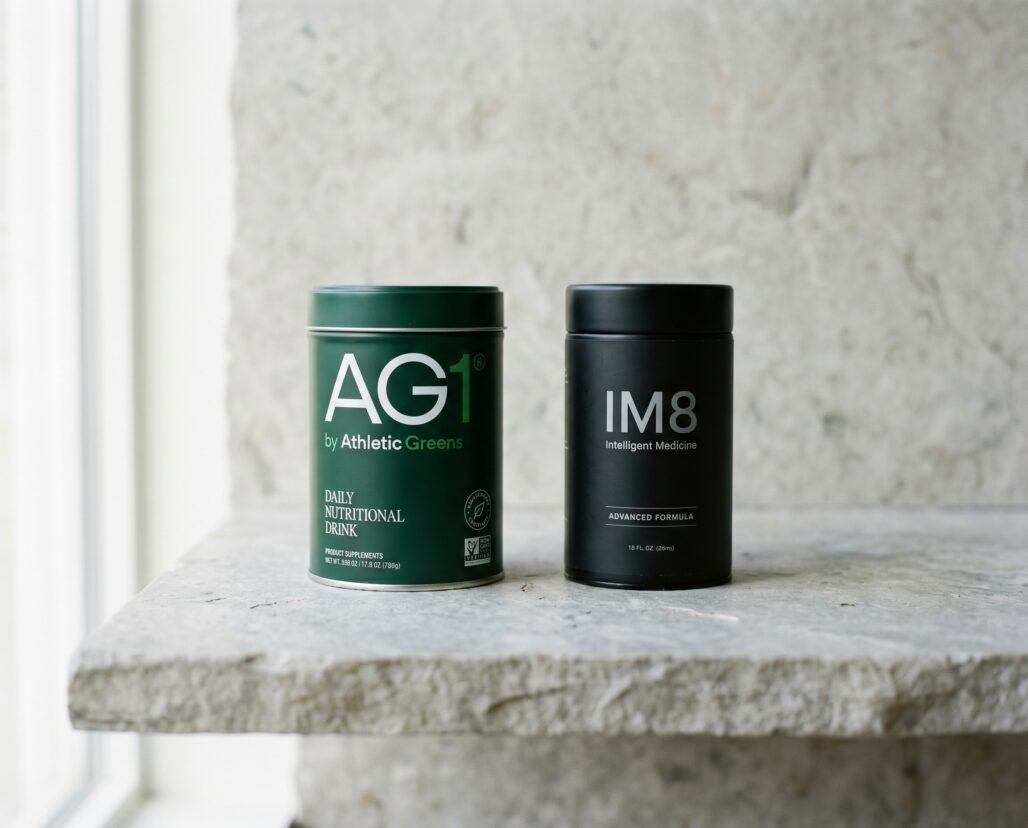
If you're comparing AG1 and IM8, the short answer is: both are expensive, and most people will get 80% of the benefit from a $40-60/month Amazon stack. That said, there are real differences in what each product prioritizes, what those differences cost you per year, and how painful it is to walk away if the product disappoints. This article breaks down pricing math, ingredient form quality, real-user taste reports, and the specific hoops each brand makes you jump through to cancel.
Affiliate disclosure: this article contains affiliate links. As an Amazon Associate, UsefulVitamins.com earns from qualifying purchases at no extra cost to you.
AG1 vs IM8 at a glance
| Category | AG1 | IM8 |
|---|---|---|
| Monthly cost | $99/mo | $190/mo |
| Annual cost | $1,188/yr | $2,280/yr |
| Ingredient count | 75 | 100+ |
| Key differentiator | All-in-one greens + adaptogens | Mitochondrial / NAD+ focus |
| Cancel policy | 7-day notice via email | 14-day notice via customer support |
| Third-party tested | NSF for Sport certified | Not NSF certified (as of 2026) |
The gap is not small. You are deciding between two $1,000+/year commitments with meaningfully different priorities.
Price: $1,092/year separates these two products
AG1 runs $99/month on a subscription, or $1,188 per year. IM8 runs $190/month, or $2,280 per year. The difference is $1,092 annually. That extra money needs to buy you something concrete, not just a longer ingredient list.
For context: Amazon greens equivalent (Amazing Grass Greens Blend Superfood, a comparable all-in-one greens powder) runs roughly $30-35/month, making AG1's cost a 2.8-3.3x premium over a mass-market greens option. IM8's cost lands at a 5.4-6.3x premium over the same baseline.

What does the IM8 premium specifically fund? Primarily the NAD+ precursor stack (NR and NMN), CoQ10 as ubiquinol (the more expensive reduced form), and a broader mitochondrial support profile. Those specific ingredients do have a cost at wholesale. But the question is not whether those ingredients cost more to source. The question is whether you need them at clinical doses, and whether this product delivers clinical doses or token label presence.
Actionable takeaway: If your goal is general daily nutrition with greens coverage, AG1's $99/month is already a significant premium over Amazon. IM8's additional $91/month only makes sense if you specifically need NAD+ pathway support AND you have reason to believe the doses in IM8 are therapeutically meaningful.
Ingredient quality: forms matter more than counts
A 100-ingredient product is not automatically better than a 75-ingredient product. It can just mean more ingredients at sub-therapeutic doses.
Bioavailability of key forms
IM8 lists CoQ10 as ubiquinol, the reduced form. This matters because ubiquinol has roughly 2-3x better absorption in most adult populations compared to ubiquinone, especially in people over 40. AG1 does not prominently feature CoQ10. If mitochondrial energy metabolism is your explicit goal, this form distinction is meaningful.
Both products list B vitamins. IM8 uses methylcobalamin and methylfolate (the methylated forms), which are directly usable by the roughly 40% of the population who carry MTHFR gene variants. AG1 also includes methylated B vitamins at its current formulation. This is a tie.
For NAD+ precursors, IM8 includes both NR (nicotinamide riboside) and NMN (nicotinamide mononucleotide). Human data on NR and NMN longevity benefits is preliminary. The honest read from published trials is: these compounds raise NAD+ levels in blood. Whether elevated NAD+ levels translate to meaningful longevity or performance benefits in otherwise healthy adults is not yet established with the same confidence as, say, creatine or vitamin D. You are paying for a promising mechanism, not a proven outcome.
Dose logic and the single-scoop problem
Both products cram many ingredients into a single serving. When you put 75-100 ingredients in one scoop, some will hit therapeutic ranges and others will be label decoration. The specific risk in both products: mineral competition. Calcium and iron compete for the same intestinal transporter (DMT1). Magnesium and zinc compete at overlapping sites. An all-in-one formula taken as one morning scoop may suppress absorption of minerals you specifically need.

Neither brand publishes a complete breakdown of which specific forms and doses they use for every single ingredient. AG1 discloses proprietary blend totals for several complexes but not individual ingredient doses within those blends. IM8 has similar disclosure limitations. This is a legitimate criticism of both products.
Actionable takeaway: If you have a specific deficiency or health target, a targeted single-ingredient or two-ingredient supplement from a brand like Thorne or NOW Foods will give you a known dose at a known form. That is a different product category from these all-in-one stacks.

Taste and daily UX: real user reports
AG1 has a recognizable taste profile. The majority of long-term users on r/supplements describe it as "grassy with a slight sweetness" and note that mixing in cold water versus room temperature water makes a noticeable difference. A common report from 2024-2025 threads: "Took about two weeks to stop noticing the taste. Now it's just part of the morning routine." One user from a February 2025 r/ag1 thread put it plainly: "It's not good, it's not bad. It's effective-tasting."
IM8's taste reception is more polarized. Several 2025 r/biohackers posts describe IM8 as significantly more palatable than AG1, with a smoother, less earthy flavor profile. Counter-reports from the same period note that the premium cost creates a psychological expectation that occasionally tips toward disappointment when the taste is "just fine." One r/supplements user in late 2025 noted: "IM8 tastes better than AG1 but I'm paying double. That's a lot for flavor."
Mixability is comparable. Both dissolve in 8-10 oz of water with moderate shaking. Neither requires a blender.
Neither product is something most people would drink voluntarily if it weren't a supplement. The real UX variable is not taste but whether you can sustain the habit. Both brands ship with shaker cups and travel packs, reducing friction for daily compliance.
Cancel policy: both require effort, IM8 requires more
This is where the "subscription as convenience" framing falls apart.
AG1 cancellation: You must cancel via email, with a minimum 7-day notice before your next charge date. There is no in-app or website cancel button. AG1's email support is responsive (most reports indicate 24-48 hour replies), but you are dependent on their team processing your request before the cutoff. To avoid the next monthly charge, cancel before day 23 of your current billing cycle.
IM8 cancellation: IM8 requires 14 days notice before your next charge, and cancellation goes through customer support contact (phone or email). The 14-day window is materially tighter than it sounds: if you decide IM8 is not working for you mid-cycle, you may already be inside the cancellation window for the next charge. Several 2025 Reddit reports describe missing the window by one or two days and receiving an unwanted additional shipment.
Both companies describe their subscriptions as "flexible" and "cancel anytime." That framing omits the notice periods, the email-only or support-dependent process, and the practical difficulty of hitting a specific calendar deadline each month. These are commitments, not conveniences.
Verdict: who should pick which
Pick AG1 if: You want a single daily scoop covering greens, probiotics, adaptogens, and basic vitamin/mineral coverage. You value NSF for Sport certification as a third-party quality signal. Your budget is $99/month and you want the most-established product in this category.
Pick IM8 if: You specifically want NAD+ and mitochondrial support in a single product, you have $190/month budgeted for supplements, and you have done enough reading on NR and NMN to accept that the evidence is early-stage but directionally interesting. Do not pick IM8 because it has more ingredients. More ingredients at unclear doses is not evidence of superiority.
Most readers should skip both and build a stack. A greens powder like Garden of Life Perfect Food Raw plus a separate vitamin D/K2, magnesium glycinate, and a quality B-complex from NOW Foods or Thorne will cover most of what AG1 covers at $40-50/month. If you need NAD+ precursors specifically, standalone NR or NMN supplements are available on Amazon at a fraction of IM8's premium.

Amazon alternatives worth considering
The budget alternative path: instead of committing to $99-190/month with a DTC subscription, three or four targeted Amazon products can cover the same functional bases with more transparency on dose and form. The four queries in our lookup list — Amazing Grass, Garden of Life Perfect Food Raw, NOW Eco-Greens, and Thorne MediClear — represent four different angles on this (pure greens, raw greens with probiotics, comprehensive eco-green formula, and a practitioner-grade elimination/support base). None require a subscription with cancellation friction.
DTC brand mentions
AG1.com — $99/mo direct from brand. Affiliate link pending.
IM8Health.com — $190/mo direct from brand. Affiliate link pending.
As an Amazon Associate, I earn from qualifying purchases. Product recommendations are based on real reviews and independent research.
Once you have picked a product, our companion app, StackMyMed, scans its label and tracks it alongside everything else you take, with timing and interaction checks built in.
Internal links cluster
DTC Greens Powder Cost & Ingredient Comparator — Compare AG1 ingredient stack vs other all-in-one greens powders.
DTC Supplement Subscription Pricing Reference 2026 — Full cost breakdown for AG1's subscription tiers and one-time purchase options. See also our detailed review at Is AG1 Worth It in 2026? and the parallel deep-dive at Is IM8 Worth It?.
our cluster on this category — If you are researching Amazon alternatives to either brand, see AG1 Alternatives on Amazon and IM8 Alternatives on Amazon for full roundups with product-pick cards.
This article is for informational purposes and not medical advice. Supplements, especially stacked formulas containing vitamins, minerals, adaptogens, and NAD+ precursors, can interact with medications and health conditions. Consult a licensed physician before starting any new supplement regimen, particularly if you are pregnant, nursing, taking prescription medications, or managing a chronic condition.
As an Amazon Associate, I earn from qualifying purchases. Product recommendations are based on real reviews and independent research.
Editorial independence note: UV earns affiliate commissions from Amazon and (selectively) from DTC brand affiliate programs. Commissions never determine our recommendations — top picks are chosen first; affiliate links are added second. Read our full methodology and editorial independence policy →
Frequently asked questions
What is the difference between AG1 and IM8?
AG1 is an all-in-one greens, adaptogen, and vitamin-mineral powder at $99 a month, and it holds NSF for Sport certification. IM8 costs $190 a month, carries 100-plus ingredients, and focuses on NAD+ precursors (NR and NMN) and mitochondrial support, but it is not NSF certified as of 2026.
Is IM8 worth almost double the price of AG1?
IM8 costs about $1,092 more per year than AG1. That premium mainly funds NAD+ precursors and ubiquinol CoQ10. It makes sense only if you specifically want NAD+ pathway support and accept that the human evidence for NR and NMN is still early-stage, not a proven outcome.
Is there a cheaper alternative to AG1 and IM8?
Yes. Most people can replicate about 80% of either formula with a $40 to $60 Amazon stack: a greens powder like Garden of Life Perfect Food Raw plus separate vitamin D and K2, magnesium glycinate, and a quality B-complex. Standalone NR or NMN is available far cheaper than IM8 if you want NAD+ support.
