
Affiliate disclosure: this article contains affiliate links. As an Amazon Associate, UsefulVitamins.com earns from qualifying purchases at no extra cost to you.
What the liver concern actually is
Ashwagandha has a long safety record at normal doses, and most people who take it never have a problem. The reason this question keeps coming up is a small but documented set of liver-injury reports that made headlines and rattled long-term users.
Those reports are worth taking seriously without panicking. The honest picture is that clinically apparent liver injury from ashwagandha is uncommon, usually mild to moderate, and reversible once you stop – but it is not zero. A few severe outcomes have been described.
This page is about using ashwagandha sensibly for the long haul: what the evidence says, the warning signs that mean stop, and the product choices that lower your odds of trouble. For the broader picture on tolerability, our rundown of ashwagandha side effects covers the milder stuff like drowsiness and stomach upset.
What NIH LiverTox actually says
The cleanest authority here is the NIH LiverTox monograph on ashwagandha, the database clinicians use to assess drug- and supplement-induced liver injury. It rates ashwagandha likelihood category B, meaning a likely but uncommon cause of clinically apparent liver injury.
That phrasing matters. "Likely cause" is not "common cause." LiverTox notes that despite very widespread use, serious hepatotoxicity remains rare.
When injury does happen, the monograph describes a fairly consistent picture. Onset is typically 2 to 12 weeks after starting, usually with a cholestatic or mixed pattern – jaundice and itching rather than the classic hepatocellular spike, though some cases start hepatocellular.
The reassuring part is recovery. LiverTox states the injury usually subsides within 1 to 4 months of discontinuing the product, and most cases are self-limited. It does flag that rare fatal cases from acute liver failure have been reported, which is exactly why the warning signs below are not optional.
The case reports, in plain numbers
Headlines tend to flatten "rare reversible cases" into "ashwagandha destroys your liver." The actual published cases tell a more grounded story.
A widely cited case series from Iceland and the U.S. DILIN network followed five patients, mean age 43. Latency ran 2 to 12 weeks, the pattern was mixed or cholestatic, and liver tests normalized within 1 to 5 months in four of the five patients; one was lost to follow-up. No patient developed liver failure, needed a transplant, or died. Chemical analysis of the products found no toxic metals or other contaminants, which points to ashwagandha itself rather than an adulterant.
A separate 2024 case report in Cureus describes a faster, hepatocellular reaction: a person who developed intense itching about 30 hours in, then dark urine and jaundice, with liver values that normalized roughly nine weeks after stopping.
So the realistic shape of the risk is this:
- It is uncommon. Millions take ashwagandha; the literature is built on case reports and small series, not a flood.
- It is usually reversible. Stopping is the main treatment, and most people fully recover.
- It can be serious in rare cases. Idiosyncratic reactions do not warn you in advance, which is why you monitor symptoms.
If you want the full background on how the herb works and who tends to use it, see our complete guide to ashwagandha.
How long is "long-term," and what the trials cover
Here is the gap nobody likes to mention. Most human ashwagandha trials run about 8 to 12 weeks, which is roughly a three-month window. Long, multi-year safety data in large groups is thin.
Within that window, the controlled evidence looks clean. In randomized, placebo-controlled trials of KSM-66 root extract at common doses around 600 mg a day, the extract was well tolerated with liver, kidney, and blood markers staying within normal ranges, and adverse events tracked close to placebo.
So "long-term" in the research sense usually means a season, not a decade. That does not mean daily use for a year is dangerous, but it does mean the sensible move is to use it for a defined stretch, reassess, and not assume forever-use is fully studied. A simple habit is to mark a review date on the calendar about three months out.
| Timeframe | What the evidence shows | What to do |
|---|---|---|
| Weeks 1 to 2 | Most side effects are mild – drowsiness or stomach upset; injury is rare but earliest cases can begin here | Take with food, note how you feel, set a review date |
| Weeks 2 to 12 | The window when nearly all reported liver-injury cases appeared | Watch for jaundice, dark urine, or right-upper-belly pain; stop and call a doctor if they show up |
| Around 3 months | The edge of most controlled trial data | Reassess whether it is still helping; consider a break before continuing |
| Beyond 3 months | Limited large-scale safety data; some studies tracked a year with normal liver markers | If you continue, keep doses sensible and mention it at routine bloodwork |
Liver red flags – when to stop and get checked
This is the part to actually memorize. Liver injury can be quiet at first, then move fast, so do not wait it out.
Stop ashwagandha and contact a doctor promptly if you notice any of these:
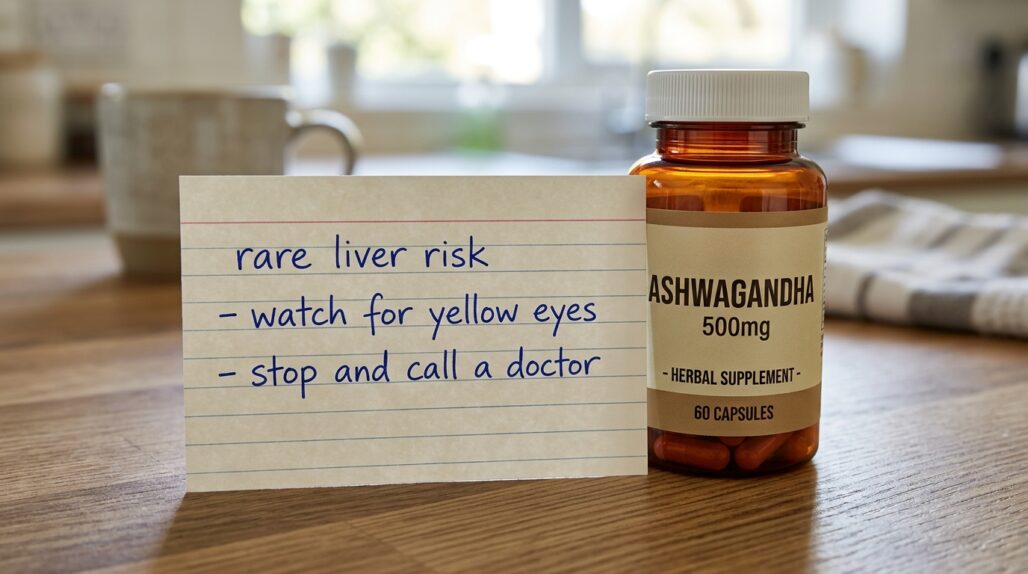
- Yellowing of the skin or the whites of your eyes (jaundice), which was the standout sign across nearly every case report.
- Dark, tea-colored urine or unusually pale stools.
- Pain or fullness in the upper right side of your belly, under the ribs.
- Persistent nausea, loss of appetite, or unusual fatigue that does not fit anything else.
- Widespread itching without a rash, which in the case literature sometimes came before the jaundice.
One practical point that comes straight from how clinicians evaluate these cases: tell your doctor every supplement you take. Drug-induced liver injury is diagnosed partly by ruling things out, and an unmentioned herbal product can send a workup in the wrong direction.
If you stop and recover, do not restart the same product to "test" it. LiverTox specifically advises against rechallenge, because a second exposure can hit harder.
Which product and form to buy
The form and the testing matter more than the brand name on the front. Here is the honest version.
First, pick a third-party-tested product. Because the FDA does not approve supplements before they go on sale and the manufacturer is the one responsible for safety, a seal from an independent lab does real work. Certification from groups like NSF or USP verifies the product contains what the label says and is screened for heavy metals and contaminants. That will not prove ashwagandha is right for you, but it removes the "what is actually in this jar" question.
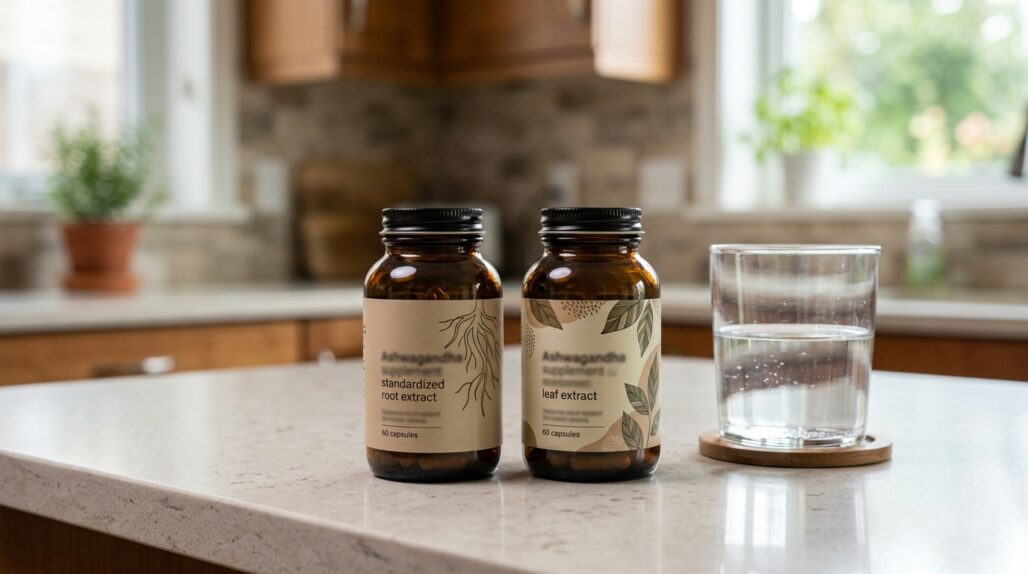
Second, prefer a standardized root extract and skip mega-doses. Common studied doses sit around 300 to 600 mg a day; the case reports often involved higher daily amounts, sometimes well past 1,000 mg. More is not safer here.
Third, choose your extract type on purpose. KSM-66 is a root-only extract studied mostly for stress and is the most common pick. Sensoril uses root and leaf and is often dosed lower. If you are weighing them, our KSM-66 versus Sensoril comparison breaks down what each was actually tested for, and our shortlist of the best ashwagandha supplements flags which products carry independent testing.
We may earn a commission from links on this page, at no extra cost to you. It does not change which products we recommend.


As an Amazon Associate, UsefulVitamins.com earns from qualifying purchases at no extra cost to you.
The safest pick is the boring one: a tested root extract at a normal dose, taken with food, used for a defined stretch rather than indefinitely on autopilot.

Who should talk to a clinician first
Some people should not start ashwagandha on their own, and the liver is the main reason.
- If you already have liver disease – hepatitis, fatty liver, cirrhosis – LiverTox advises avoiding ashwagandha in advanced chronic liver disease. Ask your doctor before using it at all.
- If you take medication processed by the liver, or anything with its own liver-related cautions, have a pharmacist check for overlap. If you manage blood sugar, our guide on taking ashwagandha with metformin walks through what to ask about.
- If you are pregnant, breastfeeding, or trying to conceive, this is a clinician conversation, not a self-call.
And the line that matters most: never stop a prescribed medication to take ashwagandha, and never use ashwagandha as a substitute for treatment your doctor prescribed. This page is general education, not personal medical advice.
FAQ
Does ashwagandha damage your liver? Not for most people at normal doses. Liver injury is a documented but uncommon risk, generally mild to moderate and reversible after stopping, with rare severe cases – which is why warning-sign awareness matters.
How long does ashwagandha take to harm the liver if it is going to? In the reported cases, symptoms usually appeared 2 to 12 weeks after starting. That window is when to stay alert for jaundice, dark urine, or upper-right belly pain.
Will my liver recover if I stop? In nearly all published cases it did, with liver tests normalizing within about 1 to 4 months of stopping. Recovery is the typical outcome, but you should be monitored by a doctor rather than just waiting.
Is one ashwagandha form safer for the liver than another? No form has been shown to be liver-safe in a way the others are not. A standardized root extract at a sensible dose with third-party testing is the reasonable default; the dose and product quality matter more than the brand.
Can I take ashwagandha every day for years? Maybe, but the controlled safety data mostly covers about three months. Using it for defined stretches, reassessing whether it still helps, and mentioning it at routine bloodwork is the cautious approach.
Should I stop ashwagandha before a blood test? You do not need to stop it, but tell your doctor you take it so any liver results are read in context. If you have liver symptoms, stop and get checked rather than waiting for a scheduled test.
The bottom line
Ashwagandha is not a liver hazard for most people, but the rare injury reports are real, reversible in nearly all cases, and worth respecting. The smart play is a third-party-tested root extract at a normal dose, taken with food, used for a defined window rather than forever on habit.
Know the red flags – jaundice, dark urine, right-side belly pain – and treat them as a stop sign, not a wait-and-see. Use our best ashwagandha supplement guide to find a tested product, and loop in a pharmacist or doctor if you have liver disease or take medication.
This article is general education and not a substitute for personalized medical advice. Talk to a qualified clinician before starting, stopping, or changing any supplement or medication, especially if you have a health condition or take prescription drugs.
Reviewed by the UsefulVitamins Editorial Team.
