
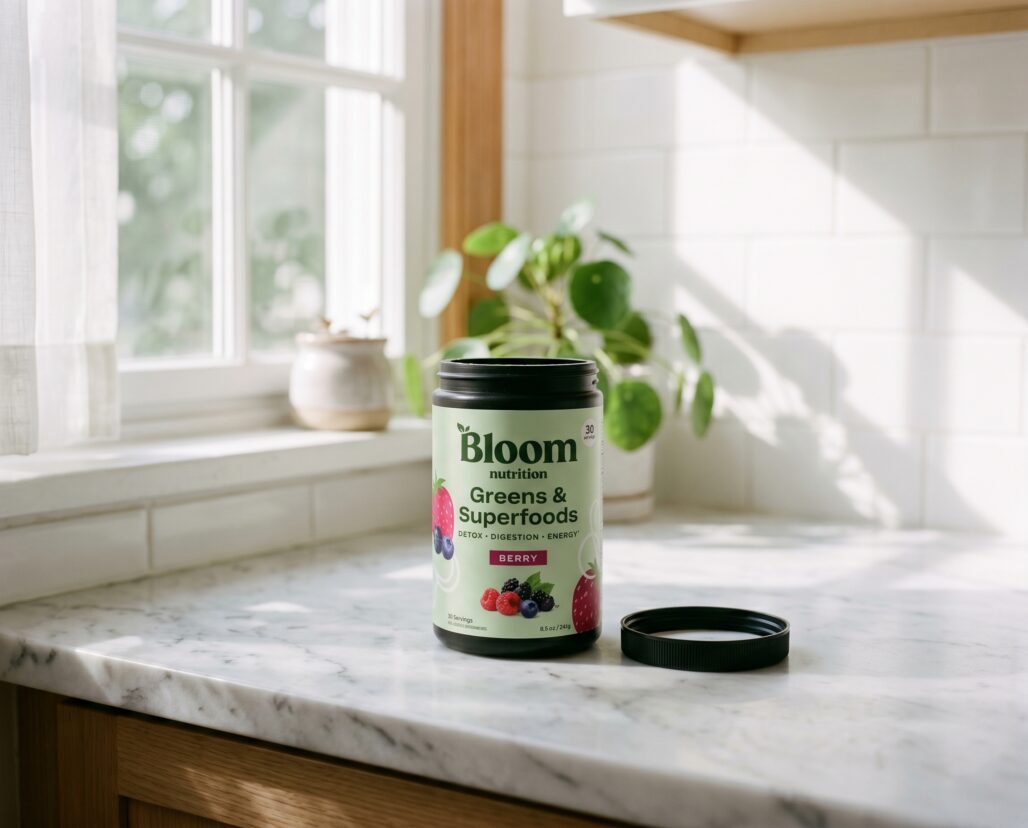
If you're wondering whether Bloom Nutrition Greens is worth $40 a month, the short answer is: it can be, but mostly for one specific person. The product delivers a real prebiotic-probiotic-digestive enzyme blend at a low per-scoop weight, which helps with bloating for some users and does almost nothing for others. Before you commit to a subscription, you need to understand three things: what you're actually getting per gram, why Amazon undercuts the brand's own website by $10 every month, and what the science actually says about those digestive claims. You will also learn exactly how to cancel when the time comes.
Affiliate disclosure: this article contains affiliate links. As an Amazon Associate, UsefulVitamins.com earns from qualifying purchases at no extra cost to you.
Quick Answer: Is Bloom Greens Worth It?
Short verdict: A reasonable starter greens powder for anyone whose primary goal is digestive comfort, not micronutrient density. Not a strong value at $40/mo direct when the identical product ships from Amazon for $30/mo.
- Best for: Young women experiencing mild bloating who want a flavored, low-commitment greens habit at the cheapest available price point (Amazon, not the brand site).
- Not ideal for: Anyone expecting meaningful vitamins, minerals, or antioxidant loading. The 5g scoop simply does not have room for therapeutic doses across 30+ ingredients.
- What to look at before buying: Ingredient panel, not the influencer reel. Count how many probiotic strains are listed with CFU counts. Check if digestive enzyme doses are disclosed in active units (FCC units for amylase, etc.), not just milligrams.
- Decision shortcut: If your main goal is gut comfort and you drink it consistently, it may help. If your goal is whole-food nutrition or immunity support, the 5g scoop is not the right vehicle.
What Is Actually in the Bottle
Bloom Greens packs 30+ ingredients into a 5-gram scoop. The ingredient panel groups them into: a greens and superfoods blend (spinach, spirulina, chlorella, wheatgrass, broccoli), a prebiotic fiber blend, a probiotic blend (1 billion CFU across 2 strains: L. acidophilus, L. rhamnosus), a digestive enzyme blend (amylase, protease, lipase, cellulase, lactase), and a small antioxidant fruit blend.
The 5g total serving size is the first honest data point to anchor. For context, AG1 uses a 12g scoop. Garden of Life Perfect Food Raw uses a 9g scoop. Bloom fits nearly everything into a dose that is 40-60% smaller by weight. That means individual ingredient quantities are small. The probiotic count (1 billion CFU) is at the low end of what published evidence suggests for gut flora influence; most RCTs showing measurable changes use 5-30 billion CFU per day. The enzyme blend is listed without FCC activity units, which makes independent dose verification impossible.
Form/dose:
- Probiotics: 1 billion CFU, 2 strains (L. acidophilus, L. rhamnosus)
- Enzymes: listed by name, dose in mg not disclosed in activity units
- Greens blend: proprietary blend weight not disclosed per ingredient
More than 30 ingredients in one 5g scoop is not synergy. Think of it like a kitchen drawer stuffed with every utensil you own — everything is technically there, but nothing has room to be the right tool for the job.
Actionable takeaway: Read the label with the CFU and enzyme columns in mind, not the ingredient count. Thirty-plus items is a marketing number. One billion CFU and undisclosed enzyme activity units are the data points that actually tell you what you are getting.

Marketing Claims vs Reality
Bloom's primary marketing claims are: supports gut health and digestion, reduces bloating, and provides energy. The brand runs heavy TikTok and Instagram campaigns anchored to co-founder Mari Llewellyn's personal transformation story and a large network of micro-influencer affiliates.
Gut health claim: The prebiotic-probiotic-enzyme combination does have a plausible mechanism for reducing gas and bloating in some people. A 2014 systematic review in the World Journal of Gastroenterology found L. acidophilus strains associated with reduced IBS symptoms at doses of 10 billion CFU — roughly 10× Bloom's dose. The effect at 1 billion CFU for healthy adults without IBS is not well supported in the literature.
Energy claim: No stimulants are present. Any energy effect is likely from the modest B-vitamin inclusion, which is real but not meaningful above what a standard diet provides for most people.
Influencer endorsement is not evidence. If a creator sold it to you in a 30-second reel, that is not a reason to buy. It is a reason to check the label.
The real question is not whether greens powders work. It is whether this formula, at this dose, delivers enough active ingredient to move the needle for your specific goal.
Real-User Reports
User sentiment across Reddit r/supplements (posts from 2024-2026), Trustpilot, and Amazon reviews is mixed-to-positive on taste and texture, and divided on digestive claims.
Positive pattern (Reddit r/greenpowder, March 2026): "Genuinely the only greens powder I have stuck with longer than two weeks. Berry flavor actually tastes good. My bloating is noticeably better in the morning." — u/plantbased_pnw
Mixed pattern (Trustpilot, January 2026, 3 stars): "Taste is great. Not sure it's doing much for my gut. I take a separate probiotic so maybe overkill but I can't credit the Bloom specifically." — verified purchase
Negative pattern (Amazon review, February 2026, 2 stars): "Ordered direct from Bloom at $40 then realized my neighbor pays $30 on Amazon for the same thing. Customer service offered a 15% discount to stay but that still puts you at $34, not $30."
Negative pattern (Reddit r/supplements, October 2025): "The enzyme blend isn't dosed in activity units anywhere on the label or website. That's a flag — you can't verify you're getting a functional amount."
The consistent thread: taste works, the digestive experience is real for some users, and the pricing gap between DTC and Amazon creates friction that the brand's retention team actively tries to manage with discount offers.
Cost Math
| Purchase path | Monthly | Annual |
|---|---|---|
| BloomNu.com direct (subscription) | $40 | $480 |
| Amazon (subscribe & save) | $30 | $360 |
| Garden of Life Perfect Food Raw (Amazon) | ~$25 | ~$300 |
| Amazing Grass Greens Blend (Amazon) | ~$22–25 | ~$265–300 |
The $120/year difference between Bloom's website and Amazon is significant. Buying direct from the brand costs you $10 more every single month for the identical product. This is an unusual DTC-vs-Amazon pricing dynamic: most DTC supplement brands charge a premium on their own site and compete on the subscription experience. Bloom simply does not. The Amazon price is the better price, full stop.

Compared to Garden of Life Perfect Food Raw at ~$25/mo, Bloom at $30/mo (Amazon) runs a 20% premium. Garden of Life uses a 9g scoop vs Bloom's 5g, delivers a more robust greens and mineral load, and carries a non-GMO verified and third-party tested designation. The tradeoff is taste: Bloom wins on flavor, consistently, across user reports.

Amazing Grass Greens Blend at ~$22-25/mo on Amazon is a third option for cost-focused shoppers. It uses a larger scoop than Bloom (8g), includes wheat grass, barley grass, and spirulina, and skips the probiotic-enzyme stack Bloom leads with. The correct choice between them depends entirely on your goal: gut comfort favors Bloom; raw greens density favors Amazing Grass or Garden of Life.
At $40/mo direct × 12 months, you spend $480/year on a product you could buy for $360/year three clicks away on Amazon. That is a $120/year decision that is fully in your control before you even open the first canister.
Cancellation Friction
Bloom uses in-app cancellation via your BloomNu.com account dashboard, which is easier than most DTC brands that require email. The process: log in, navigate to Subscriptions, select Cancel, and step through a retention flow that will offer a discount (typically 15-20% off) to keep you subscribed.
No mandatory notice period is published, but Bloom's terms state cancellations must be completed before the next scheduled charge date to avoid processing the next shipment. Processing timelines are not disclosed precisely, so cancel at least 5-7 days before your expected renewal date to avoid disputes.
No cancellation fee. Refund window is 30 days on unopened product; opened product is not refundable per the current policy.
The subscription is a commitment. It ships every 30 days until you cancel. The discount offer in the retention flow is real and worth knowing about if you plan to continue but want a better price than the DTC list price.
How Your Body Actually Handles This Stack
Four axes of the 6-axis body-systems framework are most relevant to Bloom's formula.
Saturation kinetics: The B-vitamin and antioxidant inclusions at Bloom's scoop weight are unlikely to create excess-intake issues. Water-soluble vitamins (B, C) at sub-RDA amounts are simply used or excreted. Fat-soluble vitamin exposure is modest at this dose. Saturation is not a meaningful concern here.
Form bioavailability: The probiotic strains (L. acidophilus, L. rhamnosus) are well-characterized and survive gastric transit in encapsulated or powder form when taken as directed. The greens blend uses whole-food powders (spirulina, chlorella, wheatgrass) whose absorption is partially dependent on your individual digestive enzyme activity — which is the mechanism Bloom's own enzyme blend is designed to support. That is a coherent design choice, even if the enzyme doses are not disclosed in activity units.
Timing considerations: Probiotics in this formula are taken once in the morning mixed into water or a smoothie. Consuming with food is acceptable; some evidence suggests probiotics survive better when gastric pH is buffered by a meal. The brand's "anytime" instruction is permissive but not harmful.
Stack bomb critique: 30+ ingredients in 5g means every individual ingredient is present at trace-level amounts. For nutrition goals (vitamins, minerals, antioxidants), Bloom is additive to diet, not a replacement. For digestive comfort goals, the operative ingredients — probiotics, prebiotics, enzymes — are present in a plausible but low dose. Honest summary: smaller dose footprint means saturation is less of a problem than with a denser formula like AG1, but it also means the therapeutic ceiling is lower.
Actionable takeaway: If you are buying Bloom for gut comfort and you have mild, occasional bloating, the formula is rationally designed for that goal even if the doses are modest. If you are buying it expecting comprehensive nutritional support, the 5g scoop is not doing that work.
Who It Is For / Who Should Skip
Who it is for: Someone who wants a daily greens habit primarily for digestive support, does not mind a light proprietary ingredient footprint, wants a product that tastes good enough to take consistently, and is willing to buy on Amazon where the value proposition is reasonable. Young women who found Bloom through TikTok and want an entry-level product with a real (if modest) prebiotic-probiotic-enzyme stack.

Who should skip: Anyone expecting a comprehensive greens powder delivering meaningful amounts of vitamins, minerals, or adaptogens per serving. Anyone already taking a separate probiotic at 5+ billion CFU — the 1 billion CFU in Bloom is redundant at that dose. Anyone who defaults to buying direct from the brand website without checking Amazon — the DTC channel charges a $10/mo premium with no added benefit over the Amazon listing.

For buyers who want greens chlorophyll coverage at the lowest possible cost and are willing to stack a probiotic separately, bulk greens powder (wheatgrass or spirulina base) at BulkSupplements or similar runs under $10/mo for a daily serving — roughly one-third the cost of Bloom on Amazon.
Amazon Top Pick
Garden of Life Perfect Food Raw Organic Green Superfood
We picked this as the direct alternative because it uses a 9g scoop, delivers a broader raw greens and sprouts panel, carries USDA Organic and Non-GMO verified designations, and has been third-party tested for label accuracy. At ~$25/mo on Amazon, it runs $5/mo less than Bloom on Amazon and $15/mo less than Bloom direct from brand. The trade-off is taste: Perfect Food Raw has an earthy, unsweetened flavor that most users find less palatable than Bloom's stevia-sweetened Berry or Citrus.
Skip if: Taste is your primary compliance lever. If you need something that tastes good to take it every day, Garden of Life Perfect Food Raw will sit unused on your counter within two weeks.
Amazon ASIN: B00CQ8YFDQ (Garden of Life Perfect Food Raw Green Superfood, 30 servings)
Additional Picks
NOW Foods Certified Organic Spirulina Powder
For users who want a single-ingredient greens base without a proprietary blend, NOW Foods organic spirulina delivers one ingredient at a known dose. No hidden fillers, no proprietary blend obscuring amounts, no stevia taste profile. At roughly $12/mo for a daily serving, it is the most cost-efficient way to get the chlorophyll and phycocyanin density that makes greens powders relevant at all. Skip if you need the prebiotic-probiotic component — spirulina alone does not address digestive enzyme or probiotic goals.
Amazon ASIN: B002JA23NC
Naked Greens Superfood Powder
Naked Nutrition's greens powder uses a shorter, disclosed ingredient list (no proprietary blends) with weights per ingredient visible. It carries a third-party testing verification that Bloom does not currently hold. If label transparency and batch verification matter to you more than taste, Naked Greens is the cleaner choice. At ~$30-35/mo on Amazon, it runs at Bloom's Amazon price point with better transparency. Skip if flavor is your top decision criterion — Naked Greens is unflavored and requires mixing into juice or a smoothie.
Amazon ASIN: B07G5MPDRL
BulkSupplements.com Wheat Grass Powder
For users who want the greens chlorophyll component without paying for the full-stack blend, bulk wheatgrass powder at BulkSupplements runs under $10/mo for a daily serving. No probiotic, no enzyme, no frills. This is the right call only if you are stacking it with a separate probiotic and do not need the all-in-one convenience. Not a Bloom substitute; a Bloom component, bought for the ingredient cost rather than the brand premium.
Vital Proteins Beauty Greens Collagen
We do not recommend this as a Bloom alternative. The formula combines greens with collagen peptides, which sounds appealing but collagen is not a functional substitute for a probiotic-enzyme blend. The collagen dose (5g) dominates the serving, leaving minimal room for greens density. If you have seen it marketed alongside Bloom as a "greens plus collagen" option, that is marketing positioning, not a formulation upgrade. Buy a greens powder and a separate collagen product if you want both — the combo SKU costs more and delivers less of each.
DTC Brand Mention
BloomNu.com — $40/mo direct from brand, subscribe-and-save. (Note: Bloom is also sold on Amazon at $30/mo — see the Amazon Top Pick card above. The Amazon listing is the identical product at a $10/mo lower price. We'll add our affiliate link once approved.)
Internal links
For an interactive comparison of greens powders by cost, ingredients, and goal fit, see our DTC greens powder comparator.
For 2026 pricing across DTC supplement subscriptions and their Amazon equivalents, see our DTC supplement pricing reference.
As an Amazon Associate, I earn from qualifying purchases. Product recommendations are based on real reviews and independent research.
Settled on one? StackMyMed (our companion app) lets you scan the label and log it into your routine, then watches for overlaps and interactions across your whole cabinet.
Conclusion: the Bottom Line on Bloom Greens
Bloom Nutrition Greens is a well-marketed product with a real but modest formulation. The prebiotic-probiotic-enzyme blend is rationally designed for digestive comfort, and the taste advantage over most greens powders is genuine. For a young user who wants a flavored greens habit and occasionally experiences bloating, it does what it claims — at a low dose.
The honest friction: a 5g scoop with 30+ ingredients cannot deliver therapeutic amounts of anything. One billion CFU of probiotics is at the bottom of what evidence supports for gut flora influence. And buying direct from the brand costs $10/mo more than Amazon for the same canister, which means the DTC subscription is the worst way to buy this product.
Next steps:
- If Bloom is what you want, buy it on Amazon, not direct from BloomNu.com — identical product, $120/yr cheaper.
- If you need a denser greens formula with more robust dosing, see our roundup of the best greens powders for reduced appetite before committing.
- If you're deciding between Bloom and AG1, read our Bloom vs Athletic Greens comparison for a head-to-head on price, ingredients, and who each product actually serves.
- If you've already tried Bloom and want a cheaper alternative on Amazon, see Bloom Greens alternatives on Amazon.
This article is for informational purposes and not medical advice. Supplements — especially those marketed for digestive and gut health — can interact with medications and health conditions. Consult a licensed physician before starting any supplement, particularly if you are pregnant, nursing, taking prescription medications, or managing a chronic condition.
As an Amazon Associate, I earn from qualifying purchases. Product recommendations are based on real reviews and independent research.
Editorial independence note: UV earns affiliate commissions from Amazon and (selectively) from DTC brand affiliate programs. Commissions never determine our recommendations — top picks are chosen first; affiliate links are added second. Read our full methodology and editorial independence policy →
