
Affiliate disclosure: this article contains affiliate links. As an Amazon Associate, UsefulVitamins.com earns from qualifying purchases at no extra cost to you.
What "safe long-term" actually means for probiotics
Probiotics are live bacteria and yeasts, and for healthy adults they have what the National Center for Complementary and Integrative Health calls an extensive history of apparently safe use. People have eaten live cultures in fermented food for centuries, so the baseline is reassuring.
The honest caveat is that few studies have looked at probiotic safety in fine detail, so the data on the exact frequency of side effects is thinner than the marketing suggests. That is not the same as evidence of harm. It means the strongest claim we can make is that daily use looks safe for the general population, not that every long-term question has been answered.
So "safe" here is a practical judgment, not a guarantee. For most readers the question is less "will this hurt me" and more "is this doing anything worth the money and the habit."
The mechanism, in plain words
A probiotic delivers a measured dose of specific microbes to a gut that already holds trillions of its own. Those added microbes mostly pass through. Most probiotic strains colonize only transiently, clearing from the stool within days to weeks after you stop.
That single fact explains a lot. It is why the early gas and bloating fade once your system adjusts to the temporary visitors. It is also why the benefits, when they exist, tend to stop when you stop, which is the honest argument for daily use rather than a one-off course.
It does not mean nothing lasts. A useful strain can nudge your resident bacteria and leave some downstream effects behind. But you should not picture a probiotic permanently rebuilding your gut. It is closer to a steady supply than a one-time installation. Our complete guide to probiotics walks through how that colonization actually works.
Early side effects and how long they last
The common early complaints are mild and digestive. Gas, bloating, and a slightly unsettled stomach are the usual ones, and they typically show up in the first few days as your gut meets the new microbes.
For most people these symptoms settle within 1 to 2 weeks. If they do not, that is a signal to lower the dose, switch the strain, or stop, rather than to push through indefinitely.
A few practical adjustments tend to help:
- Start with one dose a day rather than loading up.
- Take it with or just after a meal so the capsule arrives with food.
- Give a new product two full weeks before you judge it.
- Drop the dose if bloating is the problem, then build back slowly.
Here is a realistic timeline of what daily use tends to look like.
| Stage | What you may notice | What to do |
|---|---|---|
| Days 1 to 3 | Mild gas, bloating, looser or firmer stools as your gut adjusts | Take with food, keep the dose modest, do not panic |
| Week 1 to 2 | Early symptoms easing; digestion settling toward your normal | Hold the dose steady; switch strain if symptoms persist |
| Week 3 to 8 | Any real benefit for your goal should start to show by now | Judge honestly; if nothing changed, the strain may be wrong |
| Months and beyond | Stable use; benefits tend to fade if you stop | Continue only if it earns its place, or reassess the goal |
The exceptions that actually matter
This is where the "generally safe" framing earns its qualifier. The risk of harm from probiotics is greater in people with severe illness or weakened immune systems, and those cases are not theoretical.
There are documented reports of live probiotic organisms entering the bloodstream in vulnerable patients. A CDC review in Emerging Infectious Diseases identified 46 cases of Saccharomyces fungemia, with at least 43 percent of those patients using a S. boulardii probiotic. The authors concluded plainly that the yeast probiotic is not recommended for patients who have indwelling catheters, are immunocompromised, or are critically ill.
The clearest regulatory warning concerns the very young. In 2023 the FDA warned hospitals after a premature infant died of sepsis caused by a bacterium that genetically matched the probiotic the baby had received. The agency now flags that hospitalized preterm infants given probiotics face a risk of invasive, potentially fatal disease.
The people who need a clinician's sign-off before daily probiotics include:
- Anyone immunocompromised, including during chemotherapy or after a transplant.
- People who are critically ill or have a central venous catheter.
- People with short bowel syndrome or a compromised gut lining.
- Premature infants, who should only receive probiotics under hospital supervision.
- Anyone pregnant or managing a chronic illness who wants to be sure.
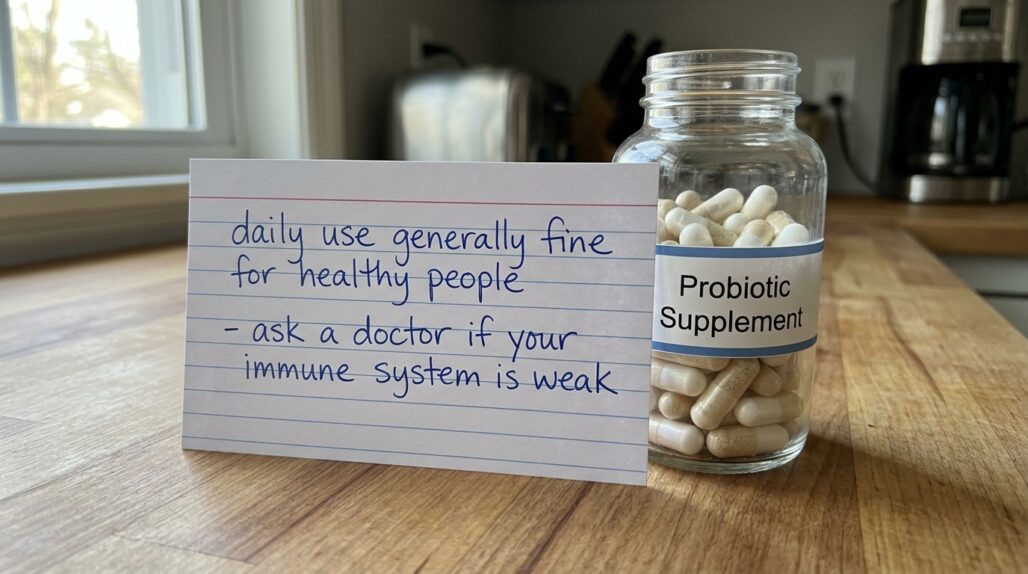
None of this should scare a healthy adult off a daily capsule. It does mean the marketing line "good for everyone" is wrong, and if you are in one of these groups the decision belongs with your doctor, not a label.

Do you even need one every day?
Here is the part most product pages skip. The American Gastroenterological Association reviewed the evidence and does not recommend probiotics for most digestive conditions, because there simply is not enough proof they help across the board.
The AGA did support a few specific uses, such as certain strains for preventing antibiotic-associated C. difficile and for preventing a serious gut illness in preterm infants. The pattern is the point: benefit is strain-specific and goal-specific, not a property of "probiotics" in general. A strain that helps one condition can do nothing for another.
That reframes the daily-habit question. Taking any probiotic out of habit is not a strategy. If you have a clear goal, match the strain to it, and if you are healthy with a varied, fiber-rich diet, you may not need a daily capsule at all. Our breakdown of which bugs do what is in probiotic strains explained, and if your goal is gut comfort specifically, the best probiotics for IBS covers the strains with the most evidence there.
The SIBO question, stated fairly
You may have seen claims that probiotics cause small intestinal bacterial overgrowth (SIBO) and "brain fog." That worry traces largely to a 2018 observational study by Rao and colleagues, which found that patients with brain fogginess were more likely to have SIBO and to be taking probiotics, and that symptoms eased after stopping them.
It is worth knowing how thin that thread is. The International Scientific Association for Probiotics and Prebiotics pointed out that the study was observational and could not show cause, that the likely direction was reversed (people with gut trouble reached for probiotics, not the other way around), and that in a normal gut the byproduct in question is simply metabolized and does not build up.
The fair takeaway: in a healthy person, probiotics are not a known cause of SIBO, though people with short bowel syndrome are a real exception and should avoid certain strains. If chronic bloating worsens on a probiotic, stopping it and seeing a doctor is reasonable. Treating one flawed study as settled science is not.
Which product or form to buy
Once you have a goal, the buying rule is short: choose by named strain and CFU, not by the biggest number on the box. More is not automatically better. Many trials work at 1 to 10 billion CFU per day, and the right strain at a modest count can beat a generic blend at a flashy one. Use our guide to how many CFU you need per day to land on a sensible number before you spend.
A few quality cues are worth weighing across forms:
- Strains listed to the strain level (genus, species, and strain code), not just “Lactobacillus blend.”
- A CFU count guaranteed through the expiration date, not only at manufacture.
- Shelf-stable versus refrigerated: shelf-stable is convenient for travel; refrigerated lines can suit higher-count daily formulas.
- A maker that does third-party testing and states it clearly.
The options below route to that sensible-choice tier: a multi-strain daily, a convenient shelf-stable pick, and a higher-count option if your goal calls for one.
We may earn a commission from links on this page, at no extra cost to you. It does not change which products we recommend.



As an Amazon Associate, UsefulVitamins.com earns from qualifying purchases at no extra cost to you.
Prices move, so treat any figure you see as a snapshot (around the listed price as of writing; check the current price). Match the strain to your goal first, then compare cost per day.

FAQ
Can your body become dependent on probiotics? No, not in the addictive sense. Because most strains pass through transiently, the effect simply fades when you stop rather than leaving you worse off than before you started.
How long should you take a probiotic before deciding it works? Give a specific strain at least two to eight weeks for your goal. If nothing has changed by then, the strain is probably wrong for you rather than the dose being too low.
Is a higher CFU count always better? No. Many studied benefits occur in the 1 to 10 billion CFU range, and a precise strain at a modest count often outperforms a generic blend with a huge number on the label.
Are refrigerated probiotics better than shelf-stable ones? Not inherently. What matters is whether the CFU count is guaranteed through the expiration date; both formats can deliver live cultures if the product is made and stored properly.
Should I stop my probiotic before surgery or if I get seriously ill? Tell your medical team you take one and let them decide. Probiotics carry more risk during critical illness or with a central line, so this is a clinician’s call, not a self-made one.
Do healthy people with a good diet need a daily probiotic at all? Often no. A varied, fiber-rich diet with some fermented foods supports your own gut bacteria, and a daily capsule is most worth it when matched to a specific goal.
The bottom line
For a generally healthy adult, taking a probiotic every day over the long term is considered safe, and the main downside is a week or two of mild gas while your gut adjusts. The genuine cautions belong to people who are immunocompromised, critically ill, pregnant, fitted with a central line, or caring for a premature infant.
The smarter question is whether you need one daily. Match the strain and dose to a real goal, lean on how many CFU you need per day to set the number, and be willing to stop a product that does nothing for you. Habit alone is not a reason to keep buying.
This article is general education, not medical advice, and it does not replace guidance from your own clinician. Do not start, stop, or change any prescription based on what you read here. If you have a health condition or take medication, talk with a pharmacist or doctor before adding a daily probiotic.
Reviewed by the UsefulVitamins Editorial Team.
