
Affiliate disclosure: this article contains affiliate links. As an Amazon Associate, UsefulVitamins.com earns from qualifying purchases at no extra cost to you.
Before you buy
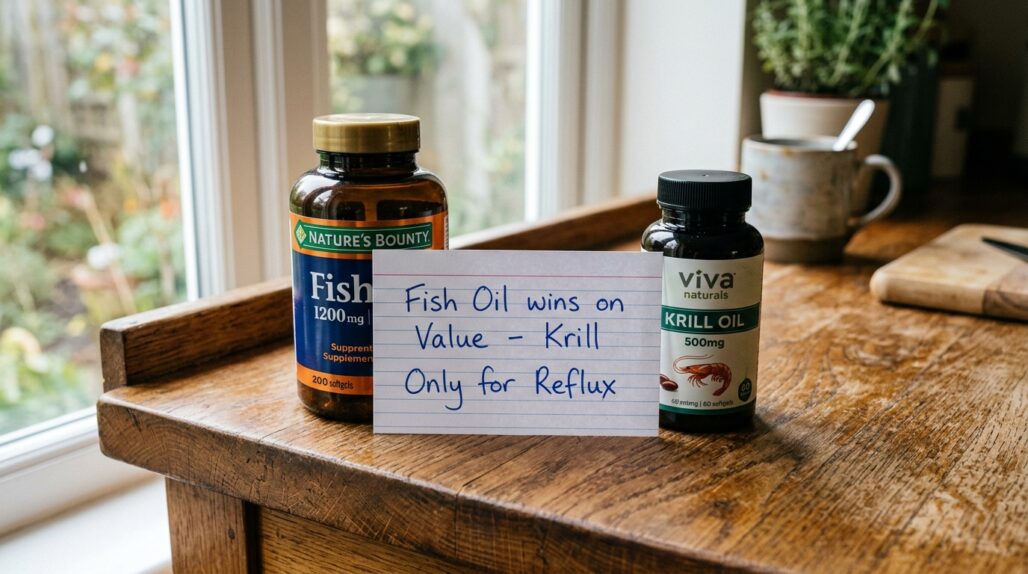
The real question is not which oil is "better" in the abstract. It is whether krill oil's two selling points – easier digestion and a claimed absorption advantage – are worth paying several times more per gram of omega-3.
Both krill oil and fish oil deliver the same two fats that matter: EPA and DHA. Your body uses them the same way once they are broken down. The marketing gap between the two is mostly about packaging – how those fats are bound, and what rides along with them.
Here is the part the ads skip. A typical krill capsule carries far less EPA and DHA than a typical fish oil softgel. So even before you compare price tags, you are usually buying a smaller dose.
If you have never had a problem swallowing or stomaching fish oil, the honest answer is that krill rarely earns its premium. Read on for the numbers, then decide.
What is actually different
Krill oil comes from Antarctic krill, tiny shrimp-like animals. Its omega-3s are bound mostly to phospholipids. Fish oil's omega-3s are bound as triglycerides or, in cheaper products, ethyl esters.
That phospholipid form is the whole pitch. Krill makers argue it mixes into your stomach contents more like the fats in food, so it absorbs more readily and burps back less.
Krill also brings two extras fish oil usually lacks: a little choline and astaxanthin, the red antioxidant that gives krill its color. Astaxanthin is genuinely interesting as an antioxidant, but the amounts in a krill capsule are small – often a few hundred micrograms to around 2,000 mcg – and there is no strong evidence that this trace dose does much on its own.
So the meaningful differences come down to form, dose, and reflux. The astaxanthin is a nice-to-have, not a reason to buy.
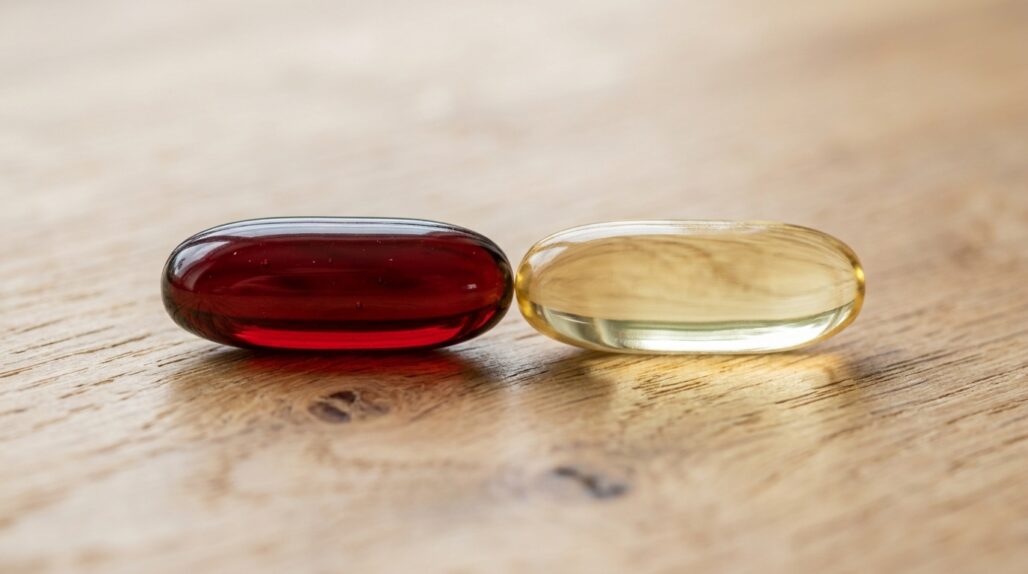
EPA and DHA per dose – the gap that matters
This is where krill loses most buyers once they see the label. A standard krill capsule often provides well under 100 mg of combined EPA and DHA, and even "high concentration" krill products land in the low hundreds.
Real examples from current labels, accurate as of writing:
- Sports Research Antarctic Krill Oil (1000 mg krill): roughly 68 to 136 mg EPA and 30 to 60 mg DHA per softgel, depending on the version.
- MegaRed 350 mg krill: a once-daily softgel with a small EPA and DHA split, marketed mainly for "no fishy aftertaste."
- Sports Research Triple Strength fish oil (1250 mg): 690 mg EPA and 260 mg DHA in a single softgel, in the triglyceride form.
Look at that last line again. One Triple Strength fish oil softgel can carry more EPA and DHA than four or five krill capsules combined. Nordic Naturals Ultimate Omega is similar, around 650 mg EPA and 450 mg DHA per two-softgel serving.
Most people aiming for general heart and brain support want somewhere around 250 mg to 1,000 mg of combined EPA and DHA a day, in line with the intake ranges the NIH Office of Dietary Supplements describes. Hitting the upper end of that with krill can mean swallowing a handful of capsules.
The absorption claim, examined honestly
Krill's headline argument is that the phospholipid form absorbs better, so a smaller dose does the same job. The NIH fact sheet is careful here: it notes that limited research suggests phospholipid omega-3s have "somewhat higher" bioavailability than the triglyceride form, not that the difference is large or settled.
The studies are genuinely mixed. A widely cited comparative bioavailability study by Schuchardt and colleagues found krill produced the highest plasma incorporation, but the variation between people was so wide that the difference for total EPA and DHA was not statistically significant.
A separate four-week randomized, double-blind trial found that fish oil and krill oil produced similar EPA and DHA blood levels when matched on omega-3 content. A later 2024 network meta-analysis found krill did absorb significantly better than fish oil at low doses (under 2,000 mg), while fish oil pulled ahead at high doses (above 3,000 mg). So krill’s edge is real, but only at small doses, exactly where its tiny EPA and DHA content leaves you under-dosed anyway.
Translation: even if krill absorbs a bit better per milligram, it does not absorb so much better that it makes up for carrying a fraction of the dose. The fish oil with five times the EPA still wins on omega-3 actually delivered.

Cost per gram of EPA and DHA
This is the number that should drive your decision, because it strips away the marketing and asks what you pay for the active ingredient.
| Option | Form | EPA+DHA per dose | Approx. cost per day | Relative cost per gram omega-3 |
|---|---|---|---|---|
| Standard krill oil | Phospholipid | ~100-200 mg per 1-2 caps | ~$1.00-$2.00 | Highest (3-5x) |
| Triglyceride fish oil (e.g. Sports Research Triple Strength) | Triglyceride | ~950 mg per softgel | ~$0.25-$0.50 | Low |
| Premium TG fish oil (e.g. Nordic Naturals Ultimate Omega) | Triglyceride | ~1,100 mg per serving | ~$0.50-$0.80 | Moderate |
| Budget fish oil | Ethyl ester / TG | ~300-600 mg per softgel | ~$0.10-$0.20 | Lowest |
Prices are approximate and as of writing; check current price before you buy. The pattern is stable regardless of the exact figures: krill costs roughly 3 to 5 times more per gram of omega-3 than a good triglyceride fish oil.
Over a year, that gap is real money. A daily krill habit can cost $300 or more annually, where an effective fish oil dose lands closer to $100.
If you want to dig deeper into why the triglyceride versus ethyl ester versus krill distinction matters for what your body actually absorbs, our breakdown of omega-3 TG vs EE vs krill bioavailability goes through the trial data in detail.
Reflux, burps, and the astaxanthin angle
Here is where krill has a legitimate, if narrow, case. The phospholipid omega-3s disperse in water and mix with stomach fluids quickly, which tends to cut down on the fishy "burp back" that drives people to abandon fish oil.
If repeat fishy burps are the reason your fish oil sits unused in a drawer, a supplement you will actually take beats a cheaper one you avoid. That is a real benefit, not just a slogan.
But note two things. First, krill is not the only fix. A fresh, low-oxidation, triglyceride-form fish oil – especially an enteric-coated or genuinely burpless one – solves the same problem for most people at lower cost. Our roundup of the best burpless fish oils covers the picks that stay down.
Second, the astaxanthin in krill is a marketing extra, not a proven benefit at these doses. It helps keep the oil itself stable, but do not buy krill expecting an antioxidant payoff. If you want a guaranteed potent, easy-on-the-stomach fish oil, our look at whether Nordic Naturals Ultimate Omega is worth it is a better starting point.

Quality and third-party testing
Both categories have well-tested options, so testing is not a reason to pick krill over fish oil or the reverse.
On the krill side, several products carry Marine Stewardship Council (MSC) sustainability certification, and a few are USP verified or third-party tested for purity. On the fish oil side, look for IFOS testing or similar freshness and contaminant verification.
Whichever you choose, buy on dose, form, freshness, and a credible test seal – not on the "krill is premium" framing. A tested fish oil with real EPA and DHA numbers beats an untested krill capsule every time. If you are comparing specific fish oil brands, our Nordic Naturals vs Sports Research omega-3 comparison lines up the two most popular options.
Top picks and the value call


As an Amazon Associate, UsefulVitamins.com earns from qualifying purchases at no extra cost to you.
UsefulVitamins is reader-supported. We may earn a commission from qualifying purchases made through links on this page, at no extra cost to you.
For most readers, the smart buy is a triglyceride-form fish oil with a high EPA and DHA count and a freshness test seal. It delivers the most omega-3 per dollar, and modern burpless versions handle the reflux complaint for far less than krill.
Reach for krill only in one situation: you have tried a fresh, quality fish oil and the burps still drive you off it. In that case, pick a third-party-tested krill product, accept the higher cost, and remember you may need two or more capsules to hit a meaningful EPA and DHA dose.
FAQ
Is krill oil better absorbed than fish oil? Slightly, in some studies, but the difference is small and inconsistent. Several trials found similar EPA and DHA blood levels from both once the doses are matched, so the absorption edge does not offset krill’s much lower dose per capsule.
Why is krill oil so much more expensive? Antarctic krill harvesting and the phospholipid extraction process cost more, and the products carry less omega-3 per capsule. The result is roughly 3 to 5 times the price per gram of EPA and DHA compared with a good fish oil, as of writing.
Does krill oil really cause fewer fishy burps? For many people, yes. The phospholipid form mixes with stomach fluids faster and tends to reduce reflux. That said, a fresh, triglyceride-form or enteric-coated fish oil usually solves the same problem at lower cost.
How much EPA and DHA do I actually need? Most people aim for somewhere around 250 mg to 1,000 mg of combined EPA and DHA a day for general support. Hitting the higher end with krill can mean several capsules, while one strong fish oil softgel often gets you there.
Is the astaxanthin in krill oil worth paying for? Not as a health benefit. The amounts are small, and there is no strong evidence that this trace dose does much beyond helping keep the oil stable. Treat it as a bonus, not a reason to buy.
Should I take krill oil if I am on blood thinners? Talk to your doctor first. Omega-3 supplements in either form can affect bleeding risk, so this is a conversation to have before starting, not after. The same caution applies to other prescriptions, so see whether you can take fish oil with blood pressure medication before you combine them.
The verdict
On the numbers, fish oil is the better value for almost everyone. It delivers several times more EPA and DHA per dollar, the studied absorption advantage of krill is modest at best, and the dose gap is large enough that fish oil still wins on omega-3 actually delivered.
Krill earns its premium in exactly one case: you cannot tolerate fish oil burps and a gentler capsule is what keeps you consistent. Even then, try a fresh burpless fish oil first, because it usually fixes the same problem for less.
Your next step: decide whether reflux is genuinely your blocker. If it is not, buy a tested triglyceride fish oil and skip the krill markup. If it is, try a burpless fish oil before paying up for krill.
This article is for general information and is not medical advice. Supplements can interact with medications and health conditions, so check with a doctor or pharmacist before starting omega-3s, especially if you take blood thinners or are pregnant.
Reviewed by the UsefulVitamins Editorial Team.
