
If you're spending $50 a month on Seed DS-01 and wondering whether it's irreplaceable, the honest answer is: probably not, for most people. DS-01 is well-engineered. The ViaCap nested capsule is a real design, the strain list is extensive, and Seed's transparency about what each strain does is better than almost anyone else in the category. But $600 a year for a probiotic is a significant commitment, and several Amazon alternatives deliver clinically-studied strains, meaningful CFU counts at expiration, and third-party verification at a fraction of that cost. This guide compares six of them across the criteria that actually matter: specific strains by Latin binomial, CFU guaranteed at expiration, refrigeration requirements, and storage stability. You will also see where the $12-a-month options cut corners and which one product genuinely earns a premium price.
Affiliate disclosure: this article contains affiliate links. As an Amazon Associate, UsefulVitamins.com earns from qualifying purchases at no extra cost to you.
Why people seek alternatives to Seed DS-01
Seed DS-01 costs $49.99 per month on subscription. That works out to $599.88 per year. The subscription ships every 30 days, and cancellation requires contacting Seed's customer support directly; there is no one-click cancel in the app. First-month cancellations must be submitted before the next billing cycle.
The price would be easier to justify if the AFU (Active Fluorescent Units) metric Seed uses mapped cleanly onto the CFU (Colony-Forming Units) metric every other brand uses. It doesn't. AFU measures live microbial cells using flow cytometry; CFU counts colonies that form on agar plates. Seed reports 53.6 billion AFU. That is not the same as 53.6 billion CFU, and the relationship between the two metrics is product-specific. Seed is not being deceptive. AFU is a defensible measurement standard. But the metric confusion makes cross-brand comparison genuinely difficult, which is convenient for a brand charging a premium.
ViaCap is a real innovation: a smaller inner capsule inside a larger outer capsule, designed so the inner capsule reaches the colon intact. Delayed-release capsule technology exists from other suppliers too, though, and several Amazon competitors use acid-resistant veggie capsules or enteric coating. The technology is plausible, but it is not unique to Seed.
How we picked
We looked for six things when selecting Amazon alternatives:
- Named strains at species level. A label reading "Lactobacillus blend" is meaningless. We required specific strains by full binomial (e.g., Lactobacillus acidophilus NCFM, Bifidobacterium longum BB536) because the clinical evidence is strain-specific, not genus-level.
- CFU guaranteed at expiration. Manufacturers set CFU levels at manufacture; the number that reaches you and survives your stomach is what matters. We excluded products that only state CFU "at time of manufacture."
- Third-party verification or pharmaceutical-grade sourcing. NSF, USP, ConsumerLab certification, or a documented supplier like Chr. Hansen or Danisco.
- Refrigeration vs shelf-stable, disclosed honestly. Some strains require cold storage; some have been freeze-dried for shelf stability. We required the label to state this clearly.
- Price per month at a standard daily dose. Compared on a cost-per-30-day basis.
- Specific use-case fit. The best overall probiotic does not exist. Each pick earns its spot for a defined reason.
Comparison table
| Brand | $/mo | Strains | CFU at expiration | Refrigeration | Best for |
|---|---|---|---|---|---|
| Visbiome High Potency | ~$40 | 8 (VSL#3 formula) | 450 billion | Yes | Clinical GI support |
| Florastor Daily | ~$20 | 1 (S. boulardii) | 5 billion | No | Travel, antibiotic recovery |
| NOW Foods Probiotic 50 Billion | ~$14 | 10 | 50 billion | No (sealed) | Budget daily use |
| Culturelle Digestive Health | ~$15 | 1 (L. rhamnosus GG) | 10 billion | No | Diarrhea prevention, kids |
| Garden of Life Dr. Formulated | ~$22 | 50+ | 50 billion | Yes | Whole-food devotees |
| Renew Life Ultimate Flora | ~$20 | 12 | 30 billion | No | Subscription alternative |
The 6 picks

Top Pick: Visbiome High Potency
We picked Visbiome because it is the closest thing the probiotic market has to a pharmaceutical-grade product with a clinical publication record. Visbiome is the successor to VSL#3, the probiotic formulation behind multiple peer-reviewed trials including work on ulcerative colitis, IBS, and pouchitis. The eight specific strains, including Lactobacillus acidophilus DSM 24735, Bifidobacterium breve DSM 24732, and Streptococcus thermophilus DSM 24731, are named by DSM registration number, which is the gold standard of strain traceability.
Form and dose: 8 strains, 450 billion CFU at expiration per packet, refrigerated (packets must stay cold; the brand ships with ice packs and advises continuous cold chain).
The trade-off: Visbiome costs roughly $40 per month for the high-potency packets, so it is not dramatically cheaper than Seed at $49.99. If you're looking to cut cost by 3x or 4x, this isn't the pick. Choose Visbiome when you want the strain lineage behind published GI trials, and price is secondary to documented evidence. Seed at $50/mo vs Visbiome at $40/mo is comparable cost; the meaningful comparison is the $25 gap vs clinical validation. Skip if you're healthy with no active GI condition and just want general gut maintenance.
Actionable takeaway: If you are managing IBS, IBD, or post-antibiotic gut disruption, Visbiome's strain portfolio is the most evidence-backed option on this list.

Best for Travel: Florastor Daily Probiotic
Florastor uses a single strain, Saccharomyces boulardii CNCM I-745, and that specificity is a feature. S. boulardii is a yeast, not a bacterium, which means it is unaffected by antibiotics and survives at room temperature. The clinical literature on S. boulardii for traveler's diarrhea and antibiotic-associated diarrhea is among the strongest in the probiotic field.
Form and dose: 5 billion CFU of S. boulardii CNCM I-745 per capsule, shelf-stable, no refrigeration required.
The trade-off: Single-strain means this is not a "replace Seed DS-01 with 24 strains" product. It is a targeted intervention. At around $20 per month for a daily dose, it costs less than Seed at $49.99, but you are buying a specific mechanism, not breadth. Skip if you want multi-strain general gut maintenance; this is the wrong tool for that job.

Best Budget: NOW Foods Probiotic 50 Billion
NOW Foods is one of the few supplement brands that has maintained consistent third-party verification across its line. The 50 Billion CFU probiotic is shelf-stable, lists 10 named strains including L. acidophilus La-14, B. lactis Bl-04, and L. rhamnosus Lr-32, and guarantees CFU at expiration. At roughly $14 per month at a daily dose, that is Seed at $49.99/mo vs NOW Foods at $14/mo = a 3.6x premium. The strains in NOW's formula are all from Danisco/DuPont heritage culture collections, which have peer-reviewed publications behind them.
Form and dose: 10 named strains, 50 billion CFU at expiration, shelf-stable in a sealed bottle (refrigerate after opening for maximum potency).
The trade-off: The breadth of strains at 50 billion CFU means each strain is present at a lower absolute count than a more concentrated single-strain product. Whether 10 strains at 5 billion CFU each is superior to 1 strain at 50 billion CFU depends on your goal, and that question does not have a universal answer. Skip if you have a specific clinical condition where strain-specific dosing matters.
Actionable takeaway: For general gut maintenance on a tight budget, NOW Foods Probiotic 50 Billion delivers the most verified strains per dollar on this list.

Best Single-Strain Daily: Culturelle Digestive Health
Lactobacillus rhamnosus GG (LGG) is the most-studied probiotic strain in human clinical trials. Culturelle uses it exclusively, at 10 billion CFU at expiration, shelf-stable. The label is correct, the strain is correct, the evidence base is extensive, and the price is roughly $15 per month. That is Seed at $49.99/mo vs Culturelle at $15/mo = a 3.3x premium for 23 additional strains whose individual evidence is considerably thinner than LGG's.
Form and dose: L. rhamnosus GG, 10 billion CFU at expiration, no refrigeration required.
The trade-off: More strains are not always more useful. Seed's 24-strain formula sounds comprehensive, and it may be, but the clinical evidence for many of those 24 strains is far weaker than LGG's 40-year publication record. If one well-studied strain satisfies your goal, you may be paying $35/mo extra for label complexity. Skip if you are post-antibiotic or managing a yeast-associated condition (LGG does not address Candida the way S. boulardii does).
Best Whole-Food Formula: Garden of Life Dr. Formulated
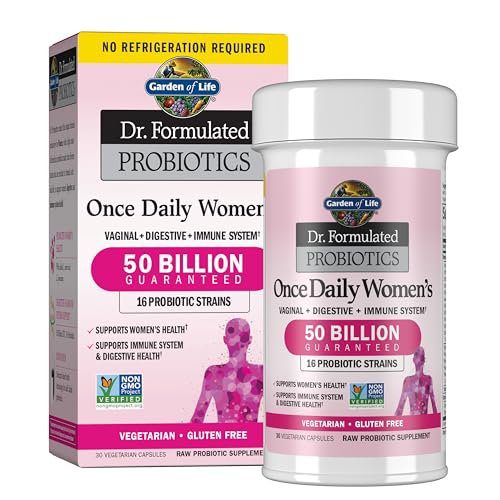
Garden of Life's Dr. Formulated line discloses 50+ strains across Lactobacillus and Bifidobacterium families, certified organic, Non-GMO Project verified, and NSF certified gluten-free. The probiotic strains come with a prebiotic fiber blend from organic acacia. Shelf-life requires refrigeration.
Form and dose: 50 billion CFU at expiration, 30+ strains, refrigeration required, organic prebiotic fiber included.
The trade-off: 50+ strains at 50 billion CFU total means many strains present at quantities below what any clinical trial has demonstrated as effective. The real question is whether a broad-spectrum low-dose formula produces detectable benefit beyond placebo. The evidence is genuinely unclear. At roughly $22 per month, it costs less than half of Seed, but the scientific rationale for extreme multi-strain formulations is thin. Skip if you want a formula where you can trace each strain to a specific published trial.
Best Subscription Alternative: Renew Life Ultimate Flora
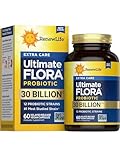
Renew Life Ultimate Flora is widely available on Amazon Subscribe-and-Save, which makes it the most direct structural substitute if you are leaving Seed's subscription model. The 12-strain formula at 30 billion CFU uses shelf-stable, delayed-release capsules and specifically names strains including L. acidophilus NCFM and B. lactis HN019, both with documented human trial data.
Form and dose: 12 named strains, 30 billion CFU at expiration, delayed-release veggie capsule, shelf-stable.
The trade-off: Renew Life is a Reckitt brand, and quality control in large consumer health conglomerates is not always at the level of specialist probiotic manufacturers. ConsumerLab has tested earlier versions of the product with positive results, but batch-level verification is not as tight as you get with Visbiome or a USP-certified line. Skip if you need clinical-grade verification for a documented health condition.
Actionable takeaway: If you want a subscribe-and-forget daily probiotic at roughly $20/mo with a credible strain list, Renew Life Ultimate Flora is the most convenient Seed replacement.
How your body actually handles this: form bioavailability and dosing logic
The single most ignored variable in probiotic buying is whether the capsule survives your stomach acid. Gastric pH sits around 1.5-3.5 in a fasted state. Standard gelatin capsules dissolve in that environment within minutes, killing most bacterial strains before they reach the ileum where colonization begins.
Seed addresses this with ViaCap: a nested capsule where the outer shell dissolves in the stomach and the inner capsule carries the organisms to the colon. It is a real mechanism. But acid-resistant enteric coating, delayed-release HPMC veggie capsules (what Renew Life and NOW Foods use), and microencapsulation (how Florastor's S. boulardii is packaged) are also real mechanisms. The technology differences matter less than whether the manufacturer has documented acid-resistance testing.
Timing is the other underrated variable. Probiotics work best when gastric acid secretion is at its lowest, which is 30 minutes before a meal on an empty stomach, or 2 hours after eating. Seed's instruction says "first thing in the morning with water," which is correct timing. That advice is free. It does not require a $50/month subscription.
The strain-count critique is worth stating plainly. A formula with 24 strains at 53.6 billion AFU contains roughly 2.2 billion units per strain. A single-strain formula at 50 billion CFU provides 50 billion of a well-documented organism. Which colonizes better? The literature leans toward higher doses of fewer validated strains for specific endpoints. That is not an argument against multi-strain formulas for general maintenance, but it is an argument against assuming 24 strains is automatically superior.
Stack-bomb critique: Seed is not a 75-ingredient formula in the AG1 sense, so this axis is less relevant here. The honest evaluation is that DS-01's 24 strains are better-researched individually than most multi-strain Amazon competitors. The question is whether that strain quality plus the ViaCap design justifies the 3-4x cost premium over the picks on this list. For most healthy adults without active GI conditions, the evidence does not support that conclusion.
Actionable takeaway: Check whether your probiotic's capsule specifies delayed-release or enteric-coated before assuming the organisms survive to your gut. This single label detail matters more than strain count.
Skip these
Skip: Supermarket store-brand probiotics with vague CFU claims
Any product that states "10 billion CFU" without specifying "at expiration" is giving you the count at manufacture, not what survives 18 months on a shelf at ambient temperature. Viable CFU degrades over time, faster without refrigeration. A product with 10 billion CFU at manufacture may contain fewer than 1 billion when you open it. This is not hypothetical; ConsumerLab testing has found multiple mainstream probiotics delivering fewer than 50% of labeled CFU at time of purchase.
Skip: Gummy probiotics
Heat is used in gummy manufacturing. Most bacterial probiotic strains do not survive the temperatures involved in producing gummy formats. A 5 billion CFU gummy is plausible only if the probiotic is added post-heat in a protected format, which very few gummy manufacturers do. If the product is sweet, chewy, and also claims to contain live bacteria, you should read the fine print very carefully. The probability of meaningful viable CFU in a standard gummy probiotic is low.
Skip: Single-claim "wonder" formulas
If a probiotic label claims to solve bloating, IBS, anxiety, immunity, skin clarity, and weight management in one product, that is a marketing signal, not a science signal. Specific strains have documented effects on specific endpoints. No single strain or formula has documented effects on all of those simultaneously. The more conditions a probiotic claims to address, the less likely the dose of any specific strain is high enough to matter for any of them.
Internal links
For 2026 pricing across DTC supplement subscriptions and their Amazon equivalents, see our DTC supplement pricing reference.
Disclosure
As an Amazon Associate, I earn from qualifying purchases. Product recommendations are based on real reviews and independent research.
Settled on one? StackMyMed (our companion app) lets you scan the label and log it into your routine, then watches for overlaps and interactions across your whole cabinet.
Conclusion: the bottom line on Seed DS-01 alternatives
Seed DS-01 is a well-designed product at a price that is hard to justify for most healthy adults. At $49.99 per month, you are paying for ViaCap technology, a vetted strain list, and clean branding. The actual organisms doing the work in your gut are not exclusive to Seed. Visbiome delivers a clinically-studied 8-strain formula at a comparable price when potency matters. Culturelle delivers the single most-researched probiotic strain on Earth at $15 per month. NOW Foods delivers 10 third-party-verified strains at $14. The real question is not whether Seed is good. The real question is whether the $35-a-month gap between Seed and the budget picks on this list buys you a measurably different health outcome. The evidence does not support that conclusion for the general population.
Next steps:
- Read our full Seed DS-01 review if you want a complete breakdown of what DS-01's strains are documented to do before deciding.
- See Seed vs Visbiome if your primary concern is clinical-grade GI support and you're comparing the two premium options.
- If you're on a GLP-1 medication and your gut is reacting badly, the best probiotics for GLP-1 GI issues applies the same framework to that specific symptom cluster.
If you'd rather pay for the all-in-one subscription convenience, Seed.com is the direct option; see our Seed DS-01 review for the full cost math and cancellation policy breakdown.
This article is for informational purposes and not medical advice. Peptides, especially those marketed for therapeutic use, can interact with medications and health conditions. Consult a licensed physician before starting any supplement, particularly if you are pregnant, nursing, taking prescription medications, or managing a chronic condition.
As an Amazon Associate, I earn from qualifying purchases. Product recommendations are based on real reviews and independent research.
Editorial independence note: UV earns affiliate commissions from Amazon and (selectively) from DTC brand affiliate programs. Commissions never determine our recommendations — top picks are chosen first; affiliate links are added second. Read our full methodology and editorial independence policy →
Frequently asked questions
What is the best cheaper alternative to Seed DS-01 on Amazon?
For general gut health, Culturelle delivers the single most-researched probiotic strain (Lactobacillus rhamnosus GG) for about $15/month, and NOW Foods Probiotic-10 offers 10 third-party-verified strains at roughly $14/month. When clinical-grade potency matters, Visbiome provides a studied 8-strain formula at a price comparable to Seed.
Are cheaper Amazon probiotics as effective as Seed DS-01?
For most healthy adults, yes. Seed DS-01 is well-engineered, but the organisms doing the work in your gut are not exclusive to Seed. Several Amazon options deliver clinically studied strains, meaningful CFU counts at expiration, and third-party verification. The $35/month price gap rarely buys a measurably different health outcome for the general population.
Why is it hard to compare Seed DS-01 to other probiotics?
Seed reports 53.6 billion AFU (Active Fluorescent Units, measured by flow cytometry), while nearly every other brand reports CFU (Colony-Forming Units, counted on agar plates). AFU and CFU are not the same and the relationship is product-specific, which makes direct cross-brand comparison genuinely difficult.
