
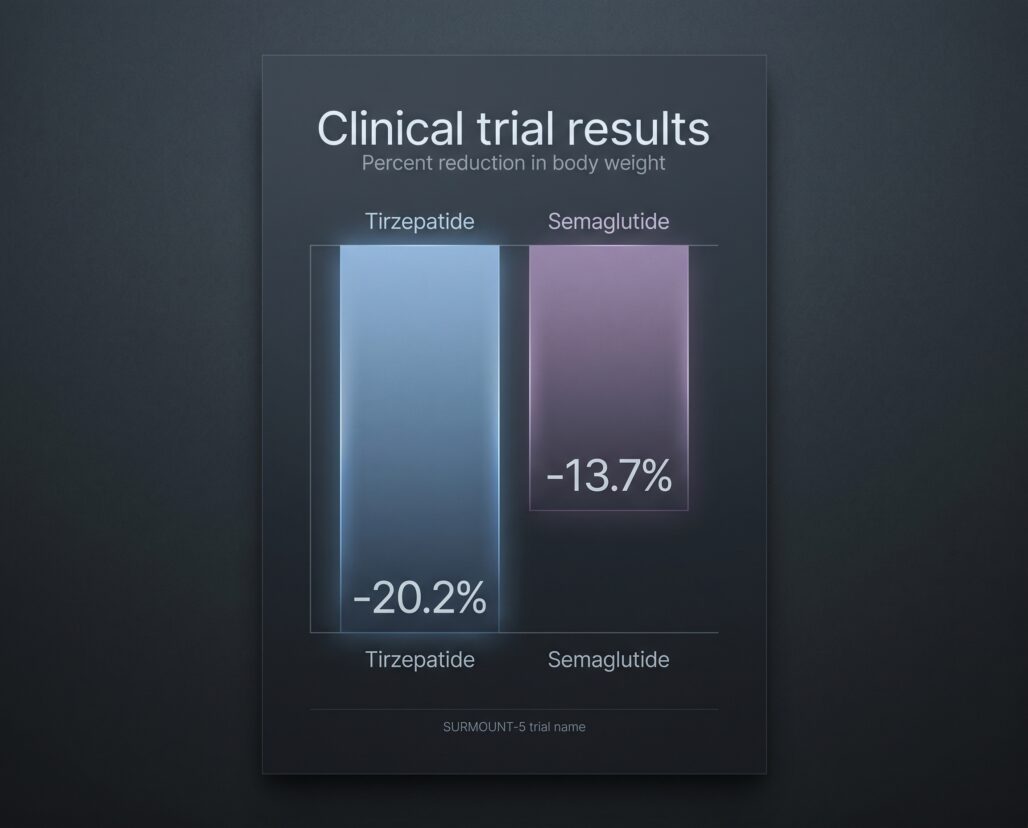
If you are choosing between Wegovy and Zepbound, the SURMOUNT-5 head-to-head trial gave a clear answer on average weight loss, but the average is not the only number that matters. Tirzepatide produced a mean body-weight reduction of 20.2 percent versus 13.7 percent for semaglutide at 72 weeks — a 6.5 percentage-point gap that is both statistically and clinically significant. Yet that gap tells only part of the story. The honest comparison also has to account for side-effect tolerance, how each drug works at the receptor level, what insurance will actually cover, and which agent your prescriber is most comfortable monitoring. Both drugs are FDA-approved for chronic weight management, both carry boxed warnings, and both require a physician relationship to prescribe safely. This article lays out the full picture so you and your doctor can have an informed conversation.
Both Products at a Glance: FDA-Approved Weight-Loss Labels
Wegovy (semaglutide injection, 2.4 mg once weekly) received FDA approval for chronic weight management in June 2021. It is indicated for adults with an initial BMI of 30 kg/m2 or greater, or 27 kg/m2 or greater in the presence of at least one weight-related comorbidity such as hypertension, dyslipidemia, type 2 diabetes, or cardiovascular disease. Manufacturer: Novo Nordisk. Full prescribing information is available on DailyMed.
Zepbound (tirzepatide injection) received FDA approval for the same chronic weight-management indication in November 2023, with identical BMI criteria. In December 2024, the FDA granted Zepbound a second, separate indication for moderate-to-severe obstructive sleep apnea (OSA) in adults with obesity — the first drug ever approved for that condition. Manufacturer: Eli Lilly. Prescribing information is available via FDA accessdata.
Both drugs are prescription-only, available by subcutaneous self-injection, and intended as adjuncts to a reduced-calorie diet and increased physical activity. Neither is a standalone solution.
Both carry the same class boxed warning: in rodents, GLP-1 receptor agonists cause thyroid C-cell tumors at clinically relevant exposures. Human relevance is unknown but both drugs are contraindicated in anyone with a personal or family history of medullary thyroid carcinoma (MTC) or multiple endocrine neoplasia type 2 (MEN 2).
SURMOUNT-5: The Head-to-Head Data
The most important clinical data point in this comparison is SURMOUNT-5 (NCT05822830), a Phase 3b, open-label, randomized controlled trial published in the New England Journal of Medicine in May 2025 (N Engl J Med 2025;393:26-36).
Design. 751 adults with obesity and no type 2 diabetes were randomly assigned 1:1 to the maximum tolerated dose of tirzepatide (10 mg or 15 mg weekly) or the maximum tolerated dose of semaglutide (1.7 mg or 2.4 mg weekly) for 72 weeks.
Primary outcome — percent body weight change at week 72:
- Tirzepatide: -20.2% (95% CI, -21.4 to -19.1)
- Semaglutide: -13.7% (95% CI, -14.9 to -12.6)
- Difference: 6.5 percentage points in favor of tirzepatide (p less than 0.001)
Secondary outcomes — waist circumference reduction:
- Tirzepatide: -18.4 cm (95% CI, -19.6 to -17.2)
- Semaglutide: -13.0 cm (95% CI, -14.3 to -11.7)
Participants in the tirzepatide group were more likely than those in the semaglutide group to achieve weight reductions of at least 10%, 15%, 20%, and 25%.
Important caveat. SURMOUNT-5 was open-label — participants and investigators knew which drug was being used. That design is reasonable for injectable drugs with distinct titration schedules, and it matters for interpreting results. The trial also excluded people with type 2 diabetes, so the head-to-head data does not automatically transfer to a diabetic population.
A post-hoc analysis of SURMOUNT-5 published in 2025 found that tirzepatide was associated with a significantly greater predicted 10-year cardiovascular disease risk reduction compared with semaglutide (absolute reduction of 2.4% vs. 1.4% from baseline, p less than 0.001), though that analysis is hypothesis-generating rather than conclusive.
Takeaway: In the only direct head-to-head trial, tirzepatide produced meaningfully greater weight loss on average. Whether that average applies to you depends on your individual response, tolerability, and adherence over a full titration period.
Mechanism Difference: GLP-1 Receptor Agonist vs. Dual GIP/GLP-1 Agonist
This is not a subtle distinction — it is the central reason the efficacy gap exists, and understanding it helps set realistic expectations.
Semaglutide (Wegovy) is a GLP-1 receptor agonist. It mimics glucagon-like peptide-1, a gut hormone that slows gastric emptying, reduces appetite signaling in the hypothalamus, and promotes insulin release in a glucose-dependent manner. The result is reduced caloric intake through a combination of earlier satiety and reduced hunger.
Tirzepatide (Zepbound) is a dual agonist: it activates both the GLP-1 receptor and the glucose-dependent insulinotropic polypeptide (GIP) receptor. GIP has its own appetite and energy-regulation pathways that appear to work synergistically with GLP-1. For a full mechanistic breakdown, see our tirzepatide complete guide. The dual mechanism is the leading explanation for why tirzepatide consistently outperforms semaglutide in head-to-head comparisons across multiple trial populations.
The analogy that helps: think of GLP-1 agonism as pressing one brake pedal on appetite, and dual GIP/GLP-1 agonism as pressing two brake pedals at once. More braking force, but also more surface area for side effects if tolerance is poor.
Side Effects Compared
Both drugs share a broadly similar gastrointestinal side-effect profile because both activate GLP-1 receptors, which slow gastric motility. The differences are in frequency and magnitude.
Wegovy (semaglutide) — common adverse events from STEP 1 (NCT03548387, N Engl J Med 2021):
- Nausea: 44%
- Diarrhea: 30%
- Vomiting: 24%
- Constipation: 24%
- Abdominal pain: 20%
In STEP 1, 7.0% of semaglutide participants discontinued due to adverse events, versus 3.1% in the placebo group. Mean weight loss in that trial was -14.9% at 68 weeks, establishing semaglutide's single-agent efficacy benchmark.
Zepbound (tirzepatide) — common adverse events from SURMOUNT-1 (NCT04184622, N Engl J Med 2022):
- Nausea, diarrhea, vomiting, and constipation were the most common events
- Discontinuation due to adverse events: 4.3% (5 mg), 7.1% (10 mg), 6.2% (15 mg) vs. 2.6% placebo
Most gastrointestinal events with both drugs are mild to moderate and cluster during dose escalation. They typically improve once the maintenance dose is established.
Shared serious warnings (both drugs):
- Pancreatitis: Both prescribing labels warn about acute pancreatitis. Discontinue if suspected.
- Gallbladder disease: Rapid weight loss from any agent increases cholelithiasis risk.
- Hypoglycemia: Risk is low in non-diabetic patients but significant if used alongside insulin or sulfonylureas.
- Heart rate increase: Both can increase resting heart rate; clinical significance is under evaluation.
- Thyroid C-cell tumors: Class boxed warning, relevant to both (see above).
- Compounded versions: The FDA has explicitly cautioned that compounded semaglutide and compounded tirzepatide are not FDA-approved, and quality, safety, and efficacy cannot be assured. This is a hard line, not a preference.
- Pregnancy: Both drugs should be discontinued at least two months before a planned pregnancy. Neither has established safety data in pregnancy, and the physiological changes of pregnancy make GLP-1 receptor agonists particularly risky.
Where they differ in tolerability: Some patients who cannot tolerate semaglutide's nausea tolerate tirzepatide better, and vice versa. Individual GI tolerance is genuinely unpredictable — it is not a reliable basis for choosing between them before trying one. Your prescriber should discuss a structured symptom log during titration.
Dosing Schedules and Ramp Protocols
Both drugs use a slow, escalating titration to reduce gastrointestinal side effects. Neither reaches its therapeutic maintenance dose immediately.
Wegovy (semaglutide) titration:
- Week 1-4: 0.25 mg once weekly
- Week 5-8: 0.5 mg once weekly
- Week 9-12: 1.0 mg once weekly
- Week 13-16: 1.7 mg once weekly
- Week 17 onward: 2.4 mg once weekly (maintenance)
Total ramp period: approximately 16 weeks to reach the 2.4 mg maintenance dose.
Zepbound (tirzepatide) titration:
- Week 1-4: 2.5 mg once weekly
- Week 5-8: 5 mg once weekly
- Escalate by 2.5 mg every 4 weeks as tolerated
- Maximum doses: 10 mg or 15 mg once weekly (maintenance)
Total ramp period: approximately 20 weeks to reach a 15 mg maintenance dose. Some patients tolerate and reach the 10 mg dose faster.
Practical note. In SURMOUNT-5, participants were assigned to the maximum tolerated dose rather than a fixed maximum dose — mirroring real-world practice where not every patient reaches the ceiling. Effective weight loss occurs at intermediate doses too. An actionable rule for anyone starting either drug: treat week-over-week nausea as information, not a failure — report it to your prescriber before the next injection date.
Injection. Both are once-weekly subcutaneous injections administered to the abdomen, thigh, or upper arm. Neither requires refrigeration during the in-use period per their current labeling.
Cost, Access, and Insurance Reality
This is where the clinical superiority of tirzepatide runs directly into a practical wall for many patients.
List prices (approximate, as of 2025-2026):
- Wegovy: approximately $1,350-$1,400 per month at list price
- Zepbound: approximately $1,050-$1,100 per month at list price (Zepbound has been modestly less expensive at launch)
Insurance coverage. Coverage for both drugs is inconsistent and actively contested. Many commercial plans exclude anti-obesity medications entirely. Medicare Part D was prohibited from covering weight-loss drugs until the CMMS proposed rule changes in 2025, and state Medicaid coverage varies widely. Prior authorization requirements, step-therapy protocols, and formulary exclusions affect both drugs. A patient who qualifies medically may face months of appeals.
Manufacturer savings programs. Both Novo Nordisk and Eli Lilly offer savings cards that can reduce out-of-pocket costs for commercially insured patients, sometimes to $25 per month. These programs do not apply to Medicare, Medicaid, or uninsured patients.
Compounded alternatives. During shortages in 2023-2024, compounded versions of both semaglutide and tirzepatide proliferated. The FDA has issued multiple public safety advisories warning that these compounded products are not equivalent to the FDA-approved drugs. The FDA removed both semaglutide and tirzepatide from its drug shortage list in 2025, which should reduce (but will not eliminate) compounded versions in circulation. If you encounter a heavily discounted "semaglutide" or "tirzepatide" from a telehealth platform with no clinical oversight, that is a significant quality and safety concern.
The bottom line on cost. The 6.5 percentage-point weight-loss advantage of tirzepatide is real and clinically meaningful — but it does not matter if you cannot afford or access the drug consistently for the 12-24 months needed to see full results. Affordability and adherence are often more important than peak efficacy data from a well-funded trial.
Side-by-Side Comparison Table
| Property | Wegovy (Semaglutide 2.4 mg) | Zepbound (Tirzepatide 10/15 mg) |
|---|---|---|
| Manufacturer | Novo Nordisk | Eli Lilly |
| Mechanism | GLP-1 receptor agonist | Dual GIP/GLP-1 receptor agonist |
| FDA weight-loss approval | June 2021 | November 2023 |
| BMI criteria | BMI 30+, or 27+ with comorbidity | BMI 30+, or 27+ with comorbidity |
| Additional FDA indication | CV risk reduction (SELECT, 2024) | OSA treatment (December 2024) |
| Maintenance dose | 2.4 mg once weekly | 10 mg or 15 mg once weekly |
| Titration period | ~16 weeks to maintenance | ~20 weeks to maximum dose |
| Mean weight loss (pivotal RCT) | -14.9% at 68 wk (STEP 1) | -20.9% at 72 wk (SURMOUNT-1, 15mg) |
| Mean weight loss (head-to-head) | -13.7% at 72 wk (SURMOUNT-5) | -20.2% at 72 wk (SURMOUNT-5) |
| Most common adverse events | Nausea, diarrhea, vomiting, constipation | Nausea, diarrhea, vomiting, constipation |
| Boxed warning | Thyroid C-cell tumors (rodent data) | Thyroid C-cell tumors (rodent data) |
| Approximate monthly list price | ~$1,350-$1,400 | ~$1,050-$1,100 |
| CV outcome trial | SELECT (NCT03574597) — HR 0.80 for MACE | No dedicated CV outcome trial yet |
| Pediatric approval | Yes (12+) | No |
| Generic available | No | No |

Frequently Asked Questions
Is Zepbound simply better than Wegovy? In the SURMOUNT-5 head-to-head trial, tirzepatide produced greater mean weight loss. But "better" depends on factors the trial cannot answer: your individual tolerability, your insurance coverage, your prescriber's familiarity with the drug, and whether you have any specific comorbidities that tilt the decision. The data support tirzepatide as the stronger weight-loss agent on average. Whether that average is your outcome requires trying the drug.
Can I switch from Wegovy to Zepbound (or vice versa)? Switching is common in practice, particularly when one drug is out of stock or not covered. Your prescriber will need to manage the transition to avoid overlapping doses and to re-titrate appropriately. There is no head-to-head data on outcomes after switching.
Does Wegovy have a cardiovascular advantage? Wegovy is the only drug in this comparison with a completed cardiovascular outcomes trial. The SELECT trial (NCT03574597, N=17,604) demonstrated a 20% relative reduction in major adverse cardiovascular events (MACE) versus placebo (HR 0.80, 95% CI 0.72-0.90, p less than 0.001) in patients with preexisting cardiovascular disease and no diabetes. This led to a separate FDA cardiovascular risk-reduction approval for Wegovy. Tirzepatide does not yet have a completed cardiovascular outcomes trial, though one is underway.
What about compounded semaglutide or tirzepatide? The FDA has been explicit: compounded versions are not FDA-approved, and their safety and efficacy are not established. Both drugs are now off the FDA shortage list. The FDA has taken enforcement action against some compounding pharmacies. Patients encountering compounded versions should discuss with their prescriber.
Are either drug covered by Medicare? As of 2026, Medicare Part D coverage for anti-obesity medications is expanding but not yet universal. Coverage varies by plan — check your specific Part D formulary directly.
What happens if I stop taking either drug? Weight regain is common after stopping either drug. The STEP 1 extension study showed participants who stopped semaglutide regained approximately two-thirds of their lost weight within one year; SURMOUNT-4 data showed similar patterns for tirzepatide. Both are chronic medications for a chronic condition.
Tracking a protocol like this? Our companion app, StackMyMed, lets you log doses, schedule them, and check interactions across everything you take — alongside, never instead of, your clinician’s guidance.
Wegovy vs. Zepbound: What the Evidence Actually Tells You
The SURMOUNT-5 data is the most direct answer we have to the question of which drug produces more weight loss, and it favors tirzepatide by a meaningful margin. A 6.5 percentage-point difference in weight reduction at 72 weeks translates to roughly 7-9 kg for a person starting at 120 kg — the difference between achieving a 15% and a 20%-plus reduction threshold.
At the same time, a few pieces of context matter here. First, Wegovy has a completed cardiovascular outcomes trial behind it; tirzepatide does not yet. For a patient whose primary concern is CV risk reduction alongside weight loss, that SELECT trial data is not trivial — it gives prescribers and patients a quantified risk benefit that tirzepatide cannot yet match with equivalent evidence.
Second, individual response varies more than the trial averages suggest. In SURMOUNT-5, some participants on semaglutide outperformed the average tirzepatide participant. The average is a population statistic. Your response is individual.
Third, compounding GLP-1 analogues from unregulated sources introduces risks that the efficacy gap cannot justify. The 20.2% average from SURMOUNT-5 was achieved with pharmaceutical-grade, dose-verified tirzepatide under clinical supervision.
The actionable conclusion: if your prescriber determines you are a candidate for GLP-1-based weight management, tirzepatide has stronger efficacy data. Wegovy has a longer safety track record and the only completed cardiovascular outcomes trial in this class. Cost, insurance access, your individual GI tolerability, and your prescriber's recommendation should shape the final decision — not a trial average read in isolation. If you want more background on how GLP-1 peptides work before that conversation, start with our peptides for weight loss overview or dive deeper into the Ozempic vs. Mounjaro comparison for the type 2 diabetes-labeled versions of these same molecules.
This article is for informational purposes and not medical advice. Peptides, especially those marketed for therapeutic use, can interact with medications and health conditions. Consult a licensed physician before starting any supplement, particularly if you are pregnant, nursing, taking prescription medications, or managing a chronic condition.
