
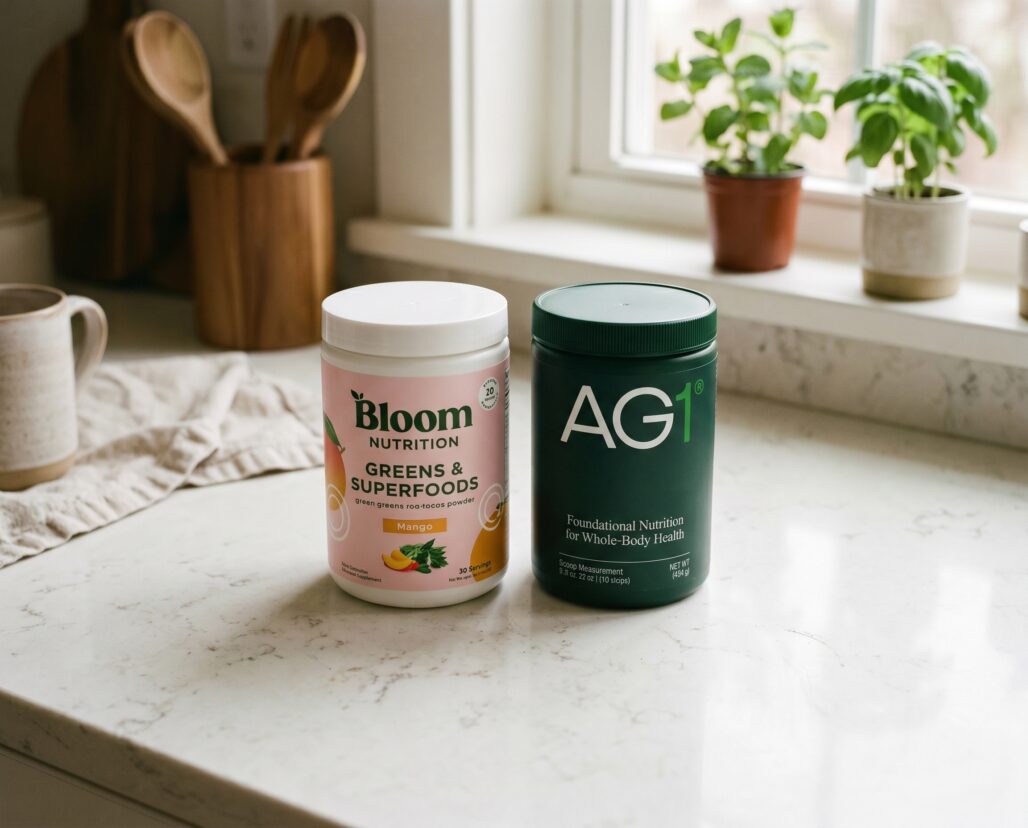
If you searched "Athletic Greens vs Bloom," you may have noticed that Athletic Greens rebranded to AG1 in 2022. They are the same product. The older name still appears in roughly 25,000 monthly searches because habits die slowly, older articles and Amazon listings use both names, and people who heard about the product years ago still call it Athletic Greens. Throughout this article we refer to the product as "AG1 (formerly Athletic Greens)" so the record is clear: there is no current product called Athletic Greens separate from AG1. We are comparing one product against one product. The short answer to which wins is: it depends almost entirely on your budget and tolerance for earthy taste. Here is where the price gap is actually justified, where it isn't, and which readers should skip both and buy something on Amazon for $25.
Affiliate disclosure: this article contains affiliate links. As an Amazon Associate, UsefulVitamins.com earns from qualifying purchases at no extra cost to you.
Side-by-side at a glance
| Feature | Bloom Nutrition Greens | AG1 (Athletic Greens) |
|---|---|---|
| Monthly cost (DTC) | $40/mo | $99/mo |
| Monthly cost (Amazon) | ~$30/mo | No broad current listing |
| Scoop size | 5g | 12g |
| Ingredient count | 30+ | 75+ |
| Probiotic CFUs | ~1 billion (2 strains) | 7.2 billion (2 strains) |
| Digestive enzyme blend | Yes, broad blend | Partial |
| Stevia-free | No (57-95 mg stevia extract) | No (some stevia) |
| NSF Certified for Sport | No | Yes |
| Flavors | 8 options | 1 original + Tropical |
| Cancel method | In-portal or email | Email or phone |
Price: the most important number in this comparison
Bloom Nutrition Greens costs $40/mo through bloomnu.com and closer to $30/mo on Amazon (Bloom lists Amazon cheaper than its own DTC, which is an unusual pricing strategy worth noting). AG1 (formerly Athletic Greens) costs $99/mo through drinkag1.com with no broad current Amazon listing at the same price point.
That is a 3.3x premium for AG1, not a marginal difference.
Annualized: Bloom $360/yr vs AG1 $1,188/yr. The gap is $828 every year. Framed differently, two years of AG1 buys you a decent piece of gym equipment.
If AG1's ingredient profile delivered meaningfully better outcomes, the premium might make sense for some buyers. The problem is that neither brand has run randomized controlled trials comparing their specific formula against a placebo in humans. AG1 funds research summaries and cites ingredient-level studies, but "ingredient X has evidence" is not the same as "this formula at this dose delivers outcome Y." The label looks impressive. The clinical proof is much thinner. We walk through exactly what that clinical evidence does and does not show in do greens powders actually work.
Actionable takeaway: if $99/mo makes you wince even slightly, you have your answer. The financial case for AG1 rests on ingredients and certification quality, not on a head-to-head superiority trial.
Ingredient quality: where the 3.3x price does (and does not) buy you something
AG1 packs 75+ ingredients into a 12g scoop. Bloom fits 30+ into a 5g scoop. More ingredients are not automatically more effective, and a smaller scoop means each individual ingredient is dosed at lower mass.
A few axes worth tracing through both formulas:
Probiotic count. Bloom delivers roughly 1 billion CFUs across 2 strains. AG1 delivers 7.2 billion CFUs. For general gut support, the research threshold for measurable effect typically sits at 1-10 billion CFU depending on the strain, so Bloom's lower count is not necessarily a disqualifier, but AG1's is more substantial. Neither formula lists specific strains with the depth of a dedicated probiotic like Seed DS-01 or Culturelle.
Stack bomb risk. When 75 ingredients share one scoop, the interaction math gets complicated. Calcium and iron compete at the same intestinal transporter. Fat-soluble vitamins (A, D, E, K) accumulate differently than water-soluble ones. AG1's formulation team presumably accounted for this, but the label doesn't show you what they excluded to manage it. More features in one scoop is not always more useful; sometimes it is just more confusing.
Third-party certification. AG1 carries NSF Certified for Sport status, which means an independent lab verified the product contains what the label claims and does not contain prohibited substances on the banned-substance list. Bloom has no equivalent certification. For athletes subject to drug testing, this is not a soft preference; it is a hard requirement. NSF certification is the one area where AG1's premium is directly tied to verifiable third-party evidence, not brand positioning.
Form bioavailability. Neither brand publicizes which specific vitamin forms they use in granular detail. AG1's label does not specify whether B12 is methylcobalamin (usable by MTHFR-variant carriers) or cyanocobalamin (cheaper, less bioavailable for roughly 40% of people). Without that disclosure, the "75 ingredients" count is partially a marketing number.
Actionable takeaway: AG1 wins on probiotic volume and NSF certification. Bloom wins on nothing in the ingredient-quality tier. If neither of these matters for your specific situation, you are paying $828/yr for label complexity.
Taste: real feedback, not brand copy
Bloom leads with flavor as a core differentiator. Eight flavor options, all sweet. Depending on the flavor, stevia extract runs 57-95 mg per serving, which is a significant load for a product with such a small 5g scoop. Consistent feedback across Fortune Recommends' Bloom greens review and r/BloomNutrition: it tastes good until it tastes too good. The stevia sweetness lingers. For new-to-greens users who cannot tolerate any earthy flavor, Bloom is genuinely easier to drink. For anyone sensitive to stevia, it is a problem from day one.
AG1 has one original flavor described consistently as earthy with a pineapple-vanilla note, plus a Tropical option. The Reddit r/AG1 consensus: "it's what you'd expect greens to taste like." People who have been taking greens powders for years generally prefer the subtler profile. People coming from flavored protein shakes find it unpleasant at first. AG1 also uses some stevia but at lower presence than Bloom by most user accounts.
Neither product is stevia-free. Readers with strong stevia sensitivity should note this for both.
Cancellation: which subscription is easier to leave
AG1 (Athletic Greens): cancellation requires you to contact the brand via email (support@drinkag1.com) or phone (1-888-390-4029). There is no in-portal cancel button visible on the membership dashboard for most subscription types. Cancellations are effective at the end of the billing period. Processing a cancellation close to a ship date can still result in one more order being charged. Budget a few days of notice.
Bloom: cancellation is accessible through the subscription portal at bloomnu.com/pages/my-subscriptions, with an email path (support@enjoybloom.com) as a backup. The in-portal flow is a retention flow with a pause option offered, but the cancel button is present. Bloom is materially easier to leave.
AG1 ships every 30 days unless you cancel via email or phone before the next billing cycle processes. This is a commitment, not a convenience. If you have ever found yourself charged for a month you didn't intend to use, the friction model matters.
"Cancel anytime", phrased without caveat on many subscription pages, is not the same as "cancel easily with no timing risk." Budget the notice window into your trial decision.
Verdict
If you are willing to pay $99/mo and want the NSF Certified for Sport credential and the broader 75-ingredient, 7.2-billion-CFU formula, AG1 (formerly Athletic Greens) is the more complete product. The price is real. The third-party certification is real. The clinical outcome superiority over Bloom is not established in human trials.
If you want a palatable entry-point greens powder and are not concerned about NSF certification, Bloom works. Buy it on Amazon at $30/mo rather than from bloomnu.com at $40/mo. The same product is cheaper through Amazon, which makes the DTC channel the worse option by design.
For 80% of readers, the honest answer is to skip both. Garden of Life Perfect Food Raw delivers comparable ingredient breadth, is certified USDA Organic, and runs roughly $25-35/mo from Amazon without a subscription commitment. You get more per dollar without handing a credit card to a DTC subscription.
Amazon top pick


BloomNu.com — $40/mo direct (or ~$30/mo on Amazon — Amazon is cheaper than Bloom's own DTC, which is worth knowing before you sign up through the brand site).
AG1.com — $99/mo direct from the brand. Affiliate link pending approval.
For broader context on whether Bloom is worth it at any price point, see our full Bloom Nutrition Greens review. For the same treatment of AG1, see Is AG1 Worth It?. If you have already decided against both DTC brands and want the best Amazon alternatives to Bloom specifically, Bloom Greens alternatives on Amazon ranks five picks with price-per-serving breakdowns.
Internal links
For an interactive comparison of greens powders by cost, ingredients, and goal fit, see our DTC greens powder comparator.
For 2026 pricing across DTC supplement subscriptions and their Amazon equivalents, see our DTC supplement pricing reference.
As an Amazon Associate, I earn from qualifying purchases. Product recommendations are based on real reviews and independent research.
Adding this to a few other supplements? Our companion app, StackMyMed, scans the label, tracks your real daily intake, and schedules the best time to take it around everything else in your routine.
Conclusion: the bottom line on Bloom vs AG1 (Athletic Greens)
AG1 is the more capable product on the criteria that are objectively verifiable: ingredient count, probiotic CFU, and NSF Certified for Sport status. None of those advantages translate into proven clinical superiority over Bloom or over a $25 Amazon greens powder. You are paying $828/yr for a premium, and the premium buys you certification and label breadth, not a trial-proven outcome difference.
Bloom costs less. It tastes sweeter because of the heavy stevia load. It is easier to cancel. It is not third-party certified.
The real question is not which is better — it's whether $99/mo is a defensible line item in your budget for a product category where the clinical evidence is genuinely thin across the board.
Next steps:
- Read Is Bloom Greens Worth It? for the full ingredient-by-ingredient breakdown
- Read Is AG1 Worth It? for the cancellation friction deep-dive and cost-math section
- Check Bloom Greens alternatives on Amazon before committing to either subscription
This article is for informational purposes and not medical advice. Consult a licensed physician before starting any supplement, particularly if you are pregnant, nursing, taking prescription medications, or managing a chronic condition.
As an Amazon Associate, I earn from qualifying purchases. Product recommendations are based on real reviews and independent research.
Editorial independence note: UV earns affiliate commissions from Amazon and (selectively) from DTC brand affiliate programs. Commissions never determine our recommendations — top picks are chosen first; affiliate links are added second. Read our full methodology and editorial independence policy →
Frequently asked questions
Is Athletic Greens the same as AG1?
Yes. Athletic Greens rebranded to AG1 in 2022, so they are the same product. The old name still appears in searches and older listings, but there is no separate current product called Athletic Greens.
Is AG1 worth three times the price of Bloom Greens?
Only for specific needs. AG1 costs $99/mo versus Bloom’s $40 ($30 on Amazon), a 3.3x premium. AG1 buys NSF Certified for Sport status and more ingredients, but no human trial proves it outperforms Bloom or a $25 Amazon greens powder.
Which is easier to cancel, Bloom or AG1?
Bloom. Bloom lets you cancel through its subscription portal with an email backup, while AG1 requires contacting the brand by email or phone with no in-portal cancel button, so budget a few days notice before your next ship date.
