
If you're searching for whether ashwagandha actually helps with sleep, the honest answer is: it can, particularly for stress-driven poor sleep, but the strongest evidence is for sleep quality and efficiency rather than treating primary insomnia outright. This article breaks down what the two most rigorous human RCTs actually showed, including the specific sleep onset latency and efficiency numbers most coverage glosses over. You'll also get a plain-language comparison between ashwagandha and the two supplements it's most often stacked with: magnesium glycinate and L-theanine. And you'll learn the one drug-interaction category that makes ashwagandha a poor choice for a meaningful slice of the people considering it.
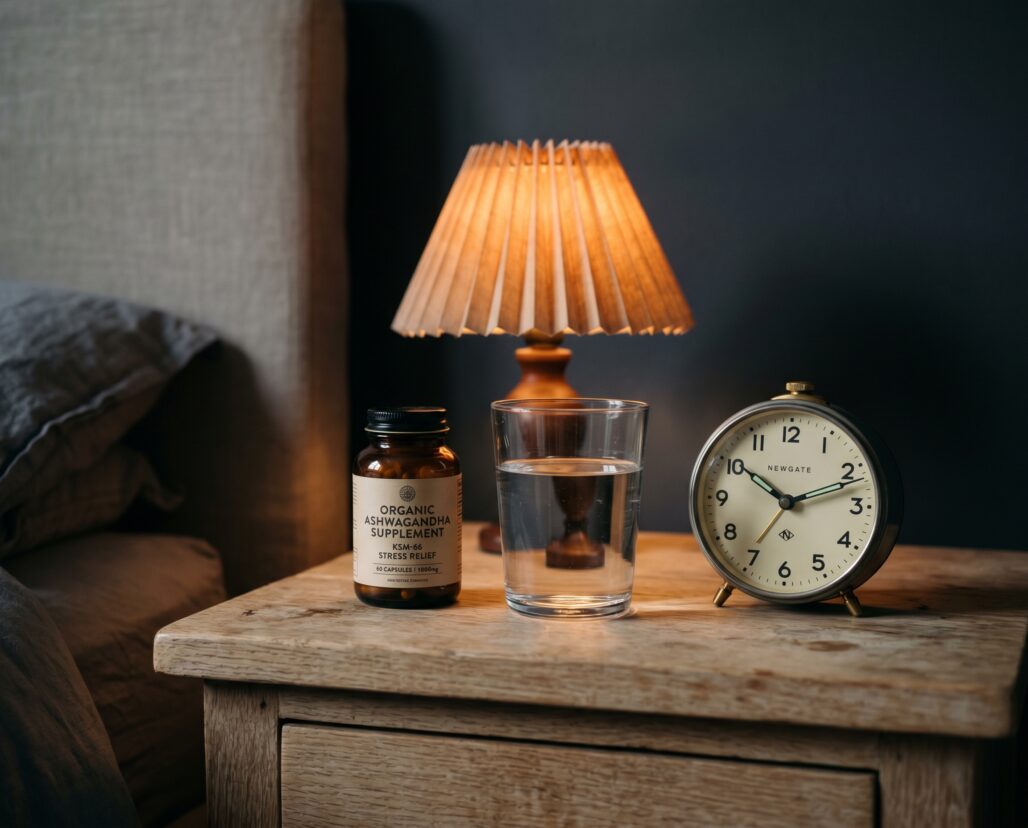
Summary / Quick Answer: does ashwagandha help with sleep?
Ashwagandha, specifically KSM-66 or Shoden standardized extracts, has shown statistically significant improvements in sleep onset latency, sleep efficiency, and sleep quality scores in two placebo-controlled human RCTs.
- Best for: Adults whose poor sleep is tied to chronic stress, elevated evening cortisol, or anxiety symptoms; people who've already addressed sleep hygiene basics
- Not ideal for: People on sedatives, benzodiazepines, or thyroid medication; anyone with primary sleep apnea; those expecting fast results (trials ran 8-10 weeks)
- What to look at before buying: Extract type (KSM-66 or Shoden, not plain root powder), withanolide standardization percentage, third-party testing
- Decision shortcut: If your poor sleep is cortisol-driven and chronic, ashwagandha has more direct evidence than L-theanine and a different mechanism from magnesium glycinate, but it's slower and carries more interaction risk.
How ashwagandha affects sleep physiology
Ashwagandha (Withania somnifera) is classified in Ayurveda as a rasayana, a rejuvenative tonic, used for centuries for stress and vitality. But traditional use is not the same as RCT evidence, and the modern sleep mechanism is more specific than "ancient calming herb."
The sleep-relevant pathways are two. First, HPA-axis modulation: chronic stress keeps cortisol elevated in the evening, when it should be falling to allow melatonin to rise. Cortisol and melatonin have an inverse relationship at the circadian level. By reducing chronic cortisol load, ashwagandha may restore the conditions for normal sleep initiation rather than forcing it pharmacologically.
The second pathway is GABAergic. Per Memorial Sloan Kettering's integrative herbs database, ashwagandha has demonstrated GABAergic properties in preclinical studies, meaning it may enhance activity at the same GABA-A receptor that benzodiazepines and Z-drugs target. This explains both the sleep benefit and the interaction risk with sedative medications.
Think of it this way: a sedative drug like zopiclone forces the GABA lock open. Ashwagandha appears to work more like removing the cortisol that was holding the lock closed. The result is more modest and slower, but without the next-morning grogginess or dependence risk.
Standardized to withanolides is what matters. A product that says "Ashwagandha root 500mg" without a standardization claim tells you nothing about whether you're getting the active-marker concentration used in any published sleep trial. The data comes from extracts, not generic root powder.
What the Salve 2019 RCT actually showed
The most commonly cited ashwagandha sleep study is Salve et al., 2019 (PMID 32021735), a double-blind, randomized, placebo-controlled trial published in Cureus (n=60, 8 weeks). Three groups received 125mg KSM-66 twice daily (250mg/day), 300mg twice daily (600mg/day), or placebo.
Both active-dose groups showed significant improvement in sleep quality versus placebo, with the 600mg/day group showing the stronger effect (cortisol: p<0.0001; 250mg/day group: p<0.05). Serum cortisol dropped significantly in both groups, which is the mechanistic throughline for the sleep benefit.
The important caveat: Salve 2019 used a seven-point sleep scale, not PSQI or polysomnography. It doesn't publish specific sleep onset latency times. It was a stress trial that also measured sleep, not a dedicated sleep trial. It tells you ashwagandha improved subjective sleep quality in chronically stressed adults. That's meaningful, but it's not a complete sleep picture.
Langade 2019: the insomnia-specific trial
The more precise sleep data comes from Langade et al., 2019 (PMID 31728244), a double-blind, placebo-controlled trial specifically in adults with insomnia and anxiety symptoms (n=48 per-protocol, 10 weeks, 300mg twice daily / 600mg/day total).
Specific effect sizes:
- Sleep onset latency (SOL): Treatment group averaged 29.00 min (SD 7.14) at 10 weeks versus 33.94 min (SD 7.65) for placebo (p=0.019). Roughly a 15% reduction in time to fall asleep.
- Sleep efficiency: Improved from 75.63% baseline to 83.48% at 10 weeks in the treatment group, versus 75.14% to 79.68% in placebo. The treatment group gained about 4 percentage points more than placebo.
- Sleep quality (PSQI-based): Significant improvement versus placebo (p=0.002).
These numbers are real and measurable. They're also modest. Going from 34 minutes to 29 minutes average SOL is clinically meaningful for someone who lies awake 45+ minutes most nights, but it's not the knockout effect of a Z-drug. The 10-week duration is important: this is a cumulative intervention, not a supplement you take the night you can't sleep.
The real question isn't whether ashwagandha "works" in a trial. It's whether the 10-week effect size justifies taking an herb with documented drug interactions for your specific sleep problem. For stress-and-anxiety-driven insomnia, Langade 2019 suggests the answer is likely yes. For primary insomnia with no cortisol or anxiety driver, the evidence is thinner.
A 2020 trial (Deshpande et al., n=144) using Shoden extract at just 120mg/day for 6 weeks found 72% of the treatment group reported improved sleep quality versus 29% of placebo (p<0.001), reinforcing that the sleep benefit is replicable across different extract types.
Actionable takeaway: Langade 2019 is the most specific human evidence for ashwagandha and sleep onset. Effect sizes are statistically significant but modest. Expect gradual improvement over 8-12 weeks, not overnight relief.
Ashwagandha vs magnesium glycinate vs L-theanine
These three are the most commonly co-recommended sleep supplements. They have different mechanisms, different evidence tiers, and different risk profiles.
| Ashwagandha (KSM-66) | Magnesium glycinate | L-theanine | |
|---|---|---|---|
| Primary mechanism | HPA-axis cortisol modulation + GABAergic | NMDA antagonism, neuromuscular relaxation | Alpha-wave promotion, glutamate modulation |
| Onset of effect | 8-10 weeks (cumulative) | Days to weeks | Acute (30-60 min) |
| Sleep RCT evidence | Two human RCTs (moderate quality) | Strong in magnesium-deficient populations | RCTs for relaxation; sparse sleep-architecture data |
| Drug interaction risk | Sedatives, thyroid meds, immunosuppressants | Low | Minimal |
| Best use case | Chronic, stress-driven poor sleep | Magnesium deficiency, restless leg symptoms | Situational pre-sleep anxiety |
Magnesium glycinate acts as a natural NMDA receptor antagonist, supporting neuromuscular relaxation. The sleep evidence is strongest in magnesium-deficient populations. Evidence for people with already-adequate magnesium is less compelling, but interaction risk is minimal.
L-theanine promotes alpha-wave activity, producing relaxed alertness rather than sedation. The sleep benefit is indirect: it reduces anxious arousal that delays sleep onset, rather than directly inducing sleep. It acts acutely and has a cleaner interaction profile than ashwagandha.
Here's the tradeoff: for tonight's anxiety (situational, acute), L-theanine is faster and safer. For three months of lying awake despite exhaustion, with normal thyroid function and no sedative prescriptions, ashwagandha has the more relevant mechanism and better-quality sleep RCTs. Magnesium glycinate is worth considering regardless if dietary intake is poor.
Who benefits and who should skip it
Strong fit:
- Adults with chronic stress lasting three months or longer, where elevated cortisol is a plausible driver of poor sleep
- People with normal thyroid function and no current prescription sedative or anxiolytic use
- Those willing to run an 8-12 week trial with a standardized extract at clinically tested doses
Skip ashwagandha for sleep if:
- You take a benzodiazepine (diazepam, clonazepam, lorazepam) or a non-benzodiazepine sleep aid (zolpidem, eszopiclone): the additive GABAergic effect is not studied at combination doses and could produce excess sedation
- You take levothyroxine or have an active thyroid condition: cases of thyrotoxicosis have been documented, and the NCCIH fact sheet specifically flags thyroid medications as an interaction category
- You're pregnant or nursing: ashwagandha should be avoided; potential abortifacient effects are documented in preclinical data
- Your sleep problem is primary sleep apnea: a structural airway issue, not addressable by any adaptogen
Dosing ranges from clinical trials
In Salve 2019, participants took 125mg or 300mg KSM-66 twice daily (250mg/day or 600mg/day) for 8 weeks. Both doses improved sleep quality; the higher dose produced stronger cortisol suppression.
In Langade 2019, the dose was 300mg ashwagandha root extract twice daily (600mg/day) for 10 weeks, producing the SOL and efficiency outcomes above.
The 600mg/day dose (300mg BID) appears most consistently supported across sleep trials. Evening dosing is logical given the cortisol-melatonin mechanism, though neither trial mandated evening-only administration. Products standardized to at least 5% withanolides are the relevant comparison for KSM-66; Shoden is standardized to 35% withanolide glycosides at a lower per-capsule weight, which reflects concentration, not equivalence.
Actionable takeaway: Look for KSM-66 or Shoden on the label. "Ashwagandha root powder" with no standardization claim is not the intervention studied in these trials. Run the trial for at least 8 weeks before drawing conclusions.
Side effects and drug interactions
Reported adverse effects from trials
Adverse events in published RCTs are generally mild and comparable to placebo: drowsiness, loose stools, mild gastrointestinal upset. Rare cases of liver injury appear in case reports, though establishing causality in supplement use is difficult.
Drug interactions (critical for sleep use)
Sedatives and benzodiazepines (high concern): Per Memorial Sloan Kettering's integrative herbs database, ashwagandha demonstrates GABAergic and sedative properties and may produce additive CNS depression when combined with benzodiazepines (diazepam, lorazepam, clonazepam, alprazolam), barbiturates, non-benzodiazepine hypnotics (zolpidem, eszopiclone), or anticonvulsants. If you take any of these medications, do not add ashwagandha without discussing it with your prescriber. The combination has not been studied in humans, and the theoretical risk is excess sedation.
Thyroid medications (moderate concern): Ashwagandha may stimulate thyroid hormone production; cases of thyrotoxicosis have been reported after use. People taking levothyroxine, those with hyperthyroidism, or those with Hashimoto's thyroiditis should avoid ashwagandha or use it only under medical supervision. Paradoxically, thyroid stimulation can worsen insomnia rather than improve it in susceptible individuals.
Immunosuppressants (moderate concern): Withanolides modulate immune function. The NCCIH ashwagandha fact sheet lists immunosuppressants (tacrolimus, cyclosporine, biologics) as an interaction category. Clinical significance is not well-characterized.
Pregnancy and breastfeeding: Ashwagandha should not be used during pregnancy. Potential abortifacient effects have been documented in preclinical studies. This is a hard stop.
Frequently asked questions
How long before ashwagandha helps with sleep?
Based on Langade 2019, statistically significant SOL improvement emerged at 10 weeks. Salve 2019 found sleep quality improvements within 8 weeks. This is a cumulative cortisol-modulation effect, not an acute sedative. If you see no change after 8-10 weeks of standardized KSM-66 at 600mg/day, it likely won't work for your sleep pattern.
Can I take ashwagandha with melatonin?
No direct RCT has studied the combination. Mechanistically, there's no obvious antagonism: melatonin acts on circadian signaling, ashwagandha works upstream on cortisol. The NCCIH does not flag melatonin as a specific interaction. Adding multiple sleep supplements simultaneously makes it hard to know what's working; starting with one for 8 weeks before adding a second is the more useful approach.
Is ashwagandha better for sleep than magnesium glycinate?
They address different drivers. Ashwagandha has more direct RCT evidence for SOL and sleep efficiency in stressed adults. Magnesium glycinate has stronger evidence in magnesium-deficient populations and a cleaner interaction profile. If dietary magnesium is low, magnesium glycinate addresses a root cause ashwagandha does not. The two can be combined without known interaction risk.
Which is stronger for sleep: 300mg or 600mg?
Salve 2019, the only trial directly comparing doses, found both 250mg/day and 600mg/day improved sleep quality; the higher dose showed stronger cortisol suppression (p<0.0001 vs p<0.05). Langade 2019 used 600mg/day for the measurable SOL improvement. The evidence favors 600mg/day for sleep, but more herb is not always better: some adaptogens show biphasic dosing where higher doses lose effect. Don't assume 1,200mg/day would be twice as useful.
Can ashwagandha worsen sleep in some people?
Yes, particularly if thyroid hormone production is stimulated. Elevated thyroid activity produces insomnia, palpitations, and anxiety, the opposite of the intended effect. This paradox is most relevant for people with undiagnosed subclinical hyperthyroidism or Hashimoto's. If sleep worsens on ashwagandha, thyroid stimulation is the first mechanism to investigate.
Related reading
- Ashwagandha: The Complete Evidence-Based Guide for 2026 — full pharmacology, stress evidence, and cortisol data behind this sleep mechanism
- Best Ashwagandha Supplement: Which Extracts Actually Hold Up to Testing — KSM-66 vs Sensoril vs Shoden compared on standardization, third-party testing, and value
- Ashwagandha Side Effects: What Clinical Trials and Case Reports Actually Show — the complete interaction and adverse event profile
Adding this to a few other supplements? Our companion app, StackMyMed, scans the label, tracks your real daily intake, and schedules the best time to take it around everything else in your routine.
Conclusion: the bottom line on ashwagandha for sleep
Ashwagandha has a real, specific, and measurable sleep benefit in at least two placebo-controlled human RCTs. Langade 2019 showed a 15% reduction in sleep onset latency and a sleep-efficiency gain of roughly 3-4 percentage points over placebo (a 75.6% to 83.5% within-group improvement) at 10 weeks on 600mg/day. Salve 2019 confirmed sleep quality improvement at both 250mg/day and 600mg/day over 8 weeks, backed by significant cortisol suppression that gives the effect a plausible mechanism.
But traditional use is not the same as RCT evidence, and RCT evidence is not a guarantee it will work for your specific sleep problem. The benefit is cumulative and modest; this is not a sedative, and it doesn't work the night you take it. The population where it's best supported is adults with stress-driven chronic sleep disruption, normal thyroid function, and no current sedative prescriptions.
If that describes you, a standardized KSM-66 or Shoden extract at 600mg/day for 8-10 weeks is a reasonable, evidence-grounded trial. If you're on benzodiazepines, thyroid medication, or immunosuppressants, the interaction profile makes ashwagandha a poor first choice without prescriber input.
Next steps:
- For the full stress and cortisol context behind the sleep mechanism, see the Ashwagandha Complete Guide
- To compare products using the extracts studied in sleep RCTs, see Best Ashwagandha Supplement
- For the full interaction and adverse event profile, see Ashwagandha Side Effects
This article is for informational purposes and not medical advice. Herbal adaptogens — even traditional ones — can interact with thyroid medication, antidepressants, anticoagulants, immunosuppressants, blood-pressure drugs, and more. Consult a licensed physician before starting any adaptogen, particularly if you are pregnant, nursing, taking prescription medications, or managing a chronic condition.
As an Amazon Associate, I earn from qualifying purchases. Product recommendations are based on real reviews and independent research.
