
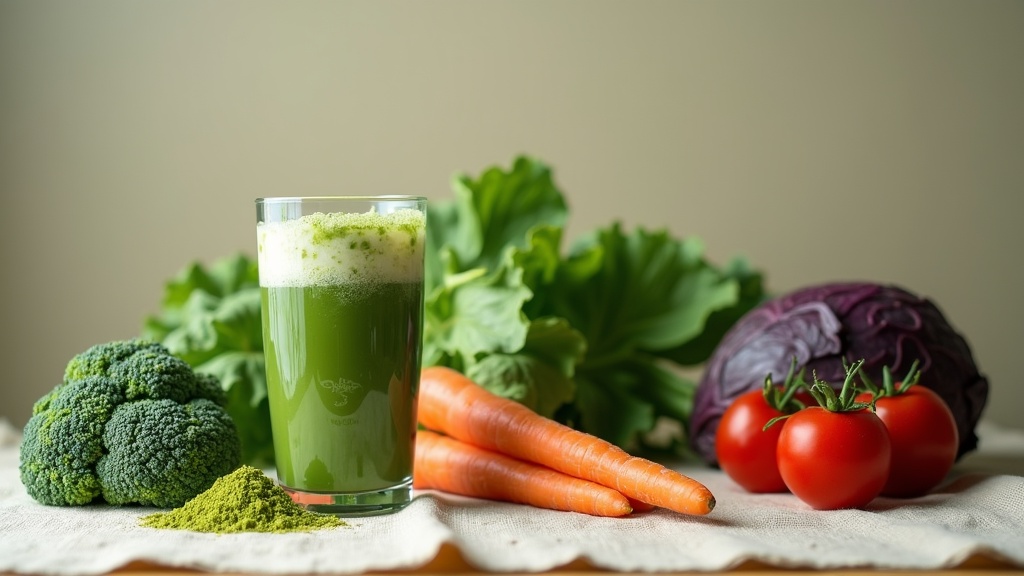
If you have ever poured a scoop of bright-green powder into a shaker bottle and quietly wondered whether that single scoop is genuinely replacing a salad, you have already arrived at the right question.
One framing point upfront. Greens powders are not a scam. They are a real category that, at the right price for the right person, can do real but modest work. The problem is the marketing claim, not the bottle. The claim that a daily scoop replaces fruits and vegetables is the part this article is here to take apart. For the companion question of what these scoops have actually been shown to do in clinical trials, see our evidence review of whether greens powders actually work.
Before you decide
The Claim
The category claim is consistent across AG1 (Athletic Greens), Bloom Greens, Live It Up Super Greens, Garden of Life Perfect Food, Amazing Grass Green Superfood, Huel Daily Greens, Nuzest Good Green Vitality, Onnit Earth Grown Nutrients, and the dozen TikTok-popular store brands chasing them. Phrased differently from brand to brand, the underlying promise rotates among three lines.
First: "One scoop equals X servings of vegetables." Second: "Get all your greens in one drink." Third, the softer version increasingly used after FTC scrutiny: "Comprehensive nutrient support to fill the gaps in a modern diet." The implicit conclusion the reader is meant to draw is the same in all three. A scoop is a stand-in for produce.
The most-searched version of this question, the AG1 version, sits on top of a roughly $79-per-month subscription product. AG1's own marketing leans on a 75-ingredient proprietary blend, a 7.2 billion CFU probiotic claim, adaptogens, and antioxidant equivalents framed against servings of fruit. Bloom, the TikTok-led entrant, runs the same playbook at a lower price point. Live It Up and the rest position themselves explicitly against AG1 on price.
The claim is appealing because it is convenient. The honest answer requires looking at what is actually in the scoop and what is actually in a serving of vegetables, side by side. That is the rest of this article.
The Evidence
The cleanest way to test the replacement claim is the same way a Registered Dietitian would assess any food substitution: walk the nutrient comparison line by line, on the categories that actually drive the long-term outcomes vegetables are credited for.
Fiber. This is the largest and most under-discussed gap. The Dietary Guidelines for Americans set the adequate intake for fiber at 25 g per day for adult women and 38 g per day for adult men under 50, dropping modestly with age. A single scoop of AG1 (12 g serving) delivers 2 g of fiber. Bloom Greens delivers about 1 g. Live It Up Super Greens, around 2 g. Most of the category sits between 1 and 3 g per scoop. By contrast, one cup of cooked broccoli delivers about 5 g, one cup of cooked black beans about 15 g, one medium pear about 6 g, one cup of raspberries about 8 g. The fiber math does not work. You cannot scoop your way to 25 g of fiber from a greens powder. The category is structurally low-fiber because soluble and insoluble fiber are bulky, and bulky does not fit in a 12 g serving meant to dissolve cleanly in water. Fiber is a critical mediator of the cardiovascular and colorectal cancer benefits attributed to vegetables, per the Reynolds et al. 2019 Lancet meta-analysis and the broader fiber literature (Slavin 2013, Nutrients).
Phytonutrients. Vegetables and fruits deliver phytonutrients in grams. Lycopene from a single medium cooked tomato runs around 4 mg. Lutein and zeaxanthin from a cup of cooked spinach, around 20 mg. Sulforaphane precursors (glucoraphanin) from a serving of broccoli or kale, in the tens of milligrams. Anthocyanins from a cup of blueberries, several hundred milligrams. The phytonutrient column on a typical greens powder label, when it is disclosed at all (most use a proprietary blend), is in micrograms or single-digit milligrams per scoop. The brands prefer to compare on "antioxidant equivalents" using ORAC scores rather than per-compound mg because the per-compound numbers are unflattering. ORAC is also no longer used by the USDA precisely because it does not correlate well with in-vivo benefit. The diversity of compounds across a real produce drawer is something a fixed-ingredient powder, no matter how well formulated, structurally cannot match.
Vitamins and minerals. Here the powders are closer to plausible. AG1's 12 g blend includes standardized vitamins (about 50 percent of the daily value for vitamin C, vitamin A, B vitamins, vitamin K, and several minerals), though the proprietary blend hides the per-ingredient dose for everything in the herbal and mushroom fraction. Bloom and Live It Up sit at similar magnitudes for the named vitamins. If the question is "does a scoop deliver some vitamin C and some B vitamins similar to a small multivitamin," the answer is roughly yes. If the question is "does a scoop deliver the multi-thousand-fold variation in trace polyphenols that a real-food diet delivers", the answer is no. A multivitamin is the more honest framing of this category's nutrient contribution, not "greens."
Probiotics. AG1 lists 7.2 billion CFU per serving. Whether those bacteria arrive alive at the gut after dry storage at ambient temperature, shaker-bottle mixing, and gastric acid is the unverified part. Some shelf-stable probiotic strains survive that gauntlet, others do not, and the label number is the dose loaded at manufacturing, not the dose delivered. The trials supporting specific probiotic benefits use specific strains at higher doses than a greens powder typically delivers.
Adaptogens. Ashwagandha, rhodiola, and similar adaptogens in greens powders are present in trace doses well below the 300 to 600 mg twice daily that the modest stress-and-cortisol RCT literature uses. Their inclusion is marketing, not pharmacology.
Cost. This is the one comparison consumers can do in their kitchen without a label. AG1 lists at roughly $79 per month for a 30-serving subscription, or about $2.60 per serving. A daily $5 bag of pre-washed spinach from any US grocery store covers more than a serving of leafy greens. A $4 head of broccoli delivers 4 to 5 servings. A weekly $30 farmer's market run in season covers the 2.5 to 3 cup-equivalents per day for most people. If you can buy AG1, you can buy a $5 bag of spinach. The price per gram of fiber and the price per mg of measurable phytonutrient are not close.
Satiety and blood sugar. A scoop of greens powder in water has negligible effect on satiety. A bowl of vegetables has substantial effect. The behavior change of "I'm eating a vegetable now" is itself part of the long-term benefit attributed to high-vegetable diets and is not replicated by a drink.
Actionable takeaway: on the categories that actually carry the long-term outcome story for vegetables (fiber, phytonutrient diversity, satiety, and dose-response mortality benefit per Aune et al. 2017, Int J Epidemiol), greens powders are not a substitute. On the multivitamin-style vitamin and mineral fraction, they are roughly comparable to a small multivitamin at higher cost.
The Verdict
The honest verdict is: useful nutrient insurance for a narrow set of situations, not a vegetable replacement for healthy adults with kitchen access.
Useful nutrient insurance if you are:
- Traveling without reliable produce access, particularly long international trips, fieldwork, military deployment, or extended camping. The scoop is genuinely better than the alternative of skipping vegetables entirely for two weeks.
- A picky eater filling documented gaps, especially in adolescence or young adulthood where the diet refuses certain vegetables outright. A scoop is better than no greens at all, and the small vitamin and mineral contribution closes part of a real gap.
- Post-bariatric surgery with reduced food volume tolerance, where the standard postoperative protocol involves multiple targeted supplements anyway and a greens powder may add modest convenience under your surgical-team's nutrition oversight.
- Acutely ill with low appetite, the flu, recovery week after a major procedure, or chemotherapy nausea. A small caloric and micronutrient load you can sip is better than nothing for a few days.
Not a vegetable replacement if you are:
- A healthy adult with a working kitchen who could buy and prepare actual vegetables. The trial-grade and observational-grade evidence for cardiovascular and mortality benefit tracks produce intake, not greens-powder intake.
- Trying to hit the Dietary Guidelines 2.5 to 3 cup-equivalents of vegetables per day.
- Trying to close the fiber gap. Most US adults are at roughly half of the fiber adequate intake. A scoop closes 5 to 8 percent of that gap. A cup of black beans closes 60 percent.
- Trying to control blood sugar through vegetable volume and slow-release carbohydrate from whole foods. The drink does not do this.
A multivitamin with a glass of water gets you most of the AG1 vitamin and mineral contribution at one tenth the cost. That is the closest honest analog, not "the produce drawer." The supplement that helps is the one that closes a real gap. A scoop of greens is not closing the vegetable gap. It is, at best, closing a small slice of the micronutrient gap.
What Works Instead
For most adults who care about the long-term health story behind the "eat your vegetables" advice, the leverage is the same as it has been for the last forty years of nutrition epidemiology. Three layers, in order.
First, varied whole vegetables, 5 or more servings per day. This is the framing the Dietary Guidelines and every major specialty society leads with. A weekly pattern that includes leafy greens (spinach, kale, arugula, romaine), cruciferous vegetables (broccoli, cauliflower, cabbage, Brussels sprouts), orange and red vegetables (carrots, sweet potato, bell pepper, tomato), legumes (lentils, black beans, chickpeas), and a rotating mix of fruit covers the fiber gap, the phytonutrient diversity, and the satiety story that no powder can replicate. Frozen vegetables count. Canned beans count. The pre-washed bag of spinach counts. Cost is not the barrier the marketing implies. The average US diet covers about 1.7 cup-equivalents of vegetables per day per NHANES, against the 2.5 to 3 cup target. Adding one cup of frozen broccoli at dinner and one cup of beans at lunch closes most of the gap.
Second, targeted single supplements where a measured gap exists. This is the dietitian framing. The five most common evidence-backed adult gaps in the US are vitamin D3 if your 25(OH)D is below the lab's adequacy range, vitamin B12 if you are over 50 or vegan or on long-term metformin or a PPI, iron if you are menstruating with heavy periods or have documented low ferritin, omega-3 EPA + DHA if you eat fewer than two servings of fatty fish per week, and magnesium if you are in the roughly 50 percent of US adults below the EAR. Each of these treats a defined gap at a defined dose. A greens powder underdoses all of them.
Third, specific fiber if needed. If your fiber intake genuinely will not get to 25 to 38 g per day through food, psyllium husk at 5 to 10 g per day delivers more fiber per scoop than the entire greens-powder category combined, at roughly $0.10 per dose. That is the dietitian's actual fiber answer, not a greens drink.
Think of it like buying kitchen tools. A greens powder is a small Swiss-army knife with a few useful blades. A varied produce drawer is the full set of proper knives plus a cutting board. The Swiss-army knife is fine for travel. It is not the same thing.
For a deeper framing on how we evaluate supplement quality and brand claims, see our supplement review methodology and the cluster of practitioner-reviewed product picks at Sarah's author page.
FAQ + Conclusion
Does AG1 actually replace vegetables? No. A 12 g scoop delivers about 2 g of fiber and trace amounts of phytonutrients against the produce drawer's grams. It delivers a small-multivitamin-style fraction of several vitamins and minerals at roughly $2.60 per serving. The label does not claim a one-to-one replacement; the social-media framing around the brand often does. The actual product is closer to a multivitamin plus probiotic than to a salad.
Is a greens powder safe with warfarin? Use caution and talk to your prescribing clinician first. Greens powders contain vitamin K from leafy-green concentrates, and the per-scoop dose can vary batch to batch. Vitamin K intake variability is one of the better-documented reasons for INR instability on warfarin, per the warfarin clinical literature and the Drugs.com vitamin K interaction monograph. Anyone on warfarin who wants to take a daily greens powder should agree it with the prescribing clinician and have INR rechecked after the addition.
Does the calcium or iron in a greens powder interfere with thyroid medication? It can. Calcium and iron both bind levothyroxine and reduce its absorption per the Drugs.com levothyroxine interaction monographs. The standard guidance is to separate levothyroxine from any calcium or iron-containing supplement by at least 4 hours. If you take levothyroxine first thing in the morning fasted, the greens powder belongs at lunch or later.
Do the probiotics in a greens powder actually work? Unclear. The label CFU is the dose loaded at manufacturing, not the dose delivered alive to the gut after shelf storage, mixing, and stomach acid. A dedicated refrigerated probiotic with strain-specific dosing has a better evidence trail when there is a specific reason to use one.
Why are greens powders so expensive? Marketing, subscription mechanics, and 75-ingredient proprietary blends that obscure per-ingredient cost. A $5 bag of spinach is the price-per-serving honest comparison.
Conclusion: the bottom line on whether greens powders replace vegetables
Do greens powders replace vegetables? For a healthy adult with kitchen access, no. The fiber math is structurally off by roughly an order of magnitude, the phytonutrient diversity is not replicable in a 12 g scoop, and the standard-of-care advice from every major specialty society remains the same: varied whole vegetables, 2.5 to 3 cup-equivalents per day, plus targeted supplementation where a measured gap exists. Greens powders are useful as narrow nutrient insurance for travel, picky-eater gaps, post-bariatric patients, and acute illness with low appetite. They are not a stand-in for produce. Ask your doctor about a blood test for vitamin D and B12 before adding any new bottle to your routine, particularly if you are over 50, vegan, or on a PPI. The supplement that helps is still the one that closes a real, measured gap.
Next steps:
- Add one cup of frozen broccoli or a cup of beans to one meal per day this week and re-check whether you still feel the powder is necessary.
- If you genuinely cannot get to 25 g of fiber per day from food, add 5 g of psyllium per day at roughly $0.10 per dose before adding a greens powder.
- For the comparison framing on how we evaluate the celebrity-stack products that often include greens powders, see our breakdowns of the Huberman supplement stack and the Joe Rogan supplement stack.
This article is for informational purposes and not medical advice. Greens powders and individual supplements can interact with medications and health conditions. Consult a licensed physician before starting any supplement, particularly if you are pregnant, nursing, taking warfarin or levothyroxine, or managing a chronic condition.
Reviewed by Sarah Thompson, Registered Dietitian, focused on vitamin and mineral nutrition.
