
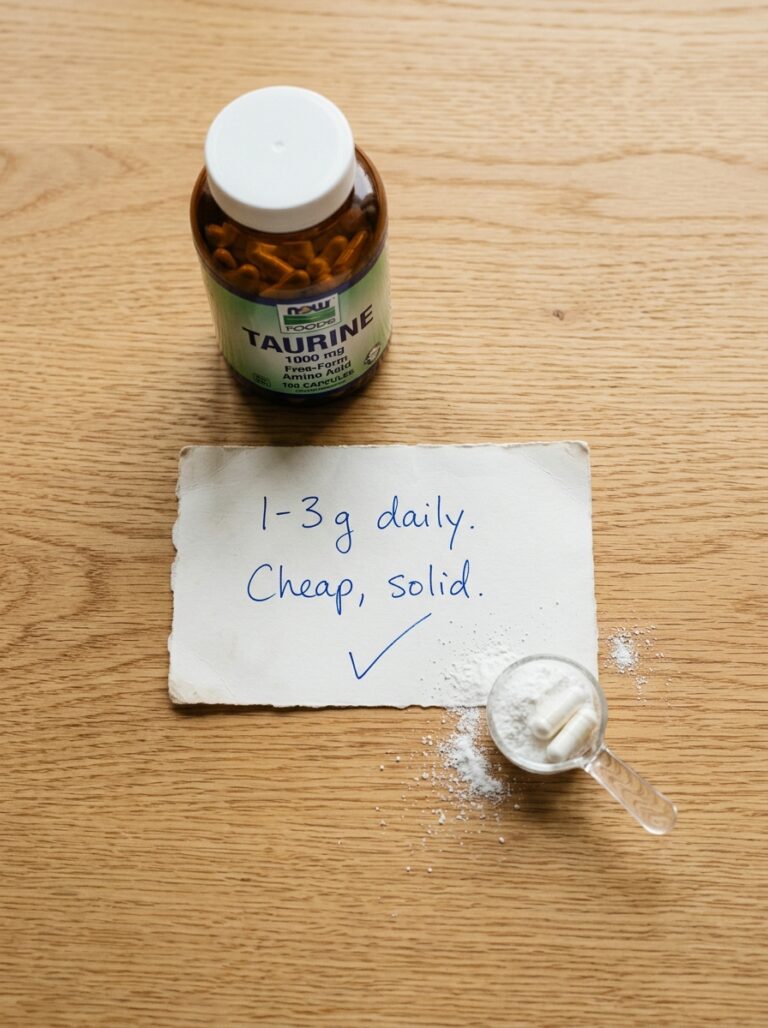
Taurine had a strange 2023: a single high-profile mouse study turned a cheap amino acid that costs pennies a gram into a "longevity" headline, and suddenly it was on every supplement-stack list. The biology is genuinely interesting, but the marketing has gotten ahead of the human data. Of everything in the longevity aisle, taurine is one of the few I'd actually keep in our own family's cabinet, mostly because it's cheap, well tolerated, and has real cardiovascular signal that has nothing to do with the aging hype.
This guide separates what the research shows from what the labels imply, so you can buy the right dose without paying a premium for a promise the human trials haven't kept.
Affiliate disclosure: this article contains affiliate links. As an Amazon Associate, UsefulVitamins.com earns from qualifying purchases at no extra cost to you.
Before you decide
A few people should not start taurine on their own. If you have kidney disease, are on dialysis, take lithium or other medications with a narrow therapeutic window, are pregnant or breastfeeding, or manage a serious heart condition, clear it with your physician first.
Taurine interacts with fluid and electrolyte handling and has been studied as an add-on in heart failure under medical supervision, so it belongs in a clinician-directed plan in those situations, not a self-prescribed trial. None of this is a cure claim. Taurine supports specific physiological processes within standard care; it does not replace treatment.
If none of that applies, be honest about why you're reaching for it. "Anti-aging" is not a goal the current human evidence can hit. A specific goal can be: supporting blood pressure alongside lifestyle work, a defined exercise block, or simply topping up an amino acid your diet may run low on.
Each of those points to a modest, evidence-grounded use, and some of them point to diet first. You can see how I weigh mechanism against human trials, and disclose conflicts, on the how we review supplements page.
What taurine actually does
Taurine is a sulfur-containing amino acid your body makes from cysteine and also gets from food, mostly meat, fish, and shellfish. It is highly concentrated in the heart, retina, skeletal muscle, and brain, where it acts less like a building block and more like a cellular housekeeping molecule.
Mechanistically, taurine modulates intracellular calcium handling, stabilizes membranes, buffers osmotic stress, and acts as a mild antioxidant. In the brain it interacts with the GABA-A and glycine receptor systems, which is part of why it gets described, loosely, as "calming." That receptor activity is real but gentle, and it is not the same as a sedative.
Here is the honest part most roundups skip. In animal models, restoring taurine looks impressive: in worms, mice, and monkeys, the 2023 Science study found supplementation reduced markers of cellular senescence, limited DNA damage, and supported mitochondrial function. The trouble is that mice are not people, and the human story turned out to be more complicated than the headline.
When independent researchers measured taurine longitudinally in three human cohorts and in nonhuman primates, circulating taurine did not reliably fall with age. In several groups it actually stayed flat or rose, according to a 2025 Science technical comment. That single finding undercuts the core "taurine declines, so replace it" premise on which the human longevity pitch rests.
What the research shows
The aging claim is where the mouse-versus-human gap is widest. The 2023 Science paper is excellent rodent and primate work, and its authors explicitly called for human trials rather than declaring the case closed.
A 2025 Science technical comment then reported that taurine levels increased or held steady with age across multiple human and primate datasets, concluding taurine is not a universal aging biomarker. A separate 2025 study in Aging Cell found no association between serum taurine and age, muscle mass, strength, or physical performance in adults aged 20 to 93. For the anti-aging use specifically, that is the most honest summary: the human evidence is preliminary and, so far, unsupportive.
The cardiovascular evidence is where taurine earns more respect. A 2024 meta-analysis of 20 randomized controlled trials in 808 participants found taurine reduced systolic blood pressure by about 4 mmHg and diastolic by about 1.4 mmHg, with no significant adverse effects versus placebo. Those are modest, real, lifestyle-tier effects, not drug-tier ones.
In heart failure, a small double-blind trial gave 500 mg three times daily and saw improved functional capacity and exercise tolerance under supervision. For exercise in healthy people, a systematic review mapped a dose-response curve where roughly 1 to 6 g had measurable effects on lactate and fatigue markers, while an endurance meta-analysis found small improvements in performance, on the order of a couple of percent. Useful at the margins, not transformative.
The metabolic data point the same direction: modest but real. A 2024 meta-analysis of 25 randomized trials in 1,024 participants reported that taurine lowered fasting glucose by about 5.9 mg/dL, triglycerides by roughly 18 mg/dL, and total cholesterol by about 8 mg/dL, with daily doses spanning 0.5 to 6 g. Those shifts won't replace a statin or a glucose-lowering drug, but they are the kind of small cardiometabolic nudge that adds up alongside diet and exercise.
The clearest single trial here is instructive. A 2020 double-blind RCT gave 3 g a day for eight weeks to people with type 2 diabetes and saw fasting glucose, insulin, and the HOMA-IR insulin-resistance marker all drop significantly, along with total and LDL cholesterol. HbA1c didn't move in eight weeks, which is honest context: two months is too short to shift a marker that reflects three months of blood sugar, so read the glucose signal as promising rather than settled.
What to look for when buying

The single most important thing to understand before you shop is that taurine is a commodity. It is produced at industrial scale, costs the manufacturer almost nothing, and is chemically identical from one reputable brand to the next. This is exactly the situation where you should refuse to overpay.
Start with the dose. The studied range that matters for most people is 1 to 3 g per day, which lines up with the cardiovascular and exercise data above. A bottle dosed at 500 mg per capsule means two to six capsules a day, so check the serving math, not just the front-label number.
Be skeptical of two pricing traps. The first is the "longevity blend" that buries a sub-gram of taurine inside a proprietary mix of NMN, resveratrol, and spermidine at a luxury price. You usually can't see how much taurine you're getting, and you're paying for the marketing story built on the mouse paper.
The second is the premium single-ingredient bottle that costs three times a basic one for identical L-taurine. Plain L-taurine powder is the cheapest format by far; capsules cost a little more for convenience. Either is fine.
Run the powder-versus-capsule math once and it settles the question. A typical 100 g bag of plain powder runs a few dollars, which works out to roughly 3 to 6 cents per gram, or about a dime a day at the top of the studied range. Capsules dosed at 500 mg to 1 g usually land at two to four times that cost per gram, because you're paying for the gelatin shell, the bottling, and the convenience of not measuring.
Purity is the other thing the label can quietly tell you. A clean taurine product lists L-taurine and little else — maybe a single flow agent like rice hull or silicon dioxide in capsules. Long ingredient decks with magnesium stearate, titanium dioxide, artificial color, or unnamed "proprietary blends" are a flag on a commodity this simple, since there's no good reason to dress up a single pure amino acid.
Because it's a commodity, the one thing genuinely worth paying a small premium for is independent verification. Look for third-party testing (USP, NSF, or Informed Choice if you're drug-tested), which confirms identity and purity on an ingredient where adulteration would otherwise be invisible.
| What you see on the label | What it tells you | Worth paying for? |
|---|---|---|
| Plain L-taurine, 500 mg to 1 g per serving | You can hit the 1 to 3 g studied range easily | Yes, this is the target |
| Third-party tested seal (USP / NSF / Informed Choice) | Independent check on identity and purity | Yes, the one premium worth it |
| Powder format | Cheapest cost per gram; mixes in water | Yes, if you don’t mind measuring |
| “Longevity blend” with hidden taurine dose | You can’t verify the dose; priced for the story | No, skip it |
| Premium single-ingredient at 3x the price | Identical L-taurine, marketing markup | No, the cheap one is the same |
On safety, taurine has a reassuring profile. The European Food Safety Authority set a no-observed-adverse-effect level of 1,000 mg per kg of body weight per day in animal data, and human trials at 1.5 to 6 g daily for weeks to months reported no significant adverse effects. That wide margin is part of why I'm comfortable with it, and why there's no reason to chase megadoses.
FAQ
Will taurine actually make me live longer?
There is no human evidence that it does. The lifespan data are from worms, mice, and monkeys, and when researchers checked humans, taurine didn't even reliably decline with age. Take it for cardiovascular or exercise support, not a longevity guarantee.
How much should I take?
For most healthy adults, 1 to 3 g per day matches the studied range for blood pressure and exercise. Higher doses up to about 6 g have been used safely in trials, but more is not clearly better.
When should I take it, and with or without food?
Timing is not critical for general use; pick a routine you'll keep. For exercise, trials often dosed it within an hour or two before training. With or without food both work.
Is it the same taurine that's in energy drinks?
Chemically, yes, it's the same L-taurine. The difference is dose and the absence of caffeine and sugar when you buy it as a standalone supplement, which is the cleaner way to take it.
Can I take taurine with my other supplements?
Generally yes for healthy adults. If you take lithium, blood pressure medication, or have kidney or heart disease, check with your pharmacist or doctor first, since taurine can interact with fluid and electrolyte balance.
Do I even need a supplement if I eat meat and fish?
Maybe not. Taurine is concentrated in meat, fish, and shellfish, so omnivores typically get 40 to 400 mg a day from food, while strict vegetarians and vegans get close to zero and rely entirely on their own synthesis. If you eat animal protein regularly, food covers your baseline; a supplement only makes sense for a specific blood pressure, metabolic, or exercise goal.
Will taurine help me sleep?
The evidence is thin, but the mechanism is plausible. Taurine's gentle activity at GABA and glycine receptors is the same calming pathway behind glycine's sleep reputation, though direct human sleep trials on taurine are limited. If relaxation before bed is your actual goal, the better-studied option is covered in best magnesium for sleep.
The bottom line on taurine
Taurine is a rare case where the honest verdict is also the cheap one. The mouse longevity data are real and interesting, but the human evidence is preliminary and, on the aging question specifically, has so far gone the wrong way — as both the 2025 Science comment and the Aging Cell analysis found.
What it does have is a modest, replicated cardiovascular signal and a clean safety record, per the 2024 blood-pressure meta-analysis. So if you want to take it, the move is simple: buy plain, third-party-tested L-taurine, dose it at 1 to 3 g a day, and don't pay a longevity premium for a commodity.
If you're building a broader stack, it fits naturally beside other low-cost, well-tolerated basics, which is why I cover it alongside the complete guide to longevity supplements and pair it with the calming amino acid in best glycine supplements.
Recommended Products


As an Amazon Associate, UsefulVitamins.com earns from qualifying purchases at no extra cost to you. We only recommend products supported by published research or third-party testing.
Reviewed by Maria Rodriguez, MS Nutrition Science, focused on cognitive and mood biochemistry. See more from Maria Rodriguez. This article is educational and is not a substitute for individualized medical advice; talk to your doctor before starting a supplement, especially if you have kidney or heart disease, take lithium or blood pressure medication, or are pregnant.
